Where to Put Coolant in a Bmw 750li

Contents
- 1 Key Takeaways
- 2 📑 Table of Contents
- 3 Understanding Your BMW 750Li’s Coolant System
- 4 Locating the Coolant Reservoir in Your 750Li
- 5 Step-by-Step: How to Add Coolant Safely and Correctly
- 6 Choosing the Right Coolant: A BMW-Specific Guide
- 7 When and How Often to Check and Top Up Coolant
- 8 Beyond Topping Up: Full Coolant System Maintenance
- 9 Conclusion: Mastery Through Understanding
- 10 Frequently Asked Questions

Car USB Charger

Pressure Washer for Car

Car Fog Light Bulb
Side Window Sunshade
Finding the coolant reservoir in your BMW 750Li is the first step to proper engine care. It’s located in the engine bay, typically a translucent white plastic tank with a yellow cap labeled ” coolant.” Always use BMW-approved coolant, never open a hot system, and follow precise fill procedures to avoid overheating and costly damage.
Owning a BMW 750Li is an experience in refined performance and engineering excellence. This full-size luxury sedan, with its potent turbocharged engine, generates immense heat that must be managed precisely. That’s where the coolant system comes in. It’s the unsung hero that keeps your engine from turning into a melted metal sculpture. Knowing where to put coolant in a BMW 750Li isn’t just a handy skill—it’s a critical part of responsible ownership. A low coolant level can lead to overheating, warped cylinder heads, and a repair bill that makes your monthly payment look tiny. This guide will walk you through everything, from finding the reservoir to choosing the right fluid, with the clarity and detail your prestigious Bavarian machine deserves.
We’ll break it down simply. First, we’ll locate that crucial tank under the hood. Then, we’ll discuss what exactly goes into it, because using the wrong stuff can be just as bad as running low. Next, a safe, step-by-step process for topping it up. Finally, we’ll cover when this is a DIY job and when it’s time to call in the pros. By the end, you’ll approach your 750Li’s coolant system with confidence, ensuring it stays cool, collected, and ready to deliver that signature BMW driving experience.
Key Takeaways
- Reservoir Location: The coolant expansion tank is in the engine bay, near the firewall, identifiable by its yellow cap and “MIN”/”MAX” marks.
- Correct Coolant Type: BMW requires specific phosphate-free, silicate-free coolant (often Pentosin or G48). Never use generic green coolant.
- Safety First: Never open the coolant cap when the engine is hot. Wait for it to cool completely to avoid scalding from pressurized steam.
- Fill Level: Fill only to the “MAX” line when cold. Overfilling can cause overflow and potential system issues.
- Bleeding the System: After adding coolant, you may need to bleed air pockets by running the engine with the cap off (consult manual for exact procedure).
- Leak Inspection: If coolant drops frequently, inspect for leaks. Repair costs can be significant, so early detection is key.
- Professional Help: For complex issues like persistent air locks or system flushes, consult a BMW specialist.
📑 Table of Contents
- Understanding Your BMW 750Li’s Coolant System
- Locating the Coolant Reservoir in Your 750Li
- Step-by-Step: How to Add Coolant Safely and Correctly
- Choosing the Right Coolant: A BMW-Specific Guide
- When and How Often to Check and Top Up Coolant
- Beyond Topping Up: Full Coolant System Maintenance
- Conclusion: Mastery Through Understanding
Understanding Your BMW 750Li’s Coolant System
Before we get our hands dirty, let’s understand what we’re dealing with. The coolant system is a closed-loop circuit. It circulates a special fluid—coolant/antifreeze—through the engine’s water jackets, the radiator, and the heater core. This fluid absorbs heat from the engine and carries it to the radiator, where air flow cools it down before it cycles back. It’s a beautifully simple concept with serious consequences if it fails.
The Expansion Tank: Your Primary Fill Point
On your 750Li, the place you add coolant is called the coolant expansion tank or reservoir. Unlike older cars where you might pour directly into the radiator, modern BMWs like the 750Li use a separate, pressurized plastic tank. This tank accommodates the natural expansion and contraction of coolant as it heats and cools. It has marked lines: “MIN” (minimum safe level) and “MAX” (maximum safe level). Your goal is to keep the fluid between these lines when the engine is cold. This is the definitive answer to where to put coolant in a BMW 750Li.
Why the Correct Coolant Type is Non-Negotiable
This is the most common pitfall for DIYers. Your 750Li’s engine is built with specific metals and seals. Using the wrong coolant can cause corrosion, gasket failure, and silicate dropout that clogs the tiny passages in the cooling system. BMW has strict specifications. For most N63 (V8) and N74 (V12) engines in 750Li models, the required coolant is typically Pentosin HT-12 or a G48-compliant, phosphate-free, silicate-free formula. It’s usually a blue or turquoise color. Never substitute with the traditional green ethylene glycol coolant found at any auto parts store. That’s a one-way ticket to a flushed system and a hefty bill. Always check your owner’s manual for the exact specification for your model year and engine code.
Locating the Coolant Reservoir in Your 750Li
Now, let’s pop the hood and find it. The engine bay of a 750Li can look intimidating with its extensive plastic covers, but the reservoir is usually accessible.
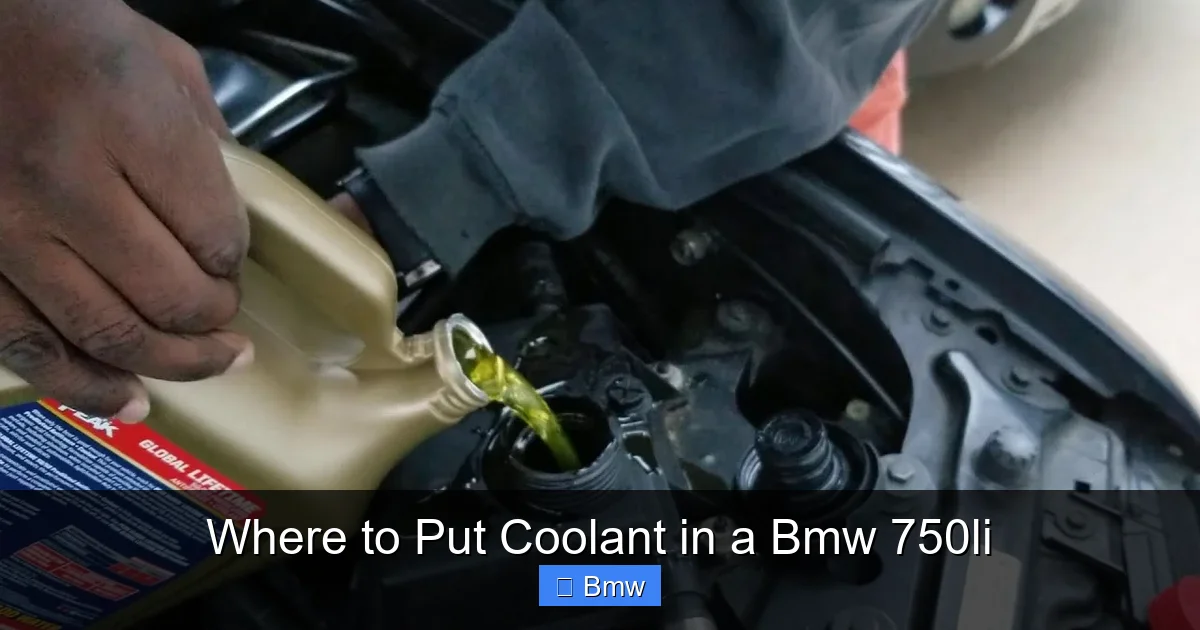
Visual guide about Where to Put Coolant in a Bmw 750li
Image source: i.ytimg.com
A Step-by-Step Visual Hunt
1. Park and Cool: Ensure the car is on a level surface and the engine is completely cold. This is for safety and an accurate reading.
2. Release the Hood: Pull the hood release lever inside your car (typically under the dashboard on the left side). Then, go to the front of the car, find the secondary latch under the hood lip, and disengage it. Prop the hood securely with the hydraulic strut or a rod.
3. Identify the Tank: Look toward the rear of the engine bay, closer to the windshield (the firewall). You’re searching for a translucent white plastic tank. It’s not the windshield washer reservoir (which is usually blue and has a washer icon). The coolant tank will have a cap that is bright yellow or sometimes black with a yellow symbol. The cap itself will often have a warning label and a symbol that looks like a thermometer in waves.
4. Confirm with Labels: The tank should be clearly labeled “COOLANT” or have the BMW logo. The plastic will have “MIN” and “MAX” lines molded into the side. If you see these, you’ve found the right place.
On some 750Li models, especially with the larger V12, the engine cover might partially obscure it. You may need to carefully remove the engine cover (it usually just clips off) to get a clear view and access. Take your time; there’s no rush.
Common Mistakes in Identification
Don’t confuse it with the brake fluid reservoir (smaller, usually near the back of the engine bay on the driver’s side, with a black cap) or the power steering fluid reservoir (if equipped, often a smaller black tank). The coolant tank is the largest plastic container in that rear area. If you’re ever 100% unsure, your owner’s manual will have a labeled diagram of the engine compartment. That diagram is your ultimate reference for where to put coolant in a BMW 750Li.
Step-by-Step: How to Add Coolant Safely and Correctly
You’ve located the tank. Now, the procedure. Precision and patience are key here.
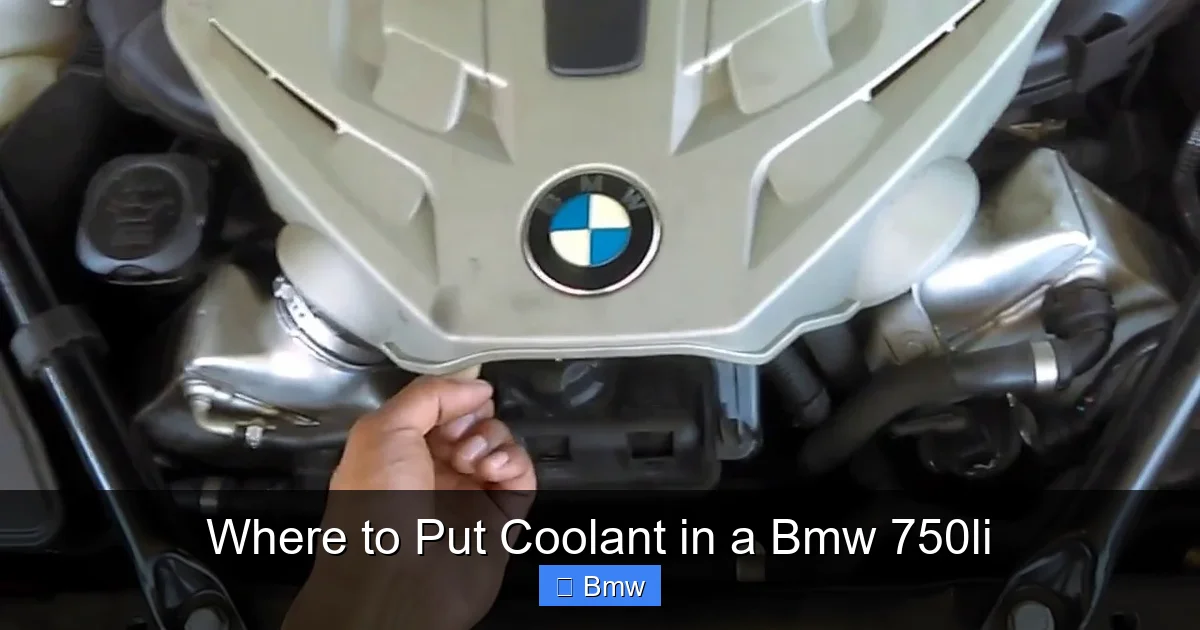
Visual guide about Where to Put Coolant in a Bmw 750li
Image source: i.ytimg.com
Preparation: The Right Tools and Fluid
Gather your supplies. You need:
- The correct BMW-approved coolant (e.g., Pentosin HT-12). Buy it from a BMW dealer, a reputable online parts seller, or an auto store that guarantees it meets the spec.
- A funnel (a clean, dedicated one for fluids). A long-neck funnel helps prevent spills.
- Gloves and safety glasses.
- Rags or paper towels.
- A container to catch any overflow.
Mix the coolant correctly. Most modern BMW coolant is a concentrate that must be mixed 50/50 with distilled water (never tap water, as minerals cause scale). Pre-mixed 50/50 coolant is also available and is more convenient. Check your bottle. If it’s concentrate, mix it before pouring it into the car.
The Filling Process: From Cap to Check
- Double-Check Cold Engine: This cannot be stressed enough. The system must be cold. Touch the radiator hoses carefully; they should be room temperature. A hot system is pressurized. Removing the cap will cause boiling coolant and steam to erupt, causing severe burns.
- Clean the Cap and Area: Wipe the cap and the top of the reservoir with a rag to prevent dirt from falling in.
- Remove the Cap: Turn the yellow cap counter-clockwise. You may need to press down slightly. Listen for a hiss—that’s pressure releasing. Let it fully depressurize before removing.
- Inspect the Current Level: Look at the side of the tank. Where does the coolant line up? If it’s below “MIN,” you need to add.
- Insert Funnel and Pour Slowly: Place your funnel in the opening. Pour your mixed coolant slowly. Watch the level rise. Stop when it reaches the “MAX” line. Do not overfill. The system needs air space for expansion.
- Replace the Cap Securely: Press the cap down and turn it clockwise until it clicks. Ensure it’s tight to maintain system pressure.
The Crucial Final Step: Bleeding Air Pockets
This is where many DIY top-ups fail. When you add coolant, air can get trapped in the system, creating an “air lock.” This prevents proper circulation and can cause the temperature gauge to read hot or trigger warnings even with a full tank. The bleeding procedure varies by model year.
The general method for many BMWs: With the engine cold and the coolant level at “MAX,” start the engine. Set the heater to maximum temperature and fan speed. This opens the heater core circuit, which is a common spot for air to collect. Let the engine idle with the radiator cap off (this is the expansion tank cap). You’ll see coolant circulating and possibly some bubbles escaping. Gently squeeze the upper radiator hose (if accessible) to help dislodge bubbles. The level will drop as air is purged. Let the engine reach normal operating temperature (watch the temp gauge), then turn it off and let it cool completely. Re-check the coolant level and top up to “MAX” if necessary. Repeat if needed. Always consult your specific owner’s manual for the exact bleeding procedure for your 750Li, as some models have a dedicated bleeder valve. If you’re uncomfortable with this, it’s a perfect job for a professional.
Choosing the Right Coolant: A BMW-Specific Guide
Let’s dive deeper into the fluid itself. Using the wrong coolant is a silent killer of cooling systems.

Visual guide about Where to Put Coolant in a Bmw 750li
Image source: thecarhow.com
BMW Coolant Specifications: G48, HT-12, and Others
BMW has evolved its coolant specs over the years, primarily to be more environmentally friendly and compatible with modern materials.
- G48 (OAT – Organic Acid Technology): This is the current standard for most BMWs from the mid-2000s onward, including many 750Li models. It’s typically blue/turquoise. It’s phosphate-free, silicate-free, and has a long service life (often 5 years/150k miles). Pentosin HT-12 is a G48-compliant coolant.
- HT-12: This is Pentosin’s specific formulation that meets BMW’s G48 standard. It’s the most commonly recommended aftermarket brand.
- Older Specs (G11, G12, G13): Earlier models used different colors and formulations. G12+ was often green/purple. Mixing these with G48 is a bad idea. If you’re unsure of your car’s history, it’s safest to have the system completely flushed and refilled with the current spec.
How to be sure? Your owner’s manual is the bible. It will list the exact specification. You can also check the color of the coolant currently in your tank (if it’s clean). Blue/turquoise strongly suggests G48/HT-12. Green or pink suggests an older, incompatible type.
The Danger of Mixing and Using Universal Coolants
“But it’s just antifreeze, how bad can it be?” Very bad. Mixing different chemical technologies can cause:
- Gel Formation: Incompatible additives can react and form a thick, gooey gel that clogs the narrow coolant passages in the cylinder head and radiator.
- Accelerated Corrosion: The protective inhibitors in one coolant can be neutralized by the chemicals in another, leaving your expensive aluminum engine vulnerable.
- Seal Damage: Different coolants have different effects on rubber seals and gaskets. The wrong one can cause them to swell, shrink, or crack, leading to leaks.
Avoid “universal” or “all-makes” coolants. They are a compromise that rarely meets the stringent requirements of a German engineering masterpiece like the 750Li. Invest in the correct, branded product. It’s cheap insurance against a multi-thousand-dollar engine repair. If you’re ever in doubt about what’s in your system, a complete flush is the only safe answer. This is a core principle when learning where to put coolant in a BMW 750Li — knowing what to put there is equally important.
When and How Often to Check and Top Up Coolant
Coolant isn’t a “set it and forget it” fluid. It degrades and systems can develop minor leaks.
Make It a Monthly Habit
The simplest maintenance is a visual check. Once a month, with the engine cold, open the hood and look at the coolant reservoir. Is the level between “MIN” and “MAX”? Is the fluid clean and brightly colored (blue/turquoise), or is it rusty, brown, or full of debris? This five-second check is the single best predictor of cooling system health. A slow, steady drop is a red flag for a small leak—perhaps from a hose, the water pump seal, or the thermostat housing. Catching it early can prevent a major failure.
Seasonal Considerations
Before winter, ensure your coolant mixture is correct. A proper 50/50 mix provides freeze protection down to about -34°F (-37°C). If you live in a colder climate and your coolant is old or diluted, it could freeze and crack the engine block or radiator. A simple refractometer test at a shop can confirm the freeze point. Conversely, in summer, the corrosion inhibitors are working overtime. Ensure your coolant is fresh and at the proper level to handle the extra heat.
After Any Cooling System Work
Anytime you have a component replaced—thermostat, water pump, radiator, hose—the system will need to be bled and the coolant level will drop. Always re-check the level after the first few drive cycles (cold start, warm up, cool down) following such a repair. This is a critical step many shops miss, leading to air locks and overheating complaints immediately after service.
Beyond Topping Up: Full Coolant System Maintenance
Adding coolant is a temporary fix. The system needs complete service over time.
The Coolant Flush: Why and When
Coolant degrades. The corrosion inhibitors get used up. Over time, it can become acidic and start eating away at your cooling system from the inside. Rust and scale can build up. BMW’s official recommendation for a full coolant system flush is typically every 4-5 years or 60,000-100,000 miles, but always check your manual. A flush involves completely draining the old fluid, flushing the system with water until it runs clear, and refilling with fresh, correct coolant. This is not a simple drain-and-fill; it requires a proper bleeding procedure to remove all air. This is a job for a professional with the right equipment, or a very dedicated DIYer with a clear procedure for their specific 750Li model year.
Recognizing Serious Problems: When to Stop and Call a Pro
Topping up is a band-aid. If you find yourself adding coolant regularly (more than a quart between services), you have a leak. Common leak points on a 750Li include:
- Water Pump: The electric water pump (common on N63/N74 engines) has a seal that can fail, leaking from a weep hole.
- Thermostat Housing: Plastic housings can crack or the gasket can fail.
- Radiator: Core leaks or tank leaks.
- Hoses: Upper/lower radiator hoses, heater hoses.
- Cylinder Head Gasket: A worst-case scenario. Coolant in the oil (milky sludge under the oil cap) or white smoke from the exhaust indicates a serious failure.
Diagnosing and repairing these leaks requires expertise. A pressure test of the cooling system is the standard diagnostic tool. If your car is overheating despite a full, correct coolant level, or if you see consistent warning lights, stop driving it. Continuing to operate an overheating engine will destroy it. The cost to fix a coolant leak on a BMW can vary widely, from a few hundred for a hose to several thousand for a water pump or head gasket, so early intervention is financially wise. You can read more about typical repair costs in our detailed guide on how much it costs to fix a coolant leak on a BMW.
Furthermore, if your BMW 750Li is approaching a major service interval, it’s wise to have a comprehensive check. Just as you would research how often to change oil in a BMW 3 Series to understand the brand’s maintenance philosophy, understanding your 750Li’s coolant service schedule is part of holistic care.
Conclusion: Mastery Through Understanding
Knowing where to put coolant in a BMW 750Li is foundational knowledge for any owner. It’s a simple task that connects you directly to the health of your vehicle’s heart. You’ve learned to locate the distinct yellow-capped reservoir in the engine bay, to respect the critical need for BMW-spec G48/HT-12 coolant, and to follow a cautious, cold-engine procedure for topping up. You understand that bleeding air from the system is often the most important part of the job, and that a recurring need for coolant points to a leak that needs professional diagnosis.
Your 750Li is a complex, high-performance machine. Treat its cooling system with the specificity it demands. Perform your monthly visual checks. Use only the correct, approved fluids. When in doubt, consult the owner’s manual or a trusted BMW specialist. By taking these steps, you protect your investment, prevent catastrophic engine damage, and ensure your luxury sedan delivers the smooth, powerful, and reliable drive it was engineered for. It’s not just about adding a liquid; it’s about preserving an experience.
Frequently Asked Questions
Can I use water instead of coolant in an emergency?
In a true emergency to prevent overheating, you can add a small amount of clean water to reach a service station, but it is not a permanent solution. Water lacks corrosion inhibitors and freeze protection. You must drain and refill with the correct coolant as soon as possible.
Should I check the coolant level when the engine is hot or cold?
Always check and add coolant when the engine is completely cold. The system is pressurized when hot, and opening the cap risks severe scalding from boiling coolant and steam. The “MIN” and “MAX” marks are calibrated for cold readings.
Can I mix different colors of BMW coolant?
No. Even if both are blue, they may be different specifications (e.g., G48 vs. an older spec). Mixing incompatible coolants can cause chemical reactions that create sludge or gel, clogging the system. If you’re unsure of the existing fluid, a complete flush is required.
How often does the coolant need to be completely changed?
BMW typically recommends a full coolant system flush every 4-5 years or 60,000-100,000 miles, but you must verify the exact interval for your specific model year and engine in the owner’s manual. This is separate from occasional topping up.
What happens if I overfill the coolant reservoir?
Overfilling leaves no room for coolant expansion as the engine heats. This can cause the excess to be forced out of the reservoir, leading to a low level, potential mess in the engine bay, and in rare cases, air being drawn into the system, causing circulation problems.
Why is my coolant level dropping but I see no obvious leaks?
A slow, invisible leak is possible (e.g., from a weeping water pump seal or a tiny crack in a hose). It could also indicate a more serious issue like a blown head gasket, where coolant is being burned in the combustion chamber. A professional pressure test is needed to locate the source.