
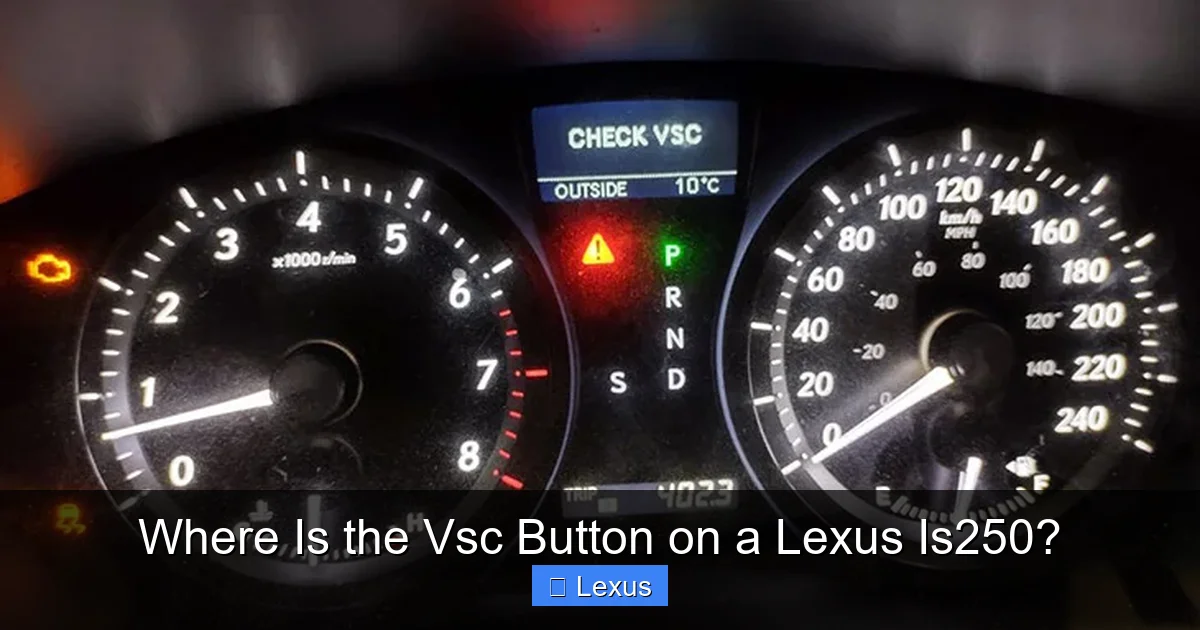
Where Is the Vsc Button on a Lexus Is250?
Contents
- 1 Key Takeaways
- 2 📑 Table of Contents
- 3 Where Is the VSC Button on a Lexus IS250?
- 4 Understanding What VSC Actually Does
- 5 Locating the VSC Button on Your Lexus IS250
- 6 When Should You Turn Off VSC?
- 7 Troubleshooting Common VSC Issues
- 8 VSC Button Location by Model Year: Quick Reference Table
- 9 Final Thoughts: Stay Safe and In Control
- 10 Frequently Asked Questions
The VSC (Vehicle Stability Control) button on a Lexus IS250 is typically located on the dashboard or center console, often near the gear shifter or climate controls. Look for a button labeled “VSC OFF” or marked with a skidding car icon—pressing it toggles the stability system on or off, useful in slippery conditions or when using snow chains.
Key Takeaways
- Locate the VSC button near the steering wheel or center console for quick access.
- Check the dashboard for a VSC warning light if the button isn’t immediately visible.
- Use the owner’s manual for precise location and function details specific to your model year.
- Press and hold the button to disable VSC if needed for specific driving conditions.
- Re-enable VSC promptly after off-road or slippery driving for optimal safety.
- Understand VSC’s role in enhancing traction and stability during sudden maneuvers.
📑 Table of Contents
Where Is the VSC Button on a Lexus IS250?
So you’re behind the wheel of your sleek, silver Lexus IS250, cruising down the highway or navigating a rainy city street, and suddenly you notice a warning light flickering on your dashboard—maybe the VSC light. You’ve heard of traction control, stability control, and all these fancy safety systems, but now you’re wondering: Where is the VSC button on a Lexus IS250? Don’t worry—you’re not alone. Many Lexus owners, especially first-timers or those upgrading from older models, find themselves searching for this seemingly elusive button.
I remember the first time I drove my friend’s IS250. It was a crisp autumn morning, leaves swirling in the wind, and I was feeling confident—until that little orange triangle with an exclamation point lit up like a firefly. I panicked for a second, thinking something was seriously wrong with the car. After a quick Google search (and a deep breath), I learned it was just the Vehicle Stability Control (VSC) system doing its job. But finding the actual VSC button? That took a bit more detective work. If you’ve ever found yourself squinting at the center console, checking under the steering wheel, or even popping the glove box open hoping it’s hiding there, this guide is for you. We’re going to walk through everything you need to know—where the button is, what it does, when to use it, and how to troubleshoot common issues—all in plain, easy-to-understand language.
Understanding What VSC Actually Does
Before we dive into where the VSC button is on your Lexus IS250, let’s take a moment to understand what VSC actually does. Vehicle Stability Control, or VSC, is a critical safety feature designed to help you maintain control of your vehicle during sudden maneuvers or slippery conditions. Think of it as your car’s co-pilot—quietly working in the background to keep you safe.

Visual guide about Where Is the Vsc Button on a Lexus Is250?
Image source: i.ytimg.com
How VSC Works in Real-World Scenarios
VSC uses a network of sensors to monitor your car’s speed, steering angle, lateral acceleration, and wheel rotation. If the system detects that your car is starting to skid or lose traction—like when you take a sharp turn too fast on wet pavement—it automatically applies brakes to individual wheels and may reduce engine power to help you regain control. It’s like having an invisible hand gently guiding your car back on track.
For example, imagine you’re driving on a rainy day and suddenly swerve to avoid a pothole. Without VSC, your car might oversteer (the back end swings out) or understeer (the front wheels lose grip and push outward). VSC detects this instability and intervenes instantly, applying the right amount of brake pressure to the appropriate wheels to keep your car aligned with your intended path. It’s not magic—it’s advanced engineering working in your favor.
VSC vs. Traction Control: What’s the Difference?
Many people confuse VSC with Traction Control System (TCS), and honestly, they’re closely related. In fact, on the Lexus IS250, VSC includes TCS as part of its functionality. Traction Control primarily prevents wheel spin during acceleration—especially useful when starting on icy roads or wet grass. VSC goes a step further by managing overall vehicle stability during cornering or emergency maneuvers.
So while TCS says, “Hey, don’t spin those wheels when you hit the gas,” VSC says, “Whoa, slow down and adjust—you’re about to lose control.” Both are essential, but VSC is the more comprehensive system. On your IS250, they’re often controlled together through the same button, which is why knowing where it is can be so important.
Locating the VSC Button on Your Lexus IS250
Now for the million-dollar question: Where is the VSC button on a Lexus IS250? The good news? It’s not hidden in some secret compartment or buried under layers of trim. The bad news? It’s not always in the most intuitive spot, especially if you’re used to other car brands.
Visual guide about Where Is the Vsc Button on a Lexus Is250?
Image source: i.ytimg.com
Standard Location: Center Console Near the Gear Shift
In most Lexus IS250 models (particularly from 2006 to 2013), the VSC button is located on the center console, just to the left of the gear shift. It’s a small, rectangular button, usually labeled “VSC OFF” or sometimes just “VSC.” It’s often black or dark gray, blending in with the surrounding dashboard trim, which is why it can be easy to miss at first glance.
To find it, sit in the driver’s seat and look down at the area between the front seats, near where your left hand would rest when shifting gears. You’re looking for a button that’s slightly raised and has a tiny icon—often a car with squiggly lines underneath it, symbolizing stability control. If you press it, you’ll hear a soft click, and the VSC warning light on your dashboard will illuminate, indicating that the system has been turned off.
Variations by Model Year and Trim
It’s worth noting that the exact placement can vary slightly depending on the model year and trim level of your IS250. For example:
- 2006–2008 IS250: The VSC button is typically located on the center console, just left of the gear lever. It’s a standalone button with clear labeling.
- 2009–2013 IS250: Some models integrate the VSC button into a cluster of other controls, including the traction control and eco mode buttons. It may be slightly recessed or grouped with other switches.
- IS250 with Navigation or Luxury Package: In higher trims, the button might be positioned closer to the climate controls or even near the cup holders, but it’s still generally within arm’s reach of the driver.
If you’re still having trouble finding it, try turning on the ignition (without starting the engine) and pressing various buttons on the center console. When you press the correct one, the VSC light on the dashboard will flash or stay on. That’s your confirmation.
Pro Tip: Use the Owner’s Manual
Still stumped? Don’t sweat it. The owner’s manual is your best friend when it comes to locating vehicle-specific controls. Flip to the “Instrument Panel” or “Driver Controls” section, and you’ll usually find a detailed diagram showing exactly where the VSC button is located. If you don’t have the physical manual, you can download a digital copy from the Lexus website using your vehicle identification number (VIN).
When Should You Turn Off VSC?
Now that you’ve found the VSC button, you might be wondering: Should I ever turn it off? After all, it’s a safety feature—why would you want to disable it? The truth is, there are a few specific situations where turning off VSC can actually be helpful.
Visual guide about Where Is the Vsc Button on a Lexus Is250?
Image source: i.ytimg.com
Driving in Deep Snow or Mud
One of the most common reasons to disable VSC is when driving in deep snow, mud, or sand. In these conditions, your wheels may need to spin slightly to gain traction and “dig out.” If VSC is active, it will detect wheel slip and automatically reduce engine power or apply brakes, which can leave you stuck.
For example, if you’re trying to pull out of a snowbank and your front wheels start spinning, VSC might interpret this as a loss of control and cut power, making it even harder to get moving. In this case, turning off VSC (and often TCS as well) allows the wheels to spin freely, giving you a better chance of breaking free.
Performance Driving or Track Use
Enthusiasts who take their IS250 to the track or enjoy spirited driving on twisty roads may choose to disable VSC for more direct control. With VSC off, the car responds more immediately to driver input, allowing for sharper turns and more aggressive acceleration. However, this comes with increased risk—without electronic aids, the car is more likely to oversteer or spin out if pushed too hard.
That said, most drivers—especially those on public roads—should leave VSC on at all times. The safety benefits far outweigh the minor inconvenience of reduced wheel spin in low-traction situations.
When Not to Turn Off VSC
There are very few everyday scenarios where turning off VSC is recommended. Avoid disabling it during:
- Rainy or wet conditions
- Ice or black ice
- High-speed highway driving
- Heavy traffic or sudden braking situations
Remember: VSC is there to protect you. Turning it off should be the exception, not the rule.
Troubleshooting Common VSC Issues
Even with the button located and understood, you might still run into problems. The VSC light on your dashboard can come on for a variety of reasons—some minor, some more serious. Here’s how to diagnose and address the most common issues.
VSC Light Stays On After Starting the Car
If the VSC light remains illuminated after you start your IS250, it usually means the system has been manually turned off—or there’s a fault. First, check if you (or someone else) accidentally pressed the VSC button. If so, simply press it again to reactivate the system. The light should go out after a few seconds.
If the light stays on even after pressing the button, there may be an underlying issue. Common causes include:
- A faulty wheel speed sensor
- Low brake fluid
- Worn brake pads affecting brake pressure sensors
- Electrical issues with the steering angle sensor
In these cases, it’s best to have your vehicle inspected by a certified Lexus technician. Ignoring a persistent VSC warning could compromise your safety.
VSC Light Flashes While Driving
A flashing VSC light typically indicates that the system is actively working to stabilize the vehicle—this is normal during slippery conditions. However, if the light flashes continuously even on dry pavement, it could signal a malfunction. Pull over safely, turn off the engine, wait a few minutes, and restart the car. If the flashing continues, seek professional diagnosis.
Resetting the VSC System
Sometimes, a simple reset can resolve minor glitches. Here’s how:
- Turn the ignition to the “ON” position (do not start the engine).
- Press and hold the VSC button for about 3–5 seconds.
- You should hear a beep, and the VSC light may flash before turning off.
- Start the engine and check if the light remains off.
If this doesn’t work, a diagnostic scan tool may be needed to clear any stored error codes.
VSC Button Location by Model Year: Quick Reference Table
To make things even easier, here’s a quick reference table showing the typical location of the VSC button across different Lexus IS250 model years:
| Model Year | VSC Button Location | Additional Notes |
|---|---|---|
| 2006–2008 | Center console, left of gear shift | Standalone button, clearly labeled |
| 2009–2011 | Center console, near gear shift or climate controls | May be grouped with other switches |
| 2012–2013 | Center console, integrated into control cluster | Sometimes recessed or less prominent |
| IS250 AWD Models | Same as RWD, but check near transfer case controls | AWD systems may have additional stability logic |
This table can help you quickly identify where to look based on your specific IS250 model. If you’re still unsure, don’t hesitate to consult your owner’s manual or visit a Lexus dealership for assistance.
Final Thoughts: Stay Safe and In Control
Finding the VSC button on your Lexus IS250 might seem like a small detail, but it’s an important part of understanding and maintaining your vehicle’s safety systems. Whether you’re dealing with a warning light, preparing for winter driving, or just satisfying your curiosity, knowing where the button is and what it does can make a big difference in your driving experience.
Remember, VSC is there to help you—not hinder you. While there are rare situations where turning it off makes sense, the vast majority of the time, you’ll want it active and working behind the scenes. And if you ever do need to disable it, now you know exactly where to find that little button near the gear shift.
So the next time you’re behind the wheel of your IS250 and that VSC light pops up, don’t panic. Take a deep breath, check the button, and trust that your Lexus is looking out for you. After all, that’s what great engineering is all about—peace of mind, one smooth ride at a time.
Frequently Asked Questions
Where is the VSC button on a Lexus IS250?
The VSC (Vehicle Stability Control) button on a Lexus IS250 is typically located on the dashboard to the left of the steering wheel or near the center console, depending on the model year. Look for a button labeled “VSC OFF” or an icon showing a car with skid marks.
How do I turn off VSC on a Lexus IS250?
To turn off VSC on a Lexus IS250, press and hold the VSC OFF button until the warning light appears on the dashboard. This disables the stability control system, which is useful in certain off-road or snowy conditions.
Why can’t I find the VSC button in my Lexus IS250?
Some newer or updated Lexus IS250 models integrate the VSC controls into the infotainment system or use a different layout. Check your owner’s manual or look near the gear shifter and lower dashboard area for the button.
What does the VSC button do on a Lexus IS250?
The VSC button allows you to disable the Vehicle Stability Control system, which helps maintain traction during slippery conditions. Turning it off may be necessary for situations like deep snow or when using tire chains.
Is it safe to drive with VSC turned off in a Lexus IS250?
Driving with VSC off reduces electronic stability assistance, which can increase the risk of skidding in slippery conditions. It’s generally safe on dry roads but not recommended in rain, snow, or during aggressive driving.
How do I reset the VSC light on a Lexus IS250?
To reset the VSC light, ensure the VSC system is turned back on by pressing the VSC OFF button. If the light remains on, there may be an underlying issue—visit a Lexus service center for a diagnostic check.