
Where Is Mazda 3 Manufactured?

The Mazda 3 is produced across multiple global facilities, including Japan, Mexico, Thailand, China, and Vietnam. Despite different locations, Mazda maintains strict quality control ensuring consistency. Your specific Mazda 3’s origin depends on your market and model year, but all meet the same high standards.
So, you’re eyeing a Mazda 3. It’s a fantastic choice—sporty, efficient, and packed with tech. But have you ever wondered, “Where is this Mazda 3 manufactured?” It’s a smart question. In today’s global car world, your vehicle’s birthplace can tell you a lot about its story, its value, and even its long-term reliability. For 2026, the answer isn’t simple. The Mazda 3 rolls off assembly lines on several continents. This isn’t about cutting corners; it’s a smart, strategic move by Mazda to serve a world market efficiently. Let’s unpack exactly where your potential Mazda 3 comes from and why it matters to you.
Key Takeaways
- Global Production Network: As of 2026, the Mazda 3 is manufactured in Japan, Mexico, Thailand, China, and Vietnam, with each plant serving distinct regional markets.
- Quality Uniformity: Mazda enforces identical quality standards worldwide through the Mazda Production System, ensuring no compromise regardless of assembly location.
- Market-Driven Manufacturing: Production locations are strategically chosen to reduce tariffs, shipping costs, and meet local demand, explaining why your Mazda 3’s origin varies by country.
- VIN Decoding: You can identify your Mazda 3’s manufacturing plant by decoding its Vehicle Identification Number (VIN), specifically the first character.
- Resale Value Nuance: Mazda 3s built in Japan often hold slightly higher resale value compared to those from other plants, influenced by perceived quality and scarcity in some markets.
- Electrified Future: All Mazda 3 production plants are being upgraded to build electrified variants, including hybrid and battery-electric models, by the late 2020s.
📑 Table of Contents
- The Mazda 3’s Manufacturing Journey: From 2003 to 2026
- Where Is the Mazda 3 Built in 2026? A Plant-by-Plant Guide
- Why Does Mazda Produce the Mazda 3 in So Many Places?
- Quality Control Across Borders: Is a Mexican Mazda 3 the Same as a Japanese One?
- What Does Manufacturing Location Mean for You as a Buyer?
- The Road Ahead: Future of Mazda 3 Production
- Conclusion: It’s a Mazda 3, No Matter the Stamp
The Mazda 3’s Manufacturing Journey: From 2003 to 2026
To understand today, we need a quick trip back. The Mazda 3 (known as the Axela in Japan and some markets) debuted in 2003. It was a game-changer—a compact hatchback and sedan with the driving joy of a sports car. For years, every single Mazda 3 was built in Japan, primarily at Mazda’s Hiroshima Plant No. 1. This “Made in Japan” badge was a huge selling point, synonymous with meticulous craftsmanship.
But as the Mazda 3’s popularity exploded globally, Mazda faced a reality: shipping cars from Japan everywhere was expensive and slow. Tariffs in key markets like North America and Europe made cars pricier. So, Mazda did what many smart automakers do: they went global. The first major step was Mexico. In 2010, Mazda’s Salamanca plant in central Mexico opened, initially building the Mazda 2 and Mazda 3. This was a masterstroke for the U.S. and Canadian markets. No more lengthy ocean voyages, lower tariffs, and cars could be priced more competitively.
Thailand followed. The Rayong plant became the hub for Southeast Asia, Australia, and New Zealand. Then came China, through the FAW Mazda joint venture in Nanjing. More recently, Vietnam joined the list. This expansion wasn’t random. Each new plant was a calculated play to be closer to the customer, adapt to local tastes (like sedan vs. hatchback preference), and navigate trade policies. By 2026, this multi-plant strategy is fully matured, making the Mazda 3 a true world car.
Where Is the Mazda 3 Built in 2026? A Plant-by-Plant Guide
This is the core of your question. In 2026, you can find Mazda 3s coming off the line in five primary locations. Each has a unique role in Mazda’s global orchestra.

Visual guide about Where Is Mazda 3 Manufactured?
Image source: i.gaw.to
1. Hiroshima & Hofu, Japan: The Birthplace and Flagship
Don’t think Japan isn’t still crucial. The Hiroshima Plant (No. 1 and No. 2) and the Hofu Plant in Yamaguchi Prefecture remain the heart of Mazda. These facilities build the highest-trim Mazda 3s, particularly the premium hatchback variants like the Mazda 3 Premium or the performance-oriented Mazda 3 Turbo (where available). They also produce many models for the Japanese domestic market and for export to regions with smaller volumes, like Europe and parts of the Middle East. The Japanese plants are also the first to get new technologies, like the latest Skyactiv-X engines or advanced hybrid systems, before they trickle down to other factories. If you buy a Mazda 3 in Europe or a top-spec model in the Middle East, chances are it’s Japanese-built. The VIN for these starts with “J” (for Japan) or sometimes “JM” for specific plants.
- Key Models: All body styles, premium trims, early-release tech.
- Primary Markets: Japan, Europe, Middle East, select Asia-Pacific.
- Tip: A VIN starting with “J” almost guarantees Japanese manufacture.
2. Salamanca, Mexico: The North American Powerhouse
Mazda de México Vehicle Operation (MMVO) in Salamanca is a massive facility. It’s the exclusive source for all Mazda 3s sold in the United States, Canada, and Mexico. This plant is a marvel of modern manufacturing, designed from the ground up to meet Mazda’s exacting standards. It builds both the sedan and hatchback, covering the full range from base to Grand Touring trims. The reason is simple economics and logistics. Building in Mexico for the massive North American market slashes shipping times from months to weeks and avoids the 2.5% tariff on cars imported from Japan (under USMCA rules, many components are tariff-free if sourced regionally). The quality here is indistinguishable from Japan—Mazda audits these plants constantly. The VIN for Mexican-built Mazda 3s starts with “3” or “4” (specifically, “3MY” or “4MY” for model year).
- Key Models: Entire U.S./Canada lineup (sedan & hatchback).
- Primary Markets: United States, Canada, Mexico.
- Practical Example: If you’re buying a new Mazda 3 from a dealership in California, it rolled off the line in Salamanca. This is why you can get it so quickly after ordering.
3. Rayong, Thailand: The ASEAN and Australasia Hub
Mazda’s plant in Rayong, Thailand, is a critical node for the Asia-Pacific region. It supplies right-hand-drive markets like Australia, New Zealand, and the UK (for some fleet sales), as well as left-hand-drive markets across Southeast Asia (Thailand, Indonesia, Malaysia, Philippines, Vietnam). This plant is incredibly flexible, producing both sedans and hatchbacks. Thailand’s role is also about cost-competitiveness within the ASEAN economic bloc, where trade barriers are lower. The VIN for Thai-built Mazda 3s typically starts with “M” (for Thailand) or “MM”.
- Key Models: Both body styles, often with specific market features (e.g., higher ground clearance for Australian roads).
- Primary Markets: Australia, New Zealand, UK (some), Thailand, Indonesia, Malaysia, Philippines.
- Tip: An Australian-market Mazda 3 is almost certainly Thai-built. You can confirm by checking the driver’s door jamb sticker for the plant code.
4. Nanjing, China: Serving the World’s Largest Auto Market
In China, Mazda partners with FAW Group in a 50/50 joint venture: FAW Mazda. Their plant in Nanjing produces Mazda 3s exclusively for the Chinese market. The Chinese market has unique demands—longer wheelbase sedans are hugely popular, and there’s a strong preference for certain tech features. The Nanjing plant builds a slightly different variant, often with a longer sedan version and specific infotainment integrations for Chinese apps. It’s a separate operation but adheres to Mazda’s global quality protocols. The VIN for Chinese Mazda 3s starts with “L” (for China) or “LF” for FAW Mazda.
- Key Models: Sedan-dominant lineup, with market-specific features.
- Primary Market: Mainland China.
- Important Note: Chinese-built Mazda 3s are not typically exported, so you won’t find them in North America or Europe.
5. Hanoi, Vietnam: The Emerging Player
Mazda’s presence in Vietnam is newer, through a partnership with local manufacturers. Production started in the early 2020s at a facility near Hanoi. This plant primarily serves the fast-growing Vietnamese market and potentially neighboring countries like Laos and Cambodia. It’s a smaller-volume operation but allows Mazda to compete effectively in a price-sensitive region without import costs. The VIN for Vietnamese Mazda 3s starts with “X” (for Vietnam).
- Key Models: Typically the most popular variants for the region, often sedans.
- Primary Market: Vietnam, with potential exports to neighboring ASEAN nations.
- Future Outlook: This plant is expected to ramp up production and may add more model variants by 2027.
Why Does Mazda Produce the Mazda 3 in So Many Places?
It all comes down to three big letters: C-O-S-T. But it’s more nuanced than just cheap labor. Here’s the breakdown.

Visual guide about Where Is Mazda 3 Manufactured?
Image source: cdn-ds.com
1. Tariff and Trade War Avoidance: This is huge. Importing a car built in Japan to the U.S. incurs a 2.5% tariff. Building it in Mexico under the USMCA (United States-Mexico-Canada Agreement) means most components can cross borders tariff-free, drastically reducing the final price. The same logic applies in Europe and Asia. By having a plant in Mexico, Mazda makes its compact car price-competitive against the Toyota Corolla and Honda Civic, which also have North American plants.
2. Shipping Costs and Speed: A car carrier ship from Japan to Los Angeles takes about 3 weeks. That’s time and fuel. Building in Mexico cuts that to days by rail or truck. For a high-volume model like the Mazda 3, those savings add up to millions. It also means fresher inventory for dealers and faster delivery for you.
3. Local Market Tuning: Cars aren’t one-size-fits-all. Australian buyers want more robust cooling systems for outback driving. Chinese buyers desire longer rear legroom. Thai buyers often prefer sedans over hatchbacks. Having a plant locally allows Mazda to tweak the final assembly—adding specific suspension tuning, interior features, or even styling elements—without re-engineering the entire car. This is why you might see subtle differences in a Mazda 3 sold in Sydney versus one in Toronto.
4. Currency and Economic Hedging: Manufacturing in multiple regions protects Mazda from currency fluctuations. If the Japanese yen strengthens, exporting from Japan becomes more expensive. But production in Mexico (using pesos) or Thailand (using baht) provides a natural hedge, stabilizing pricing globally.
5. Risk Mitigation: What if an earthquake shuts down the Hiroshima plant? Or a pandemic halts shipping? Having plants worldwide is like not putting all your eggs in one basket. It ensures Mazda can keep building Mazda 3s even if one region faces disruption. This is a lesson learned from the 2011 Tōhoku earthquake and tsunami that severely impacted Japanese auto production.
Real-World Comparison: Think about it like a fast-food chain. A Big Mac tastes the same in Tokyo and Toronto, but the ingredients might be sourced locally, and the restaurant is managed by local franchisees. Mazda’s global plants work the same way under one brand recipe.
Quality Control Across Borders: Is a Mexican Mazda 3 the Same as a Japanese One?
This is the billion-dollar question. The short, emphatic answer is yes. Mazda’s reputation for exceptional build quality and driving dynamics is non-negotiable. They don’t sacrifice it for cost savings.
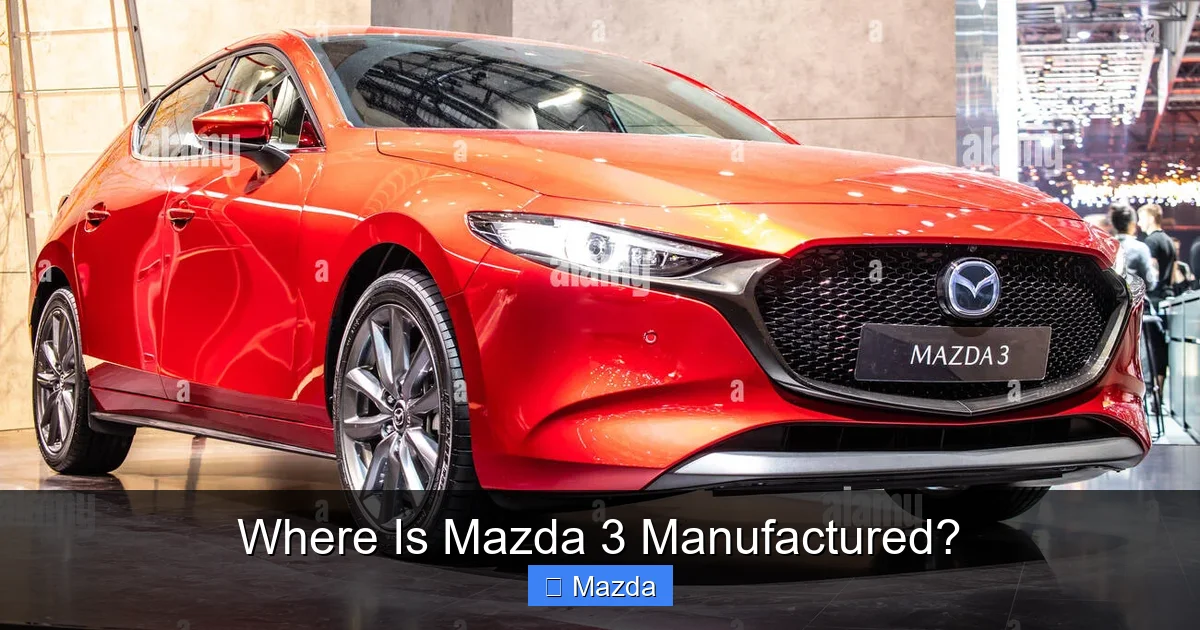
Visual guide about Where Is Mazda 3 Manufactured?
Image source: c8.alamy.com
Mazda uses a unified production philosophy called the Mazda Production System (MPS). It’s their version of Toyota’s famous “Toyota Production System.” The MPS focuses on:
- Jidoka: Automation with a human touch. Machines stop automatically if a defect is found, and workers are empowered to halt the line.
- Just-in-Time: Parts arrive exactly when needed, minimizing waste and inventory.
- Continuous Improvement (Kaizen): Every worker is encouraged to suggest small, daily improvements.
This system is taught identically at every Mazda plant worldwide. Engineers and line workers from Mexico, Thailand, and Japan train together at the Hiroshima headquarters. The same quality control checklists, paint booth standards, and torque specifications are used everywhere.
Furthermore, Mazda conducts rigorous, random audits of finished vehicles from every plant. These aren’t superficial checks. They involve disassembling sections, testing panel gaps with精密 gauges, and evaluating paint thickness and finish. A Mexican-built Mazda 3 is just as likely to pass as a Japanese one. In fact, in many independent quality studies (like J.D. Power’s Initial Quality Study), plants like Salamanca have scored on par with or even above Japanese plants.
What About “Perceived” Quality? There’s a long-held bias that “Made in Japan” is inherently superior. For Mazda, this perception is fading. The Salamanca plant, opened in 2010, was designed with the latest technology and has earned a reputation for flawless execution. Many automotive journalists who have inspected both cannot tell the difference in build quality. Any minor variations are usually due to supplier parts (like a specific brand of speaker or seat fabric) that might differ by region, not the assembly itself.
Pro Tip: If you’re concerned, check the build quality yourself. Look for even panel gaps between the hood and fenders, the trunk lid and body. Press on various interior panels—there should be no squeaks or flex. These are universal quality indicators, regardless of origin.
What Does Manufacturing Location Mean for You as a Buyer?
Okay, so quality is consistent. But does where it’s built affect you? Yes, in a few subtle but important ways.
Resale Value and Market Perception
In some markets, especially the U.S. and Europe, a “Japanese-built” badge still carries a premium in the used car market. A Mazda 3 with a VIN starting with “J” might sell for 2-5% more at auction or on a dealer lot than an identical Mexican-built one. This is a psychological factor more than a quality one, but it’s real. For the average private seller, the difference might be a few hundred dollars. For high-volume dealers, it’s a notable factor. In Australia, Thai-built Mazda 3s are the norm, so there’s no stigma; they simply represent the standard.
Warranty and Service: No Difference
This is critical. Mazda’s worldwide warranty is backed by the company, not the plant. A Mazda 3 built in Mexico comes with the same 3-year/36,000-mile bumper-to-bumper warranty in the U.S. as a Japanese-built one would (if sold there). Service bulletins and recalls apply globally. Your local dealer will honor the warranty regardless of origin. So, you have zero risk in that regard.
Parts Availability and Sourcing
This is where it gets interesting. Mazda sources many parts globally. A transmission for a Mexican-built Mazda 3 might come from a supplier in Kentucky or Kentucky. An engine for a Thai-built one might be cast in Japan. The global supply chain is intertwined. However, for very specific regional parts (like a unique headlight assembly for the Chinese market), sourcing might take longer if you’re in another country. But for standard wear-and-tear items (brakes, filters, wipers), parts are standardized across most markets. Your dealer’s parts department will have access to the correct components for your specific VIN.
How to Find Your Mazda 3’s Birthplace
It’s easy! Look at your Vehicle Identification Number (VIN). It’s a 17-digit code found on the dashboard (visible through the windshield), the driver’s door jamb sticker, and your registration. The first character or first three characters (World Manufacturer Identifier) tells you the country of final assembly.
- J, JM: Japan
- 3M, 4M, 3MY, 4MY: Mexico (Salamanca)
- M, MM: Thailand (Rayong)
- L, LF: China (Nanjing, FAW Mazda)
- X: Vietnam
You can use a free online VIN decoder to confirm the exact plant. This is a great piece of info to have when buying used, as it can influence price and your peace of mind.
The Road Ahead: Future of Mazda 3 Production
The automotive world is electrifying, and the Mazda 3 is at the forefront. Mazda has committed to making all new models electrified (hybrid, plug-in hybrid, or EV) by 2030. This has big implications for manufacturing.
Plant Retrofits for Electrification: Every Mazda 3 plant is being upgraded with new assembly lines for battery packs and electric drivetrains. The Hiroshima plant is leading the charge, already building the mild-hybrid Mazda 3. By 2026, we expect the Mexican and Thai plants to start producing hybrid variants. The Chinese plant, through FAW Mazda, is likely to get plug-in hybrid versions tailored for that market’s regulations.
Potential New Locations? Rumors swirl about Mazda building a plant in the U.S. for EVs, possibly in Alabama or Tennessee. While this wouldn’t immediately replace the Salamanca plant for the Mazda 3, it could eventually produce a future electric Mazda 3 or a related model. For now, the existing five-plant network is solid through at least 2030.
Sustainability Focus: Mazda aims for carbon neutrality by 2050. Their plants are installing solar arrays, using recycled water, and reducing waste. The Hiroshima plant, for instance, has a goal of being “water positive.” So, your Mazda 3’s environmental footprint isn’t just about fuel efficiency; it’s also about how cleanly it was built.
Conclusion: It’s a Mazda 3, No Matter the Stamp
So, where is the Mazda 3 manufactured? In 2026, the answer is: Japan, Mexico, Thailand, China, and Vietnam. Your specific car’s origin depends entirely on where you live and which model year you buy. A buyer in Dallas gets a Salamanca-made car. One in Sydney gets a Rayong-made car. One in Tokyo gets a Hiroshima-made car.
The key takeaway is this: don’t stress over the origin. Mazda’s global quality systems are robust and proven. A Mazda 3 from Mexico is built to the same exacting standards as one from Japan. The differences are logistical and economic, not qualitative. Focus on the car itself—its features, its condition, its price. Check the VIN if you’re curious, but know that you’re getting a Mazda 3, engineered with the same care, passion, and “Zoom-Zoom” spirit, no matter which stamp it bears. The global manufacturing strategy is a strength, allowing Mazda to bring this brilliant compact car to you at a better price, faster, and with a commitment to a sustainable future. That’s a win for everyone.
Frequently Asked Questions
Does the manufacturing location affect the Mazda 3’s reliability?
No. Mazda enforces identical quality control standards at all global plants through the Mazda Production System. Reliability studies show no significant difference between Mazda 3s from different factories. Any variations are typically due to individual ownership and maintenance, not assembly location.
Can I choose where my Mazda 3 is built when ordering?
No. The manufacturing plant is determined by your geographic market and the specific model variant you select. For example, all Mazda 3s sold in the United States come from Mexico. You cannot request a Japanese-built version unless you import it privately, which is complex and costly.
Is a Japanese-built Mazda 3 worth the higher price in the used market?
It depends. In some markets like the U.S., Japanese-built Mazda 3s often command a slight premium (2-5%) due to perception. However, for most buyers, the difference is minimal. A well-maintained Mexican or Thai-built Mazda 3 will be just as reliable and enjoyable. Focus on the vehicle’s history, condition, and maintenance records over its origin.
How can I find out where my specific Mazda 3 was manufactured?
Decode your Vehicle Identification Number (VIN). The first character indicates the country of final assembly. Check the driver’s door jamb sticker for the plant code. You can also use a free online VIN decoder service, which will specify the exact assembly plant for your VIN.
Are there any differences in features between Mazda 3s from different plants?
Yes, but they are market-specific, not plant-specific. For example, Chinese-market Mazda 3s often have a longer wheelbase sedan. Australian-market models might have different suspension tuning for local roads. These differences are planned by Mazda’s regional offices based on consumer demand, not because one plant is better than another.
Will future electric Mazda 3 models be built in the same plants?
Yes. All existing Mazda 3 production plants—Japan, Mexico, Thailand, China, and Vietnam—are being upgraded to produce electrified variants (hybrids and EVs). The Hiroshima plant is leading this transition, with other plants following suit through the late 2020s.
