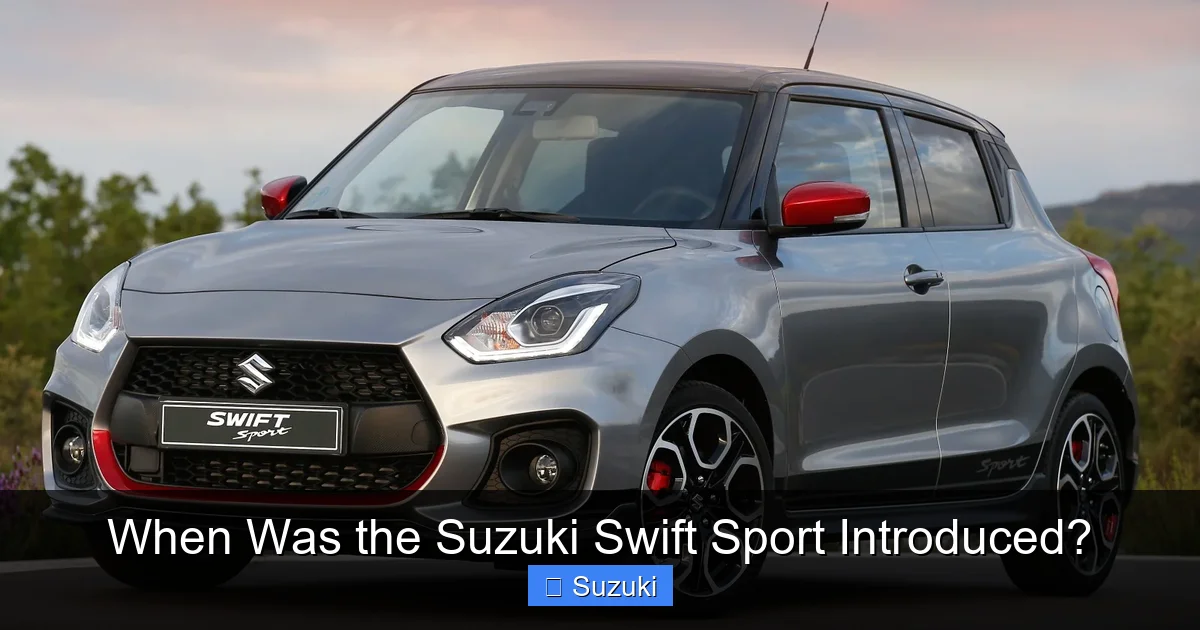
When Was the Suzuki Swift Sport Introduced?

Contents
- 1 Key Takeaways
- 2 📑 Table of Contents
- 3 When Was the Suzuki Swift Sport Introduced?
- 4 The Origins of the Suzuki Swift Sport
- 5 Evolution Through the Generations
- 6 Performance and Driving Dynamics
- 7 Global Popularity and Cultural Impact
- 8 Why the Swift Sport Stood Out
- 9 Tips for Buying a Used Suzuki Swift Sport
- 10 Conclusion
- 11 Frequently Asked Questions


The Suzuki Swift Sport was first introduced in 2005 as a high-performance variant of the popular Suzuki Swift. Designed for driving enthusiasts, it combined sporty handling, a peppy engine, and compact styling into an affordable package that quickly gained a loyal following worldwide.
Key Takeaways
- Introduced in 2005: The Suzuki Swift Sport made its debut in 2005, marking Suzuki’s entry into the competitive hot hatch segment with a focus on agility and fun-to-drive dynamics.
- Evolution Across Generations: Over the years, the Swift Sport has evolved through multiple generations, each improving on power, efficiency, and technology while retaining its lightweight, nimble character.
- Global Popularity: The model has been sold in markets across Europe, Asia, Australia, and beyond, praised for its affordability and spirited performance.
- Engine Upgrades: From the original 1.6L M16A engine to the turbocharged 1.4L Boosterjet in later models, the Swift Sport has consistently delivered responsive power in a compact frame.
- Discontinuation and Legacy: Production of the Swift Sport ended in 2022 in many markets, but it remains a beloved icon among compact performance car fans and a strong used car choice.
- Driving Experience Focus: Unlike many rivals, the Swift Sport prioritized driver engagement over luxury, offering a raw, connected feel that appeals to enthusiasts.
- Future of the Nameplate: While no longer in production, the Swift Sport’s legacy may live on through potential electrified or hybrid successors under Suzuki’s evolving lineup.
📑 Table of Contents
When Was the Suzuki Swift Sport Introduced?
If you’ve ever driven a Suzuki Swift Sport, you know it’s not just another small car. It’s a pocket rocket—light, quick, and full of character. But when did this spirited hot hatch first hit the roads? The Suzuki Swift Sport was officially introduced in 2005, marking a bold step for Suzuki into the world of performance-oriented compact cars. At a time when hot hatches were dominated by brands like Volkswagen, Ford, and Honda, Suzuki brought something refreshingly different: a car that prioritized driving joy over outright power, and affordability over luxury.
The original Swift Sport wasn’t designed to break speed records. Instead, it was engineered to deliver a pure, engaging driving experience in a package that was easy to live with every day. With its compact dimensions, responsive steering, and a peppy 1.6-liter engine, it quickly won over drivers who wanted something fun without the high price tag. Over the years, the Swift Sport evolved, gaining more power, better technology, and improved efficiency—but it never lost its core identity. Even as Suzuki phased out the model in 2022, the Swift Sport remains a benchmark for what a small performance car can be.
The Origins of the Suzuki Swift Sport

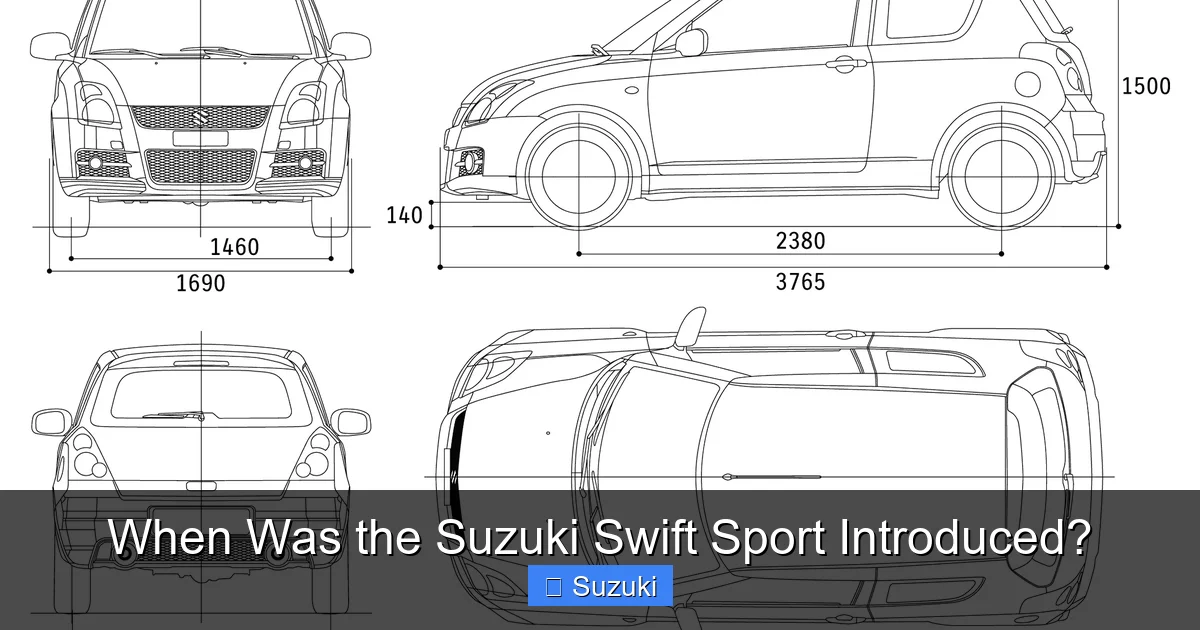
Visual guide about When Was the Suzuki Swift Sport Introduced?
Image source: drawingdatabase.com
To understand the significance of the Swift Sport’s introduction in 2005, it helps to look at the context of the early 2000s automotive market. Compact cars were becoming increasingly popular, especially in Europe and Asia, where fuel efficiency and maneuverability were top priorities. However, most small cars were tuned for comfort and economy, leaving driving enthusiasts wanting more excitement.
Suzuki, known for its expertise in small, efficient vehicles, saw an opportunity. The standard Suzuki Swift (known as the Cultus in some markets) was already a hit for its practicality and reliability. But Suzuki wanted to create a version that appealed to younger drivers and performance fans. The result was the Swift Sport—a model that took the best qualities of the standard Swift and amplified them with sportier tuning, a more powerful engine, and a more aggressive look.
The first-generation Swift Sport (codenamed ZC31S) was based on the second-generation Suzuki Swift, which debuted in 2004. It featured a 1.6-liter M16A inline-four engine producing 125 horsepower and 118 lb-ft of torque. While those numbers might not sound impressive by today’s standards, they were more than enough to make the lightweight Swift Sport feel lively. With a curb weight of around 1,000 kg (2,200 lbs), the car had an excellent power-to-weight ratio, allowing it to accelerate briskly and handle corners with confidence.
Design and Styling of the Original Model
The 2005 Swift Sport stood out not just for its performance, but for its design. It featured a more aggressive front bumper with larger air intakes, side skirts, a rear spoiler, and dual exhaust tips—all subtle but effective touches that gave it a sporty edge. The interior was equally focused on driving, with sport seats, a leather-wrapped steering wheel, and aluminum pedals. While not luxurious, the cabin felt purposeful and driver-oriented.
One of the key design philosophies behind the Swift Sport was simplicity. Unlike many competitors that loaded their hot hatches with tech and gadgets, Suzuki kept the focus on driving. The car had a manual transmission as standard (with an optional automatic in some markets), which further enhanced the sense of control and engagement. This minimalist approach resonated with drivers who wanted a car that felt connected to the road.
Market Reception and Early Success
When the Swift Sport launched in 2005, it was met with strong praise from both critics and buyers. Automotive journalists appreciated its balanced handling, responsive steering, and fun-to-drive nature. It wasn’t the fastest car in its class, but it was one of the most enjoyable. In markets like the UK, Australia, and Japan, it quickly became a favorite among young drivers and urban commuters who wanted something more exciting than a typical hatchback.
Sales were solid, and the Swift Sport helped elevate Suzuki’s brand image from a maker of budget cars to a company capable of producing genuine performance vehicles. It also paved the way for future sporty models from Suzuki, including the SX4 Sport and later, the Jimny Sierra.
Evolution Through the Generations
Visual guide about When Was the Suzuki Swift Sport Introduced?
Image source: drawingdatabase.com
The Suzuki Swift Sport didn’t stay static. Over the years, it evolved through multiple generations, each bringing improvements in performance, technology, and efficiency. Let’s take a closer look at how the model changed from 2005 to its discontinuation.
Second Generation (2009–2017)
The second-generation Swift Sport (ZC32S) arrived in 2009, based on the third-generation Swift platform. This update brought a more modern design, improved interior materials, and a revised suspension setup for better ride comfort without sacrificing handling. The engine remained a 1.6-liter unit, but it was tuned to produce 136 horsepower—11 more than the original model.
One of the standout features of this generation was its improved aerodynamics and reduced weight. Suzuki used high-strength steel in the chassis, which made the car lighter and more rigid. This contributed to sharper handling and better fuel economy. The second-gen Swift Sport also introduced features like keyless entry, automatic climate control, and a touchscreen infotainment system in higher trims—luxuries that were rare in this segment at the time.
Drivers loved the updated model for its blend of practicality and performance. It could comfortably seat four people, had a usable trunk, and still delivered that signature Suzuki agility. Whether you were navigating city streets or carving up mountain roads, the Swift Sport felt at home.
Third Generation (2018–2022)
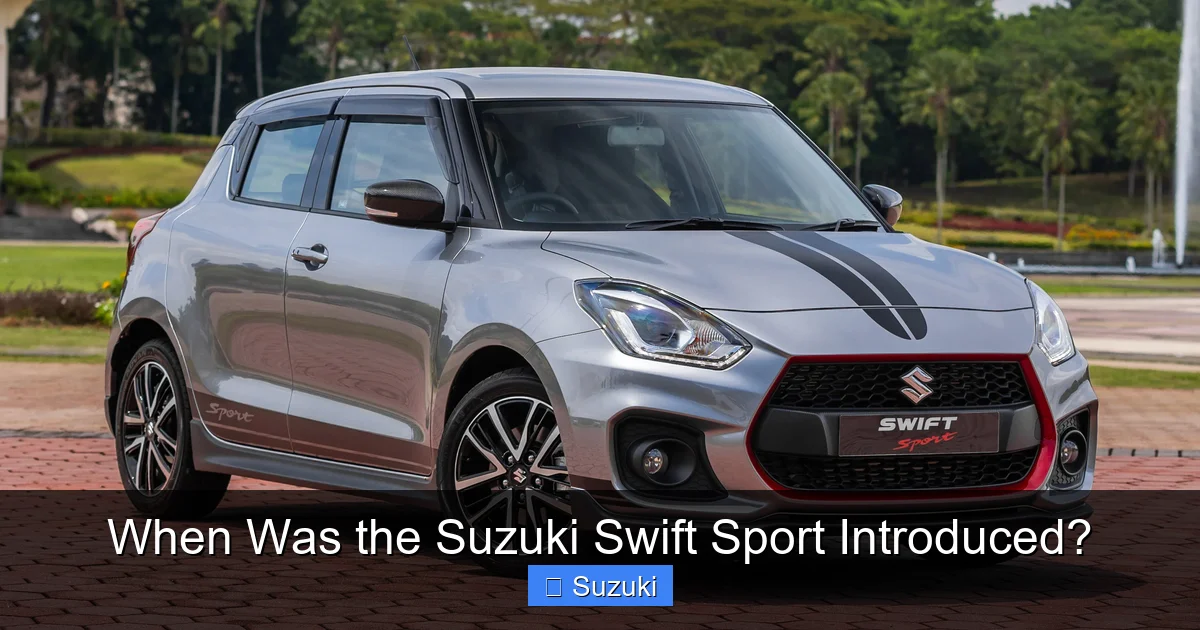
The third and final generation of the Swift Sport (ZC53S) debuted in 2018, marking a significant shift in philosophy. Suzuki moved away from naturally aspirated engines and embraced turbocharging. The new model featured a 1.4-liter Boosterjet turbocharged engine, producing 138 horsepower and 173 lb-ft of torque—a substantial increase in low-end grunt.
This engine change gave the Swift Sport a much more responsive feel, especially from a standstill. The turbocharged unit delivered power earlier in the rev range, making city driving and highway merging much smoother. Despite the added power, fuel efficiency improved thanks to direct injection and lighter components.
The 2018 model also received a complete exterior redesign, with a more aggressive front fascia, LED headlights, and a sleeker profile. Inside, the cabin was more refined, with higher-quality plastics, a digital instrument cluster, and Apple CarPlay/Android Auto compatibility. Safety features like adaptive cruise control, lane departure warning, and automatic emergency braking were also added, bringing the Swift Sport in line with modern standards.
Discontinuation and the End of an Era
In 2022, Suzuki announced that it would discontinue the Swift Sport in many markets, including Europe and Australia. The decision was driven by tightening emissions regulations, shifting consumer preferences toward SUVs and electric vehicles, and the rising cost of developing high-performance internal combustion engines.
While fans were disappointed, the move wasn’t entirely unexpected. The automotive industry is undergoing a major transformation, and even beloved models like the Swift Sport are not immune to change. However, Suzuki has hinted that the “Sport” nameplate could return in the future—possibly as a hybrid or fully electric model. For now, the Swift Sport remains a cherished part of Suzuki’s history.
Performance and Driving Dynamics
Visual guide about When Was the Suzuki Swift Sport Introduced?
Image source: paultan.org
One of the defining characteristics of the Suzuki Swift Sport has always been its driving dynamics. Unlike many hot hatches that prioritize straight-line speed, the Swift Sport was designed to be nimble, balanced, and fun. Let’s break down what made it special.
Engine and Transmission
From its debut in 2005 to its final iteration in 2022, the Swift Sport offered a range of engines, but all shared a common trait: responsiveness. The original 1.6-liter M16A engine was naturally aspirated and rev-happy, delivering power smoothly up to the redline. It wasn’t the most powerful engine, but it was perfectly matched to the car’s lightweight chassis.
The shift to the 1.4-liter Boosterjet turbo engine in 2018 was a game-changer. With 173 lb-ft of torque available from just 1,700 rpm, the car felt much more eager off the line. The turbo also improved fuel economy, making the Swift Sport more practical for daily use.
All models came with a 6-speed manual transmission as standard, which was praised for its precise, short-throw action. An automatic transmission was available in some markets, but purists preferred the manual for its greater engagement.
Suspension and Handling
The Swift Sport’s suspension setup was tuned for sporty driving without sacrificing too much comfort. It used a MacPherson strut front and torsion beam rear setup, which is common in small cars. However, Suzuki added stiffer springs, upgraded dampers, and a thicker rear anti-roll bar to improve cornering stability.
The result was a car that felt planted and predictable through corners. The steering was light but communicative, giving drivers a clear sense of what the front wheels were doing. Whether you were driving on twisty backroads or navigating tight city streets, the Swift Sport felt agile and confident.
Braking and Safety
Braking performance was solid across all generations. The Swift Sport came with ventilated front discs and solid rear discs, along with ABS and electronic brakeforce distribution. Later models added features like brake assist and cornering brake control, which helped maintain stability during hard braking in corners.
Safety ratings improved over time, with the third-generation model earning high marks from organizations like Euro NCAP. The addition of advanced driver assistance systems (ADAS) in the final years made the Swift Sport one of the safest small cars in its class.
Global Popularity and Cultural Impact
The Suzuki Swift Sport wasn’t just popular in one region—it had a global footprint. It was sold in over 50 countries, with strong sales in Europe, Japan, Australia, and parts of Southeast Asia. Its appeal crossed age groups and lifestyles, from college students to young professionals and even older enthusiasts who appreciated its simplicity.
Motorsport and Enthusiast Community
The Swift Sport also found success in motorsport. Suzuki supported various racing series, including rally and circuit events, where the car’s lightweight and handling prowess gave it an edge. In countries like the UK and New Zealand, the Swift Sport became a popular choice for amateur racers and track day enthusiasts.
A strong online community formed around the model, with forums, social media groups, and tuning shops dedicated to modifying and maintaining Swift Sports. Popular upgrades included performance exhausts, intake systems, suspension kits, and ECU tuning—all aimed at extracting more performance while preserving the car’s character.
Media Recognition
Over the years, the Swift Sport received numerous awards and accolades. It was named “Best Hot Hatch” by several automotive magazines and consistently ranked high in driver satisfaction surveys. Reviewers often praised its value for money, with headlines like “The most fun you can have for under $25,000” appearing in publications worldwide.
Why the Swift Sport Stood Out
In a market crowded with hot hatches, the Suzuki Swift Sport carved out a unique niche. Here’s what set it apart:
- Affordability: It was significantly cheaper than rivals like the Volkswagen Golf GTI or Ford Fiesta ST, making performance accessible to more drivers.
- Lightweight Design: At around 1,000 kg, it was one of the lightest cars in its class, contributing to excellent agility and fuel efficiency.
- Driver-Focused Experience: Unlike many modern cars loaded with tech, the Swift Sport kept the focus on driving, with a manual transmission and minimal distractions.
- Reliability: Suzuki’s reputation for durability meant the Swift Sport was not only fun but also dependable over the long term.
- Practicality: Despite its sporty nature, it remained a usable daily driver with decent space and fuel economy.
Tips for Buying a Used Suzuki Swift Sport
If you’re considering buying a used Swift Sport, here are some practical tips to help you make a smart choice:
- Check the Service History: Regular maintenance is key, especially for turbocharged models. Look for records of oil changes, timing belt replacements, and clutch inspections.
- Inspect the Clutch: Manual models are common, and the clutch can wear out with spirited driving. Test drive the car and listen for slipping or grinding.
- Look for Rust: Older models (pre-2010) may have rust issues, especially in wheel arches and undercarriage. Inspect carefully, particularly in wet climates.
- Test the Suspension: Push down on each corner of the car—it should rebound smoothly. Excessive bouncing could indicate worn shocks.
- Verify the Engine: Listen for unusual noises, check for oil leaks, and ensure the turbo (if equipped) spools up properly.
- Consider Mileage: Lower mileage is better, but well-maintained high-mileage examples can still be great buys.
Conclusion
The Suzuki Swift Sport was introduced in 2005 as a bold statement from a brand known for practicality and efficiency. It proved that a small car could be both fun and affordable, offering a driving experience that rivaled much more expensive hot hatches. Through three generations, it evolved with the times—embracing turbocharging, modern tech, and improved safety—while staying true to its core values of agility, simplicity, and driver engagement.
Though production has ended, the Swift Sport’s legacy lives on in the hearts of enthusiasts and the used car market. It remains a benchmark for what a compact performance car should be: not the fastest, not the most luxurious, but one of the most enjoyable to drive. Whether you’re a first-time buyer or a seasoned gearhead, the Swift Sport offers a reminder that sometimes, the best driving experiences come in the smallest packages.
As the automotive world shifts toward electrification, the spirit of the Swift Sport—lightweight, responsive, and driver-focused—could inspire future models. For now, it stands as a testament to Suzuki’s ability to make driving fun, accessible, and unforgettable.
Frequently Asked Questions
When was the Suzuki Swift Sport first introduced?
The Suzuki Swift Sport was first introduced in 2005 as a high-performance variant of the Suzuki Swift. It marked Suzuki’s entry into the hot hatch segment with a focus on agility and driving enjoyment.
What engine did the original Swift Sport have?
The original 2005 Swift Sport was powered by a 1.6-liter M16A naturally aspirated inline-four engine, producing 125 horsepower and 118 lb-ft of torque. It was paired with a 5-speed manual transmission.
Was the Swift Sport sold in the United States?
No, the Suzuki Swift Sport was not officially sold in the United States. It was primarily available in markets such as Europe, Japan, Australia, and parts of Asia.
Why was the Swift Sport discontinued?
The Swift Sport was discontinued in 2022 due to stricter emissions regulations, declining demand for small performance cars, and Suzuki’s shift toward SUVs and electrified vehicles.
Is the Swift Sport a good used car buy?
Yes, the Swift Sport is considered an excellent used car for enthusiasts. It offers strong reliability, fun handling, and low running costs, especially in well-maintained examples.
Will Suzuki bring back the Swift Sport?
While Suzuki has not confirmed a direct successor, the company has hinted that the “Sport” nameplate could return in the future, possibly as a hybrid or electric performance model.