
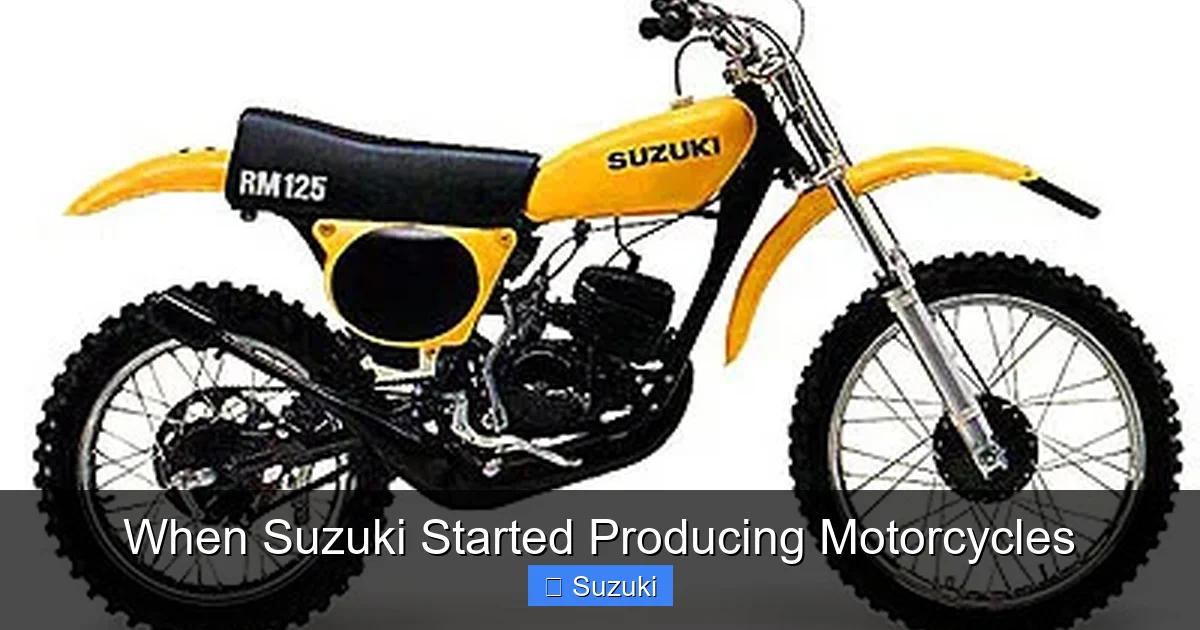
When Suzuki Started Producing Motorcycles

Contents
- 1 Key Takeaways
- 2 📑 Table of Contents
- 3 The Origins of Suzuki: From Looms to Motors
- 4 The Evolution of Suzuki Motorcycles: From Utility to Performance
- 5 The Birth of the Modern Sport Bike: The GS and GSX Series
- 6 The Hayabusa Era: Speed, Style, and Global Fame
- 7 Suzuki Today: A Diverse and Innovative Lineup
- 8 Why Suzuki’s Early Start Still Matters
- 9 Frequently Asked Questions
Wiper Blade Refills
Fuel Injector Cleaner

Windshield Cleaning Tool

Pressure Washer for Car
Suzuki began producing motorcycles in 1952 with the launch of the “Power Free,” a small motorized bicycle that marked the start of a legendary journey. Over the decades, Suzuki evolved from modest beginnings into a global motorcycle powerhouse, known for groundbreaking models like the GSX-R series and Hayabusa.
When Suzuki started producing motorcycles, it wasn’t just launching a new product line—it was igniting a revolution in personal transportation. The year was 1952, and Japan was still recovering from the aftermath of World War II. The country needed affordable, reliable ways for people to get around, and Suzuki, then primarily known for manufacturing looms and textile machinery, saw an opportunity. That year, they introduced the “Power Free,” a simple yet ingenious motorized bicycle equipped with a 36cc two-stroke engine. It was lightweight, easy to operate, and—most importantly—affordable. This humble beginning laid the foundation for what would become one of the most respected names in the global motorcycle industry.
At first glance, the Power Free might seem like a modest machine compared to today’s high-tech superbikes. But in its time, it was a game-changer. It gave ordinary people—farmers, students, delivery workers—access to motorized transport without the high cost of a full-sized motorcycle. The engine could be mounted on a standard bicycle, and with a top speed of around 30 km/h (18 mph), it was perfect for short commutes and errands. Suzuki’s early focus wasn’t on speed or style—it was on utility. This practical approach resonated with a nation rebuilding itself, and it set the tone for Suzuki’s future: innovation driven by real-world needs.
Key Takeaways
- Suzuki started motorcycle production in 1952 with the Power Free, a 36cc two-stroke motorized bicycle designed for everyday use.
- The company originally focused on textile machinery before shifting to motorized vehicles during Japan’s post-war industrial boom.
- Suzuki’s early bikes emphasized affordability and practicality, helping ordinary people gain mobility during a time of economic recovery.
- The 1960s marked Suzuki’s entry into international markets, with models like the Colleda and T20 gaining popularity in Europe and North America.
- Suzuki pioneered high-performance motorcycles with innovations such as the GS series in the 1970s and the legendary GSX-R in the 1980s.
- The Hayabusa, introduced in 1999, became the world’s fastest production motorcycle, cementing Suzuki’s reputation for speed and engineering excellence.
- Today, Suzuki continues to innovate with a diverse lineup including sport bikes, cruisers, adventure bikes, and scooters for riders of all levels.
📑 Table of Contents
The Origins of Suzuki: From Looms to Motors
To understand when Suzuki started producing motorcycles, it helps to know where the company came from. Suzuki wasn’t always a motorcycle manufacturer. In fact, it began in 1909 as Suzuki Loom Works, founded by Michio Suzuki in Hamamatsu, Japan. The company specialized in producing weaving looms for the booming silk industry. For decades, Suzuki was synonymous with textile machinery, earning a reputation for precision engineering and reliability.
But by the mid-20th century, the landscape was changing. Japan’s economy was shifting from agriculture and textiles to manufacturing and technology. The post-war era brought new challenges and opportunities. People needed affordable transportation, and the government encouraged domestic production of motor vehicles to stimulate growth. Suzuki saw this as a chance to diversify.
In 1952, the company took its first step into motorized vehicles with the Power Free. The name itself reflected its purpose: “Power” for the engine, and “Free” for the freedom it offered riders. The design was simple—attach a small engine to a bicycle frame, add a fuel tank, and you had a motorized bike. It wasn’t flashy, but it worked. And it sold. Within a year, Suzuki was producing thousands of units, and the demand kept growing.
The Post-War Mobility Revolution
Japan in the 1950s was a country on the move—literally. Cities were expanding, industries were growing, and people needed ways to get to work, school, and markets. Public transportation was limited, and cars were still a luxury. Motorcycles and motorized bicycles filled the gap. They were cheap, fuel-efficient, and easy to maintain.
Suzuki’s Power Free tapped directly into this need. It wasn’t the only motorized bicycle on the market—companies like Honda and Yamaha were also entering the space—but Suzuki’s reputation for quality engineering gave it an edge. The Power Free was reliable, well-built, and designed for everyday use. It became a symbol of Japan’s economic recovery, a small machine that helped millions of people regain their independence.
Engineering Philosophy: Simplicity and Reliability
From the very beginning, Suzuki’s approach to motorcycle design was rooted in practicality. The company believed that motorcycles should be accessible, not just to the wealthy or the adventurous, but to everyone. This philosophy guided their early models. The Power Free, for example, used a simple two-stroke engine that was easy to repair and maintain. Parts were standardized, and instructions were clear—even for people with no mechanical experience.
This focus on reliability wasn’t just good for customers; it was good for business. Word-of-mouth spread quickly. If your neighbor’s Power Free got them to work every day without breaking down, you were more likely to buy one too. Suzuki built trust through consistency, and that trust became the foundation of their brand.
The Evolution of Suzuki Motorcycles: From Utility to Performance

Visual guide about When Suzuki Started Producing Motorcycles
Image source: image.slidesharecdn.com
As Japan’s economy strengthened in the 1960s, so did Suzuki’s ambitions. The company began to expand its motorcycle lineup, moving beyond basic motorized bicycles to more advanced models. This period marked a shift from utility to performance, as Suzuki started designing bikes that weren’t just practical—they were fun to ride.
One of the first major milestones came in 1961 with the introduction of the Colleda ST-50, a 50cc two-stroke motorcycle that offered better speed and handling than earlier models. It was followed by the T20 Super T, a 250cc two-stroke bike that gained popularity among young riders in Europe and North America. The T20 was fast, lightweight, and stylish—a far cry from the humble Power Free.
Breaking into International Markets
Suzuki’s real breakthrough came when it started exporting motorcycles abroad. In the early 1960s, the company began shipping bikes to Europe and the United States. At the time, the American market was dominated by British and American brands like Triumph and Harley-Davidson. Japanese motorcycles were seen as inferior—cheap, unreliable, and underpowered.
But Suzuki changed that perception. The T20, with its high-revving two-stroke engine and agile handling, won over riders who wanted speed and excitement. It became a favorite among racers and enthusiasts, and it helped establish Suzuki as a serious player in the global motorcycle market. By the mid-1960s, Suzuki was one of the top Japanese motorcycle exporters.
The Rise of the Two-Stroke Era
The 1960s and 1970s were the golden age of two-stroke engines, and Suzuki was at the forefront. Two-strokes were lighter, simpler, and more powerful than their four-stroke counterparts, making them ideal for racing and sport riding. Suzuki invested heavily in two-stroke technology, developing engines that could rev higher and deliver more power.
Models like the T500 Titan and the GT750 “Water Buffalo” showcased Suzuki’s engineering prowess. The GT750, introduced in 1971, was one of the first production motorcycles to feature a liquid-cooled engine—a major innovation at the time. It was fast, smooth, and reliable, earning praise from riders and critics alike.
The Birth of the Modern Sport Bike: The GS and GSX Series

Visual guide about When Suzuki Started Producing Motorcycles
Image source: mcnews.com.au
By the 1970s, Suzuki had firmly established itself as a leader in motorcycle innovation. But the real transformation came with the launch of the GS series in 1976. The GS750 was Suzuki’s first four-stroke standard motorcycle, and it marked a new direction for the brand. It was designed for comfort, performance, and versatility—perfect for both city riding and long-distance touring.
The GS series was a hit. It combined the reliability of a four-stroke engine with the style and handling of a sport bike. Riders loved its smooth power delivery and comfortable riding position. It became one of Suzuki’s best-selling models and set the stage for even greater achievements.
The Legendary GSX-R: A Racing Revolution
If the GS series brought Suzuki into the mainstream, the GSX-R series put it on the map as a performance powerhouse. Launched in 1985, the GSX-R750 was a game-changer. It was the first production motorcycle to be built with a focus on track performance, using lightweight materials, advanced aerodynamics, and a race-inspired chassis.
The GSX-R750 weighed just 179 kg (395 lbs)—lighter than most competitors—and produced over 100 horsepower. It was fast, agile, and incredibly responsive. Riders could take it from the street to the racetrack with minimal modifications. The GSX-R series became a dominant force in motorcycle racing, winning championships in Superbike, Endurance, and MotoGP.
Innovation in Design and Technology
The GSX-R wasn’t just fast—it was smart. Suzuki introduced features like Suzuki Ram Air Direct (SRAD) intake systems, which improved airflow to the engine at high speeds, and advanced suspension setups for better handling. The bikes were also designed with rider ergonomics in mind, offering a sporty yet comfortable riding position.
These innovations didn’t just benefit racers—they trickled down to everyday riders. The GSX-R series influenced the design of sport bikes across the industry, setting new standards for performance and handling.
The Hayabusa Era: Speed, Style, and Global Fame

Visual guide about When Suzuki Started Producing Motorcycles
Image source: cdn-0.motorcycle-logos.com
In 1999, Suzuki launched a motorcycle that would become legendary: the Hayabusa. Officially named the GSX1300R, the Hayabusa was designed to be the fastest production motorcycle in the world. And it delivered. With a top speed of over 300 km/h (186 mph), it shattered records and captured the imagination of riders everywhere.
The Hayabusa wasn’t just about speed—it was a masterpiece of engineering. Its aerodynamic bodywork reduced drag, while its powerful 1,300cc inline-four engine provided smooth, relentless acceleration. It was also surprisingly comfortable, with a relaxed riding position and advanced suspension for long-distance touring.
A Cultural Icon
The Hayabusa quickly became more than just a motorcycle—it became a symbol of speed and freedom. It appeared in movies, music videos, and video games. Celebrities and professional racers owned them. Even non-riders knew the name. The Hayabusa’s bold design, with its distinctive twin headlights and muscular stance, made it instantly recognizable.
But the Hayabusa also sparked controversy. Its incredible speed led to concerns about safety and regulation. In 2000, European governments imposed a voluntary speed limit of 300 km/h on production motorcycles, which effectively capped the Hayabusa’s top speed. Still, the bike remained popular, and Suzuki continued to refine it with updates and special editions.
Legacy of the Hayabusa
Even decades after its debut, the Hayabusa remains one of the most iconic motorcycles ever made. It proved that Suzuki could compete with the best in the world—not just in affordability, but in performance and innovation. The Hayabusa also paved the way for future models, inspiring Suzuki to push the boundaries of what a motorcycle could be.
Suzuki Today: A Diverse and Innovative Lineup
Today, Suzuki continues to build on its rich history with a diverse range of motorcycles for every type of rider. From sport bikes and cruisers to adventure bikes and scooters, Suzuki offers something for everyone. The company remains committed to innovation, safety, and sustainability.
Modern Models and Technologies
Recent Suzuki models feature advanced technologies like ride-by-wire throttle systems, traction control, ABS, and LED lighting. The GSX-R series continues to evolve, with the latest GSX-R1000 offering cutting-edge performance for track and street use. The V-Strom series has become a favorite among adventure riders, combining off-road capability with long-distance comfort.
Suzuki has also embraced the growing demand for smaller, more efficient bikes. Models like the GSX250R and the Burgman scooter cater to urban riders and new motorcyclists, offering a blend of style, performance, and practicality.
Sustainability and the Future
As the world shifts toward greener transportation, Suzuki is exploring new technologies, including hybrid and electric motorcycles. While the company has been slower to adopt full electrification compared to some competitors, it has shown interest in sustainable mobility solutions. In 2023, Suzuki announced plans to develop electric scooters and lightweight electric motorcycles for urban markets.
The company is also investing in manufacturing efficiency and reducing its environmental footprint. Suzuki’s factories use renewable energy sources, and the company is working to minimize waste and emissions across its supply chain.
Why Suzuki’s Early Start Still Matters
When Suzuki started producing motorcycles in 1952, it wasn’t just entering a new market—it was helping shape the future of transportation. The Power Free may have been a simple machine, but it represented a bold vision: that mobility should be accessible to all. That vision has guided Suzuki for over 70 years.
Today, Suzuki motorcycles are ridden by millions around the world. They’re used for commuting, touring, racing, and recreation. They’re built with the same principles that defined the Power Free: reliability, affordability, and innovation.
A Legacy of Innovation
From the first motorized bicycle to the world’s fastest production motorcycle, Suzuki has consistently pushed the limits of what’s possible. The company’s willingness to experiment—whether with two-stroke engines, liquid cooling, or aerodynamic design—has made it a leader in the industry.
But Suzuki’s success isn’t just about technology. It’s about understanding riders. Whether you’re a beginner looking for your first bike or a seasoned rider chasing speed, Suzuki has a motorcycle that fits your needs.
Looking Ahead
As Suzuki moves into the future, it faces new challenges—rising competition, changing regulations, and the shift toward electric mobility. But if history is any guide, the company is up to the task. With a legacy of innovation and a commitment to quality, Suzuki is poised to remain a major force in the motorcycle world for decades to come.
Frequently Asked Questions
When did Suzuki start making motorcycles?
Suzuki began producing motorcycles in 1952 with the launch of the Power Free, a 36cc motorized bicycle. This marked the company’s entry into the motorized vehicle market after decades of manufacturing textile machinery.
What was Suzuki’s first motorcycle?
Suzuki’s first motorcycle was the Power Free, introduced in 1952. It featured a small two-stroke engine attached to a standard bicycle frame and was designed for everyday commuting and utility.
Why did Suzuki start making motorcycles?
Suzuki shifted to motorcycle production in response to Japan’s post-war need for affordable transportation. The company leveraged its engineering expertise to create practical, reliable motorized bikes for the masses.
What made the Suzuki Hayabusa famous?
The Suzuki Hayabusa, launched in 1999, became famous for being the world’s fastest production motorcycle, with a top speed exceeding 300 km/h. Its speed, design, and engineering made it a global icon.
Did Suzuki only make small motorcycles at first?
Initially, Suzuki focused on small, practical motorcycles like the Power Free and Colleda. However, by the 1960s and 1970s, the company expanded into larger, higher-performance models, including sport bikes and touring motorcycles.
Is Suzuki still making motorcycles today?
Yes, Suzuki continues to produce a wide range of motorcycles, including sport bikes like the GSX-R series, adventure bikes like the V-Strom, and scooters like the Burgman. The company remains active in global markets and is exploring future technologies like electric mobility.


