
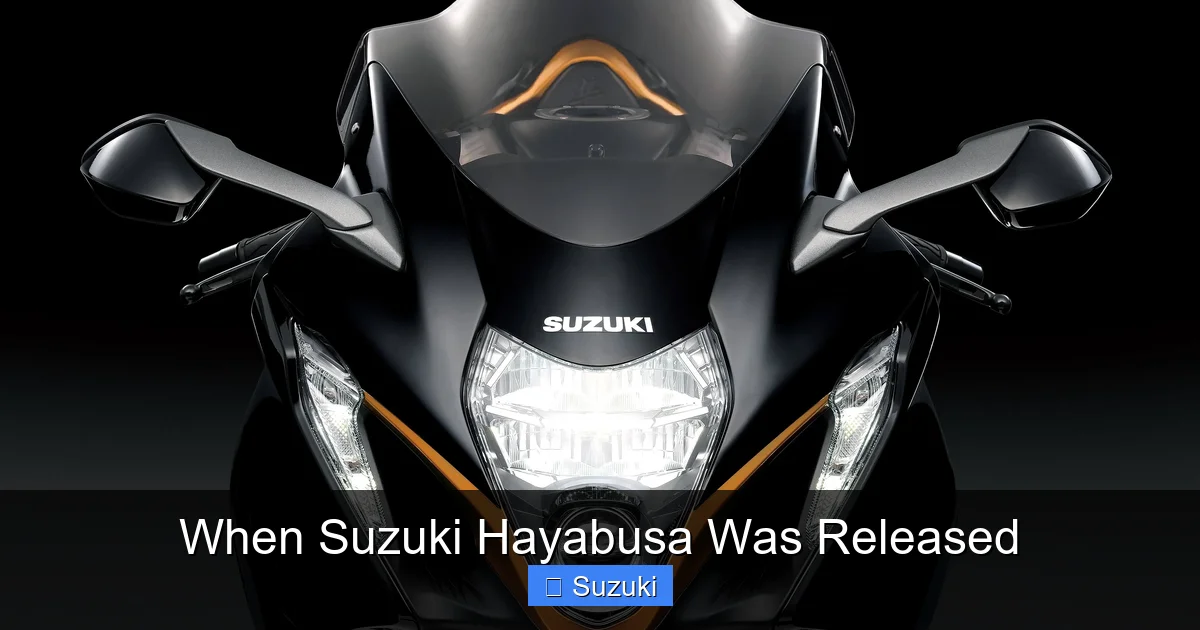
When Suzuki Hayabusa Was Released

Contents
- 1 Key Takeaways
- 2 📑 Table of Contents
- 3 The Birth of a Legend: When Suzuki Hayabusa Was Released
- 4 The 1999 Debut: A Game-Changer in Motorcycle History
- 5 Engineering Excellence: What Made the Hayabusa So Fast
- 6 The Cultural Impact of the Hayabusa
- 7 Evolution of the Hayabusa: From 1999 to Today
- 8 Why the Hayabusa Still Matters
- 9 Conclusion: The Enduring Legacy of the Suzuki Hayabusa
- 10 Frequently Asked Questions

Car Fog Light Bulb

Car Cleaning Brush Set

Tire Repair Kit

Car Back Support Cushion
The Suzuki Hayabusa was officially released in 1999, quickly becoming the world’s fastest production motorcycle. Known for its aerodynamic design and powerful engine, the Hayabusa set a new benchmark in the sportbike world and earned a legendary status among riders and enthusiasts.
Key Takeaways
- Release Date: The Suzuki Hayabusa was launched in 1999, marking a turning point in high-performance motorcycles.
- Top Speed Record: It became the fastest production bike at the time, reaching speeds over 194 mph (312 km/h).
- Engine Power: Powered by a 1,299cc inline-four engine delivering 175 horsepower, it offered unmatched performance.
- Aerodynamic Design: Its sleek, wind-tunnel-tested body reduced drag and improved stability at high speeds.
- Cultural Impact: The Hayabusa became a symbol of speed and engineering excellence, influencing future sportbike designs.
- Ongoing Legacy: Despite newer models, the original Hayabusa remains a favorite among collectors and speed enthusiasts.
- Regulatory Influence: Its speed led to a voluntary industry agreement to limit top speeds, shaping modern motorcycle regulations.
📑 Table of Contents
- The Birth of a Legend: When Suzuki Hayabusa Was Released
- The 1999 Debut: A Game-Changer in Motorcycle History
- Engineering Excellence: What Made the Hayabusa So Fast
- The Cultural Impact of the Hayabusa
- Evolution of the Hayabusa: From 1999 to Today
- Why the Hayabusa Still Matters
- Conclusion: The Enduring Legacy of the Suzuki Hayabusa
The Birth of a Legend: When Suzuki Hayabusa Was Released
In the late 1990s, the motorcycle world was hungry for speed. Riders dreamed of machines that could push boundaries, and manufacturers raced to deliver the ultimate performance bike. Amid this high-octane competition, Suzuki unveiled a machine that would not only meet expectations but shatter them: the Suzuki Hayabusa. Officially released in 1999, the Hayabusa wasn’t just another sportbike—it was a revolution on two wheels.
Named after the Japanese word for “peregrine falcon,” the fastest bird in the world, the Hayabusa was designed to dominate the road. From its first appearance, it captured attention with its aggressive stance, futuristic styling, and a promise of speed that few believed possible. But Suzuki wasn’t just making bold claims—they were delivering real performance. The Hayabusa quickly became known as the world’s fastest production motorcycle, a title it held for years and one that cemented its place in motorcycle history.
What made the Hayabusa so special wasn’t just its top speed. It was the combination of power, aerodynamics, and engineering precision that set it apart. At a time when sportbikes were getting faster and lighter, Suzuki took a different approach: they built a bike that was both incredibly fast and surprisingly stable at high speeds. This balance made the Hayabusa not only a record-breaker but also a rideable, practical machine for serious enthusiasts.
The 1999 Debut: A Game-Changer in Motorcycle History
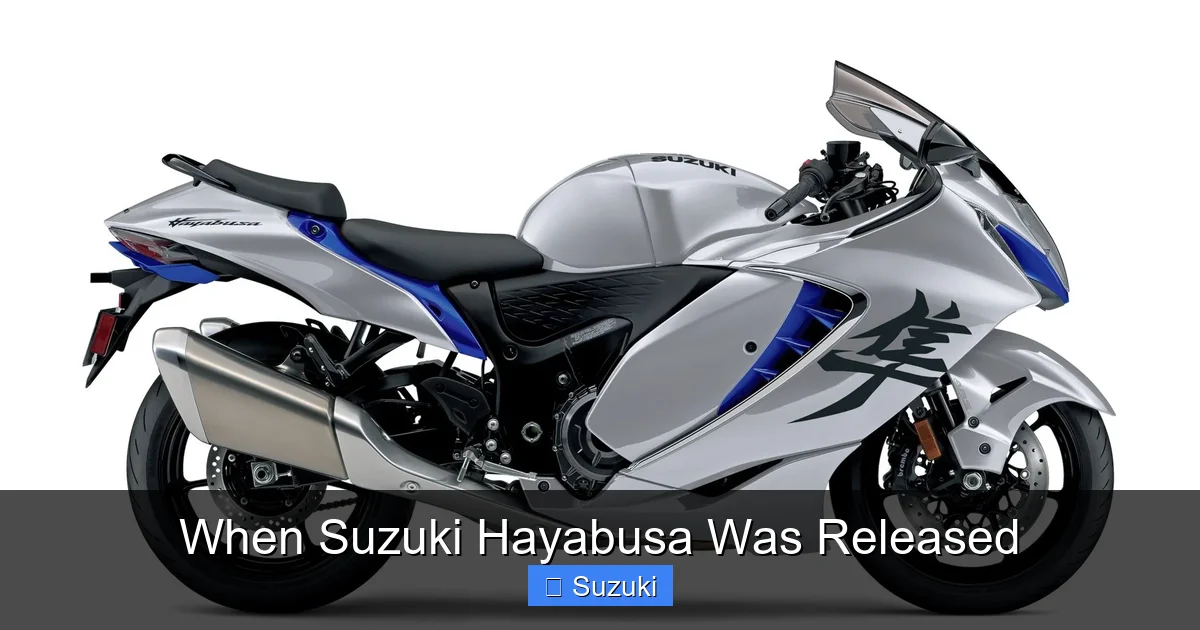
Visual guide about When Suzuki Hayabusa Was Released
Image source: images5.1000ps.net
When the Suzuki Hayabusa hit the market in 1999, it didn’t just turn heads—it rewrote the rules. Prior to its release, the title of “world’s fastest production motorcycle” was held by bikes like the Honda CBR900RR Fireblade and the Kawasaki Ninja ZX-11. But the Hayabusa didn’t just beat them—it left them in the dust.
The official launch took place at the 1998 Intermot show in Cologne, Germany, where Suzuki unveiled the GSX1300R Hayabusa to a stunned audience. The bike’s design was unlike anything seen before. It featured a long wheelbase, a low-slung body, and a distinctive dual-headlight front end that gave it a predatory look. But it wasn’t just about looks. Under the sleek bodywork was a 1,299cc inline-four engine capable of producing 175 horsepower and 100 lb-ft of torque. This power, combined with a six-speed transmission and a lightweight aluminum frame, allowed the Hayabusa to reach a top speed of 194 mph (312 km/h)—faster than any production bike at the time.
The Hayabusa’s release was more than a technical achievement; it was a cultural moment. Motorcycle magazines around the world ran cover stories, calling it “the fastest bike ever made” and “a speed demon.” Riders lined up to test it, and within months, it became a status symbol for those who craved ultimate performance. Even non-riders knew the name “Hayabusa” because of its reputation.
But the Hayabusa wasn’t just about raw speed. Suzuki engineers focused heavily on stability and control. At high speeds, wind resistance and turbulence can make a bike unstable. To combat this, the Hayabusa underwent extensive wind tunnel testing. The result was a body design that minimized drag and maximized downforce, allowing the bike to slice through the air with minimal effort. This attention to aerodynamics made the Hayabusa not only fast but also surprisingly smooth and predictable at triple-digit speeds.
Engineering Excellence: What Made the Hayabusa So Fast
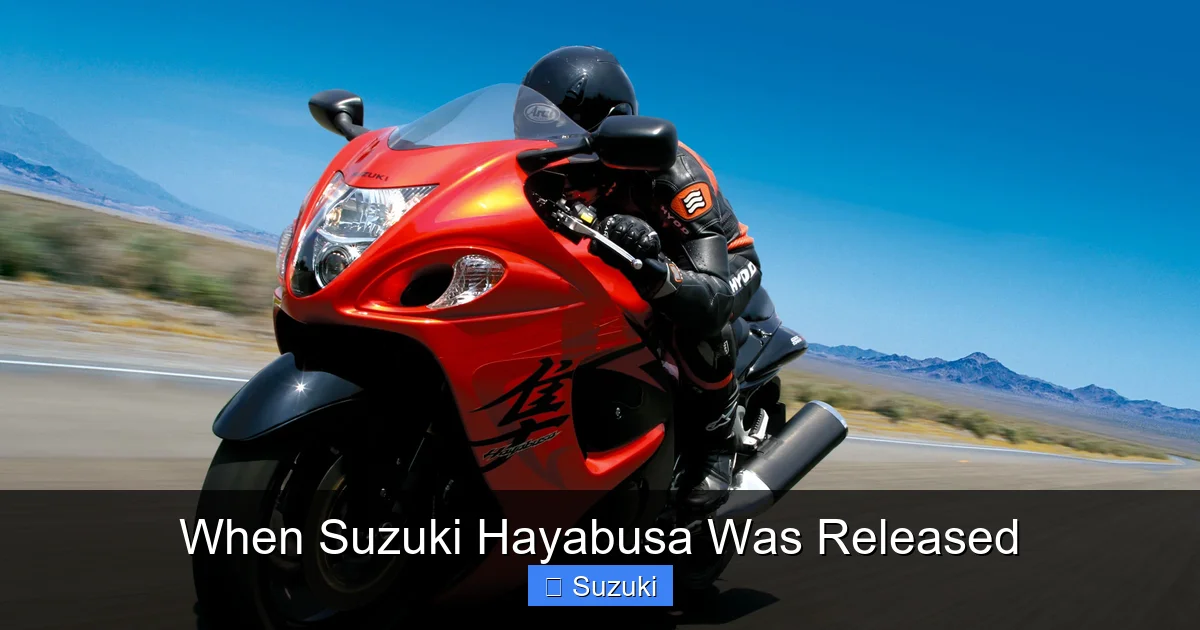
Visual guide about When Suzuki Hayabusa Was Released
Image source: hdwallpapers.in
The secret behind the Hayabusa’s incredible performance lies in its engineering. Every component was designed with one goal in mind: to deliver maximum speed without sacrificing control or reliability.
Powertrain and Engine Performance
At the heart of the Hayabusa is its 1,299cc, liquid-cooled, DOHC, inline-four engine. This engine was derived from the GSX-R1100 but heavily modified for higher output and smoother power delivery. It featured forged pistons, titanium valves, and a high-lift camshaft, all contributing to its impressive 175 horsepower. The engine was paired with a six-speed close-ratio transmission, optimized for quick acceleration and high-speed cruising.
One of the key innovations was the use of Suzuki’s Ram Air system, which forced more air into the engine at high speeds, increasing power output. This system, combined with a well-tuned fuel injection system, allowed the Hayabusa to maintain strong performance even as speed increased.
Aerodynamics and Body Design
Aerodynamics played a crucial role in the Hayabusa’s success. Unlike many sportbikes of the era, which prioritized lightweight and agility, the Hayabusa was built for stability at extreme speeds. Its long wheelbase (62.2 inches) and low center of gravity helped keep the bike planted, even when pushing past 180 mph.
The bodywork was shaped in wind tunnels to reduce drag and improve airflow. The front fairing featured a dual-headlight design that not only looked aggressive but also helped direct air smoothly over the rider. The undercowl and side panels were sculpted to minimize turbulence, while the tail section was tapered to reduce wake.
Perhaps the most notable aerodynamic feature was the integrated rear spoiler, which helped increase downforce at high speeds. This may seem like a small detail, but at 200 mph, even minor improvements in airflow can make a big difference in stability.
Chassis and Suspension
The Hayabusa’s chassis was built using a lightweight aluminum twin-spar frame, which provided excellent rigidity without adding unnecessary weight. This allowed the bike to handle high-speed cornering with confidence.
The suspension system was equally impressive. It featured fully adjustable front forks and a rear monoshock, allowing riders to fine-tune the setup based on riding conditions. At high speeds, the suspension worked in harmony with the aerodynamic design to keep the bike stable and predictable.
Braking was handled by dual 320mm front discs with four-piston calipers, providing strong, consistent stopping power. Even at top speed, the Hayabusa could slow down quickly and safely—a critical feature for a bike that could reach such extreme velocities.
The Cultural Impact of the Hayabusa
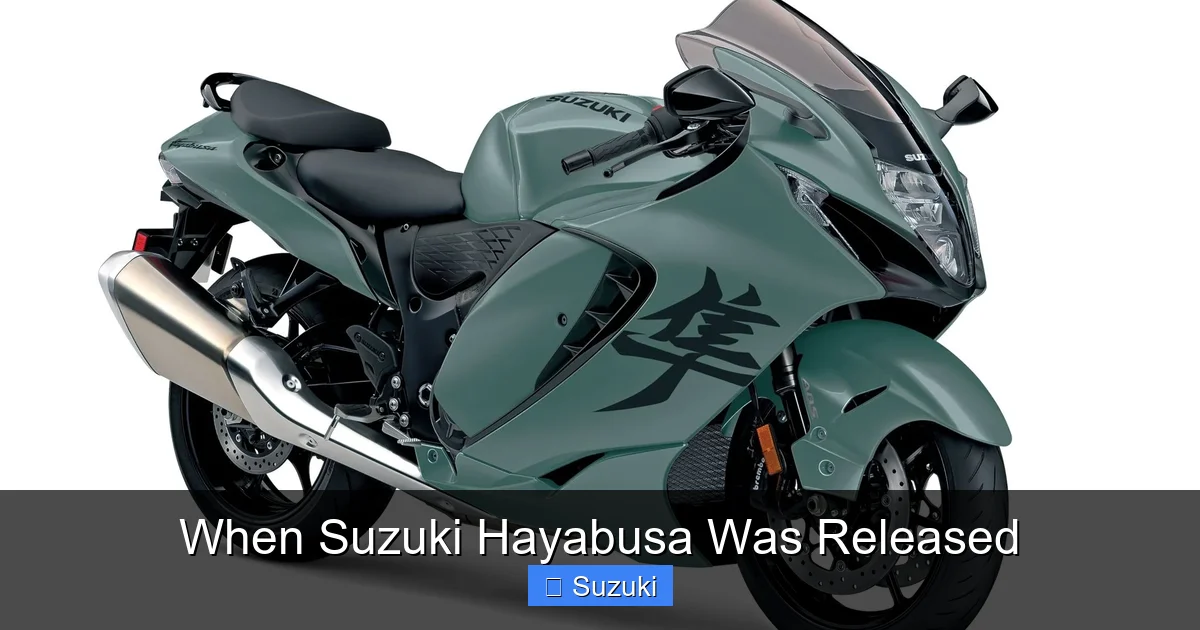
Visual guide about When Suzuki Hayabusa Was Released
Image source: images5.1000ps.net
The Suzuki Hayabusa didn’t just break speed records—it became a cultural icon. Its name, design, and performance made it instantly recognizable, and it quickly gained a loyal following among riders, collectors, and even pop culture fans.
A Symbol of Speed and Power
In the early 2000s, the Hayabusa was everywhere. It appeared in movies, video games, and music videos, often as a symbol of rebellion and freedom. Its sleek, futuristic look made it a favorite among custom builders, who modified it for even greater speed or unique styling.
Riders admired the Hayabusa not just for its performance but for its presence. It wasn’t just a motorcycle—it was a statement. Owning a Hayabusa meant you were serious about speed and performance. It became a badge of honor among sportbike enthusiasts.
Influence on the Motorcycle Industry
The Hayabusa’s success forced other manufacturers to rethink their approach to high-performance motorcycles. Suddenly, speed wasn’t just about lightweight frames and high-revving engines—it was about aerodynamics, stability, and real-world usability.
Competitors like Kawasaki and Honda responded with faster, more aerodynamic models, but none could match the Hayabusa’s combination of speed and refinement. In fact, the Hayabusa’s dominance led to a voluntary agreement among major manufacturers in 2000 to limit top speeds to 186 mph (300 km/h). This “gentlemen’s agreement” was a direct response to concerns about safety and public perception, but it also highlighted how much of a threat the Hayabusa posed to the status quo.
Legacy in the Custom and Racing Worlds
The Hayabusa’s impact extended beyond the street. In the custom motorcycle world, it became a favorite platform for builders looking to create high-speed drag bikes or show-stopping customs. Its powerful engine and robust frame made it ideal for modifications.
In racing, the Hayabusa found a home in drag racing and land speed events. Tuned versions of the bike have broken numerous records, with some reaching speeds over 300 mph in specialized setups. Even today, the Hayabusa remains a popular choice for speed enthusiasts looking to push the limits.
Evolution of the Hayabusa: From 1999 to Today
Since its debut in 1999, the Suzuki Hayabusa has undergone several updates, but its core identity has remained unchanged. Each generation has refined the original design, improving performance, electronics, and rider comfort.
First Generation (1999–2007)
The original Hayabusa, produced from 1999 to 2007, is now considered a classic. It featured analog gauges, a carbureted engine (later fuel-injected), and a mechanical throttle. Despite its age, many riders still consider this version the purest form of the Hayabusa—raw, powerful, and uncompromising.
Second Generation (2008–2020)
In 2008, Suzuki introduced a major update. The second-generation Hayabusa featured a more refined engine with better fuel efficiency and lower emissions. It also included modern electronics like Suzuki’s Drive Mode Selector (S-DMS), which allowed riders to choose between different power modes.
The styling was updated with LED lighting, a digital instrument cluster, and improved aerodynamics. The bike also received better suspension and braking components, making it more capable on both the street and track.
Third Generation (2021–Present)
The latest Hayabusa, launched in 2021, represents a complete redesign. It features a more powerful 1,340cc engine with 190 horsepower, advanced electronics like traction control, ABS, and a six-axis IMU. The bodywork is sleeker, with improved airflow and a more aggressive stance.
Despite these changes, Suzuki has stayed true to the Hayabusa’s roots. It’s still a high-speed machine built for performance, but now with the safety and convenience of modern technology.
Why the Hayabusa Still Matters
Even decades after its release, the Suzuki Hayabusa remains relevant. It’s not just a relic of the past—it’s a living legend that continues to inspire riders and engineers alike.
A Benchmark for Performance
The Hayabusa set a new standard for what a production motorcycle could achieve. Its combination of speed, stability, and style influenced generations of sportbikes. Today’s fastest bikes owe a debt to the Hayabusa’s pioneering design.
A Collector’s Dream
Original 1999 Hayabusas are now highly sought after by collectors. Well-maintained examples can fetch high prices, especially if they’re low-mileage or have documented history. The bike’s iconic status ensures its value will only grow over time.
A Ride Like No Other
For riders, the Hayabusa offers an experience that few bikes can match. It’s not just about speed—it’s about the feeling of riding a machine that was built to dominate. Whether you’re cruising on the highway or pushing the limits on a track day, the Hayabusa delivers a sense of power and control that’s hard to beat.
Conclusion: The Enduring Legacy of the Suzuki Hayabusa
When the Suzuki Hayabusa was released in 1999, it didn’t just enter the market—it changed it. With its record-breaking speed, innovative design, and unmatched performance, it became the gold standard for high-performance motorcycles. More than two decades later, the Hayabusa remains a symbol of engineering excellence and a testament to what’s possible when passion meets precision.
From its wind-tunnel-tested aerodynamics to its thunderous inline-four engine, every aspect of the Hayabusa was designed with one goal: to be the fastest. And in doing so, it became something even greater—a legend. Whether you’re a speed enthusiast, a collector, or simply someone who appreciates great design, the Hayabusa’s story is one worth knowing. It’s not just a motorcycle. It’s a milestone in the history of motorcycling.
Frequently Asked Questions
When was the Suzuki Hayabusa first released?
The Suzuki Hayabusa was officially released in 1999. It made its debut at the 1998 Intermot show in Germany and quickly became the world’s fastest production motorcycle.
What does “Hayabusa” mean?
“Hayabusa” is the Japanese word for “peregrine falcon,” which is the fastest bird in the world. Suzuki chose this name to reflect the bike’s incredible speed and agility.
How fast is the original Suzuki Hayabusa?
The original 1999 Suzuki Hayabusa has a top speed of 194 mph (312 km/h), making it the fastest production motorcycle at the time of its release.
Why did manufacturers agree to limit motorcycle speeds?
In 2000, major motorcycle manufacturers agreed to a voluntary speed limit of 186 mph (300 km/h) due to safety concerns and public pressure, largely influenced by the Hayabusa’s record-breaking performance.
Is the Suzuki Hayabusa still in production?
Yes, the Suzuki Hayabusa is still in production. The latest third-generation model was launched in 2021 with updated electronics, a more powerful engine, and modern styling.
What makes the Hayabusa different from other sportbikes?
The Hayabusa stands out for its focus on high-speed stability, aerodynamic design, and powerful engine. Unlike lighter, more agile sportbikes, it was built to dominate at extreme speeds while remaining controllable and comfortable.


