What Year Jeep Hard Tops Are Interchangeable?

Contents
- 1 Key Takeaways
- 2 📑 Table of Contents
- 3 The Golden Rule: Same Generation, Same Basic Platform
- 4 Deep Dive: Generation-Specific Compatibility
- 5 Critical Factors That Break Interchangeability (Even Within a Generation)
- 6 How to Ensure a Perfect Match: Your Action Plan
- 7 Common “Can I Swap…?” Scenarios Answered
- 8 Where to Find Parts and Community Knowledge
- 9 Conclusion: Precision Over Price
- 10 Frequently Asked Questions
Foam Cannon

Anti-Slip Dashboard Mat

Car Hydraulic Jack

Car Windshield Wiper Blades
Jeep hard top interchangeability is primarily limited to the same model generation. A TJ (1997-2006) hard top will not fit a JK (2007-2018) or JL (2019+). Even within the same generation, year-to-year swaps depend on body style (2-door vs. 4-door), trim level, and specific hardware. Always verify part numbers and mounting points before assuming compatibility, as subtle changes can prevent a perfect fit.
So, you’ve got a Jeep Wrangler with a hard top, and you’re either looking to replace it, upgrade, or maybe you found a great deal on a used one. The big question buzzing in your head is: “What year Jeep hard tops are interchangeable?” It’s a smart question. Jeep hard tops are expensive, heavy, and crucial for keeping the elements out. Understanding compatibility can save you from a costly mistake and a major headache. Let’s pop the hood on this topic and break it down generation by generation.
First, a critical truth: Jeep Wrangler hard tops are not universal. They are precision-fitted body panels designed for a specific vehicle platform. Unlike some simple bolt-on accessories, the hard top must align perfectly with the door frames, the windshield frame, the rear tailgate, and the body tub. It also houses critical wiring for the defroster, rear window wiper, and sometimes dome lights. A mismatch means leaks, wind noise, misaligned latches, and non-functional electrical components. The interchangeability question all comes down to one word: generation.
Key Takeaways
- Generation is King: Hard tops are engineered for specific Jeep generations (TJ, JK, JL, JT). Swapping between generations is almost never possible due to fundamental changes in body shape, door frames, and latch systems.
- Body Style Matters: Within a generation, a 2-door hard top will not fit a 4-door (Wrangler Unlimited) model. The roof length, rear window opening, and side rail lengths are completely different.
- Trim Level Can Be a Factor: Differences between Sport, Sahara, and Rubicon models can affect hard top compatibility, primarily regarding the presence or absence of a factory-installed spare tire carrier on the tailgate, which changes the rear seal design.
- Year Range Gaps: Mid-generation refreshes (like the 2012 JK update or the 2024 JL refresh) often introduce changes to hard top mounting points, wiring harnesses, or seal designs, breaking interchangeability for those specific years.
- Aftermarket vs. OEM: Aftermarket hard tops designed for a specific model year range may have more flexibility or adapter kits, but they still cannot overcome fundamental generational or body style differences. OEM parts are the strictest.
- Always Verify by Part Number: The only surefire way to confirm interchangeability is to compare the exact OEM part number from the donor vehicle’s top to the application guide for your specific Jeep’s year, model, and VIN.
📑 Table of Contents
- The Golden Rule: Same Generation, Same Basic Platform
- Deep Dive: Generation-Specific Compatibility
- Critical Factors That Break Interchangeability (Even Within a Generation)
- How to Ensure a Perfect Match: Your Action Plan
- Common “Can I Swap…?” Scenarios Answered
- Where to Find Parts and Community Knowledge
- Conclusion: Precision Over Price
The Golden Rule: Same Generation, Same Basic Platform
Jeep has produced six main Wrangler generations, each with its own unique hard top design. You cannot mix and match across these generations.
- YJ (1987-1995): The first “modern” Wrangler. Its hard top is completely unique and shares no parts with later models.
- TJ (1997-2006): Introduced the classic round headlight and coil-spring suspension. All TJ hard tops (2-door) are interchangeable within this 10-year run, with minor exceptions for early vs. late model seal designs.
- JK & JKU (2007-2018): The massive leap to a 4-door “Unlimited” model. This generation is split into two distinct body styles: the 2-door JK and the 4-door JKU. These tops are not interchangeable with each other. Furthermore, a significant refresh in 2012 (featuring a new front grille, hood, and fenders) also brought subtle but critical changes to the hard top’s front seal and latch points, often preventing a perfect pre-2012 top from fitting a 2012+ model without modification.
- JL & JLU (2019-Present): The current generation. Again, a strict separation between 2-door (JL) and 4-door (JLU). The JL introduced a new “Freedom Top” three-piece modular hard top system for many models, which is a different animal entirely from the one-piece tops of previous gens. A 2019-2023 JL top will not fit a 2024+ refreshed JL model due to changes in the windshield frame and rear header.
- JT Gladiator (2019-Present): The pickup truck based on the JL platform. While it shares some underlying architecture, the JT’s hard top is a completely different part number designed for the truck bed and cab configuration. It is not interchangeable with any JL Wrangler top.
Think of it like trying to put a Ford F-150 hood on a Chevy Silverado. Same vehicle type, different generations and brands—it just won’t work. The same principle applies here, even within the Jeep family.
Deep Dive: Generation-Specific Compatibility
Let’s get into the weeds for each major generation you’re likely to encounter in the used market.

Visual guide about What Year Jeep Hard Tops Are Interchangeable?
Image source: shunauto.com
Jeep TJ (1997-2006) Hard Top Interchangeability
The TJ generation is the simplest and most interchangeable. For the standard 2-door model:
- All Years (1997-2006): A hard top from a 1997 TJ will bolt directly onto a 2006 TJ with no modifications. The body shape, door openings, and latch mechanisms remained consistent throughout the entire production run. The primary variable is the rear window wiper/washer assembly and the defroster grid, which were optional or standard depending on the trim (Sport vs. Sahara/Rubicon). You may need to transfer your existing wiring harness or ensure the donor top’s harness matches your Jeep’s configuration.
- Key Check: Ensure the donor top has the correct hole pattern for your spare tire carrier if you have one mounted on the tailgate. Most TJs did not have a spare on the tailgate, so this is rarely an issue.
Practical Example: You have a 2000 Jeep TJ Sport. You find a perfect-condition 2004 TJ Sahara hard top for sale. Is it a fit? Yes. The body is identical. You just need to swap over your wiper motor if the Sahara top had one and yours didn’t, or connect the wiring if your Jeep had the defroster option.
Jeep JK & JKU (2007-2018) Hard Top Interchangeability
This is where it gets complicated. We must separate the 2-door (JK) from the 4-door (JKU) immediately.
- 2-Door JK (2007-2018): Interchangeability is generally good within the pre-2012 and post-2012 sub-generations. A 2007-2011 JK top will fit another 2007-2011 JK. A 2012-2018 JK top will fit another 2012-2018 JK. The 2012 refresh changed the front header seal area and the latch striker locations slightly. Forcing a pre-2012 top onto a 2012+ body can cause misalignment and leaks. The rear window defroster wiring connector also changed around 2011.
- 4-Door JKU (2007-2018): The same rule applies strictly within the pre-2012 and post-2012 splits. A JKU top is longer, has a different rear window opening, and uses different side rails than a JK top. They are never interchangeable.
- The Rubicon Factor: Rubicon models (both JK and JKU) often came with a standard spare tire carrier on the tailgate. This requires a specific rear seal and header panel on the hard top. A non-Rubicon top (without the spare tire carrier cutout) may not seal correctly on a Rubicon, and vice-versa. Sahara models also sometimes had the spare carrier option.
Practical Example: You have a 2015 Jeep JKU Rubicon. You see a cheap 2010 JKU Sahara hard top. Is it a fit? Probably not. The 2010 is pre-2012, so the front seal and latches are different. Also, the Sahara may not have the rear spare tire carrier cutout that your Rubicon’s tailgate requires. You’d need to verify the exact part numbers.
Jeep JL & JLU (2019-Present) Hard Top Interchangeability
The JL generation brought the revolutionary Freedom Top—a three-piece modular system (front, center, rear) that can be removed in sections. This adds another layer of complexity.
- Freedom Top System (2019-2023): For models equipped with it (most non-Sport trims), the three pieces are designed as a system. While the individual panels (front, center, rear) might have the same part number across 2019-2023 JL and JLU models, they are engineered to work as a complete unit. Swapping a center panel from a JL to a JLU is possible if it’s the correct part number, but you must ensure all seals and mounting hardware are transferred. The rear panel is different between JL and JLU.
- One-Piece Tops (Sport Models & Some Base): Base Sport models often have a traditional one-piece hard top. These are generally interchangeable 2019-2023 within the same body style (JL or JLU).
- The 2024+ Refresh: For the 2024 model year, Jeep made significant changes to the JL’s windshield frame, A-pillars, and roof rail design to accommodate new safety features and a revised interior. Hard tops from 2024+ models are not compatible with 2019-2023 JLs. The part numbers are different, and the mounting points have moved.
Practical Example: You have a 2020 JLU Sahara with a Freedom Top. The rear panel is damaged. Can you use a rear panel from a 2022 JLU? Yes, if they have the same part number. You must check the part number stamped on the inside of the panel. A 2024+ rear panel will not fit your 2020.
Jeep JT Gladiator (2019-Present) Hard Top Interchangeability
This is a separate category. The Gladiator’s hard top is designed for the truck cab and bed structure.
- All Years (2019-Present): Within the JT generation, hard tops are generally interchangeable between years and trims (Sport, Overland, Rubicon, Mojave, etc.) because the cab structure is identical. The main differences are in the rear window (some have a sliding window, some don’t) and the wiring for the rear window defroster/wiper. You may need to swap your existing wiring harness or ensure the donor top’s harness matches your Jeep’s options.
- Not for JL: A JT top will not fit a JL Wrangler. The front header is wider to meet the truck’s A-pillars, and the rear is designed to seal against the truck bed’s bulkhead, not a rear tailgate.
Critical Factors That Break Interchangeability (Even Within a Generation)
Assuming you’re within the correct generation and body style, here are the nitty-gritty details that can still make a hard top incompatible.
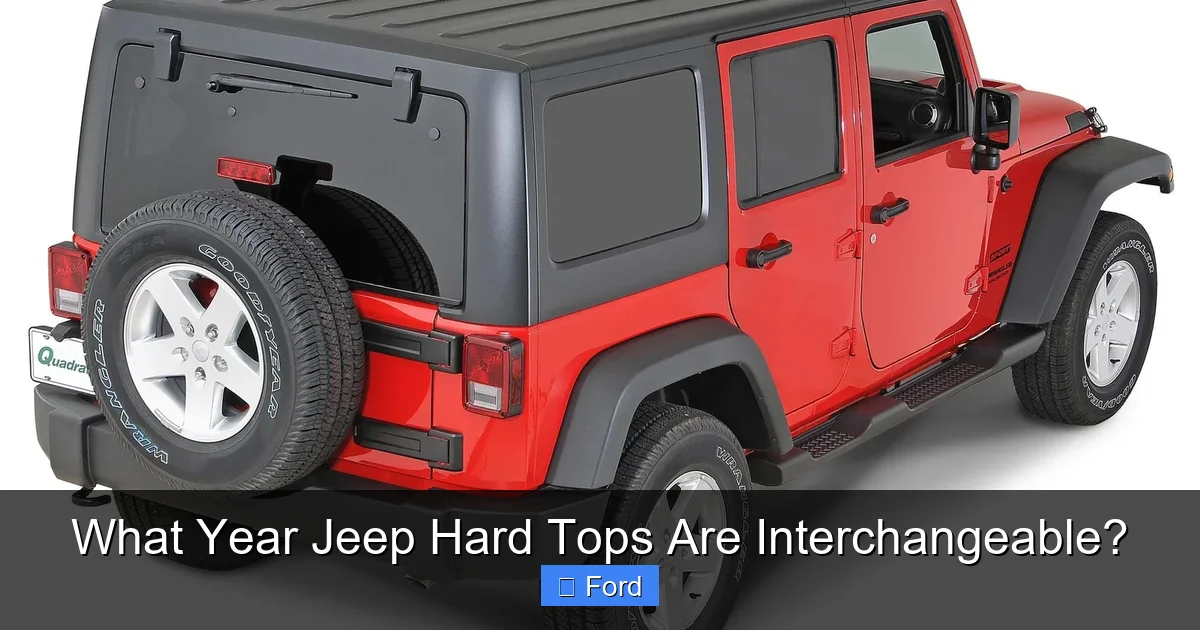
Visual guide about What Year Jeep Hard Tops Are Interchangeable?
Image source: thecarhow.com
1. The Spare Tire Carrier Seal
This is the #1 culprit for JK/JKU mismatches. If your Jeep has a spare tire mounted on the tailgate (common on Rubicons, some Saharas), the hard top must have a corresponding opening and seal in its rear header panel. A top from a vehicle without this carrier will have a solid rear header, leading to a massive leak.
2. Wiring Harness Connectors
The plug for the rear window defroster and wiper has changed at least twice in the JK generation and once in the JL. A top with the wrong connector won’t plug into your Jeep’s harness. You can sometimes swap the entire harness from your old top to the new one, but it’s a job.
3. Latch Mechanisms and Strikers
The mechanical latches that secure the front of the top to the windshield frame and the rear to the tailgate have evolved. Pre-2012 JKs used a different latch design than 2012+ models. Forcing them together will either not latch or will damage the components.
4. Seal and Gasket Design
Rubber seals wear out and are often not included with used tops. More importantly, the shape and channel design of these seals can change between model years, even within a generation. A seal from a 2010 JK will likely not seat properly in a 2015 JK’s channel.
5. Factory vs. Aftermarket Tops
Aftermarket tops (from companies like Bestop, Smittybilt, etc.) are made to fit a specific range of years and models. Their part numbers will explicitly state compatibility (e.g., “Fits 2007-2018 Jeep Wrangler JK 2-Door”). They are not designed to be cross-generational either. However, some aftermarket companies make adapter kits for specific swaps, like adding a JK top to a very early TJ, but these are rare, expensive, and require major modification. For reliable, trouble-free fitment, stick to OEM or high-quality aftermarket tops made for your exact vehicle.
How to Ensure a Perfect Match: Your Action Plan
Before you buy any used or new hard top, follow this checklist.

Visual guide about What Year Jeep Hard Tops Are Interchangeable?
Image source: i.ytimg.com
Step 1: Identify Your Jeep EXACTLY
You need the Year, Model (Wrangler, Wrangler Unlimited/4-Door, Gladiator), Trim (Sport, Sahara, Rubicon, etc.), and Body Style. The single best piece of information is your Vehicle Identification Number (VIN). Enter it into a decoder (many free ones online) or use a site like Jeep’s official parts lookup to find the exact build sheet and part numbers.
Step 2: Find the Donor Top’s Part Number
If buying used, ask the seller for the part number. It’s usually stamped into the plastic on the underside of the top, often near the center or on a label. An OEM part number looks like “68222941AA” or similar. This is your golden ticket.
Step 3: Cross-Reference the Part Number
Take that part number and plug it into a Mopar (Stellantis) parts catalog website or a reputable Jeep parts vendor’s site. It will list all the vehicle applications that part number fits. This is the only 100% reliable method.
Step 4: Visual and Physical Inspection (If Possible)
If you can see the top in person, check:
- Mounting Holes: Do they look rusted, stripped, or missing?
- Seals and Gaskets: Are they cracked, brittle, or missing entirely? Replacing these can cost $200-$400.
- Glass: Is the rear window tempered glass (most common) or acrylic? Is it scratched or hazed?
- Wiring: Is the harness intact, or are wires frayed/chewed?
- Interior: Is the headliner sagging or stained? This can be a sign of water intrusion.
Common “Can I Swap…?” Scenarios Answered
Let’s tackle the most frequent questions we see.
Can I put a TJ hard top on a JK?
No. The windshield frame is different, the door openings are different shapes and sizes, and the rear latch system is different. The body tub on a JK is wider. It’s a fundamental mismatch.
Can I put a 2-door JK top on my 4-door JKU?
Absolutely not. The length difference is about 30 inches. The rear window and header are completely different shapes. The side rails are different lengths. This is one of the most common and impossible myths.
Can I mix and match JL Freedom Top panels?
You can mix a JL panel with a JLU panel only if they have the exact same part number for that specific panel (front, center, or rear). The rear panel is always different between JL and JLU. The front and center panels may share part numbers across JL/JLU for the same year range (2019-2023). But a 2024+ front panel will not fit a 2020.
What about a soft top replacement? Are those interchangeable?
Soft tops have their own, equally complex interchangeability rules involving frame components, zippers, and window inserts. The same generation/body style rule applies. A TJ soft top frame will not fit a JK. This article focuses on hard tops, but the same research principle applies.
Where to Find Parts and Community Knowledge
Navigating this world requires resources.
- Official Mopar Parts Catalog: The ultimate authority. Use your VIN.
- Jeep Forums (JeepForum.com, WranglerForum.com): Goldmines of real-world experience. Search for “[Your Year] [Your Model] hard top interchange” or post your specific VIN and the donor top’s part number. Thousands of enthusiasts have already answered your question.
- Jeep Specialty Parts Retailers: Sites like Quadratec, Morris 4×4 Center, and Jeep HD have excellent fitment guides and knowledgeable staff. They often have interchange notes in their product listings.
- Salvage Yards (Auto Recycling): Great for finding used tops. Call with your exact Jeep info and ask if they can verify the part number on any tops they have.
When in doubt, do not guess. A $500 used top that doesn’t fit is worse than a $2,000 new top that does. The cost of professional paint, seal replacement, and modification to make a wrong top fit will quickly exceed the price of the correct part.
Conclusion: Precision Over Price
The world of Jeep hard top interchangeability is not a free-for-all; it’s a carefully defined matrix of generation, body style, and model year. Your safest path is to treat the hard top as a generation-specific component. A TJ top belongs on a TJ. A JK top belongs on a JK of the same body style and sub-generation (pre-2012 vs. post-2012). A JL top belongs on a JL of the same body style and pre-2024 refresh. The JT Gladiator is its own world.
resisting the temptation of a “great deal” on a top from a different model year or body style is crucial. The time, money, and frustration spent trying to make it work will far outweigh the initial savings. Your best tool is knowledge: know your exact Jeep, decode the part numbers, and consult the vast community of Jeep owners who have already walked this path. A properly fitting hard top is quiet, watertight, and secure—exactly what you need when you’re miles from nowhere and the weather turns. Don’t compromise on that foundation.
Frequently Asked Questions
Can I put a 2008 Jeep Wrangler 2-door hard top on a 2015 Jeep Wrangler 4-door?
No. This swap fails on multiple levels: it’s a different body style (2-door vs. 4-door) and a different sub-generation (pre-2012 vs. post-2012). The lengths, rear header, and front latch points are incompatible.
My 2012 JKU Rubicon has a spare on the tailgate. Will a hard top from a 2012 JK Sport (no spare) fit?
No. The Rubicon’s tailgate-mounted spare tire carrier requires a specific cutout and seal in the hard top’s rear header. A top from a non-spare-carrier model will have a solid rear header and will not seal, causing major leaks.
Are all 2007-2011 Jeep JK 2-door hard tops the same?
Yes, for the most part. The body and mounting points were consistent through the 2011 model year. The only minor variations are in the rear window options (with/without wiper) and the wiring harness, which you can often swap from your old top.
Can I use a 2020 Jeep JLU Freedom Top rear panel on my 2023 JLU?
Yes, likely. The 2019-2023 JL/JLU Freedom Top panels share the same part numbers across those years. You must still verify the exact part number on the donor panel matches the one for your 2023 model.
Will a Jeep JT Gladiator hard top fit a Jeep JL Wrangler Unlimited?
No. The Gladiator top is engineered for the truck’s cab and bed structure. The front header is wider, and the rear is designed to seal against the bed, not a tailgate. The mounting points are completely different.
What’s the one thing I should check before buying any used Jeep hard top?
Always get and verify the exact OEM part number from the top itself. Then, use that part number in a Mopar parts catalog or a Jeep forum to see all the vehicle applications it is certified for. This is the only way to be 100% sure of compatibility.