
What Year Did the Toyota Tacoma Have Transmission Problems?

The Toyota Tacoma’s most notorious transmission problems are concentrated in the 2005 through 2015 model years, primarily with the 4-speed automatic transmission. The 2016 and newer models with the 6-speed Aisin transmission have also reported specific, though less widespread, issues. Always check a vehicle’s specific history and maintenance records before purchasing.
Key Takeaways
- 2005-2015 (4-Speed Auto) is the High-Risk Period: This generation, especially 2005-2007, has the highest volume of documented transmission failure reports, often linked to a defective solenoid and general design wear.
- 2016+ (6-Speed Aisin) Has Newer, Different Issues: While more robust, these transmissions can suffer from solenoid pack failures, torque converter shudder, and programming-related harsh shifts.
- Manual Transmissions Are Generally More Reliable: The 5-speed and 6-speed manuals from this era are considered very durable, with far fewer widespread failure reports.
- Maintenance History is Non-Negotiable: A well-maintained Tacoma transmission, with timely fluid changes, has a dramatically higher chance of lasting 300,000+ miles, regardless of year.
- Always Get a Pre-Purchase Inspection (PPI): A specialized mechanic must road-test the vehicle, check for diagnostic codes, and examine transmission fluid condition before any used purchase.
- Warranty Coverage May Existed for Some Models: Some 2007-2008 models had extended warranty coverage for transmission components; checking with a dealer using the VIN is crucial.
- Not Every Truck Will Fail: Many 2005-2015 Tacomas with original transmissions are still on the road. Risk is statistical, not a guarantee for every single vehicle.
📑 Table of Contents
- Introduction: The Tacoma’s Reputation and the Transmission Question
- The Problematic Era: 2005-2015 Tacomas and the 4-Speed Automatic
- The Newer Concern: 2016+ Tacomas and the 6-Speed Aisin
- Manual Transmissions: The Safe Harbor
- How to Protect Yourself: A Buyer’s Action Plan
- What to Do If You Already Own a Problematic Tacoma
- Conclusion: Knowledge is Your Best Defense
Introduction: The Tacoma’s Reputation and the Transmission Question
When you think of the Toyota Tacoma, words like “reliable,” “tough,” and “bulletproof” probably come to mind. For decades, this midsize pickup has earned its legendary status as a workhorse that just won’t quit. But no vehicle is perfect, and the Tacoma has one significant asterisk next to its name in the reliability hall of fame: transmission problems. If you’re shopping for a used Tacoma, the question isn’t just “What year?” but “What year did the Toyota Tacoma have transmission problems?” The answer is nuanced, splitting the truck’s modern history into two distinct eras of concern. This guide will break down exactly which years to watch, what specifically can go wrong, and how to protect yourself when buying a used model.
The core issue centers on two different automatic transmissions used over the last 20 years. The first, a 4-speed unit found from 2005 to 2015, developed a reputation for costly failures. The second, a more advanced 6-speed Aisin unit introduced in 2016, is generally stronger but has its own set of known, often electronic or solenoid-related, quirks. Understanding this split is the first step to making a smart purchase.
The Problematic Era: 2005-2015 Tacomas and the 4-Speed Automatic
This is the period most associated with Tacoma transmission woes. For the 2005 model year, Toyota completely redesigned the Tacoma, moving to a larger, more powerful truck. With this redesign came a new 4-speed automatic transmission (the A750F or similar variants) paired with the 4.0L V6 engine. While adequate for its time, this transmission would become the source of the Tacoma’s biggest reliability blemish.

Visual guide about What Year Did the Toyota Tacoma Have Transmission Problems?
Image source: autozonic.com
Why Was the 4-Speed So Problematic?
The issues weren’t about a single catastrophic design flaw but a combination of factors that led to premature wear and failure:
- The Defective Solenoid (The “TCC Solenoid”): This is the most famous culprit. The Torque Converter Clutch (TCC) solenoid, particularly in 2005-2007 models, was prone to failure. When it failed, it often caused the transmission to slip severely, behave erratically, or go into “limp mode.” Many failures were traced to a poorly designed or manufactured solenoid that could not withstand normal operating conditions.
- General Wear and “Soft” Build: Compared to the legendary durability of the earlier (pre-2005) 4-speed in the 3.4L trucks, this newer 4-speed was seen by many mechanics and owners as less robust. The increased power and torque of the 4.0L V6, combined with the added weight of the larger truck, put more stress on the transmission. Over time, internal clutches and bands could wear out, leading to slipping, harsh shifts, and eventual failure.
- Fluid Degradation: Toyota recommended long fluid change intervals (sometimes 60,000+ miles). Many owners never changed the fluid. Old, burnt fluid loses its lubricating and cooling properties, accelerating internal wear dramatically.
- Heat: The Tacoma is often used for towing and off-road duty. The 4-speed, with fewer gears, often had to work harder at higher RPMs, generating more heat. An auxiliary transmission cooler was not standard, making the transmission more susceptible to heat-related damage.
Worst Years Within the 2005-2015 Range
While the entire generation is at higher risk, the earliest models are the most concerning:
- 2005-2007: The peak of the TCC solenoid failure epidemic. These model years have the highest volume of complaints, class-action lawsuit discussions, and costly repair bills. The solenoid issue was so prevalent that some sources suggest a failure rate high enough to consider it a common problem.
- 2008-2010: Toyota reportedly revised the solenoid design around 2008-2009, which may have reduced the *rate* of that specific failure. However, the underlying transmission’s relative fragility remained. These years still see a significant number of failures due to general wear, especially on high-mileage or poorly maintained examples.
- 2011-2015: This is the tail end of the 4-speed’s life. While the solenoid issues were likely mitigated, these are high-mileage candidates today. A 2015 Tacoma with 200,000+ miles is pushing the original transmission to its absolute limits, regardless of the solenoid’s status. General wear, fluid neglect, and heat are the primary threats here.
The Newer Concern: 2016+ Tacomas and the 6-Speed Aisin
For the 2016 model year, Toyota finally replaced the aging 4-speed with a modern, robust 6-speed automatic transmission (the Aisin A7606). This was a massive upgrade in theory, offering better fuel economy, smoother shifts, and more robust construction. For the most part, it delivered. However, no new complex component is perfect from day one.
What Issues Plague the 6-Speed?
The problems with the 6-speed are less about catastrophic internal failure and more about frustrating electronic and solenoid-related symptoms:
- Solenoid Pack Failures: The transmission uses an electro-hydraulic solenoid pack to control shifts. These solenoids can fail, causing harsh, jerky shifts (often between 2nd and 3rd gear), delayed engagement, or the transmission getting “stuck” in one gear. This is the most common complaint.
- Torque Converter Shudder/Vibration: Some owners report a vibration or shudder, particularly at low speeds (around 40-50 mph) under light throttle. This can feel like a continuous shake and is often traced to the torque converter clutch not engaging smoothly, which may be a software/tuning issue or a failing torque converter itself.
- Software/Programming Hiccups: Early 2016-2018 models sometimes had transmission control module (TCM) programming that resulted in overly hesitant or jerky shifts, especially when cold. Toyota released technical service bulletins (TSBs) and software updates to address these driveability concerns.
- Seal Leaks: A few reports exist of internal seals leaking, leading to low fluid levels and potential damage if not caught early.
It’s critical to note that the failure rate of the 6-speed is statistically much lower than the 4-speed’s. A vast majority of 2016+ Tacoma owners will never experience a major transmission problem. But the issues that do arise can be expensive to diagnose and repair, often requiring a solenoid pack replacement or a costly torque converter swap.
Manual Transmissions: The Safe Harbor
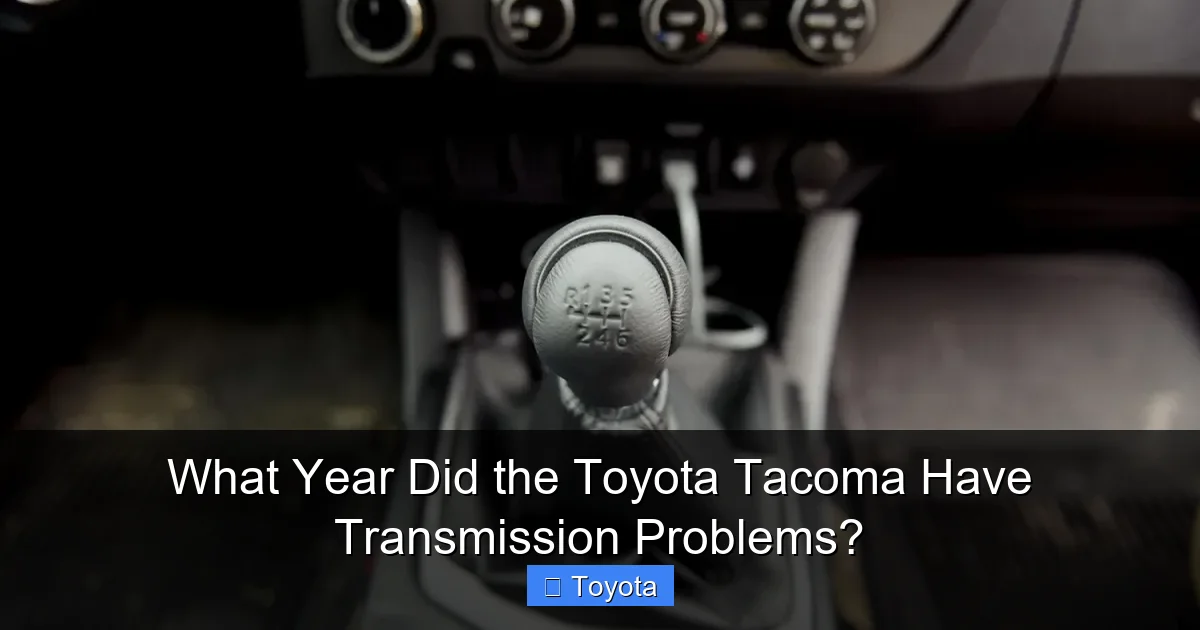
Amidst the automatic transmission drama, one fact stands out: the manual transmissions in the Tacoma are exceptionally reliable. The 5-speed manual (2005-2015) and the 6-speed manual (2016+) are known for their simplicity, strength, and longevity. They have far fewer complex electronic components and are less stressed by heat.

Visual guide about What Year Did the Toyota Tacoma Have Transmission Problems?
Image source: di-sitebuilder-assets.dealerinspire.com
Common complaints about manuals are driver-related (clutch wear, gear grinding from misuse) or minor (synchronizer wear on high-mileage examples), not fundamental design failures. If your driving style allows for a manual and you find a well-maintained example, you have essentially eliminated the Tacoma’s biggest reliability weak point. Always ensure the clutch engages smoothly and all gears shift cleanly during a test drive.
How to Protect Yourself: A Buyer’s Action Plan
Knowing the problem years is only half the battle. Your due diligence is what separates a good buy from a money pit.
Visual guide about What Year Did the Toyota Tacoma Have Transmission Problems?
Image source: i1.wp.com
1. The Pre-Purchase Inspection (PPI) is Your Best Friend
Do not buy a used Tacoma without one. This is non-negotiable. But not just any mechanic will do. You need a transmission specialist or a shop with extensive Toyota truck experience. A general mechanic might miss subtle signs. The PPI should include:
- A thorough road test under varying conditions (cold start, acceleration, deceleration, up/down hills). The mechanic should feel for slips, harsh shifts, shudder, or delayed engagement.
- Scanning for any stored or pending transmission-related diagnostic trouble codes (P07xx, P17xx, etc.). Many problems set codes before symptoms become severe.
- Checking the transmission fluid. It should be red and smell slightly sweet. If it’s dark brown/black and smells burnt, that’s a major red flag for internal wear or overheating.
- For 4-speed trucks, asking specifically about the TCC solenoid and checking if any related TSBs were performed.
2. Decode the Vehicle’s History
First, get the Vehicle Identification Number (VIN). You can use it to:
- Order a detailed vehicle history report (Carfax, AutoCheck) to see reported accidents, service records, and number of owners.
- Call a Toyota dealer’s service department. Give them the VIN and ask them to check for any open recalls, extended warranties, or important TSBs related to the transmission. This is free and can reveal if a specific vehicle was part of a goodwill repair program. For example, some 2007-2008 models had extended coverage for the transmission solenoid.
- Use online forums like Tacoma4G or Reddit’s r/ToyotaTacoma to search for the exact year, engine, and transmission combination. Real owner experiences are invaluable.
3. Ask the Right Questions and Verify Answers
When talking to a seller:
- “Do you have all the service records?” Specifically look for transmission fluid and filter changes. For the 4-speed, this should have been done every 30,000-60,000 miles. For the 6-speed, Toyota’s interval is often “lifetime” but many experts still recommend a change every 60,000-100,000 miles for longevity.
- “Has the transmission ever been repaired or rebuilt?” Get specifics. A rebuilt transmission with a reputable shop’s warranty is better than an unknown history, but it still has a value impact.
- “Has the vehicle been used for towing?” Frequent towing, especially with a 4-speed, is a significant stress factor.
If the seller cannot produce records or is vague, treat that as a major warning sign. A well-cared-for Tacoma will have a paper trail.
What to Do If You Already Own a Problematic Tacoma
If you’re reading this because your Tacoma is showing symptoms (slipping, jerking, check engine light), here’s your immediate action plan:
- Stop Driving It Aggressively: If it’s slipping, avoid hard acceleration and towing. Drive it gently to prevent further damage.
- Get a Professional Diagnosis: Take it to a transmission specialist. Do not go to a quick-lube place. A proper diagnosis with a scan tool and road test is essential. For the 4-speed, they will likely check solenoid resistance and look for specific codes. For the 6-speed, they will check solenoid pack performance and TCM data.
- Understand the Repair Options:
- Solenoid/Valve Body Replacement: For both generations, a failed solenoid pack or contaminated valve body is a common fix. This can cost $1,000 – $2,500.
- Full Rebuild or Replacement: For the 4-speed with internal clutch wear or the 6-speed with a failed torque converter, this is the nuclear option. A quality rebuild from a reputable shop can cost $3,500 – $5,000+. A used transmission from a salvage yard is cheaper but a gamble.
- Check for TSBs and Warranty Coverage: Have the dealer check your VIN again. Even if the factory warranty is long expired, sometimes manufacturers issue goodwill extensions for specific, widespread problems. It’s worth asking.
Conclusion: Knowledge is Your Best Defense
The Toyota Tacoma’s transmission story is a classic case of “buyer beware” within an otherwise stellar reputation. The 2005-2015 automatic models carry the highest risk, with the earliest years of that run being the most problematic. The 2016+ 6-speed automatics are a significant improvement but are not infallible, with solenoid and torque converter issues being the primary concerns. The manual transmission remains the gold standard for worry-free ownership.
Ultimately, the condition of any individual Tacoma depends almost entirely on its maintenance history and usage. A pristine, fully serviced 2010 V6 automatic could outlast a neglected 2020 model. This is why your due diligence—the VIN check, the specialist PPI, the service records—is infinitely more important than simply avoiding a certain model year. Arm yourself with this knowledge, inspect meticulously, and you can still find an incredibly reliable and capable Tacoma that will serve you for years to come. Remember, when in doubt, pay for the inspection. It’s the cheapest insurance policy you can buy on a used vehicle.
Frequently Asked Questions
What is the most common symptom of a failing Tacoma transmission?
For the 2005-2015 4-speed, the most common symptom is severe slipping or a harsh “bang” when shifting into drive or reverse, often accompanied by a check engine light with TCC solenoid codes. For the 2016+ 6-speed, the most frequent complaint is a harsh, jerky shift between 2nd and 3rd gear, especially when cold.
Can I prevent transmission problems in my Tacoma?
Yes, proactive maintenance is key. For automatics, use only Toyota WS fluid (or the exact specified equivalent) and change it according to a severe service schedule (every 30,000-60,000 miles), not the “lifetime” factory interval. Avoid excessive heat by using a transmission cooler if you tow or drive in hilly, hot conditions. For manuals, use the correct fluid and ensure the clutch is fully depressed when shifting.
Is it better to buy a manual or automatic Tacoma for reliability?
Without question, the manual transmission is the more reliable choice. It lacks the complex solenoids, torque converters, and valve bodies that cause automatic failures. The manual’s primary wear items (clutch, synchronizers) are wear parts expected to be replaced at high mileage, not sudden, catastrophic failures. If you can drive a manual, it’s the safest bet for long-term, worry-free ownership.
How much does it cost to fix a Tacoma transmission?
The cost varies wildly. A simple solenoid pack replacement on a 2016+ model might cost $1,200-$2,000. A full rebuild of the 4-speed on a 2005-2015 model typically costs $3,500-$5,000 at a reputable independent shop. A remanufactured transmission from a dealer can exceed $6,000. Always get multiple quotes from transmission specialists, not general mechanics.
Did Toyota ever recall Tacomas for transmission problems?
There was no broad, safety-related recall for the transmission. However, there were specific Technical Service Bulletins (TSBs) and in some cases, limited extended warranty coverage for the defective TCC solenoid in certain 2007-2008 models. You must have a dealer check your specific VIN to see if any such programs applied to a vehicle you’re considering.
Should I avoid buying a Tacoma with over 200,000 miles?
Not necessarily, but the transmission becomes the primary focus. For a 2005-2015 automatic, 200,000 miles is well into the risk zone for failure unless you have absolute proof of impeccable, frequent transmission fluid changes. For a 2016+ automatic, 200,000 miles is still relatively new for the 6-speed, but a thorough PPI is critical. A manual transmission at 200,000 miles is a much more viable prospect if the clutch feels healthy.
