
What Type of Oil Does a Volkswagen Passat Take

Your Volkswagen Passat requires engine oil that meets specific Volkswagen (VW) factory approvals, such as VW 502 00 or VW 504 00. The correct viscosity, like 5W-30 or 0W-20, depends on your model year and engine type. Using the wrong oil can lead to severe engine damage, poor performance, and voided warranties. Always confirm the exact specification in your owner’s manual before purchasing oil.
You’re staring at the oil dipstick or opening the hood of your Volkswagen Passat, and a simple question turns into a mini research project: what type of oil does a Volkswagen Passat take? It’s a crucial question. Your Passat’s engine is a finely tuned piece of German engineering, often turbocharged and designed with tight tolerances. The oil isn’t just a lubricant; it’s a lifeblood that cools, cleans, seals, and protects components from the microscopic to the massive. Pouring in the wrong type is like giving a marathon runner a sugary soda instead of water—it might run for a while, but long-term damage is inevitable. This guide will cut through the confusion, decoding the exact oil requirements for every Passat generation, explaining the why behind the specs, and giving you the confidence to make the perfect choice every time.
Key Takeaways
- VW mandates specific oil approvals: Passats require oil that meets Volkswagen’s rigorous factory specifications (e.g., 502 00, 504 00, 507 00), not just any synthetic.
- Model year is critical: Oil specifications changed significantly across Passat generations (B5, B6, B7, B8). A 2012 model has different needs than a 2020 model.
- Viscosity matters: Common grades are 5W-30 and 0W-20, but you must use the exact one listed for your specific engine. The “W” stands for winter.
- Full synthetic is non-negotiable: All modern Passats require full synthetic oil to meet VW’s standards for turbocharger protection and emissions system compatibility.
- Your owner’s manual is the ultimate source: The definitive answer is always in your vehicle’s manual, often also printed on the oil cap.
- Wrong oil risks engine damage: Using oil without proper VW approval can cause sludge, wear on timing chains, turbo failure, and catalytic converter issues.
- Service intervals follow the oil spec: Using VW 504 00/507 00 (LongLife) oil allows for extended 10,000-mile changes, while older specs require more frequent service.
📑 Table of Contents
- The Heart of the Matter: Understanding Volkswagen’s Oil Specifications
- Model Year Breakdown: What Your Specific Passat Needs
- Decoding the Viscosity: What Do 5W-30 and 0W-20 Actually Mean?
- Synthetic vs. Conventional: Why VW Requires Full Synthetic
- How to Check and Change Your Passat’s Oil: A Practical Guide
- Common Oil-Related Mistakes Passat Owners Make
- Conclusion: Your Passat’s Longevity Hinges on This Choice
The Heart of the Matter: Understanding Volkswagen’s Oil Specifications
Forget everything you think you know about “good” motor oil. Volkswagen doesn’t use generic industry standards. They have their own, strict, internally developed specifications that oils must pass to earn the VW badge of approval. This isn’t marketing hype; it’s engineering necessity. The Passat’s turbocharged TSI (gasoline) and TDI (diesel) engines operate under high pressure and temperature. The oil must protect the turbocharger’s bearings, resist shear thinning, and work harmoniously with sensitive emissions equipment like diesel particulate filters (DPFs) and gasoline particulate filters (GPFs).
Decoding the Codes: VW 502 00, 504 00, 507 00, and More
You’ll see codes like VW 502 00, VW 504 00, or VW 507 00 on oil bottles. These are the key to your Passat’s health. Here’s what they mean in plain English:
- VW 502 00: This is the classic standard for gasoline engines (TSI) without extended drain intervals. It requires excellent high-temperature stability and shear resistance. It’s the baseline for many pre-2010 and some later models. Oils with this approval are fantastic but typically require changes every 5,000-7,500 miles.
- VW 504 00 / 507 00: This is the LongLife III standard. It’s a higher, more demanding specification that allows for extended oil change intervals of up to 10,000 miles or one year (whichever comes first). It includes enhanced additive packages for better sludge prevention, turbo protection, and compatibility with emissions systems. For any Passat that specifies this, you must use an oil with both the 504 00 (for gasoline) and 507 00 (for diesel) approvals if it’s a TDI. Using a 502 00 oil in an engine that calls for 504 00/507 00 can void your warranty and lead to long-term issues.
- VW 508 00 / 509 00: These are the newest standards (introduced around 2018-2019 for some models) designed for even lower viscosity (0W-20) and extreme fuel economy benefits while maintaining engine protection. They are primarily for newer TSI engines.
The golden rule: Use the exact specification listed for your car. A higher number (like 504 00) is generally backwards compatible with older specs (like 502 00), but the reverse is not true. Never use an oil with a lower specification than required.
Why Can’t I Just Use Any “Synthetic” Oil?
This is the most common mistake. The term “synthetic” is unregulated and means nothing on its own. A generic “synthetic blend” or even a full synthetic from a big-box store may lack the specific additive chemistry Volkswagen engineers demanded. For example, the anti-wear additives, detergents, and friction modifiers must be precisely balanced to protect the Passat’s delicate turbocharger bearings and prevent intake valve deposits (a common issue in direct-injection engines). Only oils that have undergone and passed VW’s rigorous testing protocols earn the approval codes. Look for the official VW specification seal on the bottle, not just a claim that it’s “synthetic.”
Model Year Breakdown: What Your Specific Passat Needs
The Passat has gone through several generations (internally coded B5, B6, B7, B8), each with different engine families and therefore different oil requirements. Let’s break it down by era. Remember, your engine code (found on a sticker under the hood or in your manual) is the final decider, but this guide covers the vast majority of cases.
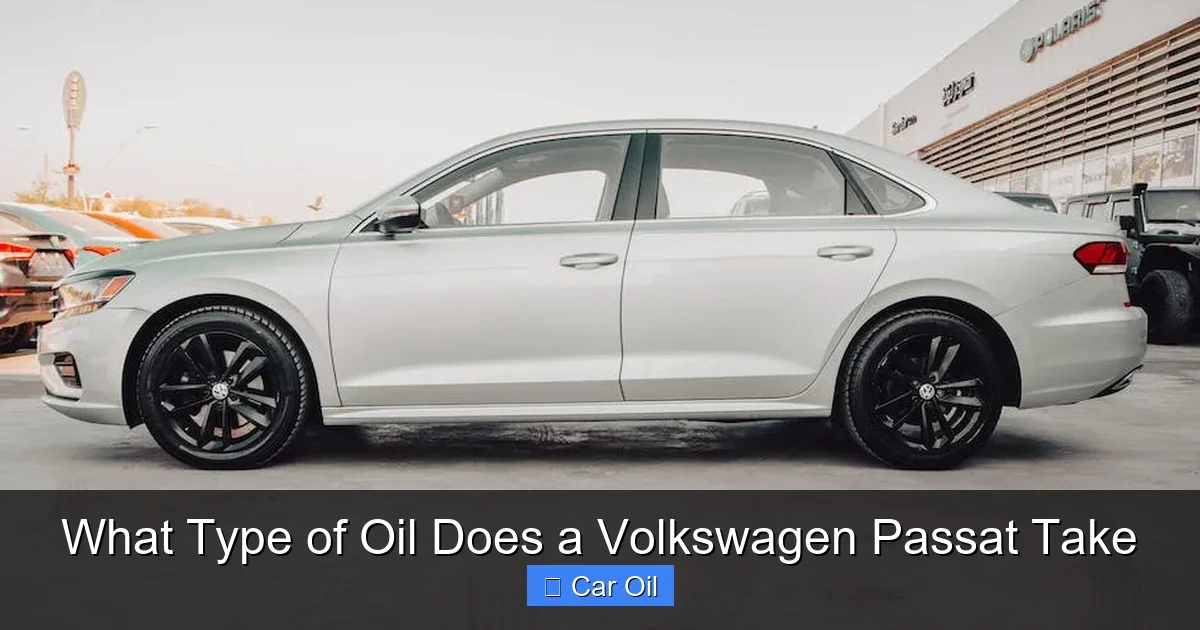
Visual guide about What Type of Oil Does a Volkswagen Passat Take
Image source: homeygears.com
B5 Platform (1997-2005): The Last of the Naturally Aspirated & Early Turbo
These are the classic, rugged Passats. Gasoline engines (1.8L, 2.8L V6, 3.0L V6) typically use 5W-30 or 10W-30 oil meeting VW 502 00 or the older VW 501 01 specification. The early 1.9L TDI diesel engines require 5W-30 or 5W-40 meeting VW 505 00. These are simpler times; full synthetic meeting the correct VW spec is still highly recommended over conventional oil.
B6 Platform (2006-2010): The Turbo Era Begins in Earnest
This generation saw the widespread introduction of the 2.0L TSI turbocharged gasoline engine and the updated 2.0L TDI. The rules solidify here:
- 2.0L TSI (Gasoline): Requires 5W-30 or 5W-40 meeting VW 502 00. This is a critical application. The turbocharger is very sensitive.
- 2.0L TDI (Diesel): Requires 5W-30 meeting VW 507 00 (for extended intervals) or VW 505 01. The DPF-equipped models absolutely need the 507 00 spec.
- 3.6L VR6 FSI (Gasoline): A special high-revving engine. It often requires 5W-30 or 5W-40 meeting VW 502 00 or sometimes VW 504 00 for later model years.
For this generation, using an oil with both 502 00 and 504 00 approvals is a safe bet for the TSI engines, as it meets the higher standard while being compatible.
B7 Platform (2011-2014): Refinement and the Rise of LongLife
This generation consolidated the engine lineup. The 2.0L TSI received updates, and the LongLife service concept became standard for many models.
- 2.0L TSI (Gasoline): Most require 5W-30 meeting VW 504 00 (for the 10,000-mile LongLife interval). Some earlier B7 models might still call for 502 00, so check your manual.
- 2.0L TDI (Diesel): Almost universally requires 5W-30 meeting VW 507 00. This is non-negotiable for DPF health.
- 3.6L VR6: Typically uses 5W-30 meeting VW 502 00 or 504 00.
For B7 Passats, if your owner’s manual mentions “LongLife” or “WIV” (WartungsIntervallVerlängerung, or Service Interval Extension), you must use an oil with the 504 00/507 00 specification. Using a 502 00 oil in a LongLife car will cause the service interval light to come on prematurely and may not provide adequate protection over the extended drain period.
B8 Platform (2015-Present): Efficiency and New Standards
The current Passat (until its recent discontinuation in North America) and the latest European models feature the most advanced engines. The trend is towards lower viscosity for fuel economy.
- 1.4L TSI & 2.0L TSI (Gasoline): The majority, especially from 2018 onward, require 0W-20 meeting the newest VW 508 00 / 509 00 specification. Some earlier B8 models (2015-2017) may still use 5W-30 with VW 504 00. This is a major shift. 0W-20 is thinner when cold but must meet very stringent standards.
- 2.0L TDI (Diesel): Continues to require 5W-30 meeting VW 507 00.
For the newest Passats with 0W-20 requirements, do not substitute 5W-30. The engine’s hydraulic systems and turbocharger clearances are designed for that specific flow characteristic. Using a thicker oil can cause increased wear, poor fuel economy, and potentially trigger check engine lights.
Decoding the Viscosity: What Do 5W-30 and 0W-20 Actually Mean?
That string of numbers and letters on the oil container isn’t arbitrary. It’s the Society of Automotive Engineers (SAE) viscosity grade. Understanding it helps you grasp why your Passat needs its specific grade.
Visual guide about What Type of Oil Does a Volkswagen Passat Take
Image source: homeygears.com
The “W” Stands for Winter
The number before the “W” (e.g., the “5” in 5W-30) indicates the oil’s flow at cold start temperatures. A lower number means the oil flows more easily when it’s cold, providing faster lubrication to critical engine parts on startup. A 0W oil flows better in extreme cold than a 5W oil. For most of the U.S., a 5W is perfectly fine. But for very cold climates (Minnesota, Canada), a 0W oil has an advantage. Volkswagen specifies the grade based on extensive cold-start testing for each engine design.
The Second Number: High-Temperature Protection
The number after the hyphen (e.g., the “30” in 5W-30) describes the oil’s viscosity at the standard operating temperature of 100°C (212°F). This is where the oil forms a protective film between moving parts. A “30” weight is thicker at high temp than a “20” weight. Thicker oil generally provides a better cushion under extreme heat and load. However, modern engines with tighter tolerances often require thinner oils (like 0W-20) to reduce friction and improve fuel economy. Your Passat’s engineering dictates this number precisely. Never assume a 5W-30 is a safe substitute for a required 0W-20, or vice versa.
Why Not Just Use 10W-40?
Older, heavier oils like 10W-40 were common in the days of looser engine tolerances. Using them in a modern Passat with a small-displacement turbo is a recipe for trouble. It will be too thick on cold starts (causing wear), may not flow quickly enough to the turbo, and can increase drag on internal parts, reducing fuel economy. The engine is designed for a specific viscosity range; you must stick to it.
Synthetic vs. Conventional: Why VW Requires Full Synthetic
You might be wondering if you can save a few dollars with a conventional or synthetic blend oil. For a Volkswagen Passat, the answer is a firm no. Here’s why full synthetic is mandatory:
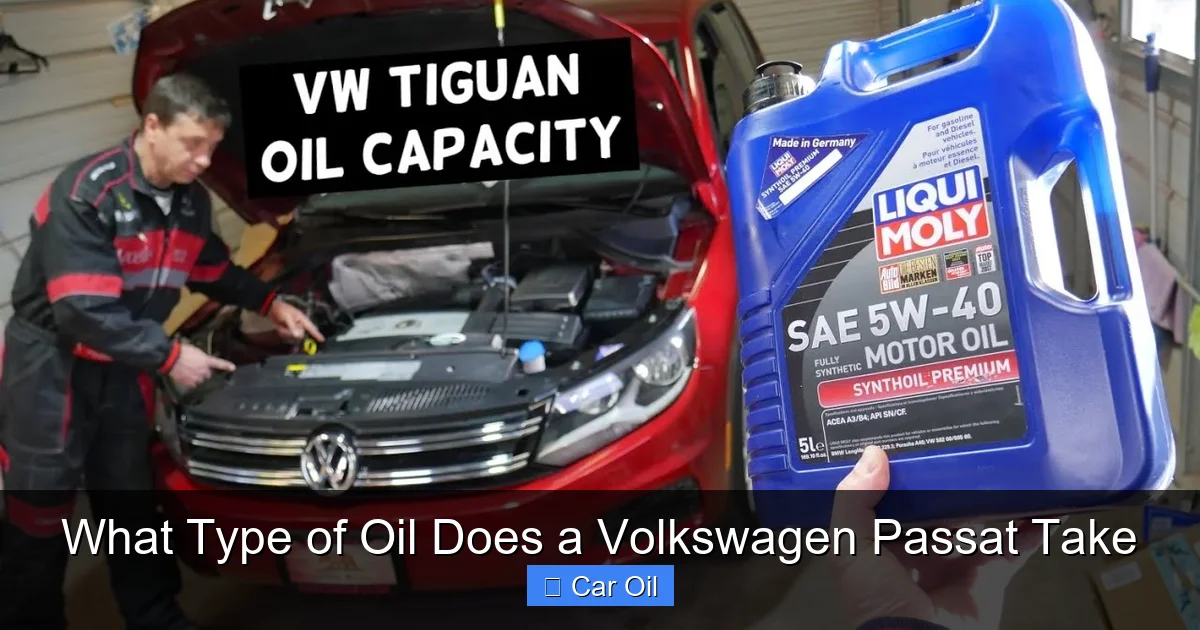
Visual guide about What Type of Oil Does a Volkswagen Passat Take
Image source: i.ytimg.com
Turbocharger Protection
The turbocharger spins at over 200,000 RPM and operates at exhaust-gas temperatures exceeding 1,000°F. It relies entirely on a constant, uninterrupted supply of oil for lubrication and cooling. Conventional oils break down (oxidize) faster under this extreme heat, leading to coking and carbon deposits on the turbo shaft and bearings. Full synthetic oils have superior thermal stability, resisting breakdown and keeping your turbo clean and cool. This is arguably the most important reason.
Shear Stability
Shear is the force that occurs when oil is between two moving surfaces, like in a piston ring or bearing. Under high pressure, oil molecules can be forced apart, causing the oil to thin out (lose viscosity). Full synthetics are engineered to resist shear much better than conventional oils. Maintaining the correct viscosity is essential for maintaining the protective oil film under load. A sheared-down oil can lead to direct metal-to-metal contact and accelerated wear.
Compatibility with Emissions Systems
Modern Passats have complex after-treatment systems. Diesel particulate filters (DPFs) can be clogged by ash from certain oil additives. Gasoline particulate filters (GPFs) have similar sensitivities. The VW specifications (especially 504 00/507 00) mandate low-SAPS (Sulfated Ash, Phosphorus, Sulfur) formulations. These “low-ash” oils prevent filter clogging and are compatible with the catalytic converters. Conventional and many older synthetic formulations do not meet these low-SAPS requirements.
Extended Drain Intervals
The LongLife specification (504 00/507 00) is only possible because of the superior detergency and oxidation resistance of full synthetic oil. It can stay “clean” and protective for up to 10,000 miles. Conventional oil simply cannot do this without forming harmful sludge and varnish.
How to Check and Change Your Passat’s Oil: A Practical Guide
Knowing the spec is one thing; getting the right oil and installing it correctly is another. Here’s how to be sure.
Step 1: Find the Holy Grail – Your Owner’s Manual
This is your single source of truth. In the “Capacities and Specifications” or “Technical Data” section, you will find a table listing the exact oil specification (e.g., “VW 504 00 / 507 00”) and the viscosity (e.g., “5W-30”) for your specific engine code. If you don’t have the physical manual, Volkswagen often provides digital copies on their owner’s website. Alternatively, a quick VIN lookup at a VW dealership or reputable online parts store can pull your exact specifications.
Step 2: Check the Oil Cap or Dipstick
Many modern Passats have the oil specification printed directly on the engine’s oil filler cap. It might say “VW 504 00 / 507 00” or “0W-20 VW 508 00”. This is a convenient backup. The dipstick may also have the viscosity printed on it. However, the owner’s manual always trumps the cap if there’s any discrepancy.
Step 3: Purchasing the Correct Oil
When buying oil, ignore the confusing “European Car” aisle labels. Go straight to the specification. Look for bottles that explicitly state “Meets VW 504 00 / 507 00” or “VW 502 00”, etc. Reputable brands like Mobil 1, Castrol EDGE, Pennzoil Platinum, Liqui Moly, and Motul all produce VW-approved oils. You can often find a entire list of approved oils on the Volkswagen website or in technical service bulletins. For example, if your Passat requires 504 00/507 00, a bottle of “Castrol EDGE Professional LongLife III 5W-30” is a perfect match.
Step 4: The DIY Oil Change – Key Considerations
If you’re changing the oil yourself:
- Use the correct oil filter. The filter is part of the system. Use a high-quality filter that meets or exceeds OEM specifications. Brands like Mann, Mahle, and Bosch are excellent.
- Torque the drain plug and filter correctly. Under-torquing causes leaks; over-torquing strips threads. Use a torque wrench. The manual will specify the torque value (often around 22-30 Nm for the drain plug).
- Don’t overfill. After draining and replacing the filter, add the specified capacity (usually 5.5-6.5 quarts for a Passat) minus what you drained. Start the engine, let it run for 30 seconds, shut it off, wait a minute, and check the dipstick. Add more if needed to reach the “MAX” line.
- Dispose of old oil properly. Take it to a auto parts store or recycling center.
If you’re unsure, a professional service at a VW dealership or a trusted independent mechanic who understands VW specs is always a safe investment. They have direct access to the latest specification databases.
Common Oil-Related Mistakes Passat Owners Make
Even with the best intentions, it’s easy to slip up. Here are the most frequent pitfalls:
Mistake 1: “It’s Just Oil, It’s All the Same”
This is the cardinal sin. As detailed above, VW specs are unique. Using a generic “synthetic” that meets API SP and ILSAC GF-6 but lacks VW 504 00 is insufficient for a LongLife Passat. It’s not about brand loyalty; it’s about the certification stamp on the bottle.
Mistake 2: Ignoring the LongLife Requirement
You buy a Passat with the service interval set to 10,000 miles. You take it to a quick-lube shop that uses a standard 5W-30 (meeting only API SN, not VW 504 00). The oil change light resets, but over the next 10,000 miles, that oil is not equipped to handle the extended stress. It will oxidize, form deposits, and potentially harm the turbo and emissions systems. You’ve just defeated the purpose of the LongLife design. If your car requires LongLife oil, you must use LongLife oil, regardless of where you get the service done.
Mistake 3: Using the Wrong Viscosity for the Season
While modern multi-viscosity oils are remarkably versatile, extreme conditions matter. If you live in a desert climate with scorching summers (consistently above 100°F) and your manual allows a choice between 5W-30 and 5W-40, the slightly thicker 40-weight might offer better high-temperature shear protection. Conversely, in a sub-zero climate, a 0W-20 is superior to a 5W-20 for cold starts. Your manual’s primary spec is law, but understanding climate nuances can help you choose between approved options if given a choice.
Mistake 4: Neglecting the Diesel
TDI Passat owners face an even more critical situation. The oil must meet VW 507 00 to protect the DPF. Using a 502 00 gasoline oil in a TDI will almost certainly lead to DPF clogging, poor performance, and costly regeneration failures or replacement. The diesel spec is separate and more demanding in terms of low-ash content.
Mistake 5: Not Changing the Oil on Time
Even the best oil degrades. The additives get used up, the oil becomes contaminated with fuel, water, and metal particles. Sticking to the recommended interval—whether it’s 5,000 miles (for older specs) or 10,000 miles (for LongLife)—is non-negotiable. An oil analysis can tell you the health of your oil, but for most, following the manual’s schedule is the simplest and safest policy.
Conclusion: Your Passat’s Longevity Hinges on This Choice
Asking “what type of oil does a Volkswagen Passat take?” is one of the most important maintenance questions you can ask. The answer isn’t found in a generic chart but in the specific Volkswagen approval code and viscosity grade for your model year and engine. It’s the difference between an engine that runs smoothly for 300,000 miles and one that suffers premature wear, turbo failure, or emissions system damage. The process is simple: consult your owner’s manual, find the VW specification (502 00, 504 00/507 00, 508 00/509 00), and buy a full synthetic oil that explicitly states it meets that spec. Don’t guess. Don’t assume. The $40 you might save on a cheaper oil is a paltry sum compared to the thousands a major engine repair will cost. Respect the engineering. Use the right oil. Your Passat will reward you with years of reliable, efficient, and enjoyable driving.
Frequently Asked Questions
Can I use 5W-30 oil if my Passat calls for 0W-20?
No. You should never substitute a different viscosity grade than what is specified. 0W-20 is specifically formulated for the tighter tolerances and fuel economy targets of newer engines. Using 5W-30 can cause increased friction, reduced fuel economy, and potential long-term wear because it may not flow as quickly at cold starts or maintain the correct film thickness at operating temperature.
What happens if I accidentally use oil without the correct VW approval?
Using non-approved oil can lead to sludge buildup, premature wear on the turbocharger and timing chain, damage to the emissions system (like the DPF or catalytic converter), and will likely void your engine warranty. The effects might not be immediate but can cause catastrophic failure well before the engine’s expected lifespan.
Is it okay to use a “European Car Formula” oil that doesn’t list my specific VW code?
No. “European Car Formula” is a vague marketing term. You must see the specific VW approval code (e.g., VW 504 00) on the bottle. An oil might be “for European cars” but only meet older specs like VW 502 00, which would be insufficient for a car requiring the LongLife 504 00/507 00 specification.
My 2015 Passat owner’s manual says VW 504 00, but the oil cap says 5W-30. Is that all I need to know?
The cap gives you the viscosity (5W-30), which is crucial. The manual gives you the specification (VW 504 00). You need both. You must buy a 5W-30 oil that is also approved to the VW 504 00 (and 507 00 if it’s a TDI) standard. The specification ensures the oil’s additive package is correct for your engine’s needs.
Can I switch from conventional oil to synthetic in an older Passat?
Yes, and it’s highly recommended. Modern full synthetic oils have superior detergent and dispersant properties. When switching, it’s a good idea to perform a full oil change with a high-quality synthetic filter. You may notice slightly smoother operation and potentially reduced oil consumption in older engines that have developed minor leaks due to synthetic’s better sealing properties.
How do I know if my Passat needs the “LongLife” oil (504 00/507 00)?
The surest way is your owner’s manual. It will explicitly state the required specification. A strong indicator is if your vehicle’s service reminder system is set for a 10,000-mile or one-year interval. Cars with this extended interval system almost always require the LongLife oil specification. If you’re unsure, a VW dealership can look up your VIN and confirm the required service specification.