
What Side Is Bank 2 on a Ford F150

On Ford F150 trucks, “Bank 2” refers to the side of the engine cylinder bank that does NOT contain cylinder number 1. For all F150 V8 engines and the 3.5L EcoBoost V6, Bank 2 is the driver’s side of the engine bay. For the 5.0L V8 and earlier 4.6L/5.4L V8s, it’s also the driver’s side. The key is that cylinder 1 is always on the passenger side, making the opposite side Bank 2.
You’re staring at your Ford F150’s check engine light, dreading the repair bill. You run a diagnostic scan and get a code like P0141 or P0157. The description says “Bank 2, Sensor 2.” Your immediate question is a simple but crucial one: what side is Bank 2 on a Ford F150? It’s a common point of confusion, but getting it right is essential for ordering the correct oxygen sensor, locating the correct exhaust leak, or performing any diagnostics on your truck’s emissions system. Let’s clear this up once and for all, with practical, visual explanations you can use in your driveway.
The term “bank” refers to a set of cylinders. In a V-configured engine, like the V6 or V8 in your F150, the cylinders are split into two separate rows or “banks.” The engine’s computer (PCM) needs a way to identify which bank of cylinders is experiencing a problem, hence the Bank 1/Bank 2 designation in diagnostic trouble codes. The rule is simple and universal across virtually all modern vehicles: Bank 1 is the side of the engine that contains cylinder number 1. Therefore, Bank 2 is simply the other side.
Key Takeaways
- Bank 2 is the driver’s side: On all modern Ford F150 V8 and EcoBoost V6 engines, Bank 2 is located on the driver’s (left) side of the engine compartment when viewed from the front of the truck.
- Cylinder #1 defines the banks: The entire “bank” system is based on the location of cylinder number 1. The bank containing cylinder 1 is Bank 1 (passenger side). The other bank is Bank 2 (driver’s side).
- It applies to all F150 V8s: This includes the popular 5.0L Coyote, the 3.5L EcoBoost V6 (which is transversely mounted but still follows the same rule), and older Modular V8s like the 4.6L and 5.4L.
- O2 sensor locations are key: Bank 2 sensors are always on the driver’s side exhaust manifold or downpipe. “Sensor 1” is before the catalytic converter, “Sensor 2” is after.
- Physical access can be tricky: On the driver’s side (Bank 2), the exhaust manifold is often tucked behind the engine and can be difficult to reach, especially on 4×4 models with the transfer case.
- Always consult a factory diagram: For absolute certainty, especially when working on emissions or diagnostics, use a factory service manual or a reliable repair database specific to your exact year and engine.
- This is a universal OBD-II standard: The Bank 1/2 designation is not unique to Ford; it’s a standardized naming convention used by all manufacturers for OBD-II diagnostic trouble codes (like P0130-P0167).
📑 Table of Contents
The Golden Rule: Finding Cylinder #1 on Your F150
So, the real task is finding out where cylinder number 1 is located on your specific Ford F150 engine. This is the anchor point for everything. The good news is that for virtually every Ford F150 ever made with a V-type engine, cylinder number 1 has a consistent location. This consistency makes our job easy.
Why Cylinder 1’s Location is Fixed
Engineers design the firing order and numbering system early in the design process. For Ford’s Modular V8 engines (4.6L, 5.4L, 5.0L Coyote) and their derivative, the 3.5L EcoBoost V6, cylinder 1 has always been on the passenger’s side of the engine block, and it’s the cylinder closest to the front of the vehicle (the timing cover end). This is a standard practice for many manufacturers to keep numbering consistent across platforms.
To visualize this, open your hood and stand in front of your truck. The side with the steering wheel is the driver’s side (left in the USA). The opposite side is the passenger’s side (right). Now, look at the engine. The cylinder heads are on either side. The head on the passenger’s side houses cylinder number 1. Therefore, the passenger’s side cylinder head is Bank 1. By process of elimination, the driver’s side cylinder head is Bank 2.
Visual Confirmation: The Timing Cover Marker
If you want to be 100% certain, you can often find a cast-in number on the engine block itself. On the front of the engine, where the timing cover bolts on, there is usually a raised pad with the engine size and sometimes a cylinder number. For a 5.0L V8, you’ll see “5.0L” and the number “1” cast into the block on the passenger side front corner. This marks the location of cylinder 1. If you trace that cylinder head back, it’s the entire passenger-side bank. This is the definitive proof you need.
For those who prefer a more hands-on method, you can also look at the firing order decal often found on the engine cover. The firing order lists the sequence in which the cylinders fire. The first number in that sequence is always cylinder 1. For example, a common firing order for the 5.0L Coyote is 1-5-4-8-3-7-2-6. The “1” tells you which cylinder to start with, confirming its side.
Bank 2 on Specific Ford F150 Engines
Now let’s break it down by the most common engines you’ll find under the hood of an F150. The rule holds true across the board, but the physical layout and access can vary.
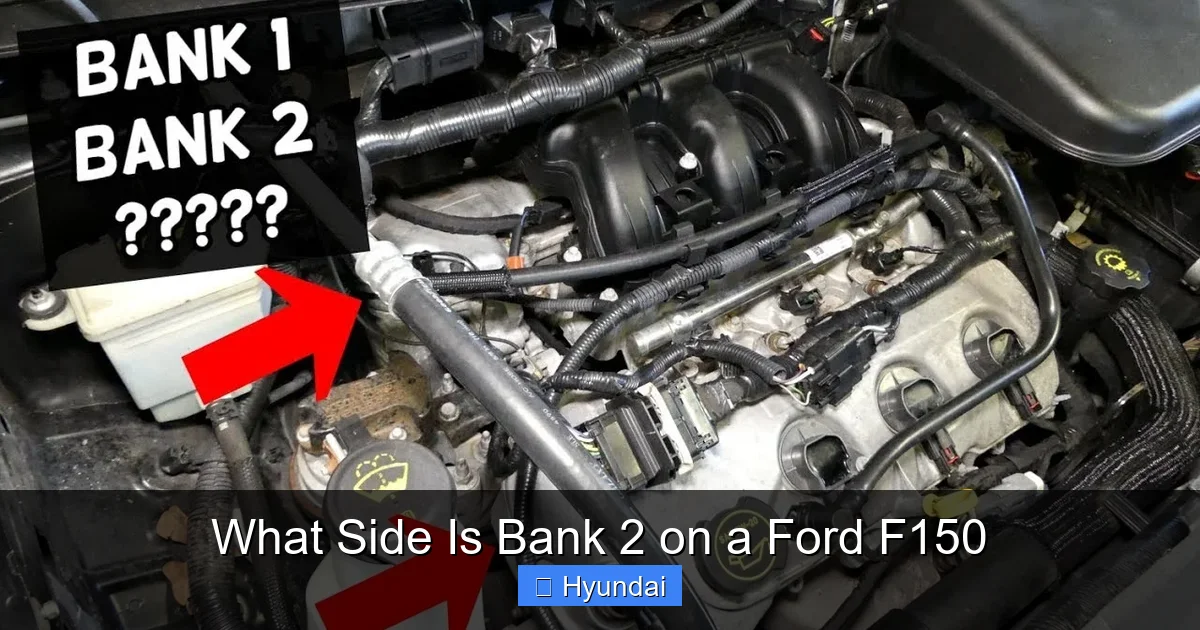
Visual guide about What Side Is Bank 2 on a Ford F150
Image source: i.ytimg.com
The 5.0L Coyote V8 (2011-Present)
This is the most common F150 engine. It’s a 90-degree V8. Bank 2 is unequivocally the driver’s side. The driver’s side exhaust manifold is bolted to the driver’s side cylinder head. The oxygen sensors for Bank 2 are on this manifold. The first sensor (Bank 2 Sensor 1) is mounted near the manifold itself, before the catalytic converter. The second sensor (Bank 2 Sensor 2) is located further down the exhaust system, after the cat. Access to the Bank 2 manifold can be challenging because it’s tucked behind the engine block and close to the steering linkage and, on 4×4 models, the transfer case. You’ll often need special socket extensions and swivels to reach the upstream sensor.
The 3.5L EcoBoost V6 (2011-Present)
This twin-turbocharged V6 is transversely mounted (the engine is mounted sideways, with the accessory belts facing the passenger side). This changes the physical orientation but NOT the bank designation. Cylinder 1 is still on the passenger’s side of the engine block. Therefore, Bank 2 is still the driver’s side. The turbochargers and exhaust manifolds are integrated into the cylinder heads. The Bank 2 turbo and its associated exhaust piping are on the driver’s side of the engine bay. The oxygen sensors are located in the downpipes right after the turbo. This makes Bank 2 components, including the O2 sensors, somewhat easier to access than on the V8 because they are more forward in the engine bay, though they are still behind some shielding.
The 2.7L EcoBoost V6 (2015-Present)
Following the same logic as the 3.5L, the 2.7L is also a transverse V6. Cylinder 1 is on the passenger side. Bank 2 is the driver’s side. The exhaust manifold is part of the cylinder head casting. The Bank 2 oxygen sensor (Sensor 1) is in the driver’s side downpipe, immediately post-turbo. Access is generally good compared to the V8.
The 5.4L and 4.6L Modular V8 (2004-2010)
These are the predecessors to the Coyote. They use the exact same cylinder numbering logic. Bank 2 is the driver’s side. The layout is very similar to the 5.0L, with the driver’s side exhaust manifold being the harder one to reach. The O2 sensor locations are analogous: Bank 2 Sensor 1 on the driver’s side manifold, Bank 2 Sensor 2 further down the pipe.
The 4.2L V6 (1997-2004)
For the older, carbureted and early fuel-injected V6 F150s, the same rule applies. The 4.2L is a 90-degree V6 derived from the 5.0L V8. Bank 2 is the driver’s side. The cylinder numbering is consistent with the later V8s.
Practical Tip: If you ever have any doubt, the most foolproof method is to look at the engine from the front and identify the side with the number one cylinder. You can often see the spark plug wires or coils. On a V8, there are 4 coils on each side. The passenger side front coil is for cylinder 1. That entire side is Bank 1. The other side is Bank 2.
Why Does This Matter? Practical Applications
Knowing which side is Bank 2 isn’t just an academic exercise. It directly impacts your ability to diagnose and fix problems correctly and efficiently.
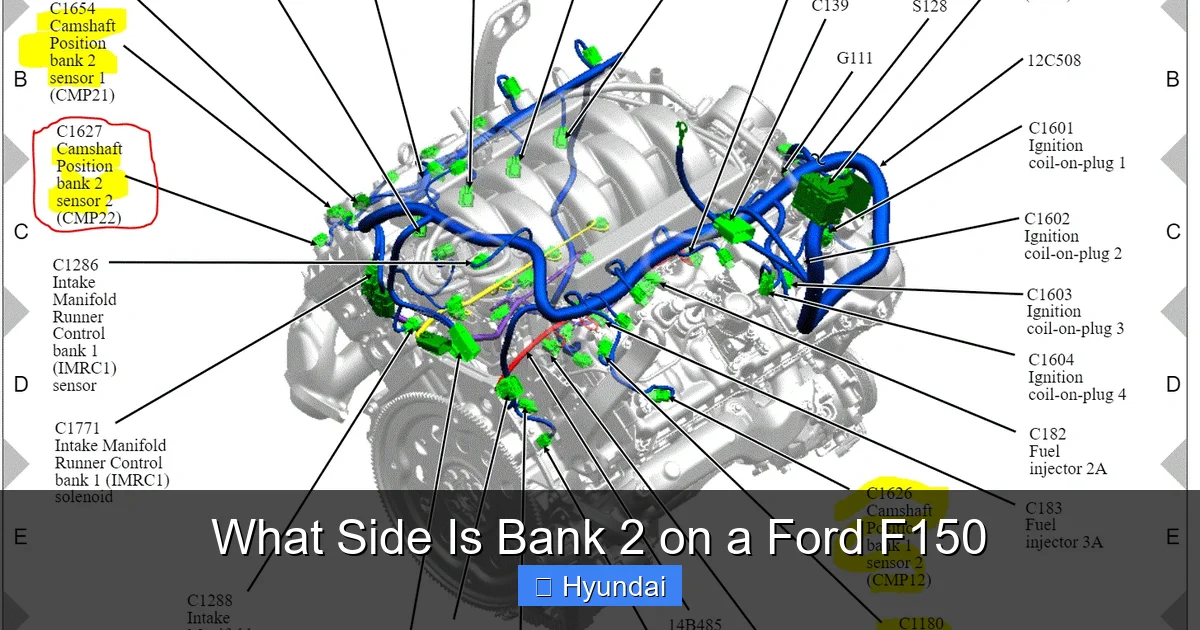
Visual guide about What Side Is Bank 2 on a Ford F150
Image source: 2carpros.com
Replacing Oxygen (O2) Sensors
This is the most common reason people need to know. An O2 sensor code like P0141 (Bank 1, Sensor 2 Heater Circuit) or P0157 (Bank 2, Sensor 2 Heater Circuit) tells you exactly which sensor to replace. If you get a Bank 2 code, you must go to the driver’s side of the exhaust system. Buying a “Bank 2 sensor” means you’re getting the sensor for the driver’s side. If you accidentally install it on the passenger side, the code will not clear, and you’ve wasted time and money. On V8s, the driver’s side (Bank 2) upstream sensor is notoriously difficult. Some people mistakenly replace the easier-to-reach passenger side sensor, which is Bank 1. Always double-check before purchasing and installing.
Diagnosing Exhaust Leaks
An exhaust leak before an O2 sensor can cause lean codes and poor performance. If you have a code for Bank 2, your inspection should focus on the driver’s side exhaust manifold and its gasket. Listen for ticking or hissing sounds from that side of the engine bay, especially when the engine is cold. Look for soot marks around the manifold-to-head joint. A smoke machine test can also pinpoint the leak on the correct bank.
Understanding “Cross-Bank” Misfire Codes
Sometimes, a severe misfire can set multiple codes. A code for a specific cylinder (like P0306 for cylinder 6) will tell you which cylinder is misbehaving. Since cylinder 6 on a Ford V8 is on Bank 2 (driver’s side), you know to focus your spark plug, coil, and injector inspection on that side. This saves you from randomly pulling parts from both sides of the engine.
Catalytic Converter Efficiency Codes
Codes like P0420 (Catalyst System Efficiency Below Threshold) can sometimes be bank-specific (P0430 for Bank 2). This indicates the catalytic converter on the driver’s side exhaust system may be failing. This is critical information because replacing the wrong catalytic converter is an expensive mistake.
Common Mistakes and How to Avoid Them
Even with the rule clear, mistakes happen. Here’s how to avoid the most common pitfalls.
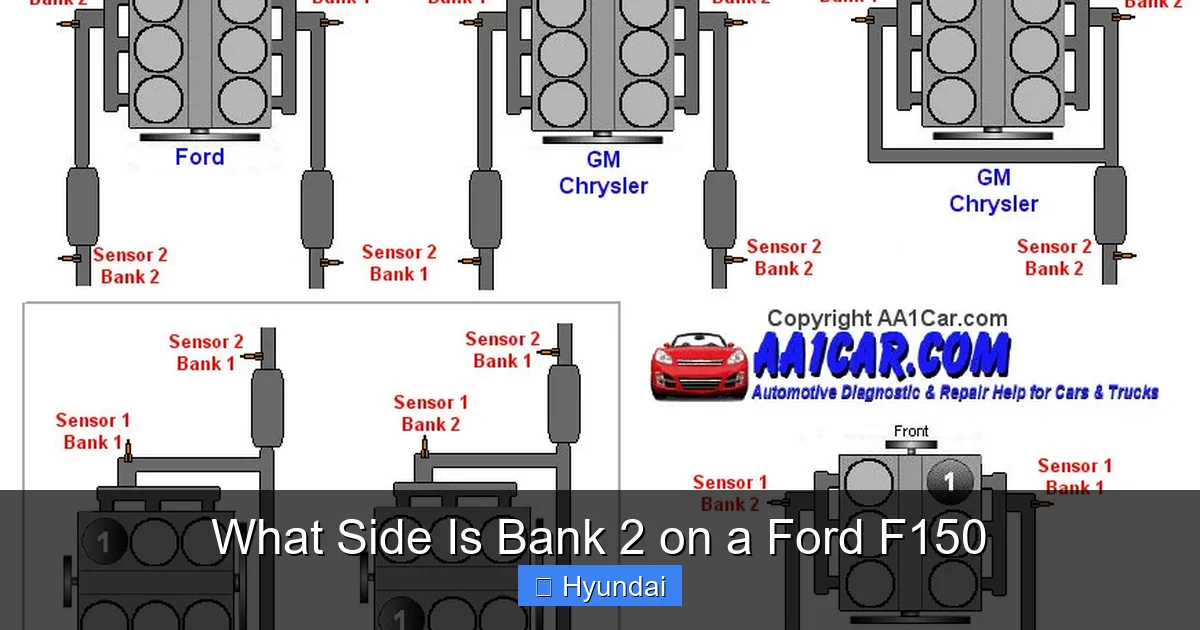
Visual guide about What Side Is Bank 2 on a Ford F150
Image source: aa1car.com
Mistake 1: Confusing “Side” with “Bank”
The instinct is to think “driver’s side = Bank 1” because that’s where you sit. It’s not. Bank 1 is defined by cylinder 1, which is on the passenger side. Always anchor yourself to cylinder 1, not your seat position.
Mistake 2: Assuming All V6s are the Same
While the 3.5L and 2.7L EcoBoost V6s in the F150 follow the rule (Bank 2 = driver’s side), some other manufacturers’ transverse V6s (like some GM or Honda models) number cylinders differently. But for your Ford F150, you are safe with the rule.
Mistake 3: Forgetting About the Transmission Bellhousing
On some engines, the rear cylinders are numbered differently. However, in the Ford Modular family (all relevant F150 engines), the numbering is sequential from front to rear on each bank. Cylinder 1 is front passenger. Cylinder 2 is front driver. Cylinder 3 is next passenger back, and so on. The transmission bellhousing does not change this numbering.
Mistake 4: Ignoring Model Year Variations
While the bank designation has been constant for decades, sensor locations can change slightly between generations. A 2004 F150 with a 5.4L and a 2021 F150 with a 5.0L both have Bank 2 on the driver’s side, but the exact position of the downstream sensor relative to the muffler might differ. Always, if possible, use a repair guide for your specific year, make, and model.
Pro Tip: When in doubt, perform a physical trace. Find the number one cylinder (front passenger). Follow that exhaust manifold back. That’s Bank 1. The other manifold is Bank 2. This hands-on method never fails.
Frequently Asked Questions (FAQs)
Is Bank 2 always the driver’s side on a Ford F150?
Yes. For all Ford F150 trucks equipped with a V6 or V8 engine (including the 3.5L, 2.7L, 5.0L, 5.4L, 4.6L, and 4.2L), Bank 2 is located on the driver’s side of the engine compartment. This is because cylinder number 1, which defines Bank 1, is always on the passenger’s side front of the engine.
Where is the Bank 2 oxygen sensor on a 5.0L F150?
There are two Bank 2 oxygen sensors on a 5.0L F150. Bank 2 Sensor 1 is located on the driver’s side exhaust manifold, near where it connects to the cylinder head. It’s very difficult to access. Bank 2 Sensor 2 is located on the driver’s side of the exhaust system, after the catalytic converter and before the muffler. It’s typically easier to access than the upstream sensor.
What’s the difference between Bank 1 and Bank 2 sensors?
They are physically located on opposite sides of the engine. A Bank 1 sensor is on the passenger-side exhaust component. A Bank 2 sensor is on the driver-side exhaust component. They are not interchangeable; they have different wiring harness connectors that are designed to plug into their specific locations on the vehicle’s wiring harness. Always match the part to the correct bank.
Can a bad spark plug cause a Bank 2 code?
Yes, indirectly. A misfire code (P030X) for a specific cylinder on Bank 2 (like cylinder 2, 4, 6, or 8 on a V8) can be caused by a bad spark plug, ignition coil, or fuel injector on that cylinder. If the misfire is severe and persistent, it can eventually cause a downstream sensor code (like a catalyst efficiency code) to set for Bank 2 because the unburned fuel is damaging the catalytic converter on that side.
Why is my Bank 2 oxygen sensor code not going away after replacement?
First, ensure you replaced the correct sensor (driver’s side). Second, check for an exhaust leak on the Bank 2 side before the sensor you replaced, as this can cause a lean condition that triggers the code again. Third, inspect the wiring harness for damage, corrosion, or poor connections. Finally, the problem may not be the sensor itself but could be an issue with the air/fuel ratio caused by a vacuum leak, bad MAF sensor, or fuel pressure problem affecting that bank specifically.
Is Bank 2 the same on an F150 and an Explorer with the same engine?
Yes. The bank designation is determined by the engine’s internal design and cylinder numbering, not the vehicle it’s placed in. A 5.0L Coyote V8 in an F150, an Explorer, or a Mustang will have cylinder 1 on the passenger side and Bank 2 on the driver’s side. The physical layout in the engine bay might differ slightly, but the fundamental bank assignment is identical.
Frequently Asked Questions
Is Bank 2 always the driver’s side on a Ford F150?
Yes. For all Ford F150 trucks equipped with a V6 or V8 engine (including the 3.5L, 2.7L, 5.0L, 5.4L, 4.6L, and 4.2L), Bank 2 is located on the driver’s side of the engine compartment. This is because cylinder number 1, which defines Bank 1, is always on the passenger’s side front of the engine.
Where is the Bank 2 oxygen sensor on a 5.0L F150?
There are two Bank 2 oxygen sensors on a 5.0L F150. Bank 2 Sensor 1 is located on the driver’s side exhaust manifold, near where it connects to the cylinder head. It’s very difficult to access. Bank 2 Sensor 2 is located on the driver’s side of the exhaust system, after the catalytic converter and before the muffler. It’s typically easier to access than the upstream sensor.
What’s the difference between Bank 1 and Bank 2 sensors?
They are physically located on opposite sides of the engine. A Bank 1 sensor is on the passenger-side exhaust component. A Bank 2 sensor is on the driver-side exhaust component. They are not interchangeable; they have different wiring harness connectors that are designed to plug into their specific locations on the vehicle’s wiring harness. Always match the part to the correct bank.
Can a bad spark plug cause a Bank 2 code?
Yes, indirectly. A misfire code (P030X) for a specific cylinder on Bank 2 (like cylinder 2, 4, 6, or 8 on a V8) can be caused by a bad spark plug, ignition coil, or fuel injector on that cylinder. If the misfire is severe and persistent, it can eventually cause a downstream sensor code (like a catalyst efficiency code) to set for Bank 2 because the unburned fuel is damaging the catalytic converter on that side.
Why is my Bank 2 oxygen sensor code not going away after replacement?
First, ensure you replaced the correct sensor (driver’s side). Second, check for an exhaust leak on the Bank 2 side before the sensor you replaced, as this can cause a lean condition that triggers the code again. Third, inspect the wiring harness for damage, corrosion, or poor connections. Finally, the problem may not be the sensor itself but could be an issue with the air/fuel ratio caused by a vacuum leak, bad MAF sensor, or fuel pressure problem affecting that bank specifically.
Is Bank 2 the same on an F150 and an Explorer with the same engine?
Yes. The bank designation is determined by the engine’s internal design and cylinder numbering, not the vehicle it’s placed in. A 5.0L Coyote V8 in an F150, an Explorer, or a Mustang will have cylinder 1 on the passenger side and Bank 2 on the driver’s side. The physical layout in the engine bay might differ slightly, but the fundamental bank assignment is identical.
