
What Side Is Bank 2 on a Ford F-150?

Bank 2 on a Ford F-150 refers to the cylinder bank opposite the primary bank containing cylinder number one. For the vast majority of V8-powered F-150s, this is the passenger side of the engine. Correctly identifying Bank 2 is absolutely critical for accurately diagnosing OBD-II trouble codes and performing maintenance on components like oxygen sensors and spark plugs.
Ever popped the hood of your Ford F-150, seen a check engine light, and felt a wave of confusion wash over you? You’re not alone. One of the most common—and frustrating—points of confusion for DIY mechanics and even some professionals is figuring out exactly which side of the engine is “Bank 2.” It seems like a simple question, but getting it wrong can send you down a rabbit hole of unnecessary repairs. So, let’s clear the fog right now. For the overwhelming majority of Ford F-150 trucks equipped with a V8 engine, Bank 2 is the passenger side of the engine. But why is that? And what about V6 models? What does “Bank” even mean? This guide will walk you through everything you need to know, transforming that confusion into confident, accurate knowledge.
Understanding engine banks isn’t just automotive trivia; it’s a fundamental skill for anyone who wants to diagnose their own truck or simply understand what a mechanic is telling them. When your truck’s computer stores a code like P0174, it’s literally telling you, “The air-fuel mixture on Bank 2 is too lean.” If you don’t know which side that is, you’re guessing. Guessing with modern engines is expensive. We’ll break down the logic, show you how to identify it visually on your specific truck, and explain why this matters for common repairs. By the end, you’ll be able to walk up to any F-150, open the hood, and point confidently to Bank 2.
Key Takeaways
- Bank 2 is the non-primary cylinder bank: It’s the bank that does not contain cylinder number one, which is Bank 1.
- For V8 F-150s, Bank 2 is the passenger side: This applies to popular engines like the 5.0L Coyote V8, 6.2L V8, and 6.8L V8.
- Engine configuration dictates bank layout: V6 engines like the 3.5L EcoBoost also have two banks, but always verify using a service manual for your specific model year.
- Misidentification leads to misdiagnosis: Confusing Bank 1 and Bank 2 can cause you to replace the wrong sensors or parts, wasting time and money.
- Physical location is consistent but access varies: While Bank 2 is always on the passenger side, accessing its components can be trickier due to engine bay layout and other components.
- OBD-II codes specify the bank: Codes like P0171 (System Too Lean Bank 1) and P0174 (System Too Lean Bank 2) directly tell you which bank is affected.
- Always consult the factory service manual: This is the only guaranteed way to confirm bank locations and procedures for your specific truck.
📑 Table of Contents
- Decoding Engine Banks: What Does “Bank 2” Mean?
- Ford F-150 Engine Configurations Through the Years
- How to Physically Locate Bank 2 on Your F-150
- The Diagnostic Importance of Knowing Bank 2
- Practical Examples: Working on Bank 2 Components
- Common Mistakes and How to Avoid Them
- Maintenance Tips Specific to Bank 2
- Conclusion
Decoding Engine Banks: What Does “Bank 2” Mean?
Before we talk about sides, we need to understand the term “bank” itself. In automotive engineering, a “bank” refers to a set of cylinders that are on the same side of a V-type engine. A V8 engine has two banks of four cylinders each, arranged in a V shape. A V6 has two banks of three cylinders. The straight-six or inline-four engines you might find in smaller cars have only one bank. The “bank” designation is how the engine’s computer (PCM) keeps track of which group of cylinders it’s monitoring or controlling.
The Primary Bank: Bank 1
Bank 1 is always the bank that contains cylinder number one. This is the universal rule set by the OBD-II standard that all vehicles follow. Cylinder number one is not arbitrarily placed; it’s a specific location determined by the manufacturer. For most American V-type engines, including Ford’s, cylinder number one is typically located at the front of the engine on the driver’s side (the left side when you’re sitting in the truck facing forward). This means for a Ford F-150 with a V8, Bank 1 is the driver’s side of the engine block.
Think of it like a house with two identical wings. The engine computer needs to know which wing (bank) has the “master bedroom” (cylinder 1). That wing is Bank 1. The other wing is Bank 2. All sensors, like oxygen sensors, are then numbered relative to these banks. You’ll see terms like “Bank 1 Sensor 1” (the upstream oxygen sensor on the driver’s side) and “Bank 2 Sensor 2” (the downstream oxygen sensor on the passenger side). This numbering is crucial for reading codes and ordering the correct parts.
Why Manufacturers Use Bank Designations
Why not just say “left” and “right”? Because “left” and “right” are relative to the direction you’re facing. In automotive terms, “left” is almost always the driver’s side (US market), and “right” is the passenger side. However, when you’re lying under the engine or looking at it from the front, your perspective changes. The bank system is consistent from the engine’s own perspective. More importantly, the bank system allows the PCM to have a standardized way to reference cylinder groups that works regardless of the engine’s orientation in the vehicle. It’s a precise technical language that eliminates ambiguity.
This system becomes critically important with modern emissions controls. The PCM constantly monitors the oxygen content in the exhaust from each bank to adjust fuel delivery. If it detects a lean condition (too much air, not enough fuel) on Bank 2, it sets a code like P0174. If it detects a catalyst efficiency problem on Bank 2, it might set a P0420 for that specific bank. Without the bank designation, these codes would be useless. You’d have no idea which set of cylinders or which exhaust manifold the problem originates from. This is why knowing Bank 2’s location is step one in any diagnostic process for a V-engine.
Ford F-150 Engine Configurations Through the Years
The Ford F-150 has been offered with a wide array of engines over its generations. The location of Bank 2 depends entirely on whether the engine is a V-type (two banks) or an inline-type (one bank). For the purpose of this article, we’re focused on V-type engines, as only they have a Bank 2. Let’s look at the common F-150 powerplants.

Visual guide about What Side Is Bank 2 on a Ford F-150?
Image source: cdn.cartipsdaily.com
V8 Engines: The Classic Bank 2 Scenario
For decades, the F-150’s flagship engine has been a V8. From the ancient overhead valve (OHV) 5.0L and 5.8L engines of the 1990s and early 2000s to the modern dual-overhead-cam (DOHC) 5.0L Coyote and 6.2L V8s, the bank layout has remained consistent for Ford’s V8s in front-engine, rear-wheel-drive applications like the F-150.
- Cylinder 1 Location: On these Ford V8s, cylinder number one is located at the front of the engine on the driver’s side (left side of the truck).
- Bank 1: Therefore, Bank 1 is the driver’s side cylinder bank. This bank contains cylinders 1, 2, 3, and 4.
- Bank 2: Consequently, Bank 2 is the passenger side cylinder bank. This bank contains cylinders 5, 6, 7, and 8.
This holds true for:
- The iconic 5.0L “Coyote” V8 (2011-present)
- The powerful 6.2L “Boss” V8 (2011-2014, 2017-2020 in various trims)
- The supercharged 5.2L V8 in the Raptor (2017-2020)
- The older 4.6L and 5.4L Triton V8s (1997-2010)
- The 6.8L V10 (1997-2005 in some heavy-duty models)
If your F-150 has a V8, you can be 99% sure that Bank 2 is on the passenger side. You can confirm this by looking at the engine. The exhaust manifolds will be on the outer sides of each bank. The passenger-side exhaust manifold is attached to Bank 2. The upstream oxygen sensors (Bank 1 Sensor 1 and Bank 2 Sensor 1) will be screwed into the exhaust manifolds just after the cylinder heads.
V6 Engines: The EcoBoost Exception
The F-150’s lineup has been dominated by turbocharged V6 engines, primarily the 3.5L EcoBoost V6, since 2011. This is a 60-degree V6 with two cylinder heads. Does it have banks? Yes, it does. It has Bank 1 and Bank 2.
For the 3.5L EcoBoost V6 in the F-150:
- Cylinder 1 Location: Cylinder number one is on the driver’s side (left side) of the engine, at the front.
- Bank 1: The driver’s side cylinder head (cylinders 1, 2, 3).
- Bank 2: The passenger side cylinder head (cylinders 4, 5, 6).
So, even with the V6, Bank 2 remains the passenger side. The same logic applies. The turbocharger for Bank 2 is typically on the passenger side of the engine bay. The Bank 2 upstream oxygen sensor is in the passenger-side exhaust manifold. This consistency across V-engine types in the F-150 is helpful. The only time you won’t have a Bank 2 is with an inline-four engine, which the F-150 has never used in its mainstream models.
What about the older 4.0L V6 (1997-2010)? That was a SOHC V6, and it followed the same pattern. Cylinder 1 was on the driver’s side, making Bank 2 the passenger side. The principle is solid across Ford’s truck V-engines for the last 25+ years.
How to Physically Locate Bank 2 on Your F-150
Knowing it’s the passenger side is one thing. Finding it in the crowded engine bay of a modern F-150 is another. Here’s how to pinpoint Bank 2 components with confidence.
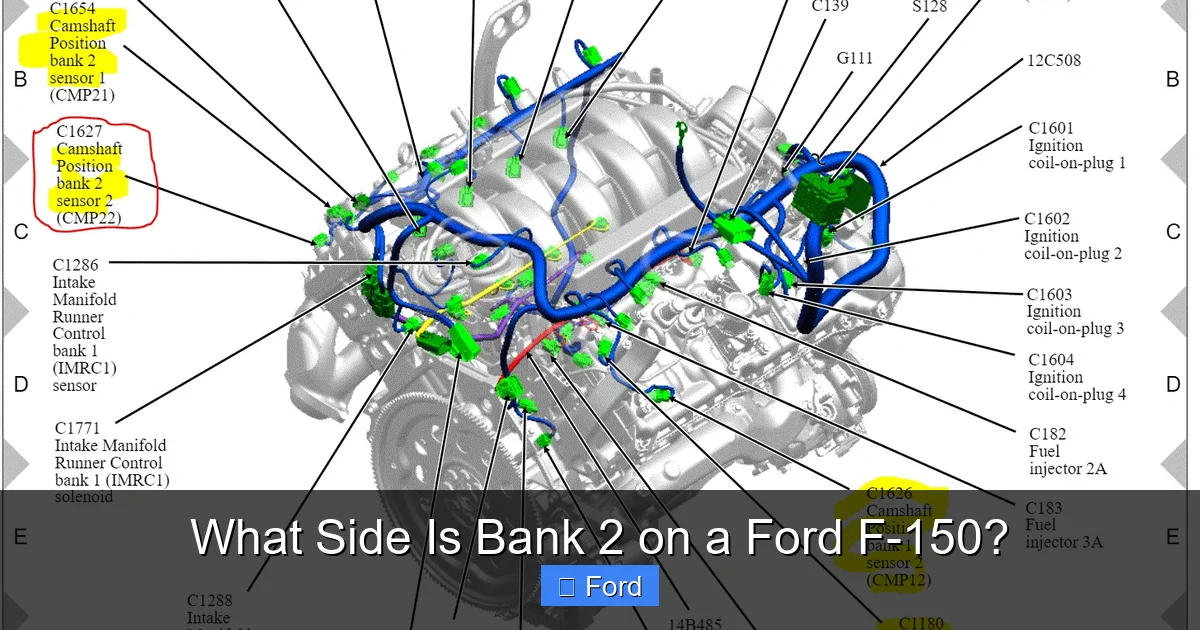
Visual guide about What Side Is Bank 2 on a Ford F-150?
Image source: 2carpros.com
Visual Cues and Landmarks
Open the hood and stand in front of the truck. The “passenger side” is the right side of the engine bay (your right as you face the truck). Now, look for these giveaways:
- The Exhaust Manifolds: Each cylinder bank has its own exhaust manifold bolted to the head. The manifold on the right/passenger side is the Bank 2 manifold. It will be hot when the engine is running, so be careful. You’ll see the exhaust pipes from this manifold merge into a single pipe, often with the Bank 2 downstream oxygen sensor (after the catalytic converter) in that pipe.
- The Upstream Oxygen Sensors: These are the most common point of reference. They are usually located just below the exhaust manifold ports, screwed into the pipe coming from the manifold. There will be one sensor on each bank’s exhaust. The sensor on the passenger-side manifold is Bank 2 Sensor 1. It will have a wiring harness running from it towards the center of the engine bay. The connector might be labeled or you can trace it. On later models, these sensors are often accessed from underneath the vehicle.
- The Intake Manifold: While the intake manifold is a single piece on many modern engines, the fuel injector connectors and sometimes the manifold itself will have labels or a physical split indicating the two banks. The passenger-side portion of the intake runners feeds Bank 2 cylinders.
- The Spark Plugs and Ignition Coils: On coil-on-plug systems like the 5.0L Coyote, each cylinder has its own ignition coil mounted directly on the spark plug. The coils on the passenger-side cylinder head are for Bank 2 (cylinders 5, 6, 7, 8). They are usually easier to see from the top than the driver’s side bank, which is often partially obscured by the intake tubing.
Using the Vehicle’s Service Manual
This is your ultimate authority. A factory service manual (FSM) or a high-quality aftermarket manual like Haynes or Chilton will have detailed diagrams. Look for sections titled “Engine Identification,” “Cylinder Head Removal,” or “Oxygen Sensor Replacement.” These will have exploded views clearly labeling “Bank 1” and “Bank 2.” Investing in a manual for your specific model year is one of the best moves a DIY truck owner can make. It removes all guesswork.
Identifying Bank 2 Sensors and Components
Once you know the side, identifying specific components is straightforward. For a code like P0420 (Catalyst System Efficiency Below Threshold Bank 2), you need to look at the catalytic converter on the passenger-side exhaust system. That’s the Bank 2 catalyst. For a misfire code like P0306 (Cylinder 6 Misfire Detected), you need to know that cylinder 6 is on Bank 2 (since cylinders 5-8 are Bank 2 on a V8). So cylinder 6 is on the passenger-side head. You would then inspect the spark plug, ignition coil, and fuel injector for that specific cylinder on that side.
A practical tip: When replacing oxygen sensors, it’s a great practice to label the wiring harness connectors with tape before unplugging them. Write “B1S1” and “B2S1” on the tape. This prevents cross-connecting them during reinstallation, which can cause serious driveability issues. This simple habit saves hours of headache.
The Diagnostic Importance of Knowing Bank 2
Let’s connect the dots to real-world problems. Why does knowing Bank 2’s location save you money and time? Because it directs your diagnosis.

Visual guide about What Side Is Bank 2 on a Ford F-150?
Image source: i.ytimg.com
Common OBD-II Codes Related to Bank 2
The PCM sets codes that are specific to a bank. Here are the most frequent ones you’ll encounter that point to Bank 2:
- P0171 and P0174: System Too Lean (Bank 1 / Bank 2). A lean condition means there’s too much air or not enough fuel. P0174 specifically points to Bank 2. Your diagnosis should focus on vacuum leaks on the passenger side of the intake (intake manifold gasket, hoses, brake booster line), fuel pressure issues affecting both banks equally, or faulty Bank 2 fuel injectors.
- P0420: Catalyst System Efficiency Below Threshold. This code can be for Bank 1 or Bank 2. P0420 for Bank 2 means the catalytic converter on the passenger-side exhaust is not cleaning the exhaust as effectively as it should. This could be due to a failed catalyst, a faulty upstream or downstream oxygen sensor on that bank, or an exhaust leak before the downstream sensor.
- P0430: Catalyst System Efficiency Below Threshold (Bank 2). Same as P0420 but specifically for Bank 2. The diagnostic path is identical, focusing on the passenger-side exhaust system.
- P030X: Cylinder X Misfire Detected. If the code is P0305, P0306, P0307, or P0308 on a V8, that’s a Bank 2 cylinder misfire (cylinders 5,6,7,8). You would then focus your inspection on the passenger-side head for that specific cylinder’s ignition coil, spark plug, and fuel injector.
- P013X / P015X: Oxygen Sensor Circuit Malfunction (Bank 1 / Bank 2). These codes point directly to a problem with a specific oxygen sensor’s circuit. P0136 is Bank 1 Sensor 1, P0156 is Bank 2 Sensor 1. You’d check the sensor itself, its wiring, and connections on the passenger side for a P0156 code.
How Misidentifying Banks Leads to Wrong Repairs
Imagine this scenario: Your F-150 throws a P0174 (Bank 2 System Too Lean). You, not knowing which side that is, decide to replace the mass air flow (MAF) sensor because it’s a common lean cause. You replace it, clear the code, and it comes back. Why? Because the actual problem is a small vacuum leak in the brake booster hose on the passenger side—a leak that only affects Bank 2. You wasted $200 on a new MAF sensor and didn’t fix the problem. Or worse, a mechanic misdiagnoses it and tells you the catalytic converter on Bank 2 is bad, and you pay for an expensive replacement only to have the code return because the upstream oxygen sensor was faulty. Knowing the bank is your first line of defense against being sold unnecessary parts and labor.
This principle extends to other manufacturers too. For instance, diagnostic trouble codes on a Dodge Ram might include a “No Bus” code, which indicates a communication fault on the vehicle’s Controller Area Network (CAN) bus—a completely different issue, but one that also requires precise understanding of manufacturer-specific systems. The key takeaway is: the code tells you the system and the bank. You must know the bank’s location to target your investigation.
Using Diagnostic Tools Effectively
Modern scan tools like the FORScan software (highly recommended for Ford owners) or a professional-grade scan tool will not only read the code but often provide a description. However, they won’t tell you “passenger side.” That’s your job. A good tool will show you live data from oxygen sensors. You can monitor the “Bank 2 Sensor 1” voltage. If it’s stuck at a low voltage (around 0.1-0.3V), it might indicate a lean condition on that bank. You can then physically go to the passenger-side exhaust manifold and check that sensor. This targeted approach is efficient.
When performing a smoke test for vacuum leaks, you know to pay extra attention to all vacuum lines, the intake manifold gasket, and the brake booster hose on the passenger side of the engine if you have a Bank 2 lean code. You wouldn’t waste time meticulously checking the driver’s side first. This focused troubleshooting is the hallmark of an efficient mechanic.
Practical Examples: Working on Bank 2 Components
Let’s walk through a couple of common maintenance tasks where knowing Bank 2 is essential.
Replacing Bank 2 Oxygen Sensors
Your F-150 is throwing a P0156 (Bank 2 Sensor 1 Circuit). Time for a new upstream oxygen sensor on the passenger side. Here’s the process with bank knowledge:
- Safety First: Let the engine cool completely. Exhaust manifolds get extremely hot.
- Locate: Find the exhaust manifold on the right/passenger side of the engine. The sensor is the stubby, usually silver or black, component with a wire harness plugged into it, screwed into the manifold pipe.
- Access: On many F-150s, the easiest way to access the upstream sensors is from underneath the vehicle. You’ll need to safely lift the truck and secure it on jack stands. The passenger-side sensor will be on the exhaust pipe coming from the front of the passenger-side cylinder head.
- Remove: Spray the sensor threads with penetrating oil (like PB Blaster) and let it soak. Use a proper oxygen sensor socket (has a slot for the wire) and a breaker bar. Turn counter-clockwise. It may be very tight.
- Install: Thread the new sensor by hand first to avoid cross-threading. Tighten to the manufacturer’s specification (usually 30-45 ft-lbs). Apply anti-seize compound to the threads if the new sensor doesn’t come pre-coated.
- Reconnect: Plug the wiring harness in. Ensure the clip is secure. Lower the vehicle.
Notice how knowing it’s the “passenger side” guided every step, from where to look under the truck to which exhaust pipe to trace. If you had replaced the sensor on the driver’s side, the code would have remained.
Changing Spark Plugs on Bank 2
For a misfire on cylinder 6 (P0306), you need to change the spark plug on cylinder 6 of the passenger-side head. On a 5.0L Coyote V8:
- Cylinders 5, 6, 7, 8 are on the passenger side (Bank 2).
- Cylinder 6 is the second cylinder from the front on that head (front is closest to the radiator, rear is closest to the firewall).
The procedure:
- Let the engine cool.
- Remove the engine cover if equipped (usually just pulls off).
- Locate the ignition coils on the passenger-side head. They are rectangular modules bolted to the valve cover, each with a wiring connector.
- Disconnect the wiring harness from the coil for cylinder 6. Press the tab and pull.
- Remove the bolt holding the coil in place (usually 8mm or 10mm).
- Pull the coil straight up and out. It may stick due to the boot seal; twist slightly if needed.
- You’ll now see the spark plug deep in the hole. Use a spark plug socket with a rubber boot or a magnetic socket to extract the old plug. Turn counter-clockwise.
- Check the gap on the new plug (usually pre-gapped for the application) and install it by hand first, then torque to specification (about 13-15 ft-lbs for the Coyote).
- Reinstall the coil, bolt, and connector. Ensure a good seal.
Again, bank knowledge tells you exactly which head to work on and which coil to remove. The passenger-side head is often more accessible than the driver’s side, which is partially hidden by the intake plumbing.
Common Mistakes and How to Avoid Them
Even with the right information, pitfalls exist. Here’s how to sidestep them.
Assuming All V8s Are the Same
While Ford’s V8s in the F-150 are consistent, this is not a universal rule. Some European or Asian manufacturers place cylinder 1 on the opposite side. For example, many BMW V8s have cylinder 1 on the passenger side, meaning their Bank 1 is passenger and Bank 2 is driver. Always verify for your specific engine. The rule of thumb for American trucks (Ford, GM, Ram) is that V8s have cylinder 1 on the driver’s side, making Bank 2 the passenger side. But when in doubt, the service manual is your bible.
Overlooking Engine Orientation
The F-150 has a front-engine, rear-wheel-drive layout. The “front” of the engine is the end with the belts and pulleys (the accessory drive). The “rear” is the end connected to the transmission. Cylinder 1 is *always* at the front of the engine block. This is a critical point. On a transverse-mounted engine (like in many front-wheel-drive cars), “front” and “rear” get confusing, but on your F-150, it’s straightforward. The front bank cylinders are closest to the radiator support.
Skipping the Service Manual
Relying on internet forums alone can be risky. A well-meaning but incorrect post can send you down the wrong path. The factory service manual provides the definitive diagram for your exact model year, engine, and even cab/bed configuration, as some components (like the downpipe) can differ. It also gives you critical torque specifications and procedural warnings (e.g., “do not reuse this gasket”). Having the right manual is as important as having the right tools, like when replacing suspension components that require specific sequences and torque values.
Forgetting About Year-to-Year Changes
The basic bank layout (Bank 2 = passenger) has been constant for Ford’s V-truck engines for a long time. However, sensor locations, connector types, and even engine covers can change from one generation to the next. A 2004 F-150 with the 5.4L Triton has its oxygen sensors in different positions than a 2021 F-150 with the 5.0L Coyote. The Coyote’s coils are on the valve cover; the Triton’s might have a different setup. Always look for resources specific to your truck’s model year range.
Maintenance Tips Specific to Bank 2
Knowing Bank 2 helps you be proactive. Here are some tips:
Regular Inspection Points
During routine oil changes or under-hood inspections, take a moment to look at the Bank 2 side (passenger).
- Check for Exhaust Leaks: Look for soot marks or hear for a ticking sound coming from the passenger-side exhaust manifold or downpipe, especially when the engine is cold. An exhaust leak before the oxygen sensor will cause a lean code and poor performance.
- Inspect Wiring: Trace the wiring harness for the Bank 2 oxygen sensor and ignition coils. Look for chafed insulation, burn marks, or rodent damage. These wires run hot and are a common failure point.
- Look for Oil Leaks: On the 5.0L Coyote, the passenger-side valve cover gasket is a known leak point. Oil dripping down the side of the engine can contaminate the oxygen sensor or cause a misfire if it gets on the spark plug boots. Addressing small leaks early prevents bigger, more expensive problems, much like keeping up with software updates in an aftermarket radio to avoid glitches.
- Listen for Noises: A ticking or tapping noise that seems louder on the passenger side could indicate a lifter or pushrod issue specific to that bank.
When to Seek Professional Help
If you’ve identified a Bank 2-specific code and the simple fixes (tightening gas cap, checking for obvious vacuum leaks, replacing the suspect oxygen sensor) don’t resolve it, the problem may be deeper. This could involve:
- Internal engine mechanical issues (low compression on Bank 2 cylinders).
- A failing fuel injector on Bank 2.
- A damaged or clogged catalytic converter on the passenger-side exhaust.
- PCM wiring harness issues affecting only the Bank 2 circuits.
Diagnosing these often requires specialized tools like a cylinder leakage tester, fuel pressure tester, or advanced scan tool to monitor fuel trims per bank. At that point, consulting a technician with experience on Ford trucks is the wise move. They can use their knowledge of Bank 2’s layout to efficiently test each component.
Conclusion
The question “What side is Bank 2 on a Ford F-150?” has a clear and consistent answer for the engines that matter most: it’s the passenger side. This simple piece of knowledge is a powerful tool in your automotive arsenal. It transforms vague check engine lights into targeted diagnostic paths. It ensures you buy the correct replacement part—the Bank 2 oxygen sensor, not the Bank 1. It helps you understand your mechanic’s diagnosis and avoid unnecessary repairs.
The logic is elegant: Bank 1 is where cylinder 1 lives (driver’s side for Ford V-truck engines), so Bank 2 is the other side. Always confirm with your specific model year’s service manual, as there can be exceptions in extreme cases or with very old engines. But for the modern F-150, from the 4.6L V8 to the mighty 5.0L Coyote and the turbocharged 3.5L V6, you can confidently point to the right side of the engine bay and say, “That’s Bank 2.” The next time a code like P0174 or P0420 appears, you’ll know exactly where to start looking, saving you time, money, and a whole lot of frustration. Knowledge, after all, is the best diagnostic tool there is.
Frequently Asked Questions
Is Bank 2 always the passenger side on a Ford F-150?
Yes, for all V8 and V6 engines (like the 5.0L Coyote, 6.2L V8, and 3.5L EcoBoost) used in F-150s from the late 1990s to the present, Bank 2 is the passenger side. This is because cylinder number one is on the driver’s side, making that Bank 1.
How can I be 100% sure which side is Bank 2 on my specific truck?
The only foolproof method is to consult your factory service manual. It will have exact diagrams. As a strong secondary check, locate the upstream oxygen sensors; the one on the passenger-side exhaust manifold is Bank 2 Sensor 1.
What happens if I misdiagnose a Bank 2 issue as a Bank 1 problem?
You will likely replace parts on the wrong side of the engine, such as the incorrect oxygen sensor or spark plugs. The check engine light will return because the actual problem on Bank 2 remains unfixed, costing you additional time and money for parts and labor.
Can I use the same diagnostic procedure for Bank 1 and Bank 2 codes?
The diagnostic *logic* is the same (e.g., check for vacuum leaks, sensor operation, fuel delivery), but the *location* of your inspection changes. A Bank 2 code directs you to the passenger-side components and vacuum lines, while a Bank 1 code directs you to the driver’s side.
Are Bank 2 components harder to access than Bank 1 components?
Often, yes. On many F-150s, the driver’s side (Bank 1) is partially obstructed by the intake air tube and other plumbing, making the passenger side (Bank 2) slightly more accessible for jobs like spark plug replacement. However, accessing the Bank 2 oxygen sensors usually requires going underneath the vehicle for both sides.
Does the engine size (4.6L vs 5.0L vs 6.2L) change which side Bank 2 is on?
No. Regardless of the V8 displacement, the fundamental cylinder numbering and bank layout is the same across Ford’s Modular engine family and earlier overhead valve V8s used in the F-150. Bank 2 is always the passenger side cylinder bank.
