
What’s the Difference Between Jeep Grand Cherokee Models?

The Jeep Grand Cherokee lineup is incredibly diverse, spanning from value-packed family haulers to high-performance supercharged beasts and luxurious three-row explorers. Understanding the differences between models like the Laredo, Limited, Overland, Summit, and Trackhawk is crucial, as each offers distinct powertrains, drivetrain systems, interior appointments, and technology packages. Whether you prioritize off-road capability, on-road comfort, towing capacity, or premium amenities, there’s a specific Grand Cherokee model tailored to your needs and budget.
So, you’ve decided on a Jeep Grand Cherokee. Excellent choice. It’s an iconic nameplate that blends legendary off-road heritage with surprising on-road refinement and a whole lot of modern tech. But here’s where the plot thickens: walk into a Jeep dealership, and you’ll see a “Grand Cherokee” badge on everything from a relatively modestly equipped SUV to a $100,000+ supercharged monster. “What’s the difference?” you ask. It’s a great question, and the answer is everything. The Grand Cherokee isn’t one model; it’s a family of vehicles sharing a core platform but differentiated by trim level, powertrain, drivetrain, and body style. Choosing the right one is about matching its specific personality to your life. Let’s break it all down, from the ground up.
Key Takeaways
- Understanding What’s the Difference Between Jeep Grand Cherokee Models?: Provides essential knowledge
📑 Table of Contents
- Understanding the Grand Cherokee Lineup: It’s More Than Just Trims
- Engine and Performance: From Efficient to Insane
- Drivetrain and Capability: Not All 4x4s Are Created Equal
- Interior and Technology: A World of Difference
- Model Year Breakdown: What Changed When (2021-2024)
- Choosing the Right Grand Cherokee Model For You
Understanding the Grand Cherokee Lineup: It’s More Than Just Trims
First, let’s get the big-picture view. For the 2021 model year and beyond, Jeep split the Grand Cherokee lineup into two distinct body styles. This is the most fundamental difference you need to grasp.
The Standard Two-Row Grand Cherokee
This is the classic Grand Cherokee you’ve known for decades. It seats five passengers comfortably and focuses on providing maximum cargo space behind the second row. It’s the more agile, sportier-feeling of the two on the road. The two-row model is where you’ll find the full spectrum of trims, from the workhorse Laredo to the apex predator Trackhawk. If you don’t need a third row, this is your starting point.
The Three-Row Grand Cherokee L
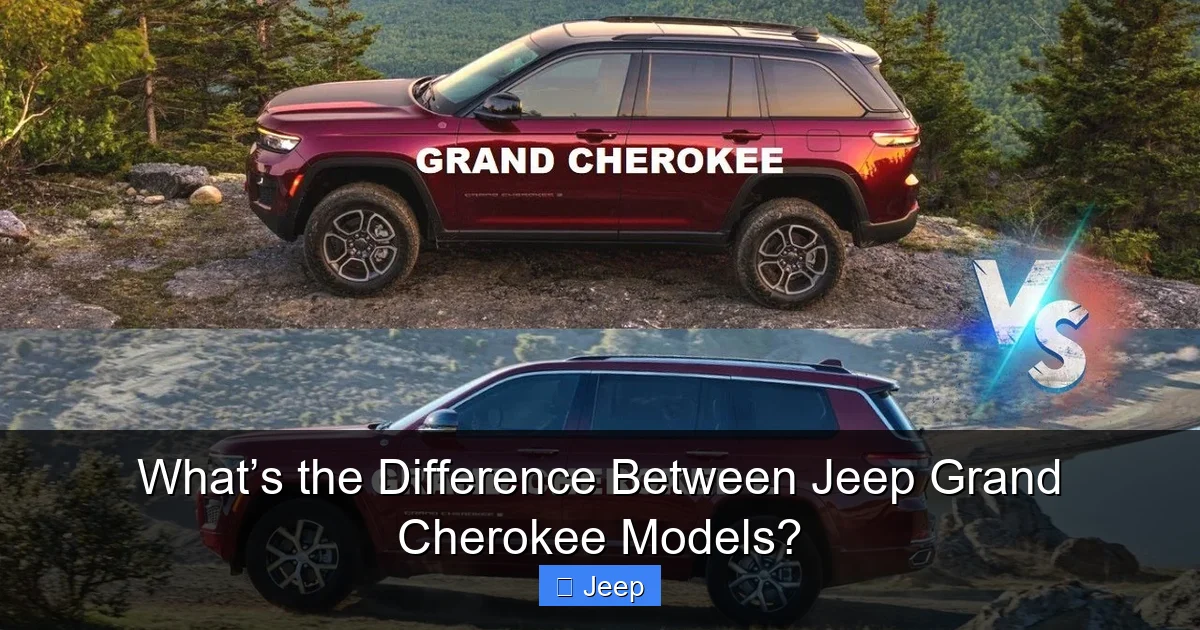
Introduced for the 2023 model year, the Grand Cherokee L stretches the wheelbase by about 5 inches to accommodate a third-row seat. This transforms it into a direct competitor to the Toyota Highlander and Honda Pilot. It’s a more family-oriented, spacious machine, but that added length slightly reduces its approach and departure angles for serious off-roading. Crucially, the Grand Cherokee L is not available in the high-performance Trackhawk or Trailhawk trims; its lineup focuses on comfort, space, and luxury (Limited, Overland, Summit). For a deep dive into the three-row variant, check out our guide on the 2023 Grand Cherokee L Overland.
Within each body style, the hierarchy of trims is generally consistent, though availability differs.
Engine and Performance: From Efficient to Insane
Under the hood is where the Grand Cherokee’s chameleon-like nature really shines. The same SUV shape can house four completely different engines. Your choice here defines the vehicle’s character—fuel economy, towing muscle, and sheer acceleration.

Visual guide about What’s the Difference Between Jeep Grand Cherokee Models?
Image source: jeepguides.com
The Standard V6: The Workhorse
The 3.6-liter V6 is the default engine for most base and mid-level trims (Laredo, Limited, Overland). It produces 290 horsepower and 257 lb-ft of torque. It’s a smooth, reliable, and adequately powerful engine for daily driving and light towing (up to 5,000 lbs). It’s paired with a standard 8-speed automatic transmission. If your needs are mostly grocery-getting and highway cruising, this is more than sufficient and offers the best fuel economy in the non-hybrid lineup (around 19-21 MPG combined).
The V8: For Serious Towing and Throttle Response
Available on higher trims like the Summit and standard on the Trackhawk, the 5.7-liter Hemi V8 churns out 357 horsepower and 390 lb-ft of torque. The big difference is low-end grunt. You feel that torque immediately, making merging and passing effortless. Its primary advantage is towing capacity, which jumps to a maximum of 7,200 pounds—over 2,000 lbs more than the V6. The trade-off is significantly worse fuel economy (around 15-17 MPG combined).
The 4xe Turbo-Hybrid: Efficiency with a Boost
This is a game-changer. The 4xe (pronounced “four-by-e”) pairs a 2.0-liter turbocharged 4-cylinder with an electric motor for a combined 375 horsepower. It’s the most powerful setup next to the Trackhawk, but its superpower is efficiency. With a full battery, you get an estimated 26 MPG combined and up to 26 miles of electric-only range. It’s perfect for short commutes and dramatically reduces fuel costs. It’s available on most two-row trims (Limited, Overland, Summit) but not on the L or Trackhawk.
The Supercharged V8 (Trackhawk Only): The Apex Predator
This isn’t just an engine; it’s a statement. The 6.2-liter supercharged Hemi V8 in the Grand Cherokee Trackhawk produces a staggering 707 horsepower and 645 lb-ft of torque. It launches the 5,300-lb SUV from 0-60 mph in just 3.5 seconds. This engine is found nowhere else in the Grand Cherokee family. If your priority is drag-strip-level performance in an SUV, the Trackhawk is your only choice. Its fuel economy is, predictably, abysmal (around 11-13 MPG). To truly understand what this powertrain means, you have to read about the Trackhawk Experience.
Drivetrain and Capability: Not All 4x4s Are Created Equal
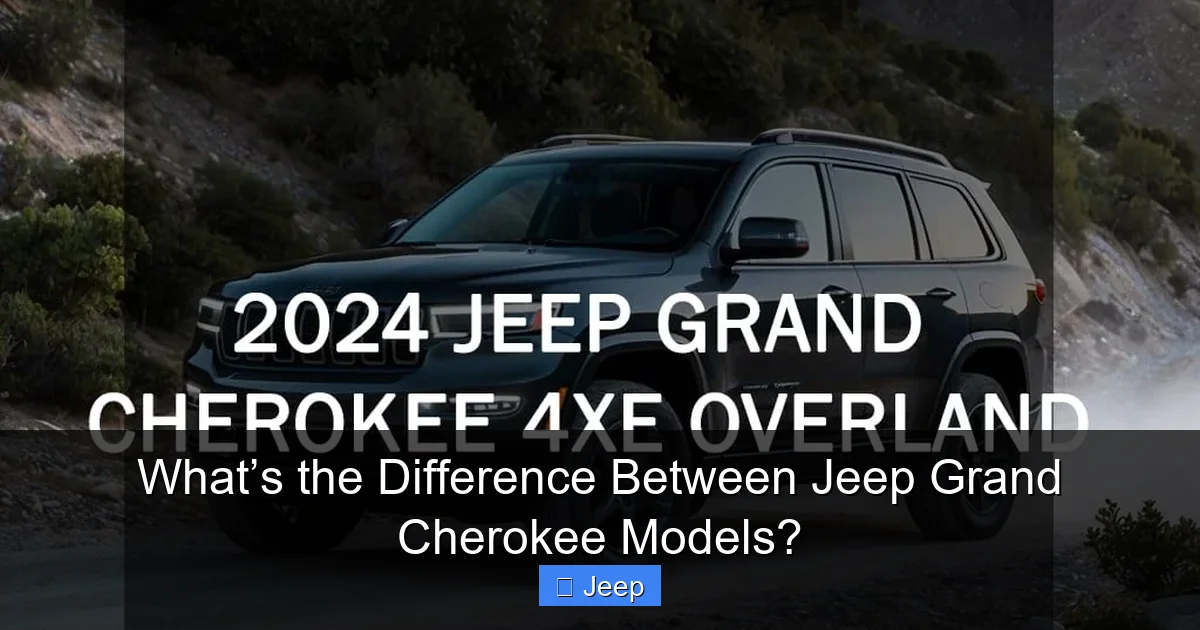
“Jeep” and “4×4” are synonymous, but a base Laredo and a Trailhawk have wildly different off-road toolkits. Jeep uses a naming system—Quadra-Trac I, Quadra-Trac II, Selec-Trac, and Quadra-Drive II—that corresponds directly to capability.
Visual guide about What’s the Difference Between Jeep Grand Cherokee Models?
Image source: jeepguides.com
Quadra-Trac I: Basic, Full-Time AWD
This is the standard system on rear-wheel-drive models and some base AWD versions. It’s a full-time all-wheel-drive system that can send up to 100% of the engine’s power to the rear wheels under normal conditions and automatically transfer torque to the front wheels if slip is detected. It’s great for inclement weather and light dirt roads but lacks low-range gearing for serious rock crawling.
Quadra-Trac II & Selec-Trac: Enhanced Control
Found on most mid-level V6 and V8 models, Quadra-Trac II adds a two-speed transfer case with a true low-range gear. This gives you a significant capability boost for steep hills, deep mud, and sand. Selec-Trac is a part-time system that allows you to select 2WD, 4WD High, or 4WD Low, offering more driver control. These systems are a big step up.
Quadra-Drive II: The Ultimate Off-Road System
This is Jeep’s flagship system, standard on the Trailhawk and optional on some Summit and Overland models. It includes the two-speed transfer case of Quadra-Trac II but adds an electronic limited-slip rear differential (ELSD). This clever device can instantly send 100% of the rear axle’s torque to the wheel with the most grip. For extreme off-roading, it also offers a front ELSD as an option. This system is what allows the Grand Cherokee Trailhawk to tackle the same Rubicon trails as the Wrangler, albeit with less approach/departure angles. If off-roading is a real hobby, you must seek out a model with Quadra-Drive II.
Interior and Technology: A World of Difference
Step inside a Grand Cherokee Laredo, then step into a Summit. It feels like you’re in two different vehicles. The disparity in materials, features, and tech is vast and is a major factor in the price spread.
Visual guide about What’s the Difference Between Jeep Grand Cherokee Models?
Image source: i.ytimg.com
Uconnect and Infotainment
All modern Grand Cherokees have the Uconnect system. The base screen is a 7-inch display with Apple CarPlay/Android Auto. Mid-trims upgrade to a larger 8.4-inch screen, while the Summit and Trailhawk get the impressive 10.1-inch screen with GPS navigation and more processing power. The system is generally user-friendly, but screen size and resolution improve with trim.
Material Quality and Comfort
The Laredo has durable, functional cloth or vinyl seats. The Limited adds leather. The Overland introduces premium features like ventilated seats, a heated steering wheel, and real wood/metal trim. The Summit is the pinnacle, offering quilted leather upholstery (often with premium Nappa leather), massaging front seats, a heated rear seat, and a superb McIntosh premium audio system with 19 speakers. The difference in daily comfort and perceived luxury is substantial. For a full picture of this top-tier experience, explore the 2023 Grand Cherokee Summit.
Cargo and Passenger Space
The two-row model offers about 37 cubic feet of cargo space behind the rear seats, expanding to 72 cubic feet with them folded. The Grand Cherokee L, with its third row, sacrifices some cargo space (about 17 cubic feet behind the third row) but adds the ability to carry 6-7 people. The second and third rows in the L are comfortable for adults, making it a true family hauler.
Model Year Breakdown: What Changed When (2021-2024)
Buying new or used? The model year matters a lot in this generation. Here’s a quick timeline of the major changes.
2021-2022: The Fresh Start
This was the first year of the current generation (WL platform). It introduced the new, more sophisticated design, the standard V6, and the available 4xe hybrid. The 2022 model year brought a mild refresh with slightly revised front and rear styling, a new base engine (the 3.6L V6 remained but was now standard), and the discontinuation of the previous generation’s 5-seat Laredo with the V6 and base audio. If you’re looking at a used model, a 2022 is a sweet spot with the new design but before some of the later tech updates.
2023: The L Arrives
The big news was the launch of the three-row Grand Cherokee L. This three-row model was not available in 2021-2022. For the two-row models, the main changes were minor feature adjustments. If you need a third row, 2023 is your first and only option (so far) in this generation.
2024: Hybrid Expansion and More
For 2024, Jeep made the 4xe hybrid powertrain available on more trims, including the Grand Cherokee L (Limited and Overland). This is huge for families wanting efficiency. Other changes include a new “Sport” appearance package on the Laredo and minor feature tweaks. The Trackhawk soldiered on unchanged as the ultimate performance model.
Choosing the Right Grand Cherokee Model For You
So, with all these variables, how do you decide? Answer these questions.
- What’s your budget? The Laredo starts around $40,000. The Summit crests $60,000, and the Trackhawk begins near $90,000. Set a realistic range.
- Do you need a third row? If yes, your choice is automatically narrowed to the Grand Cherokee L, which means no Trackhawk or Trailhawk and a focus on Limited, Overland, and Summit trims.
- What’s your priority: power, efficiency, or capability? Power/Towing = V8 or Trackhawk. Efficiency = 4xe Hybrid. Serious Off-Road = Trailhawk with Quadra-Drive II. Balanced Daily Driver = V6 with Quadra-Trac II.
- How important is luxury and tech? If you want the quietest cabin, best seats, and top audio, you must look at the Overland and Summit. The difference from a Limited is noticeable.
- Are you buying new or used? A used 2017-2020 Grand Cherokee (previous generation) can be an incredible value. They are spacious, capable, and can be had for thousands less. Our look at the 2017 Jeep Grand Cherokee Limited shows how much capability and comfort you can get for your money in the older model.
Ultimately, the “difference” is your difference. The Grand Cherokee’s genius is its breadth. It’s not one SUV; it’s a toolbox. Your job is to pick the right tool for your job. Always test drive the specific trim you’re considering. The feel of a Summit’s ride versus a Laredo’s is a world apart, and you won’t know until you’re behind the wheel.
Frequently Asked Questions
What is the main difference between a Grand Cherokee Laredo and a Limited?
The Limited is a significant step up from the Laredo. Key additions include genuine leather upholstery (vs. cloth/vinyl), a larger 8.4-inch touchscreen (vs. 7-inch), dual-zone automatic climate control, a power liftgate, and more standard driver-assist features like blind-spot monitoring. The Limited is aimed at families wanting more comfort and tech.
Which Grand Cherokee model is best for off-roading?
The undisputed off-road king is the Grand Cherokee Trailhawk. It comes standard with Jeep’s most advanced Quadra-Drive II system with an electronic limited-slip rear differential, aggressive all-terrain tires, a lifted suspension, skid plates, and unique front/rear fascias for better approach/departure angles. The standard two-row Grand Cherokee is required; the Grand Cherokee L is not available in Trailhawk trim.
Is the Grand Cherokee 4xe worth it?
For many buyers, absolutely yes. If your commute is within its ~26-mile electric range, you can drive gas-free daily. Even without plugging in, the hybrid system provides a power boost and improves fuel economy by 4-6 MPG compared to the standard V6. It’s available on most two-row and L models (Limited, Overland, Summit) and qualifies for federal tax incentives.
What’s the difference between an Overland and a Summit?
The Summit is the non-performance luxury flagship. Compared to the Overland, it adds even more premium features: quilted Nappa leather seats, a heated and ventilated rear seat, a 19-speaker McIntosh premium audio system, a panoramic sunroof, more extensive real wood/metal interior trim, and a 360-degree camera system. The Overland is very luxurious but the Summit is the ultimate in pampering.
Are Grand Cherokee models reliable?
Reliability varies by model year and powertrain. The previous generation (2014-2020) with the 3.6L V6 has a solid reputation for long-term reliability when maintained. The current generation (2021+) is too new for long-term data, but early reports are positive, especially for the V6. The supercharged Trackhawk engine is high-performance and may have higher maintenance costs. Always check model-specific reliability studies before purchasing.
How much more expensive is a V8 Grand Cherokee over the V6?
On a comparable trim level (e.g., Limited V6 vs. Limited V8), the V8 powertrain typically adds about $2,000-$2,500 to the MSRP. However, the V8 is often bundled with other packages (like the tow package) and may only be available on higher trims (Summit), so the overall price jump from a base V6 model to a V8 model can be $10,000 or more.
