
What Oil Does a Volvo D13 Take?

The Volvo D13 diesel engine requires a very specific type of oil: a full synthetic motor oil that meets Volvo’s VDS-4.5 specification and typically the ACEA E6 or E9 classification, with a viscosity of 10W-40. Using the correct oil is not a recommendation but a critical requirement for protecting the engine’s advanced emissions systems and ensuring longevity. This oil must provide exceptional wear protection, soot dispersion, and compatibility with the D13’s diesel particulate filter (DPF) and exhaust gas recirculation (EGR) system. Always consult your owner’s manual for the exact specification for your model year, as requirements can evolve.
So, you’re staring at the dipstick or the owner’s manual for your Volvo D13-powered truck, and the big question looms: “What oil does a Volvo D13 take?” This isn’t a simple “5W-30” answer like you might find for a family sedan. The Volvo D13 is a workhorse, a 12.8-liter turbocharged diesel engine built for long-haul durability and extreme performance under the hood of Class 8 semi-trucks. Getting its lubrication right is absolutely critical to protecting a multi-hundred-thousand-dollar investment. Using the wrong oil isn’t just a minor issue; it can lead to catastrophic engine failure, fouled emissions equipment, and voids your warranty. Let’s break down everything you need to know, from the cryptic codes on the oil bottle to the best practices for keeping your D13 purring.
Key Takeaways
- Mandatory Full Synthetic: The D13 engine exclusively requires full synthetic oil. Conventional or synthetic blend oils will not meet the performance standards and can cause severe damage.
- Volvo VDS-4.5 is Non-Negotiable: The oil must carry Volvo’s VDS-4.5 (Volvo Driver Standard) specification. This is Volvo’s own rigorous standard for oils used in their heavy-duty diesel engines.
- ACEA E6/E9 Classification: Most VDS-4.5 oils also meet the European Automobile Manufacturers’ Association (ACEA) E6 or E9 specs, which are critical for engines with advanced after-treatment systems like DPFs.
- Viscosity is Typically 10W-40: For most operating conditions, a 10W-40 viscosity grade is specified. Some newer models or specific climates may call for 5W-30 or 0W-30; your manual is the final authority.
- Brand Matters, Specification is King: Many reputable brands (Mobil, Shell, Pennzoil, etc.) make oils that meet VDS-4.5. Choose based on the specification on the bottle, not just the brand name.
- Regular Changes are Crucial: Even the best oil degrades. Follow Volvo’s recommended drain intervals, which can range from 15,000 to 50,000 miles depending on the oil and service severity.
- Use Genuine Volvo Filters: Pairing the correct oil with a genuine Volvo or high-quality OEM-equivalent oil filter is essential for maintaining engine cleanliness and protection.
📑 Table of Contents
Understanding the Volvo D13 Engine’s Unique Demands
Before we dive into specific oil codes, it helps to understand why the D13 is so picky. This engine is a masterpiece of modern diesel engineering, designed with incredibly tight tolerances and a sophisticated suite of after-treatment devices to meet stringent emissions standards. Key systems that depend on perfect oil quality include:
- Diesel Particulate Filter (DPF): This filter traps soot. The oil must have a “Low-SAPS” (Sulfated Ash, Phosphorus, Sulfur) formulation to prevent ash from clogging the DPF, which leads to expensive regeneration issues or replacement.
- Exhaust Gas Recirculation (EGR): Hot exhaust gases are recirculated to reduce nitrogen oxide emissions. This creates a harsh, sooty environment. The oil must combat deposits and keep the EGR cooler from coking up.
- High-Pressure Common Rail Fuel System: Modern fuel injectors operate at immense pressure (often 30,000+ psi). They rely on oil for hydraulic actuation and cooling. Oil must maintain viscosity and cleanliness to prevent injector sticking or failure.
- Turbocharger: The turbo spins at over 100,000 RPM. It needs oil that can withstand extreme heat and shear stress without breaking down, providing constant lubrication to the bearings.
Because of these systems, the oil isn’t just for reducing friction; it’s a critical fluid for the entire emissions and performance system. That’s why specifications like VDS-4.5 and ACEA E6 exist—they are tested and approved to work in harmony with this hardware.
The Gold Standard: Volvo VDS-4.5 Specification
When you see “VDS-4.5” on an oil bottle, that is the single most important thing to look for. VDS stands for Volvo Driver Standard. It is Volvo’s proprietary, rigorous testing regimen for lubricants. An oil must pass a battery of engine bench tests and real-world field trials to earn this badge.
The “4.5” denotes the generation of the specification. VDS-4.5 is the current standard for most D13 engines (and other Volvo Trucks engines like the D11, D16). It succeeded VDS-4 and introduced even stricter requirements for:
- Wear Protection: Against piston ring and liner scuffing.
- Deposit Control: Keeping pistons and turbochargers clean under severe conditions.
- Oil Consumption: Minimizing burn-off in high-temperature environments.
- Compatibility with Emissions Equipment: As noted, low sulfated ash is mandatory for DPF life.
Practical Tip: Always look for the official VDS-4.5 logo on the oil container. Do not rely on a salesperson’s word or a vague “suitable for Volvo” claim. The logo is your guarantee. You can also verify approved oils on the official Volvo Trucks website or through your Volvo dealer.
The European Benchmark: ACEA E6/E9
While VDS-4.5 is Volvo’s specific requirement, you will almost always see it paired with an ACEA E6 or ACEA E9 classification. ACEA is the European Automobile Manufacturers’ Association, which sets sequences for engine oils. The “E” series is for heavy-duty diesel engines.
- ACEA E6: The most stringent. It is a “Low-SAPS” oil designed for the most advanced emissions systems (DPF, EGR). It offers the highest level of wear protection but may have a slightly higher fuel consumption penalty due to friction modifiers.
- ACEA E9: Also a Low-SAPS oil, but with a slightly different balance, often focusing on extended drain intervals while still protecting DPFs.
For a Volvo D13, you need one of these. E6 is the most common and safest recommendation. If an oil meets ACEA E6, it will almost certainly meet the older E7 standard, but you should not use an E7-only oil in a D13, as it may not have the required low-SAPS formulation.
How This Connects to Other Vehicles: You might notice that many modern European diesel cars (like certain Audi, BMW, or Mercedes models) also require ACEA C3 or E6 oils. The principles of protecting DPFs and EGrs are the same. For a deeper dive into why modern engines, even passenger cars, demand such specific oils, our article “Does My Car Use Synthetic Oil? A Simple Guide” explains the shift from conventional to synthetic lubricants.
Decoding the Viscosity: What Does 10W-40 Mean?
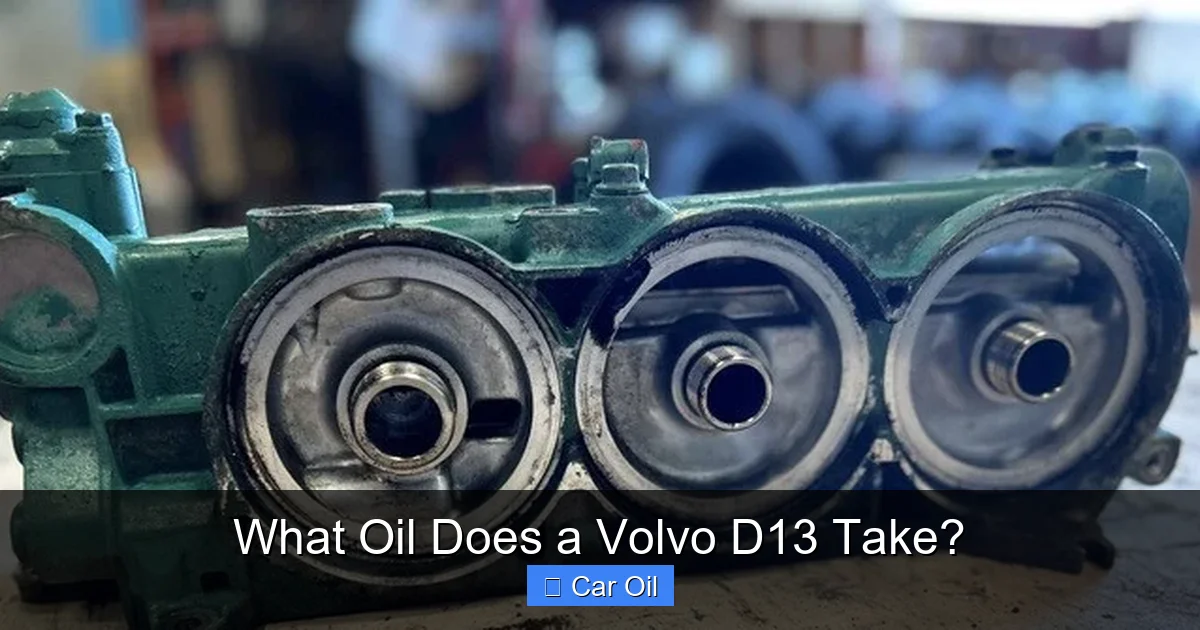
Viscosity is the oil’s resistance to flow. The number before the “W” (winter) indicates cold-flow performance; the second number indicates high-temperature thickness. For the D13, 10W-40 has been the traditional, all-season workhorse for decades.
Visual guide about What Oil Does a Volvo D13 Take?
Image source: cdn11.bigcommerce.com
- 10W: It flows reasonably well in cold weather, allowing the engine to start and circulate oil quickly on cold mornings. It’s a good balance for most North American climates.
- 40: At 100°C (212°F), the oil maintains a thickness that provides a robust lubricating film under high heat and load, protecting bearings and cylinder walls.
Are There Alternatives? Yes, but be cautious. Newer model year D13 engines (especially post-2018/2019) may have specific approvals for 5W-30 or even 0W-30 viscosity oils. These lower-viscosity oils can improve fuel economy by reducing internal friction. However, you must only use them if your owner’s manual explicitly states they are approved for your specific engine and operating conditions. Using a thinner oil than specified in an older engine can lead to inadequate wear protection. When in doubt, default to 10W-40.
Cold Weather Consideration: If you operate in consistently extreme cold (below -20°F/-29°C), the “10W” part might be too thick for ideal cold starts. Some operators in places like Alaska or Canada might opt for a 5W-40 that is also VDS-4.5 approved. The principles of cold oil flow are universal. Our guide “What Temperature Does Car Oil Freeze?” explains the science behind winter grades, which applies directly to diesel engine oils as well.
Top Brands and Specific Product Recommendations
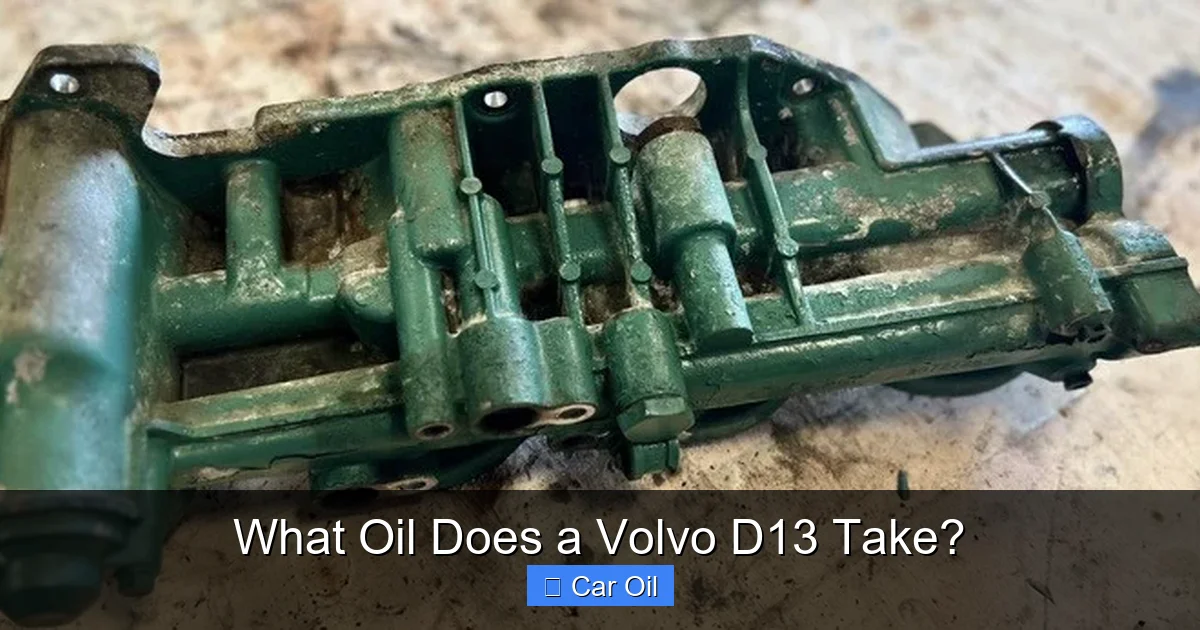
Many major lubricant manufacturers produce oils that meet VDS-4.5 and ACEA E6. You are not limited to one brand. The key is the specification on the bottle. Here are some widely available and respected brands that consistently have VDS-4.5/E6 products:
Visual guide about What Oil Does a Volvo D13 Take?
Image source: cdn11.bigcommerce.com
- Mobil Delvac: Mobil 1 Delvac 1 LE 5W-30 and Mobil Delvac 1300 Super 10W-40 are top-tier choices. Mobil has a long history with Volvo Group.
- Shell Rimula: Shell Rimula Ultra 5W-30 and Rimula R6 M 10W-40 are formulated specifically for modern European engines with DPFs and are commonly used in Volvos.
- Pennzoil Platinum Euro: Their Euro L 5W-30 and L 10W-40 meet VDS-4.5 and ACEA E6 standards.
- Valvoline Premium Blue: Valvoline Premium Blue One 5W-30 and E 10W-40 are heavy-duty diesel oils with the necessary certifications.
- Castrol EDGE: Castrol EDGE Professional L 5W-30 LL and V 10W-40 meet the specs.
- Volvo Trucks Genuine Oil: Volvo also markets its own branded oil, which is essentially a co-branded product with a major manufacturer (historically Shell), guaranteed to meet all specs.
Practical Example: You’re at the truck stop. You have two options: “Trucker’s Choice 15W-40” for $4/gallon and “Shell Rimula Ultra 5W-30” for $7/gallon. The first one, while cheaper, does not have VDS-4.5 or ACEA E6 on the bottle. It’s a conventional or synthetic blend oil for older engines without DPFs. The second one checks all the boxes. The extra $3/gallon is cheap insurance for a $30,000 engine.
Oil Capacity, Drain Intervals, and the Importance of Filters
Knowing what oil to put in is only half the battle. Knowing how much and how often is equally important.
Visual guide about What Oil Does a Volvo D13 Take?
Image source: i.ebayimg.com
How Much Oil Does a Volvo D13 Take?
The total system capacity of a Volvo D13 engine varies slightly by model year, configuration (VPT vs. non-VPT), and whether you’re including the filter. As a general guideline:
- Standard Capacity (with filter): Approximately 11 to 12.5 U.S. quarts (10.4 to 11.8 liters).
- VPT (Variable Pitch Turbo) models: May hold slightly more, closer to 12.5 quarts.
This is not a guess-and-check situation. Overfilling can cause aeration (foaming), leading to oil pressure loss and severe damage. Underfilling leads to starvation. Always:
- Consult your specific owner’s manual for the exact capacity.
- After draining, fill to the specified level (usually indicated on the dipstick, often with a cross-hatch or mark).
- Start the engine, let it idle for a minute, shut off, wait a few minutes, and re-check the dipstick. Add small amounts as needed to reach the full mark.
Drain Intervals: Follow the Manual or Your Service Plan
Volvo provides drain interval recommendations based on the oil specification and your operating conditions (on-highway vs. severe service). With a full synthetic VDS-4.5 oil:
- Standard On-Highway: Intervals can extend to 50,000 miles or 12 months, whichever comes first, when using certain premium oils and with an active Volvo Trucks service contract that includes oil analysis.
- General Recommendation: A safe, conservative interval for most operators is 25,000 to 30,000 miles or 12 months.
- Severe Service: For frequent short trips, extreme temperatures, dusty conditions, or idling, shorten the interval to 15,000 miles or less.
The Smart Move: Oil Analysis. The best way to determine your exact drain interval is to participate in an oil analysis program (like Volvo’s own or a third-party like Polaris). A small oil sample sent to a lab tells you the exact condition of the oil and the internal health of the engine (fuel dilution, soot levels, coolant contamination, wear metals). This is a common practice for fleets and is highly recommended for owner-operators. It turns a guess into a science, saving money on unnecessary changes and preventing catastrophic failures.
The Critical Role of the Oil Filter
Putting the world’s best oil in with a cheap, inefficient filter is like drinking a protein shake through a dirty straw. The oil filter’s job is to remove contaminants—metal particles from wear, soot, and other debris—from the oil before they can scratch bearings or block oil passages.
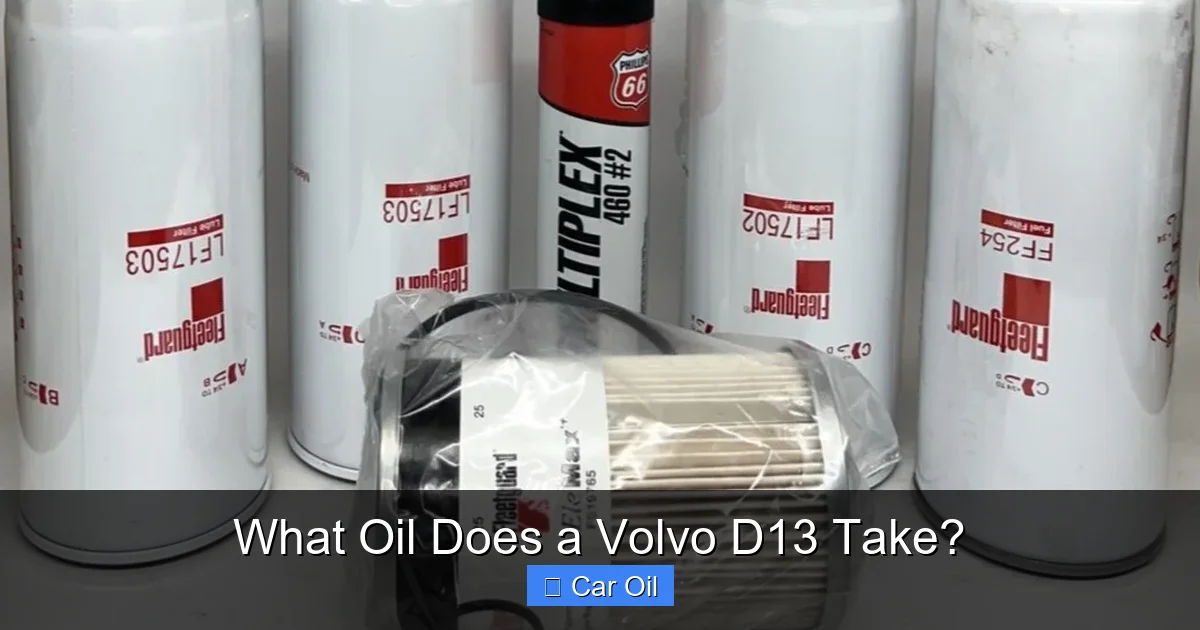
- Always use a filter that meets Volvo specifications. This is typically a Volvo Genuine Oil Filter or a high-quality OEM equivalent from brands like Donaldson, Fleetguard, or WIX.
- Pay attention to the micron rating and efficiency. A good filter for a D13 will have a high efficiency rating (e.g., 99.5% at 20 microns) to catch the fine soot particles that are so prevalent in diesel engines.
- Change the filter with every oil change. Never reuse it.
- Find your manual. Identify the exact specification and viscosity for your model year.
- Shop by spec, not by brand name. Look for the VDS-4.5 and ACEA E6 logos on the bottle.
- Buy enough high-quality oil. You’ll need roughly 12 quarts, plus a premium oil filter.
- Change it on schedule. Use oil analysis to fine-tune your intervals.
- Check the level regularly. Make it a habit.
Common Mistakes and Pitfalls to Avoid
Even with the right oil, mistakes happen. Here are the most common pitfalls that can undo all your good work:
Using the Wrong Specification (The #1 Sin)
This bears repeating: No VDS-4.5, No Go. An oil that says “Diesel Engine Oil” and is 15W-40 is almost certainly not correct for a D13 with a DPF. It likely has high sulfur content (high SAPS) that will poison the DPF in a matter of thousands of miles. The repair costs for a clogged DPF can exceed $10,000. Do not gamble.
Ignoring the Viscosity Recommendation
Using 15W-40 in an engine that calls for 10W-40 might “work,” but it can increase fuel consumption and cause slower lubrication during cold starts. Using 5W-30 in an older, high-mileage engine designed for 10W-40 could lead to increased wear. Follow the manual.
Extending Drain Intervals Too Far
Just because an oil *can* go 50,000 miles doesn’t mean it *will* in your specific operation. If you’re running in dusty construction zones, hauling overweight loads, or idling for hours, the oil is being stressed. When in doubt, change it sooner. The cost of an extra oil change is trivial next to an engine overhaul.
Using Poor-Quality or Off-Brand Filters
A $10 filter from a big-box store might look like a deal, but its filter media can be inferior, allowing more contaminants to circulate or even collapse under pressure. Stick to known, reputable brands that specify their filters for Volvo D13 applications.
Neglecting the Oil Level Check
Diesel engines, especially high-hour ones, can develop minor leaks or consume small amounts of oil. Check the dipstick at least once a week, or before every long trip. Running an engine even a quart low can cause catastrophic failure quickly.
Conclusion: Your D13’s Lifeline is in the Fill Hole
So, what oil does a Volvo D13 take? The answer is a precise, engineered fluid: a full synthetic motor oil meeting Volvo VDS-4.5 and ACEA E6/E9 specifications, with a viscosity of 10W-40 (or as otherwise specified for your model year). This is not a area for compromise or cost-cutting. The oil is the lifeblood of your engine, and in a modern diesel like the D13, it is an integral part of the emissions and performance systems.
Your action plan is simple:
By treating your oil choice with the seriousness it deserves, you protect one of the most valuable assets on the road. Your Volvo D13 will reward you with reliable, powerful, and efficient service for millions of miles. For any other vehicle-specific oil questions, our library has detailed guides for everything from a 2017 Nissan Rogue to a Dodge Journey, but remember, the stakes are highest with a heavy-duty diesel.
Frequently Asked Questions
Can I use 15W-40 oil in my Volvo D13?
Generally, no. While older D13 engines might have run on 15W-40, modern D13 engines with DPFs require a Low-SAPS oil like a 10W-40 that meets VDS-4.5/ACEA E6. A standard 15W-40 typically has too much sulfated ash, which will damage the DPF. Always follow your model-year manual specification.
Is it okay to use car diesel oil in my Volvo D13 truck?
No. Passenger car diesel oils (often meeting specs like API CK-4 or ACEA C3) are designed for lighter-duty engines and may not have the robust additive packages or shear stability required for a heavy-duty truck engine like the D13. You must use an oil specifically approved for Volvo Trucks heavy-duty engines (VDS-4.5).
How often should I really change the oil in my D13?
The maximum interval with full synthetic VDS-4.5 oil can be up to 50,000 miles under ideal, on-highway conditions with an active service contract. However, a conservative and widely recommended interval is 25,000-30,000 miles or 12 months. The most accurate method is to use an oil analysis program to determine the oil’s actual condition and adjust your drain interval accordingly.
What are the best oil brands for a Volvo D13?
Any brand that formulates an oil meeting the VDS-4.5 and ACEA E6/E9 specifications is acceptable. Top brands include Mobil Delvac, Shell Rimula, Pennzoil Platinum Euro, Valvoline Premium Blue, and Castrol EDGE Professional. Volvo Genuine Oil is also an excellent, guaranteed choice. Choose based on availability, price, and your trust in the brand’s quality control.
Can I switch from 10W-40 to 5W-30 to save fuel?
Only if your owner’s manual explicitly approves 5W-30 (or another viscosity) for your specific engine and operating conditions. Newer D13 engines may have this approval. For older models, switching to a thinner oil without manufacturer approval risks increased engine wear and is not recommended. Fuel savings are often minimal compared to the potential risk.
What happens if I put the wrong oil in my D13?
The consequences can be severe and expensive. Wrong oil (e.g., non-VDS-4.5, high-SAPS) can lead to: DPF clogging and failure ($10,000+), turbocharger coking or failure, accelerated wear on piston rings and liners, injector sticking, and sludge formation. Engine damage from incorrect lubrication is typically not covered by warranty. Always use the correct, specified oil.