What Is the Trade-in Value of a 2019 Toyota Corolla?

Contents
- 1 Key Takeaways
- 2 📑 Table of Contents
- 3 Introduction: Why Your Corolla’s Trade-In Value Matters
- 4 What Factors Actually Determine Your Car’s Worth?
- 5 How to Get an Accurate Trade-In Value Estimate
- 6 Trim-Level Deep Dive: How Much More is an SE or XLE Worth?
- 7 Mileage and Condition: The Fine Details That Add or Subtract Thousands
- 8 How to Maximize Your Trade-In Offer: The Negotiation Game
- 9 Should You Trade-In or Sell Privately? The Final Math
- 10 Conclusion: Knowledge is Your Best Negotiation Tool
- 11 Frequently Asked Questions

Steering Wheel Cover

Car Neck Pillow

Anti Rust Spray
Power Steering Fluid
The trade-in value of a 2019 Toyota Corolla typically ranges from $12,000 to $18,000, depending heavily on trim level, mileage, condition, and local market demand. To get the most accurate price, you must check multiple valuation sources like Kelley Blue Book (KBB) and the National Automobile Dealers Association (NADA), and be prepared to negotiate with dealers. Understanding these factors and presenting your car in its best light can significantly increase your final offer.
Key Takeaways
- Value Range is Wide: A 2019 Toyota Corolla’s trade-in value can vary by thousands based on specific factors like trim, mileage, and condition.
- Trim Level Matters: Higher trims (SE, XLE) with more features command significantly higher prices than the base L model.
- Mileage is Critical: Average mileage (around 12,000 miles per year) is ideal; high mileage drastically reduces value.
- Condition is King: A clean, well-maintained car with a full service history will always fetch a better price than one with cosmetic damage or unresolved issues.
- Get Multiple Quotes: Never rely on a single dealer’s offer. Check online estimators and get competing bids from several dealerships.
- Private Sale Often Pays More: You’ll usually get more money selling privately, but trading in is faster, easier, and can reduce sales tax on your new purchase.
- Timing Can Help: Trading in at the end of a month, quarter, or during model year changeovers can sometimes yield better dealer offers.
📑 Table of Contents
- Introduction: Why Your Corolla’s Trade-In Value Matters
- What Factors Actually Determine Your Car’s Worth?
- How to Get an Accurate Trade-In Value Estimate
- Trim-Level Deep Dive: How Much More is an SE or XLE Worth?
- Mileage and Condition: The Fine Details That Add or Subtract Thousands
- How to Maximize Your Trade-In Offer: The Negotiation Game
- Should You Trade-In or Sell Privately? The Final Math
- Conclusion: Knowledge is Your Best Negotiation Tool
Introduction: Why Your Corolla’s Trade-In Value Matters
So, you’re thinking about trading in your 2019 Toyota Corolla. Maybe you’re eyeing a new model, a different type of vehicle, or just ready for a change. That trusty compact sedan has served you well, but now you’re faced with one crucial question: what is it actually worth? Figuring out the trade-in value of a 2019 Toyota Corolla isn’t just a casual curiosity—it’s a key financial step that puts real money back in your pocket for your next car.
The good news is that the Corolla has a stellar reputation for reliability and value retention. The bad news? “Value” is a moving target. It’s not a single number you can look up. It’s a figure shaped by your car’s specific story: the exact trim you have, the miles on the odometer, how well you’ve cared for it, and even what’s happening in the used car market in your town. This guide will pull back the curtain. We’ll walk you through every single factor that influences your car’s worth, show you exactly how to find a trustworthy estimate, and give you the practical tips to walk into a dealership with confidence and walk out with the best possible check.
What Factors Actually Determine Your Car’s Worth?
Think of your car like a house. Its value isn’t just about square footage (or in this case, make and model). It’s about location, upgrades, condition, and the current market. For your 2019 Corolla, here are the big five drivers of value.

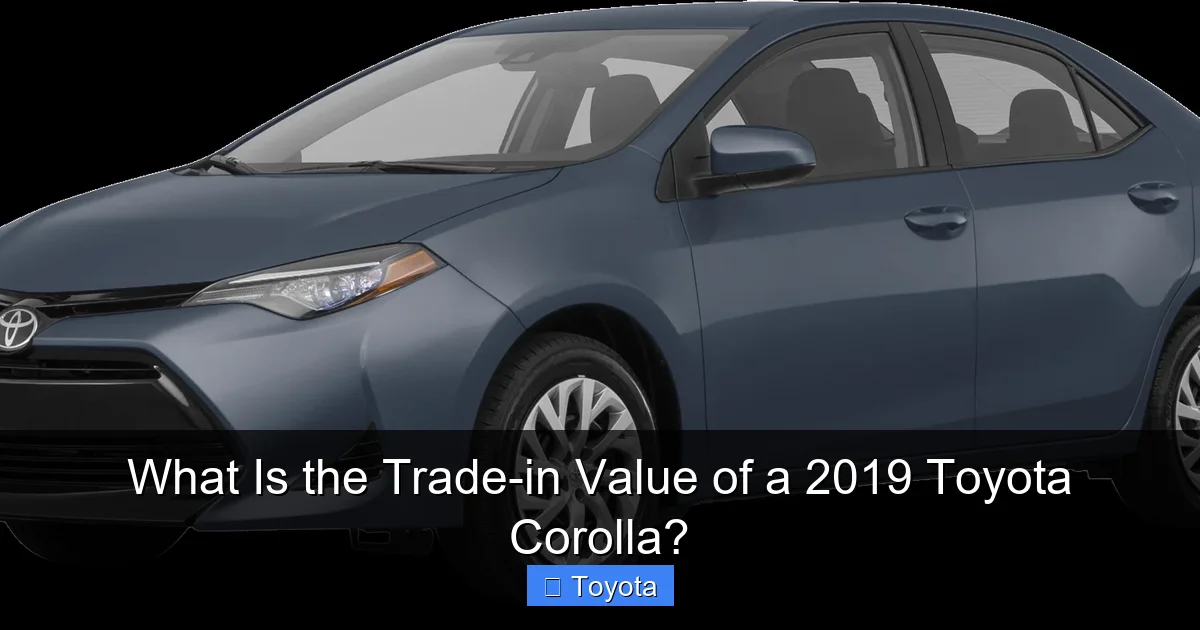
Visual guide about What Is the Trade-in Value of a 2019 Toyota Corolla?
Image source: file.kelleybluebookimages.com
1. Trim Level: The Biggest Starting Point
The 2019 Corolla came in several trims, each with a different Manufacturer’s Suggested Retail Price (MSRP) when new. That starting gap creates a lasting ripple effect on trade-in value. The main trims were:
- Toyota Corolla L: The base model. It’s reliable and efficient but lacks many comfort and tech features. This will have the lowest starting trade-in value.
- Toyota Corolla LE: The most popular trim. It adds key features like a power driver’s seat, Toyota Safety Sense™ 2.0, and a larger touchscreen. This is the volume leader and sets the baseline for most value estimates.
- Toyota Corolla SE: A sportier version with a more aggressive front fascia, black interior accents, paddle shifters (on CVT), and often a sunroof. The added features boost its value noticeably over the LE.
- Toyota Corolla XLE: The top non-hybrid trim. It includes leather-trimmed seats, a premium audio system, heated front seats, and a moonroof. This commands the highest premium among gasoline trims.
- Toyota Corolla Hybrid LE: The hybrid model. Its value is influenced by both its fuel efficiency and its unique powertrain. It often holds value exceptionally well due to high demand for efficient used hybrids.
Practical Example: In average condition with 50,000 miles, you might see a 2019 Corolla LE valued around $14,500. The same car as an SE could be $15,500, and an XLE could push $16,500. The hybrid version could be even higher.
2. Mileage: The Odometer’s Tell-Tale Story
Mileage is the single most quantifiable factor. The national average is about 12,000 miles per year. A 2019 Corolla with 48,000 miles is considered “average” and is the benchmark for valuation. Every 10,000-15,000 miles above that average typically subtracts a few hundred to over a thousand dollars from the value. Conversely, a car with very low miles (e.g., 30,000 miles) can command a “low-mileage premium.”
It’s not just the total number, either. Is the mileage mostly highway (gentler on the car) or city (more stop-and-go wear)? A car with 60,000 miles of mostly highway cruising is often valued higher than one with 50,000 miles of harsh city driving and taxi-like use.
3. Vehicle Condition: Inside, Outside, and Underneath
This is where you have control. Condition is broken down into:
- Exterior: Any dents, scratches, rust, or mismatched paint? A small door ding is one thing; a cracked bumper or significant rust is another. Clean, shiny cars with no body damage get top dollar.
- Interior: Is it clean and odor-free? Are the seats free of rips, stains, and excessive wear? Do all controls, buttons, and the infotainment system work perfectly? A pristine interior signals a caring owner.
- Mechanical: Has it been serviced regularly? Are there any warning lights, strange noises, or performance issues? A car with a clean service history and no mechanical problems is worth more. If you’re unsure about a specific sound or light, resources like our article on how to open the hood of a Toyota Corolla can help you perform basic checks before an appraisal.
- Tires: Are the original tires still on and with good tread? A set of worn-out tires is a $500-$1,000 deduction a dealer will factor in.
4. Vehicle History and Maintenance Records
A clean title is non-negotiable for full value. Any accident history, especially major structural damage, will lower the value. However, a single minor fender-bender that was properly repaired may only have a small impact. The real secret weapon is a complete stack of maintenance records. Oil changes, tire rotations, and scheduled services documented with dates and mileage prove you’ve cared for the car. This builds immense trust with an appraiser and can add a few hundred dollars to the offer.
5. Local Market Demand and Seasonality
Your zip code matters. In areas with high demand for reliable, fuel-efficient sedans (like college towns or cities with high gas prices), Corolla values are stronger. In rural areas or places where trucks and SUVs dominate, the demand—and thus the price—may be softer. Seasonally, convertibles and 4x4s have their peaks, but for a reliable sedan like the Corolla, the differences are minimal year-round.
How to Get an Accurate Trade-In Value Estimate
Now that you know what moves the needle, it’s time for numbers. You need a realistic range, not a single hopeful figure. Here is your three-step research plan.

Visual guide about What Is the Trade-in Value of a 2019 Toyota Corolla?
Image source: i2.wp.com
Step 1: Use the “Big Three” Online Valuation Tools
These are the industry standards. You must use all three and compare the results.
- Kelley Blue Book (KBB): The most recognized source. Input your exact 2019 Corolla’s trim, mileage, condition, and zip code. KBB gives you a “Trade-In Range” (what a dealer will likely pay) and a “Private Party Range.” Pay close attention to the condition descriptions—be honest with yourself. “Good” means normal wear for the year; “Very Good” means exceptionally well-cared-for.
- NADA Guides: Often used by dealers themselves. It tends to be slightly more conservative than KBB but is excellent for establishing a firm baseline based on clean, average-mileage vehicles.
- Edmunds True Market Value (TMV): This tool is fantastic because it analyzes recent actual sales data in your area. It gives you a “Trade-In” price that is based on what similar cars have sold for, not just theoretical values.
Pro Tip: Do this research on a desktop, not your phone, for the best experience. Have your VIN handy—you can enter it to pull the exact original specs, which eliminates errors in trim selection.
Step 2: Check “Real-World” Sold Listings
Go to Autotrader, Cars.com, and even Facebook Marketplace. Filter for 2019 Toyota Corollas in your state or region. Look at the “SOLD” listings (on Facebook, you may need to search and see what’s actually pending or recently marked sold). What are similar cars (same trim, close mileage, similar condition) actually selling for? This is the real market talking. The trade-in value is typically 10-20% less than the private party selling price you see here.
Step 3: Understand the Dealer’s Perspective (The Invoice Price)
Here’s a critical piece of insider knowledge. When a dealer buys a car at auction or trades for one, they don’t think about your car’s original MSRP. They think about what they can retail it for, and what they can wholesale it for if they don’t keep it. Their goal is to buy your car for less than they plan to sell it for. To understand the new car market context that influences used values, it helps to know concepts like the invoice price of a Toyota RAV4 or any model. The invoice price is what the dealer paid the manufacturer. For your used Corolla, the dealer’s target buy price is based on the car’s current wholesale auction value, which is a number you can’t see but is reflected in the lower end of the KBB/NADA trade-in ranges. Your goal is to get as close to the top of that range as possible.
Trim-Level Deep Dive: How Much More is an SE or XLE Worth?
Let’s get specific. Using a hypothetical 2019 Corolla with 50,000 miles and in good condition as our baseline, here’s how trims typically stack up nationally. Remember, these are estimates; your local market will vary.

Visual guide about What Is the Trade-in Value of a 2019 Toyota Corolla?
Image source: blog.consumerguide.com
- Corolla L (Base): The value anchor. Features: manual AC, basic audio, fabric seats. Estimated Trade-In Range: $11,500 – $13,500.
- Corolla LE (Mid-Level): The sweet spot. Adds: power driver’s seat, Toyota Safety Sense 2.0 (pre-collision, lane departure, etc.), 6.1” touchscreen, 4.2” multi-information display. Estimated Trade-In Range: $13,500 – $15,500.
- Corolla SE (Sport): The value booster. Adds: sport-tuned suspension, black exterior accents, leather-wrapped steering wheel, paddle shifters, available moonroof. Estimated Trade-In Range: $14,500 – $16,500.
- Corolla XLE (Top Gas): The luxury contender. Adds: leather-trimmed seats, 8-way power passenger seat, premium 6-speaker audio, heated front seats, moonroof. Estimated Trade-In Range: $15,500 – $17,500.
- Corolla Hybrid LE: The efficiency king. Unique powertrain, great fuel economy. High demand keeps value strong. Estimated Trade-In Range: $15,000 – $17,000+.
The Takeaway: The jump from L to LE is the biggest value increase due to the critical addition of Toyota Safety Sense. The SE and XLE offer more incremental gains for their added comfort and tech. If you have a higher trim, emphasize those features during your appraisal. If you have a base L, focus on its impeccable reliability and low cost of ownership.
Mileage and Condition: The Fine Details That Add or Subtract Thousands
Let’s drill down on the two factors you can most directly influence: miles and condition.
The Mileage Math
A “clean” 2019 Corolla with 60,000 miles might be valued at $14,000. The exact same car with 80,000 miles might drop to $12,500. That’s a $1,500 penalty for 20,000 extra miles. The depreciation curve is steep after the warranty period (3 years/36,000 miles for basic, 5 years/60,000 for powertrain). Keeping your miles below the national average is the single best way to preserve value long-term.
The Condition Checklist: Your Pre-Appraisal Battle Plan
Before you ever drive to a dealer, do this:
- Wash and Detail: A thorough wash, vacuum, and window clean costs $50 at a detailer and can add $500 to an appraisal. It shows effort and care.
- Fix Minor Damages: Replace a cracked headlight or taillight assembly (~$100-$200). Fix a small dent or scratch if it’s inexpensive. Small fixes prevent the dealer from inflating the cost of repairs.
- Gather ALL Records: Oil changes, tire rotations, any repairs. A binder or organized digital file is gold. If you’ve had major services like a timing belt (though the Corolla uses a chain) or transmission fluid change, highlight those.
- Check All Functions: Test the AC, heater, radio, windows, locks, cruise control, and all dashboard displays. Make sure everything works. A single non-functioning feature, like a broken driver’s side mirror motor, is a known deduction.
- Know Your Tires: If they have less than 4/32” of tread, budget for a replacement. New tires are a strong positive for an appraiser.
If your Corolla has a specific feature like an Eco or Hold button for its hybrid system or CVT, make sure it functions correctly. Mentioning that all special features work perfectly reinforces the “excellent condition” narrative.
How to Maximize Your Trade-In Offer: The Negotiation Game
Getting the number is step one. Getting the best number is step two. This is a sales process, and you are the product.
1. Get Competing Offers (The Power of Three)
Never, ever take the first offer. Get written or email offers from at least three different dealerships. Use CarMax, Carvana, and local Toyota dealers. Having another offer in hand is your #1 leverage tool. When Dealer A says $14,000, you can politely say, “Dealer B offered me $14,500. Can you beat that?” They often will.
2. Separate the Transactions
Negotiate the trade-in value after you have a firm, out-the-door price on your new car. If you combine them, the dealer can play games, giving you a great trade-in price but inflating the new car price, or vice versa. Always finalize the purchase price of the new vehicle first, lock it in, then discuss your trade.
3. Be Prepared to Walk Away
This is your ultimate power. If the offer is below the low end of your KBB/NADA range for your car’s condition, it’s not a good offer. Thank them for their time and leave. More often than not, they’ll call you back with a better number. If they don’t, you have other buyers.
4. Time Your Trade-In Strategically
Dealers have monthly, quarterly, and yearly sales targets. Trading in at the end of a month (especially a quarter-end like March, June, September, December) when they are trying to hit their numbers can make them more aggressive and willing to pay a little more for your car to close a deal.
Should You Trade-In or Sell Privately? The Final Math
This is the eternal question. Trading in is convenient. Selling privately is potentially more profitable.
- Trading In Pros: Instant transaction. No advertising, no showing the car to strangers, no payment risk. Often no sales tax on the trade-in value (this varies by state but is a huge financial benefit). Seamless part of the new car purchase.
- Trading In Cons: You will get less money. The dealer needs to make a profit, so they buy below retail.
- Selling Privately Pros: You get the full private-party value, which can be 15-25% more than a trade-in offer. You set the price and control the sale.
- Selling Privately Cons: It’s a hassle. You deal with tire-kickers, lowballers, and time-wasters. You’re responsible for payment security (cashier’s checks only!). It can take weeks or months. You pay sales tax on the full price of the new car (no deduction).
Rule of Thumb: If your car is in excellent condition, has low miles, and is a higher-demand trim (SE, XLE, Hybrid), the extra $2,000-$4,000 from a private sale might be worth the effort. If your car is average, higher-mileage, or you value convenience and speed above all else, the trade-in is the smarter, less stressful path.
Conclusion: Knowledge is Your Best Negotiation Tool
Determining the trade-in value of a 2019 Toyota Corolla is not a guessing game; it’s a research project. Start by understanding that your car’s value is a unique combination of its trim, its mileage, its physical and mechanical condition, and the local market. Use KBB, NADA, and Edmunds to establish a realistic price range, then validate that range by checking real sold listings in your area.
Prepare your car meticulously—cleanliness and documentation are free value-adds. Then, approach the process like a business transaction. Get multiple offers, negotiate from a position of knowledge and strength, and never be afraid to walk away. By following this structured approach, you transform from a uncertain seller into an informed one, ensuring you extract every last dollar your reliable 2019 Corolla deserves as you move on to your next vehicle.
Frequently Asked Questions
What is a good trade-in offer for a 2019 Toyota Corolla?
A good offer is at or near the top end of the Kelley Blue Book “Trade-In Range” for your specific trim, mileage, and condition. For a well-maintained average-mileage LE, that means aiming for $15,000+ rather than accepting a lowball $13,500 offer without pushing back.
Does the hybrid version have a higher trade-in value?
Yes, generally. The 2019 Corolla Hybrid LE often holds value better than its gasoline counterparts due to strong and sustained demand for efficient, reliable used hybrids. Its trade-in value is typically comparable to or slightly higher than a well-equipped XLE gasoline model.
How much does an accident history lower the value?
It depends heavily on the severity. A minor fender-bender with perfect repair might only reduce value by 5-10%. A major accident with frame damage can slash 20-30% or more off the value. Always disclose known history, as dealers will discover it anyway during their appraisal.
Should I fix small scratches and dents before trading in?
It’s a cost-benefit analysis. Fixing a $200 door ding that a dealer would charge $600 to repair is smart. Replacing a cracked $1,200 bumper for a $500 value gain is not. Focus on inexpensive, high-impact fixes like broken lights, major scratches on the hood/trunk, and interior stains or tears.
What is the best time of year to trade in my Corolla?
The end of the month, quarter (March, June, September, December), and calendar year are prime times. Dealerships are motivated to meet sales targets and may be more flexible on trade-in values to close a deal on a new car. Model-year changeovers (when new 2025 models arrive) also pressure dealers to move 2024 inventory, which can help your leverage.
Can I negotiate the trade-in value separately from the new car price?
Absolutely, and you should. Always negotiate the out-the-door purchase price of the new car first and get it in writing. Only then discuss your trade-in. This prevents the dealer from “packing” the value of your trade into the new car’s price, which obscures the true numbers and often leaves you with less overall value.