What Is the Towing Capacity of a 1994 Toyota Pickup 22re

Contents
- 1 Key Takeaways
- 2 📑 Table of Contents
- 3 Understanding the Legend: The 1994 Toyota Pickup 22RE
- 4 Decoding the Numbers: What “Towing Capacity” Really Means
- 5 The 1994 Toyota Pickup 22RE: Engine, Configurations, and Official Ratings
- 6 Real-World Factors That Reduce Your Towing Capacity
- 7 Essential Equipment and Modifications for Safe Towing
- 8 Practical Towing Tips and Best Practices for Your 22RE
- 9 Common Misconceptions and the Limits of the 22RE
- 10 Conclusion: Respect the Rating, Enjoy the Ride
- 11 Frequently Asked Questions

Car Seat Organizer

Portable Air Pump

Anti Rust Spray

Multipurpose Lubricant Spray
The 1994 Toyota Pickup with the 22RE engine has a manufacturer-rated towing capacity of 5,000 pounds when properly equipped. However, this maximum is a best-case scenario and depends heavily on your truck’s specific configuration, payload, and the use of a proper weight-distributing hitch. Real-world safe towing is often lower, and understanding the factors that affect this number is critical for safety and preventing damage to your vehicle.
Key Takeaways
- Official Maximum: The maximum rated towing capacity for a 1994 Toyota Pickup 22RE is 5,000 lbs, but only for specific 2WD models with the standard package and a weight-distributing hitch.
- Payload is Key: Your truck’s payload capacity (the weight it can carry *in* the cab and bed) directly reduces how much you can tow, as the trailer’s tongue weight counts against your payload.
- Configuration Matters: 4WD models, long-bed trucks, and those with the “heavy-duty” package have slightly different (often lower) gross combined weight ratings (GCWR) that dictate the true max.
- Brake Controller is Non-Negotiable: For any trailer over 1,500 lbs, a properly installed and adjusted trailer brake controller is essential for safe stopping and is required by law in most areas.
- Transmission Health is Paramount: The 22RE’s A340F (automatic) or G58 (manual) transmissions are robust but can overheat under load. An auxiliary transmission cooler is highly recommended for frequent towing.
- Real-World vs. Rating: The 5,000 lb rating is a static, ideal-condition number. Factors like altitude, steep grades, wind, and trailer aerodynamics will significantly reduce your effective towing performance and strain the engine.
- Safety Over Specs: Never prioritize hitting the maximum number. It is safer and smarter to tow 20-30% below the rated capacity to ensure control, adequate braking, and minimal wear on your classic Toyota.
📑 Table of Contents
- Understanding the Legend: The 1994 Toyota Pickup 22RE
- Decoding the Numbers: What “Towing Capacity” Really Means
- The 1994 Toyota Pickup 22RE: Engine, Configurations, and Official Ratings
- Real-World Factors That Reduce Your Towing Capacity
- Essential Equipment and Modifications for Safe Towing
- Practical Towing Tips and Best Practices for Your 22RE
- Common Misconceptions and the Limits of the 22RE
- Conclusion: Respect the Rating, Enjoy the Ride
Understanding the Legend: The 1994 Toyota Pickup 22RE
So, you’ve got your hands on a classic—a 1994 Toyota Pickup. Maybe it’s a reliable workhorse you’ve had for years, or perhaps you just picked up a clean example of these indestructible trucks. You’re looking at it, that trusty 22RE engine under the hood humming along, and a thought crosses your mind: “What can this thing actually pull?” You’re not alone. Towing capacity is one of the most common—and most important—questions for any pickup owner. For the 1994 Toyota Pickup, affectionately known as the “Hilux” in many markets, the answer isn’t just a single number. It’s a story of engineering, configuration, and, most importantly, responsibility.
This isn’t about bragging rights. Knowing your truck’s true towing capability is about safety for you, your cargo, and everyone else on the road. It’s about protecting your engine, your transmission, and your brakes from premature failure. The 1994 model year sits at a fascinating point in Toyota pickup history. It’s the final year of the second generation (1989-1994) before the iconic third-gen Tacoma arrived. These trucks are celebrated for their simplicity, reliability, and go-anywhere attitude. But that simplicity also means we need to be clear-eyed about what the 22RE—a 2.4-liter, 16-valve, fuel-injected inline-four—was designed to do. Let’s break it down, piece by piece, so you know exactly what your 22RE can and cannot tow.
Decoding the Numbers: What “Towing Capacity” Really Means
Before we dive into the 22RE’s specific number, we need to speak the language. “Towing capacity” is the maximum weight your truck is engineered to pull *safely*. But it’s not a standalone figure. It’s the final result of a few critical calculations. Think of it like a budget. Your truck has a total weight budget it can handle, called the Gross Combined Weight Rating (GCWR). This is the maximum allowable total mass of the truck *plus* the trailer *plus* everything inside both. To find your max trailer weight, you start with the GCWR and subtract the actual, loaded weight of your truck (with fuel, passengers, and cargo).

Visual guide about What Is the Towing Capacity of a 1994 Toyota Pickup 22re
Image source: tailoredtrucks.com
The Pillars of Payload: GVWR and GAWR
Two other terms are crucial: Gross Vehicle Weight Rating (GVWR) and Gross Axle Weight Rating (GAWR). The GVWR is the maximum safe weight your truck can carry on its own tires—that’s the curb weight plus all payload (people, tools, cargo in the bed). The GAWR is the max weight each axle (front and rear) can support. Why does this matter for towing? Because the weight of the trailer pressing down on the hitch, called tongue weight, directly loads your truck’s rear axle and eats into your payload capacity. A trailer that’s too heavy or has too much tongue weight will overload your rear axle, causing poor handling, brake fade, and potential suspension failure.
The Hitch Makes the Difference
You’ll also see ratings for “with weight-distributing hitch” and “without.” A weight-distributing hitch uses spring bars to spread the tongue weight across both axles of the truck and the trailer’s axles. This is critical for heavier loads (typically over 3,500 lbs) to prevent the rear of the truck from sagging, which can cause headlights to point skyward, steering to feel loose, and rear axle overload. The 5,000 lb rating for the 22RE almost always assumes the use of a weight-distributing hitch. Using a simple ball hitch for a trailer near that limit is unsafe and will violate the truck’s engineering limits.
The 1994 Toyota Pickup 22RE: Engine, Configurations, and Official Ratings
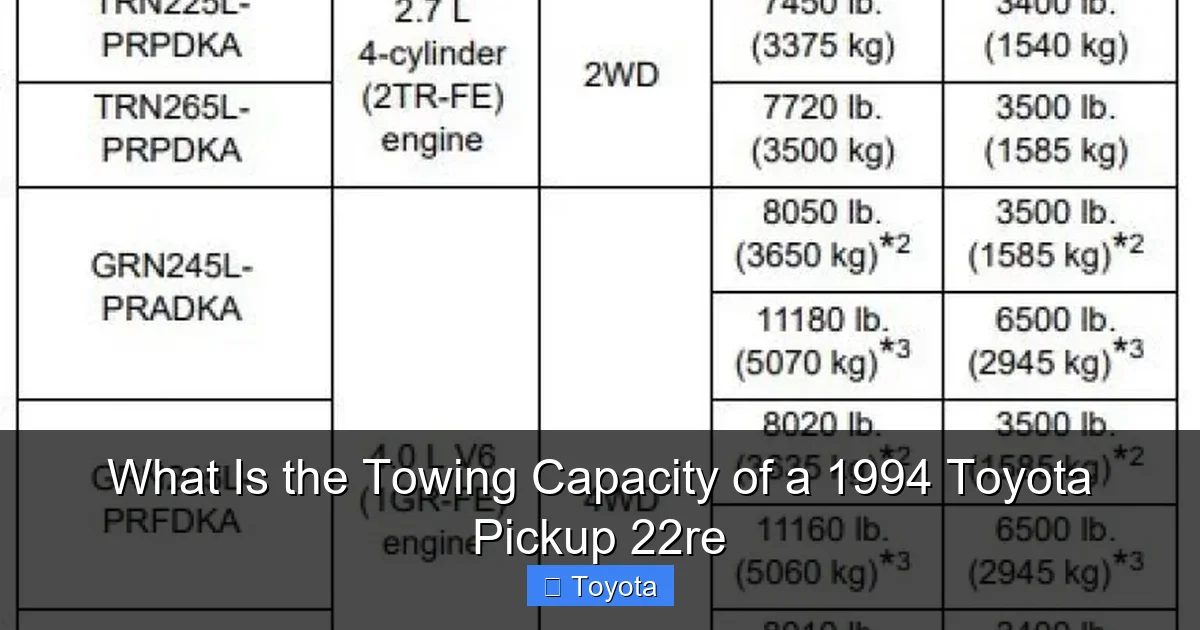
Now, to the heart of the matter. The 22RE is a fantastic, torquey little engine for its size, producing about 150 horsepower and 177 lb-ft of torque. It’s mated to either a robust 5-speed manual (G58) or the legendary A340F 4-speed automatic. Both transmissions are strong, but the automatic is generally preferred for towing due to its torque converter and lower first gear. Your truck’s specific towing capacity depends almost entirely on three things: drivetrain (2WD vs. 4WD), bed length (short or long), and whether it has the optional heavy-duty package.
Visual guide about What Is the Towing Capacity of a 1994 Toyota Pickup 22re
Image source: tailoredtrucks.com
Finding Your Truck’s Sticker
The absolute authority is the tire and loading information sticker inside your driver’s side door jamb. This sticker lists your truck’s specific GVWR and GAWRs. You’ll also find the GCWR in your owner’s manual, often in a towing section or a specifications chart. For the 1994 model, here are the general, manufacturer-published guidelines for the 22RE-powered models:
- 2WD, Short Bed, Standard Package: GCWR typically 7,700 lbs. Max trailer weight (with weight-distributing hitch) ~5,000 lbs.
- 2WD, Long Bed, Standard Package: GCWR typically 7,700 lbs. The long bed adds about 200-300 lbs to the truck’s curb weight, so max trailer weight drops slightly, often to ~4,700 lbs.
- 4WD Models (any bed): The transfer case, front axle, and additional hardware add significant weight. GCWR is typically 7,300 lbs. This reduces the max trailer weight to approximately ~4,300 lbs.
- Heavy-Duty Package (if equipped): This included a heavier-duty rear axle and sometimes a different rear spring pack. It could raise the GCWR slightly, sometimes to 8,000 lbs, potentially allowing for a trailer up to ~5,300 lbs, but this was less common on the 22RE four-cylinder models.
Critical Reminder: These are maximums. To calculate your actual available capacity, you must: 1) Find your truck’s actual curb weight (from a scale or manufacturer specs for your exact VIN). 2) Add the weight of all fluids (full tank of gas is ~150 lbs), passengers, and cargo in the bed/cab. 3) Subtract that total from the GCWR. The remainder is your maximum safe trailer weight. For example, if your 2WD short-bed 22RE has a curb weight of 3,500 lbs, you have 1,500 lbs for people/cargo/trailer tongue weight before you even hit the 5,000 lb trailer limit.
Real-World Factors That Reduce Your Towing Capacity
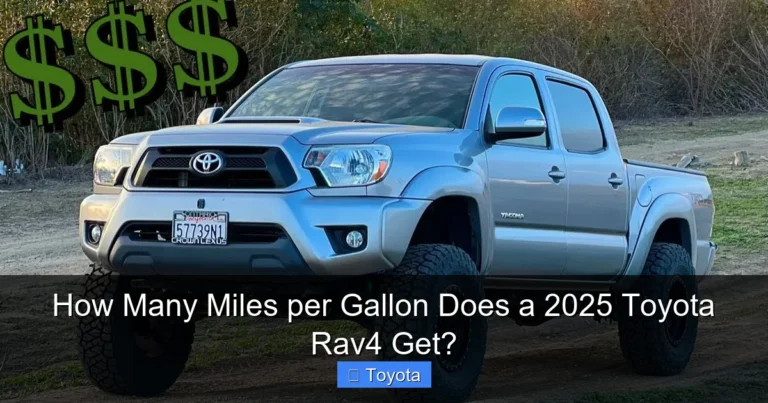
Here’s where the rubber meets the road—or rather, the trailer meets the hill. The factory number is a dry lab test. The real world is messy. Several factors will conspire to make that 5,000 lb number feel like a fantasy if you’re not prepared.

Visual guide about What Is the Towing Capacity of a 1994 Toyota Pickup 22re
Image source: bringatrailer.com
Altitude and Temperature
Naturally aspirated engines like the 22RE lose power as you go up in altitude—roughly 3% per 1,000 feet. Towing a max-weight trailer in the mountains of Colorado or even the high plains of Wyoming will feel like towing a much heavier load at sea level. The engine will struggle on grades, shifting down constantly and running hot. High ambient temperatures also reduce engine efficiency and increase the risk of transmission overheating.
Trailer Aerodynamics and Wind
A sleek, low-profile car hauler is a dream for a 22RE. A big, boxy, high-sided utility trailer or a travel trailer is a nightmare. It acts like a sail. Even a moderate crosswind can push you around, requiring constant steering correction and sapping momentum. The aerodynamic drag increases exponentially with speed, making it very hard to maintain highway speeds and dramatically increasing fuel consumption.
Grade and Terrain
Flat highways? Maybe you can flirt with the limit. Steep, sustained grades? You must derate significantly. A safe rule of thumb is to reduce your target trailer weight by 1,000 lbs for every 4-5% average grade you’ll encounter regularly. Gravel roads, mud, and sand also demand more power and traction, further reducing your effective capacity.
Your Truck’s Condition
Is your 22RE running perfectly? Fresh spark plugs, wires, fuel filter, and a clean air filter? A slightly clogged catalytic converter or weak fuel pump will make a huge difference under load. Is your transmission fluid fresh and at the correct level? Old, burnt fluid loses its frictional properties and cooling ability. Are your brakes in top shape? Towing magnifies brake wear. A neglected truck will struggle far below its potential capacity.
Essential Equipment and Modifications for Safe Towing
To tow safely and reliably near your truck’s limit, you need more than just a hitch ball. You need a system. Think of it as outfitting your soldier for battle.
The Hitch: Class III or IV with Weight-Distributing Components
For a 5,000 lb trailer, you need a Class III or IV receiver hitch welded or bolted to your truck’s frame. The factory step-bumpers on these trucks are NOT for towing. You must use a frame-mounted hitch. More importantly, you need the weight-distributing hitch kit (spring bars, brackets, and a proper ball mount) designed for your specific hitch and truck. This kit is what allows you to use the full 5,000 lb rating by leveling the truck and distributing weight. Without it, you are severely limited, often to under 3,500 lbs, to avoid rear sag.
The Brake Controller: Your Most Important Safety Device
Any trailer with brakes (required over 1,500-3,000 lbs depending on state) needs a proportional brake controller mounted in your cab. This device activates the trailer’s brakes in sync with your truck’s brakes. A timed or inertia-based controller is better than nothing, but a true proportional (or “smart”) controller is the gold standard. It reads your truck’s deceleration and applies the trailer brakes accordingly, preventing the trailer from pushing you or locking up. This is non-negotiable for safe, legal towing at these weights. If you’re looking at modern solutions, understanding features like what is the set button on a Toyota Tacoma can give you insights into integrated systems, but for your 1994, an aftermarket unit is the way to go.
Transmission Cooling
The A340F automatic is tough, but it’s a 30-year-old design working hard. Heat is its enemy. An auxiliary transmission cooler (a small, additional radiator for the ATF) is one of the best modifications you can make. It keeps fluid temperatures down, ensuring smooth shifts and long transmission life. For the manual, a high-quality synthetic gear oil and perhaps a vented transmission pan can help, but heat is less of a critical issue than with the automatic.
Mirrors, Lights, and Wiring
You need extended towing mirrors to see past your trailer. A proper 7-pin wiring harness must be installed to control trailer lights (brake, turn, running) and charge the trailer battery if it has one. Check all lights before every trip.
Practical Towing Tips and Best Practices for Your 22RE
Okay, you’ve got your hitch, brake controller, and cooler installed. You’ve weighed everything. You’re within your calculated limits. Now, how do you actually drive?
Driving Techniques: Slow and Steady
Your 22RE has limited horsepower. Embrace the slow lane. Plan your passes carefully; you likely won’t have the power to pass a slow-moving vehicle on a two-lane road. Use lower gears proactively. In the automatic, use the “3” or “2” position (if equipped) to hold gears on long downgrades instead of riding the brakes. In the manual, downshift early to use engine braking. Accelerate gently and allow double the normal stopping distance. Anticipate traffic far ahead.
Pre-Trip Inspection is Law
Before every single trip, walk a circle around your setup. Check: tire pressures on truck and trailer (inflate to max sidewall pressure when cold); hitch connection and safety chains crossed; brake controller test; all lights; trailer coupler locked and latched; cargo secure and balanced. A 15-minute check can prevent a major disaster.
Know Your Legal Limits
Towing laws vary by state. They cover maximum trailer length, width, height, and speed limits for vehicles towing trailers. Some states require brake controllers for trailers over a certain weight. Some require special permits for certain weights. Always check the laws for the states you’ll be traveling through. The speed limit for a car towing a caravan is often lower than the standard highway speed.
Common Misconceptions and the Limits of the 22RE
Let’s clear the air on some myths that get people into trouble.
“My Truck Can Pull It, So It Can Tow It”
Pulling and stopping are two different things. Your 22RE might get a 6,000 lb trailer moving on flat ground, but your stock truck brakes cannot stop it safely. That’s why the GCWR exists. Exceeding it means you are operating outside the safety margins engineered into the truck’s brakes, tires, and frame.
“Four-Low is for Towing on the Highway”
Absolutely not. Four-low is for slow, extreme off-road situations where maximum torque multiplication is needed. Never use 4WD on dry pavement for towing; it will cause driveline binding and damage. On slippery surfaces (wet, icy, gravel), 4WD can help with traction, but it does not increase your towing capacity. Your GCWR remains the same.
The Real “Heavy-Duty” Package
While a “heavy-duty” package existed, it was mostly about the rear axle and springs. It did not transform the 22RE into a V8. The engine’s power and the transmission’s strength were still the primary limiting factors. Don’t expect a night-and-day difference in towing performance from a standard to a “HD” model.
When to Say No
There are trailers you should simply not consider. Large, heavy travel trailers (25+ ft), large car haulers with multiple vehicles, or construction equipment trailers loaded with skid steers are poor matches. Your 22RE pickup is best suited for: small to mid-size utility trailers (4×8 or 5×8), small boat trailers ( aluminum boats up to 18-20 ft), lightweight travel tear-drop campers, and small enclosed cargo trailers. If you regularly need to tow more than 4,000 lbs, you should seriously consider a vehicle with a larger engine, like a V6 or V8 pickup.
Conclusion: Respect the Rating, Enjoy the Ride
So, what is the towing capacity of a 1994 Toyota Pickup 22RE? The official, published maximum is 5,000 pounds for a 2WD standard-bed model using a weight-distributing hitch. But as we’ve explored, that number is the beginning of the conversation, not the end. Your real-world, safe, and sustainable towing capacity is likely between 3,500 and 4,500 pounds after accounting for your truck’s actual weight, payload, terrain, and conditions.
The key takeaway is this: your 22RE pickup is a capable, reliable light-duty hauler when treated with respect. It will happily pull a small boat to the lake, a utility trailer to the job site, or a modest camper on weekend adventures. To do so successfully, you must be the engineer. Calculate your true GCWR headroom. Invest in the proper, high-quality towing equipment—especially the brake controller and weight-distributing hitch. Keep your truck meticulously maintained. And drive with patience and anticipation.
These trucks have a legendary reputation for a reason. They are simple, tough, and repairable. By understanding and adhering to its true limits, you’ll protect that reputation for your own vehicle, ensure your safety, and get countless miles of enjoyable, trouble-free towing from your classic 22RE. It’s not about how much you can pull; it’s about how well and how safely you can pull it. Now, go hook up that trailer and hit the road—the right way.
Frequently Asked Questions
What is the absolute maximum trailer weight for a 1994 Toyota Pickup 22RE?
The manufacturer’s stated maximum is 5,000 lbs, but this applies only to specific 2WD, short-bed models with the standard package and when using a certified weight-distributing hitch. All other configurations (4WD, long-bed) have lower maximums, typically around 4,300-4,700 lbs.
Do I absolutely need a weight-distributing hitch?
Yes, for any trailer approaching 3,500 lbs or more. A weight-distributing hitch is required to safely utilize the truck’s full rated towing capacity. It prevents the rear axle from being overloaded by tongue weight, which causes dangerous sway, poor steering, and brake inefficiency. For lighter trailers under 2,000 lbs, a simple ball hitch may suffice, but you’ll still be limited by payload.
Can my 22RE tow a large travel trailer or fifth-wheel?
No. Large travel trailers and fifth-wheels typically weigh well over 5,000 lbs, even on the small end. The 22RE engine and the truck’s chassis, brakes, and suspension are not designed for such loads. Attempting to tow a trailer beyond the truck’s GCWR is extremely dangerous and will cause severe damage.
Is an automatic or manual transmission better for towing with a 22RE?
The A340F automatic is generally considered better for towing. It has a torque converter that helps manage low-speed power and a lower first gear. It also allows for engine braking by manually selecting lower gears. The manual (G58) is very strong and can be fine, but requires more driver involvement to keep the engine in the power band and for engine braking on downgrades. The automatic’s main weakness is heat, which is why a transmission cooler is a recommended upgrade.
How do I find my truck’s actual Gross Combined Weight Rating (GCWR)?
The definitive source is your owner’s manual. Look in the specifications or towing section. You can also sometimes find it on a sticker in the driver’s door jamb, though the manual is more reliable. If those are missing, you can contact a Toyota dealer with your VIN, or research reputable forums for owners with your exact configuration (year, cab type, bed length, 2WD/4WD) who have documented their GCWR.
What is the single most important safety upgrade I can make for towing?
Installing a high-quality, proportional trailer brake controller. If your trailer has electric brakes (it should for weights over ~1,500 lbs), this device is the single biggest factor in safe stopping. It integrates the trailer’s brakes with your truck’s system, preventing the trailer from pushing you into an intersection or causing sway during emergency stops. It is required by law in most jurisdictions for trailers over a certain weight and is a fundamental safety system, not an accessory.