

What Is the Top Speed of a Dodge Charger?

Contents
- 1 Key Takeaways
- 2 📑 Table of Contents
- 3 What Is the Top Speed of a Dodge Charger?
- 4 Understanding the Dodge Charger’s Performance Spectrum
- 5 Top Speed by Trim: A Detailed Breakdown
- 6 What Affects the Charger’s Top Speed?
- 7 Real-World Performance: Can You Actually Reach Top Speed?
- 8 Tips for Maximizing Your Charger’s Performance
- 9 Conclusion: The Charger’s Speed Legacy
- 10 Frequently Asked Questions


The top speed of a Dodge Charger varies by model and engine, ranging from 130 mph to an impressive 204 mph. High-performance variants like the Charger SRT Hellcat and Redeye lead the pack, while base models prioritize efficiency and everyday driving.
Key Takeaways
- Top speed varies by trim: The Dodge Charger’s maximum speed depends heavily on the engine and performance package, with base models capped around 130 mph and high-performance versions exceeding 200 mph.
- Hellcat and Redeye dominate: The Charger SRT Hellcat reaches up to 204 mph, making it one of the fastest production sedans in the world.
- Aerodynamics and weight matter: Despite its large size, the Charger’s design and weight distribution help maintain stability at high speeds.
- Electronic limiters are common: Most Chargers have factory-set speed limiters for safety, tire durability, and legal compliance.
- Real-world conditions affect performance: Road surface, weather, altitude, and fuel quality can all influence how fast a Charger can safely go.
- Regular maintenance is key: To achieve and sustain top speeds, proper engine care, tire condition, and fluid levels are essential.
- Legal and safety considerations: Driving at top speed is illegal on public roads and should only be done in controlled environments like racetracks.
📑 Table of Contents
- What Is the Top Speed of a Dodge Charger?
- Understanding the Dodge Charger’s Performance Spectrum
- Top Speed by Trim: A Detailed Breakdown
- What Affects the Charger’s Top Speed?
- Real-World Performance: Can You Actually Reach Top Speed?
- Tips for Maximizing Your Charger’s Performance
- Conclusion: The Charger’s Speed Legacy
What Is the Top Speed of a Dodge Charger?
If you’ve ever watched a Dodge Charger roar down the highway, you’ve probably wondered: just how fast can this beast really go? The Dodge Charger isn’t just a stylish four-door sedan—it’s a symbol of American muscle, blending bold design with serious performance. Whether you’re a car enthusiast, a potential buyer, or just curious, understanding the top speed of a Dodge Charger gives you insight into its engineering, capabilities, and legacy.
But here’s the thing: the answer isn’t one-size-fits-all. The top speed of a Dodge Charger depends on several factors, including the engine under the hood, the trim level, and even the model year. From the efficient V6-powered base models to the fire-breathing supercharged V8s in the SRT lineup, the Charger offers a wide range of performance options. So, while one Charger might top out at 130 mph, another can rocket past 200 mph with ease.
In this guide, we’ll break down everything you need to know about the Dodge Charger’s top speed. We’ll explore how different engines affect performance, compare trims, discuss the role of aerodynamics and electronics, and even touch on real-world driving tips. Whether you’re dreaming of owning one or just love learning about high-performance vehicles, this article will give you a complete picture of what makes the Charger one of the most exciting sedans on the road.
Understanding the Dodge Charger’s Performance Spectrum
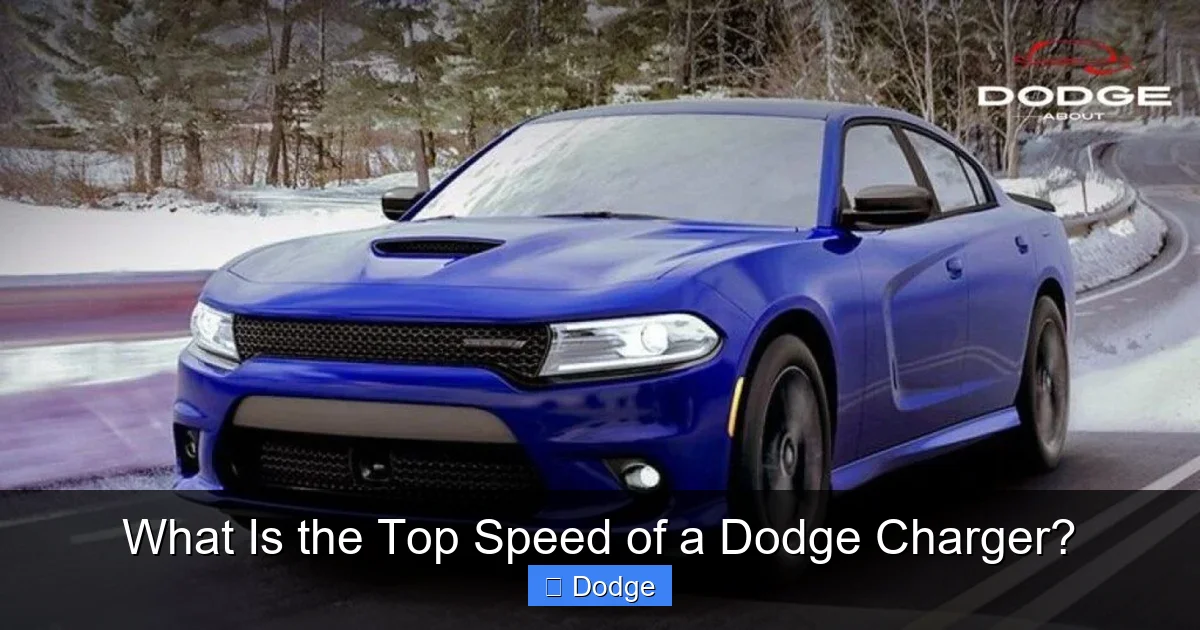
Visual guide about What Is the Top Speed of a Dodge Charger?
Image source: dodgeabout.com
The Dodge Charger is more than just a car—it’s a performance platform with multiple personalities. Depending on how you configure it, the Charger can be a comfortable family cruiser, a sporty daily driver, or a track-ready monster. This versatility is one of its biggest strengths, but it also means that top speed varies significantly across the lineup.
At the heart of every Charger is its engine. Dodge offers a range of powertrains, each designed for different driving needs and performance goals. The base model typically comes with a 3.6-liter Pentastar V6 engine, which delivers solid power for everyday driving but isn’t built for extreme speed. As you move up the trim ladder—through the R/T, Scat Pack, and into the SRT and Hellcat models—the engines get bigger, more powerful, and more capable of pushing the Charger to its limits.
But engine power isn’t the only factor. The car’s weight, aerodynamics, transmission, and electronic controls all play a role in determining how fast it can go. For example, the Charger SRT Hellcat Redeye weighs over 4,500 pounds, which is heavy for a performance car. Yet, thanks to its supercharged 6.2-liter HEMI V8 producing over 797 horsepower, it can still achieve a top speed of 203–204 mph. That’s faster than many supercars, despite being a full-size sedan.
Another key element is the transmission. Most high-performance Chargers use an 8-speed automatic transmission that’s tuned for quick shifts and optimal power delivery. This helps the car accelerate rapidly and maintain momentum at high speeds. Meanwhile, the all-wheel-drive system (available on some models) improves traction, especially during launch, but can slightly reduce top speed due to added mechanical drag.
It’s also worth noting that Dodge uses electronic speed limiters on most of its vehicles. These are factory-set caps that prevent the car from exceeding a certain speed, usually for safety, tire integrity, and legal reasons. For instance, even if a Charger SRT Hellcat has the power to go faster, it’s electronically limited to around 204 mph. This is common in the automotive industry—many high-performance cars are limited not because they can’t go faster, but because it’s safer and more practical.
So, when asking “What is the top speed of a Dodge Charger?” the real answer is: it depends. But one thing’s for sure—no matter which model you choose, the Charger delivers an exhilarating driving experience that few sedans can match.
Top Speed by Trim: A Detailed Breakdown

Visual guide about What Is the Top Speed of a Dodge Charger?
Image source: dodgeabout.com
Now that we’ve covered the basics, let’s dive into the specifics. The top speed of a Dodge Charger varies dramatically depending on the trim level and engine configuration. Here’s a detailed breakdown of the most popular models and their maximum speeds.
Charger SXT and GT (V6 Models)
The entry-level Charger SXT and the slightly more performance-oriented GT both come equipped with the 3.6-liter Pentastar V6 engine. This engine produces around 292 to 300 horsepower, depending on the model year and drivetrain (RWD or AWD). While it’s not a powerhouse by muscle car standards, it’s more than capable of handling daily commutes and highway driving with ease.
The top speed for these models is electronically limited to approximately 130 mph. This cap is in place to protect the tires, which are typically rated for lower speeds, and to ensure long-term reliability. In real-world driving, you’ll rarely—if ever—need to push a V6 Charger this fast. But if you do find yourself on a closed track, you’ll notice that the car feels stable and responsive even near its limit.
One thing to keep in mind is that the all-wheel-drive (AWD) version of the GT may have a slightly lower top speed due to the added weight and drivetrain losses. However, the difference is minimal—usually just a few miles per hour.
Charger R/T (5.7L HEMI V8)
Stepping up to the R/T trim introduces the 5.7-liter HEMI V8 engine, a classic American powerplant known for its torque and throaty exhaust note. This engine delivers around 370 horsepower and 395 lb-ft of torque, giving the Charger a noticeable boost in acceleration and overall performance.
The top speed for the R/T is typically limited to about 150 mph. This is a significant jump from the V6 models and reflects the increased power and performance capabilities. The R/T also comes with upgraded suspension, larger brakes, and a sport-tuned exhaust, all of which contribute to better high-speed handling.
Drivers often describe the R/T as the “sweet spot” for those who want V8 power without going full-on SRT. It’s fast enough to feel exciting on the highway, but not so extreme that it’s impractical for daily use.
Charger Scat Pack (6.4L HEMI V8)
The Scat Pack is where things start to get serious. Equipped with a 6.4-liter HEMI V8 engine, this model produces around 485 horsepower and 475 lb-ft of torque. That’s enough to launch the Charger from 0 to 60 mph in under 4.5 seconds—impressive for a four-door sedan.
The top speed for the Scat Pack is electronically limited to approximately 160 mph. This model also features performance upgrades like Brembo brakes, a sport suspension, and wider tires, all of which help it handle high-speed driving more confidently.
One of the coolest things about the Scat Pack is that it retains much of the Charger’s daily usability. You can drive it to work, take the kids to school, and still enjoy a thrilling weekend canyon run. It’s a great balance of power and practicality.
Charger SRT 392 (6.4L HEMI V8, SRT-Tuned)
The SRT 392 is essentially a more refined and track-focused version of the Scat Pack. It uses the same 6.4-liter HEMI V8 engine but with SRT-specific tuning, including improved cooling, a more aggressive exhaust system, and enhanced aerodynamics.
The top speed remains around 160 mph, but the SRT 392 feels more composed at high speeds thanks to its upgraded suspension and stability systems. It also comes with features like adaptive damping, launch control, and a performance pages display that lets you monitor engine data in real time.
This trim is ideal for drivers who want a high-performance sedan that can also handle occasional track days.
Charger SRT Hellcat (6.2L Supercharged HEMI V8)
Now we enter the realm of supercar territory. The Charger SRT Hellcat is powered by a 6.2-liter supercharged HEMI V8 engine that produces a staggering 717 horsepower and 650 lb-ft of torque. This makes it one of the most powerful production sedans ever built.
The top speed of the Hellcat is electronically limited to 204 mph. That’s faster than many Lamborghinis and Ferraris, and it’s a testament to Dodge’s engineering prowess. The car also features a reinforced chassis, upgraded cooling systems, and high-performance tires (usually Pirelli P Zero or Michelin Pilot Sport) designed to handle the extreme forces at play.
Even with all this power, the Hellcat remains surprisingly drivable in everyday conditions. It has multiple drive modes—including Auto, Sport, Track, and Custom—that adjust throttle response, suspension stiffness, and transmission behavior. This allows you to dial down the aggression when you’re just cruising around town.
Charger SRT Hellcat Redeye (797 HP)
The Redeye is the ultimate expression of the Charger’s performance potential. With 797 horsepower and 707 lb-ft of torque, it’s the most powerful production sedan in the world. The supercharger is larger, the fuel system is upgraded, and the engine is tuned for maximum output.
The top speed is slightly lower than the standard Hellcat, at around 203 mph, due to increased aerodynamic drag and the need to protect the drivetrain. However, the Redeye makes up for it with blistering acceleration—0 to 60 mph in just 3.4 seconds.
This model is not for the faint of heart. It’s a street-legal dragster that demands respect. But for those who crave raw power and unapologetic performance, the Redeye is hard to beat.
What Affects the Charger’s Top Speed?

Visual guide about What Is the Top Speed of a Dodge Charger?
Image source: motorbiscuit.com
While engine power is the most obvious factor in determining top speed, it’s not the only one. Several other elements influence how fast a Dodge Charger can go, both in theory and in practice.
Aerodynamics and Drag
The Charger’s body style—a large, four-door sedan—creates more aerodynamic drag than a low-slung sports car. At high speeds, this drag becomes a significant force that the engine must overcome. Dodge has worked to minimize this through design tweaks like active grille shutters, underbody panels, and rear spoilers (on SRT models), but the Charger will never be as slippery as a coupe.
The Hellcat and Redeye models, in particular, generate more drag due to their larger intakes and wider bodies. This is one reason why their top speeds are slightly lower than what the engine alone might suggest.
Weight and Weight Distribution
The Charger is a heavy car, especially in its high-performance trims. The Hellcat, for example, weighs over 4,500 pounds. While modern materials and engineering help keep weight in check, all that mass requires more power to accelerate and maintain speed.
However, the Charger’s front-engine, rear-wheel-drive layout provides excellent weight distribution, which helps with stability at high speeds. The car feels planted and predictable, even when pushing the limits.
Tire Ratings and Grip
Tires are a critical limiting factor. Most Chargers come with high-performance tires rated for speeds up to 149 mph (V-rated) or 168 mph (W-rated). The Hellcat and Redeye models use Z-rated tires, which are designed for speeds over 149 mph and can handle the extreme forces at 200+ mph.
If you modify your Charger or drive aggressively, it’s essential to ensure your tires are rated for the speeds you plan to reach. Using the wrong tires can lead to blowouts or loss of control.
Electronic Limiters and Safety Systems
As mentioned earlier, Dodge uses electronic speed limiters to cap the top speed of its vehicles. These are programmed into the car’s engine control unit (ECU) and cannot be easily overridden without aftermarket tuning.
The limiters serve several purposes: they protect the engine and drivetrain from excessive stress, ensure tire safety, and comply with legal and insurance standards. While some enthusiasts choose to remove or adjust these limiters, doing so can void warranties and increase the risk of mechanical failure.
Environmental and Driving Conditions
Real-world top speed is also affected by external factors. High altitude reduces engine power due to thinner air, while hot weather can cause overheating. Road surface quality, wind, and traffic conditions also play a role.
For the safest and most accurate top speed runs, experts recommend using a closed track or professional testing facility. Public roads are not designed for such speeds and pose serious legal and safety risks.
Real-World Performance: Can You Actually Reach Top Speed?
So, you’ve got a Charger SRT Hellcat, and you’re wondering if you can actually hit 204 mph. The short answer is: yes, but not on public roads.
Reaching a car’s top speed requires ideal conditions—long, straight, flat roads with no traffic, perfect weather, and a skilled driver. Even then, it’s dangerous and illegal in most places. In the U.S., the maximum legal speed limit is 85 mph (on a few rural highways), and driving at 200+ mph would result in severe penalties, including license suspension and vehicle impoundment.
That’s why manufacturers and performance enthusiasts typically test top speeds on closed courses like the Johnny Bohmer Proving Grounds in Florida or professional racetracks. These environments are designed for high-speed testing and have safety measures in place.
If you’re serious about experiencing your Charger’s full potential, consider attending a track day or high-performance driving event. Many car clubs and organizations offer these opportunities, allowing you to push your vehicle in a controlled, legal setting.
Another option is using a dynamometer (dyno) to measure engine output and simulate top speed. While not the same as real-world driving, dyno testing can give you a good idea of your car’s capabilities.
Tips for Maximizing Your Charger’s Performance
Whether you’re driving a V6 SXT or a Hellcat Redeye, there are ways to get the most out of your Charger’s performance—safely and responsibly.
Regular Maintenance
Keep your engine tuned, fluids fresh, and tires in good condition. A well-maintained Charger will perform better and last longer. Pay special attention to the supercharger (on Hellcat models), transmission fluid, and brake system.
Use High-Quality Fuel
High-performance engines like the HEMI V8s require premium fuel (91 octane or higher) to run optimally. Using lower-octane fuel can cause knocking, reduced power, and potential engine damage.
Upgrade Tires and Brakes
If you plan to drive aggressively or attend track days, consider upgrading to high-performance tires and brake pads. This improves grip, stopping power, and overall safety.
Monitor Engine Parameters
Use the Charger’s built-in performance pages or an aftermarket gauge to monitor engine temperature, boost pressure, and other vital stats. This helps you avoid overheating or over-revving.
Drive Responsibly
Remember that the Charger is a powerful machine. Always obey traffic laws, wear your seatbelt, and avoid reckless driving. Save the high-speed fun for the track.
Conclusion: The Charger’s Speed Legacy
The Dodge Charger is more than just a fast car—it’s a cultural icon that represents the best of American automotive engineering. From the efficient V6 models to the earth-shaking Hellcat Redeye, the Charger offers a top speed for every kind of driver.
While the exact number depends on the trim and configuration, one thing is clear: the Charger is built to go fast. Whether you’re cruising down the highway or tearing up the track, this sedan delivers an unforgettable driving experience.
So, what is the top speed of a Dodge Charger? It’s not just a number—it’s a testament to power, passion, and performance. And if you’re lucky enough to get behind the wheel, you’ll understand why the Charger continues to captivate car lovers around the world.
Frequently Asked Questions
What is the top speed of a Dodge Charger SRT Hellcat?
The Dodge Charger SRT Hellcat has a top speed of 204 mph, making it one of the fastest production sedans available. This speed is electronically limited for safety and tire integrity.
Can a base model Dodge Charger go 150 mph?
No, the base model Charger with the 3.6L V6 engine has a top speed of around 130 mph. Only higher trims with V8 engines can reach or exceed 150 mph.
Is it legal to drive a Dodge Charger at top speed?
No, driving at top speed is illegal on public roads in most countries. It should only be done in controlled environments like racetracks or testing facilities.
Does the Charger Redeye have a higher top speed than the Hellcat?
No, the Redeye has a slightly lower top speed (203 mph) compared to the standard Hellcat (204 mph) due to increased aerodynamic drag and drivetrain stress.
Can I remove the speed limiter on my Dodge Charger?
Yes, but it requires aftermarket tuning and may void your warranty. It also increases the risk of mechanical failure and is not recommended for street use.
What tires are needed for high-speed driving in a Charger?
High-performance Chargers like the Hellcat require Z-rated tires, which are designed for speeds over 149 mph. Using lower-rated tires can be dangerous at high speeds.


