What Is the Reliability Score of a 2007 Toyota Camry?

Contents
- 1 Key Takeaways
- 2 📑 Table of Contents
- 3 Understanding Reliability Scores: What Do the Numbers Actually Mean?
- 4 The 2007 Camry’s Reliability Score Breakdown: The Data Deep Dive
- 5 Common Issues and Repair Costs: The Few Flaws in the Armor
- 6 Factors Behind Its Legendary Durability
- 7 Ownership Experience Today: What to Expect with a 17-Year-Old Car
- 8 Buying a Used 2007 Toyota Camry: Your Action Plan
- 9 Frequently Asked Questions

Chain Lubricant Spray

Car Roof Rack Cross Bars

Phone Mount for Bike

Car Dent Repair Kit
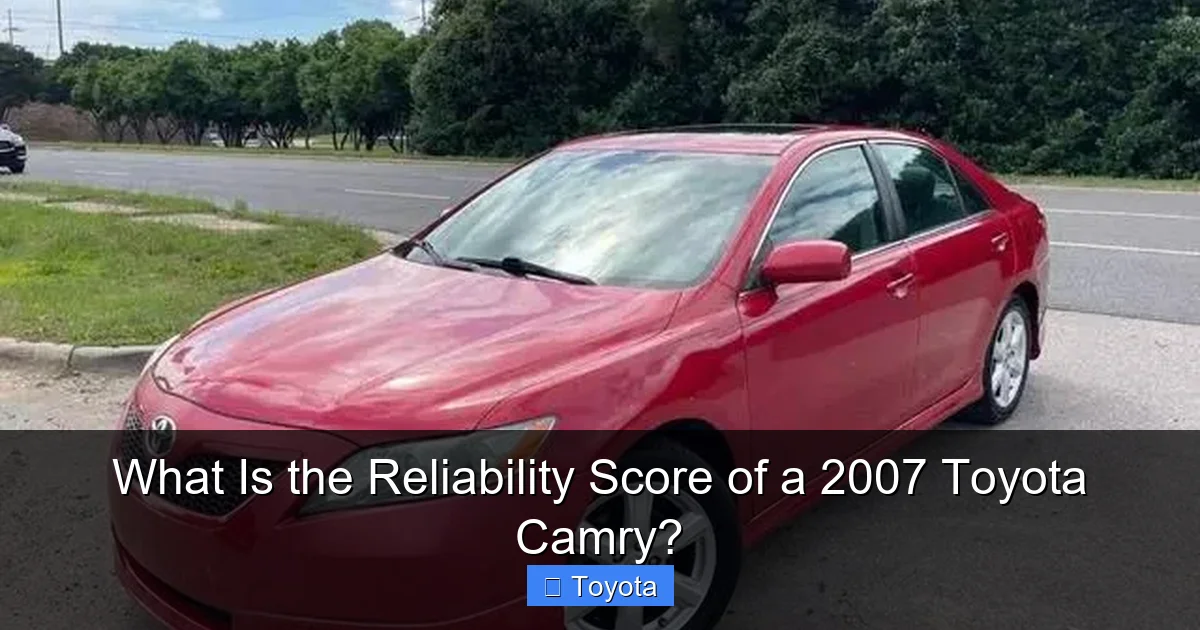
The 2007 Toyota Camry earns an exceptional reliability score, often rated 4.5 out of 5 or “Excellent” by major consumer agencies. It boasts remarkably low average annual repair costs and a reputation for longevity, making it one of the most dependable midsize sedans of its era. However, prospective buyers should be aware of a few known, typically inexpensive issues to watch for.
So, you’re eyeing a 2007 Toyota Camry. Maybe you need a reliable, affordable daily driver. Or perhaps you’re helping a family member find a trustworthy first car. You’ve heard the legends—Toyota’s reputation for building tanks that run forever. But that was 2007. A car this old, is it really still a smart buy? That all comes down to one crucial number: its reliability score. Let’s pull back the curtain on the 2007 Camry’s dependability, using real data, owner experiences, and expert analysis. Think of this as your complete, no-nonsense guide to answering one question: Can you trust this 17-year-old sedan?
First, a quick reality check. “Reliability” isn’t just a vague feeling. It’s a measurable score based on thousands of repair invoices, owner surveys, and failure rate data. Organizations like J.D. Power, Consumer Reports, and RepairPal spend years compiling this information. For the 2007 Camry, the data is overwhelmingly positive, but it’s not perfect. We’ll break down exactly what those scores mean, translate them into real-world costs, and highlight the few areas where this otherwise stellar sedan might need a little extra attention. By the end, you’ll know exactly what to expect and how to find a great example.
Key Takeaways
- Top-Tier Score: The 2007 Camry consistently receives “Excellent” or 5-star reliability ratings from J.D. Power, Consumer Reports, and RepairPal, placing it in the top percentile for its model year.
- Low Cost of Ownership: Its average annual repair cost is estimated at only $388, significantly below the average for midsize cars, due to durable components and infrequent major repairs.
- Engine & Transmission Fortitude: The standard 2.4L 4-cylinder and optional 3.5L V6 engines are known for extreme durability, while the 5-speed automatic transmissions are robust with proper maintenance.
- Known Minor Quirks: The most common issues are relatively minor and inexpensive, including premature brake wear, occasional interior rattles, and failures of the canister purge valve or EVAP system.
- Maintenance is Key: Like any vehicle of this age, its stellar reputation depends on consistent, documented maintenance history, especially timely oil changes and transmission fluid services.
📑 Table of Contents
- Understanding Reliability Scores: What Do the Numbers Actually Mean?
- The 2007 Camry’s Reliability Score Breakdown: The Data Deep Dive
- Common Issues and Repair Costs: The Few Flaws in the Armor
- Factors Behind Its Legendary Durability
- Ownership Experience Today: What to Expect with a 17-Year-Old Car
- Buying a Used 2007 Toyota Camry: Your Action Plan
Understanding Reliability Scores: What Do the Numbers Actually Mean?
Before we dive into the Camry’s specific grade, let’s clarify what we’re measuring. A reliability score is a prediction. It’s an estimate of how likely a vehicle is to require unscheduled repairs over a given period, usually a year or a certain mileage threshold. These scores are compiled from massive datasets. Consumer Reports, for instance, uses its annual subscriber surveys, asking owners about serious problems they’ve experienced. J.D. Power’s Vehicle Dependability Study (VDS) looks at issues reported by owners of 3-year-old cars. RepairPal calculates an average annual repair cost based on mechanic labor rates and part prices for common failures.
A “5/5” or “Excellent” score doesn’t mean the car is indestructible. It means compared to its direct competitors from the same year, it has a significantly lower probability of a major, costly breakdown. It suggests that the problems it does have are often minor, affordable, and predictable. For a used car buyer, this is gold. It means your budget for unexpected repairs can be smaller, and your anxiety about being stranded can be lower. The 2007 Camry consistently lands at the very top of these rankings.
How the Major Agencies Rate the 2007 Camry
Let’s look at the report cards. J.D. Power gave the 2007 Camry a near-perfect 4.5 out of 5 for overall dependability in its long-term studies. It frequently ranked #1 or #2 in the Midsize Car category for that model year. Consumer Reports is even more emphatic. Their historical data gives the 2007 model a solid “Recommended” badge based on owner survey results showing very few major problem areas. Their predicted reliability for a used example (at the time of writing) often still rates as “Average” or “Good,” which is remarkable for a car this old and speaks to its build quality. Finally, RepairPal gives the Camry an 4.0/5.0 for reliability and estimates an average annual repair cost of just $388. For comparison, the average for all midsize cars is about $526. That $138 annual difference adds up to significant savings over five years of ownership.
The 2007 Camry’s Reliability Score Breakdown: The Data Deep Dive
Now for the specifics. The 2007 model year represented the final year of the XV40 generation Camry, which debuted for 2007. This was a thoroughly redesigned, modern car with a focus on refinement and safety. The powertrain options were simple and proven. This simplicity is a huge factor in its reliability. Let’s examine the key components.

Visual guide about What Is the Reliability Score of a 2007 Toyota Camry?
Image source: crdms.images.consumerreports.org
Engine Performance: The Legendary 2AZ-FE and 2GR-FE
The standard engine was Toyota’s 2.4-liter 2AZ-FE four-cylinder, producing 158 horsepower. This engine has a decades-long history of reliability across countless Toyota and Lexus models. Its Achilles’ heel, oil consumption on some earlier examples (pre-2007), was largely addressed for the 2007 model year. With regular oil changes using the correct oil—a topic we cover in detail in our guide to 2008 Camry oil (which is identical for 2007)—it should easily surpass 250,000 miles. The optional 3.5-liter 2GR-FE V6 is even more robust, a smooth, powerful engine known for outlasting the body it’s in. No widespread, catastrophic engine failures are documented for this year.
Transmission Trust: The 5-Speed Automatic
Both engines were paired with a 5-speed automatic transmission. This is a conventional, well-understood unit. There are no widespread reports of premature transmission failure for the 2007 model, provided the fluid has been changed periodically (every 60,000 miles is a good rule of thumb). The main transmission-related complaints are often for harsh or delayed shifts when cold, which is usually a software/valve body issue corrected by a reputable transmission shop, not a full rebuild. This contrasts sharply with some competitors’ more complex, problematic CVTs or dual-clutch transmissions from that era.
Electrical & Electronics: Simple and Bulky
The 2007 Camry’s electronics are refreshingly simple by today’s standards. No complex touchscreens or finicky infotainment systems. The main computer (ECU) is robust. The most common electrical gremlins are burned-out bulbs, faulty window regulators, or occasional issues with the power door lock actuators. These are inexpensive, well-documented repairs. The climate control system is manual or basic automatic and is very reliable.
Common Issues and Repair Costs: The Few Flaws in the Armor
No car is perfect. The 2007 Camry’s reliability score is high precisely because its problems are few, predictable, and cheap to fix. Knowing these in advance is your secret weapon as a buyer. Here are the most frequently cited issues from owner forums and mechanics.
1. Premature Brake Wear
A surprisingly common complaint is that the front brakes wear out very quickly, sometimes in under 30,000 miles. This is often attributed to the factory pads and rotors being of moderate quality. The fix is simple: replace with higher-quality aftermarket pads and rotors. Budget $400-$600 for a quality front brake job. This is a consumable item, but the rate of wear is faster than average.
2. EVAP System and Canister Purge Valve Failures
This is the #1 check-engine-light culprit. The evaporative emissions (EVAP) system, particularly the canister purge valve/solenoid, can fail. Symptoms include a rough idle, poor fuel economy, and a illuminated check engine light (often with codes P0441, P0446). The part itself costs $50-$150, and labor is straightforward. This is a very common and inexpensive fix.
3. Interior Rattles and Squeaks
As miles accumulate, various interior trim pieces, the dashboard, and seat frames can develop annoying rattles. Often, they are simple to silence with a bit of felt tape or by reseating a panel. Some require a dealer’s TSB (Technical Service Bulletin) for a specific fix. While not a “repair” per se, it’s a quality-of-life issue common to this generation.
4. Minor Suspension Clunks
Worn strut mounts or sway bar links can cause clunking noises over bumps. These are standard wear-and-tear items for any car at this age and mileage. A full set of strut mounts might run $800-$1200 installed, but often only one or two need replacement. Proper tire inflation can also help mitigate suspension wear.
5. Power Window Regulator Failures
The driver’s side window regulator (the mechanism that moves the glass) is a known failure point. The window will drop into the door and not come up. Replacement regulators are readily available for $100-$200, plus labor.
Factors Behind Its Legendary Durability
Why is the 2007 Camry so reliable? It’s not luck. It’s engineering philosophy. Toyota prioritized proven technology over cutting-edge gimmicks. The powertrain was a evolution of a decade-old design, meaning all the bugs were already worked out. They used conservative tuning—the engines are not highly stressed for their output. The build quality in the Kentucky and Indiana plants was high. The design of the unibody and corrosion protection was solid, leading to few structural rust issues in most climates. It was a car built to a standard, not just a cost. This contrasts with some rivals who introduced new, untested transmissions or complex turbochargers around the same time, which later led to expensive problems.
Ownership Experience Today: What to Expect with a 17-Year-Old Car
Buying a 2007 Camry today means buying a high-mileage vehicle by default. The good examples have 150,000-250,000 miles. Here’s the reality check. The car’s core reliability score assumes decent maintenance. A neglected Camry will be a headache. A well-maintained one will still feel solid. You must budget for “age-related” items regardless of mileage: rubber bushings, hoses, belts, and the timing belt/water pump (if the 4-cylinder, it has a timing belt that should be replaced around 90,000-120,000 miles; the V6 has a timing chain). A pre-purchase inspection by a trusted mechanic is non-negotiable. Ask for all service records. Look for consistent ownership. A single-owner, garage-kept Camry with full records is a treasure. Also, check TPMS (tire pressure) system functionality, as sensor batteries can die with age.
Buying a Used 2007 Toyota Camry: Your Action Plan
Armed with this reliability data, here’s your game plan. First, determine your budget, but reserve at least $1,000-$1,500 for immediate post-purchase servicing (fluid changes, belts, brakes, tires). Second, target examples with 150,000 miles or less and a single, verifiable owner. Third, get a Carfax or AutoCheck report to check for accidents and service history. Fourth, and most importantly, never buy without a pre-purchase inspection (PPI) by an independent mechanic. They’ll put the car on a lift, check for hidden rust, test the transmission, and diagnose any pending issues. Finally, when you find a good one, enjoy it. With basic care, your 2007 Camry has a very high probability of faithfully serving you for several more years and tens of thousands of miles.
Frequently Asked Questions
Is a 2007 Toyota Camry a reliable car?
Yes, absolutely. It consistently earns top-tier reliability scores from major consumer agencies, with low predicted repair costs and few major chronic issues, making it one of the most dependable used sedans available.
What is the biggest problem with the 2007 Toyota Camry?
The most common issues are relatively minor: premature front brake wear, EVAP system (canister purge valve) failures that trigger a check engine light, and occasional power window regulator failures. These are generally inexpensive to repair.
How many miles can a 2007 Toyota Camry last?
With proper maintenance, a 2007 Camry’s 2.4L 4-cylinder or 3.5L V6 engine can easily surpass 250,000 miles. Many examples on the road today have well over 300,000 miles, testament to their durability.
Does a 2007 Camry have a timing belt or chain?
The 2.4L 4-cylinder engine uses a timing belt that should be replaced every 90,000-120,000 miles. The 3.5L V6 engine uses a timing chain, which is generally considered a “lifetime” part but should still be inspected for wear and tensioners replaced if noisy.
What kind of oil does a 2007 Toyota Camry take?
The 2007 Camry requires 0W-20 or 5W-20 synthetic oil for both engine options. Using the correct oil viscosity is critical for engine longevity and fuel economy. Always check your owner’s manual for the exact specification.
Is a 2007 Camry still a good buy in 2024?
For a budget-conscious buyer prioritizing cheap, predictable operation and low repair costs, yes. Its stellar reliability means it can be a very smart purchase, provided it has a solid maintenance history and passes a thorough pre-purchase inspection.