What Is the Master Warning Light on a 2013 Toyota Highlander?

Contents
- 1 Key Takeaways
- 2 📑 Table of Contents
- 3 Understanding the Master Warning Light: Your Vehicle’s General Alarm
- 4 Common Causes for a 2013 Toyota Highlander Master Warning Light
- 5 How to Diagnose the Master Warning Light on Your 2013 Highlander
- 6 Step-by-Step: How to Reset the Master Warning Light
- 7 When to Seek Professional Help Immediately
- 8 Preventive Maintenance to Avoid Master Warnings
- 9 Conclusion: Knowledge is Your Best Tool
- 10 Frequently Asked Questions

Car Paint Touch Up Pen

Car Wireless Charger Mount

Anti-Slip Dashboard Mat

Trunk Organizer
The Master Warning Light on a 2013 Toyota Highlander is a critical, catch-all alert that illuminates for various serious issues, from low oil pressure and an open door to a failed sensor or the required maintenance light. It is not a light to ignore, as it signals a problem needing immediate diagnosis. Often, resolving the underlying issue—like topping up fluids or performing scheduled service—and then resetting the system will turn it off. If the light persists after a reset, it indicates a fault that requires professional attention to ensure your safety and your vehicle’s health.
You’re driving your trusty 2013 Toyota Highlander, the family’s reliable hauler, when suddenly a new icon catches your eye on the dashboard. It’s a triangle with an exclamation point inside—the Master Warning Light. Your heart skips a beat. What does this mean? Is it serious? Should you pull over right now? Don’t panic. This light is your vehicle’s way of getting your attention, but it’s not always a dire emergency. Think of it as a master-of-ceremonies, pointing you toward the specific problem that needs your attention. In this complete guide, we’ll demystify the Master Warning Light on your 2013 Highlander, covering everything from its common causes and simple fixes you can do yourself to the times when you absolutely need to call a professional. By the end, you’ll know exactly what to do when that little triangle illuminates, turning anxiety into confident action.
Key Takeaways
- It’s a Master Alert: The Master Warning Light is a general, non-specific warning that something is wrong, requiring you to check other gauges or messages for details.
- Common Triggers Include: Low engine oil pressure, an unlatched door or hood, low washer fluid, a failed sensor, or the ” Maintenance Required” light being active.
- Immediate Action is Needed: When it illuminates, you should safely pull over, check for obvious issues (like an open door), check fluid levels, and assess drivability.
- Diagnosis is Key: Use the multi-information display to read any accompanying text messages, and an OBD2 scanner is the best tool to read the specific trouble code stored.
- Reset Only After Fixing: You should only reset the light after addressing the actual problem. Resetting without repair will cause the light to return, often immediately.
- Professional Help May Be Required: For issues like low oil pressure, brake system faults, or persistent codes, consult a qualified mechanic immediately.
- It’s Different from the Check Engine Light: While sometimes related, the Master Warning covers broader vehicle systems (safety, body, maintenance) beyond just engine/emissions (Check Engine Light).
📑 Table of Contents
- Understanding the Master Warning Light: Your Vehicle’s General Alarm
- Common Causes for a 2013 Toyota Highlander Master Warning Light
- How to Diagnose the Master Warning Light on Your 2013 Highlander
- Step-by-Step: How to Reset the Master Warning Light
- When to Seek Professional Help Immediately
- Preventive Maintenance to Avoid Master Warnings
- Conclusion: Knowledge is Your Best Tool
Understanding the Master Warning Light: Your Vehicle’s General Alarm
First, let’s get one thing straight: the Master Warning Light is not a single-issue light like the “Check Engine” or “Oil Pressure” warnings. It’s a general alert system. Its job is to say, “Hey, pay attention! There’s a problem somewhere, and here’s a hint.” On your 2013 Highlander, it’s part of Toyota’s comprehensive warning system designed to consolidate less-critical-but-still-important alerts into one central indicator to avoid a cluttered dashboard. When it comes on, it’s usually accompanied by a text message on the multi-information display located in the gauge cluster. That message is your first and most valuable clue. It might say “DOOR OPEN,” “LOW WASHER FLUID,” “MAINTENANCE REQUIRED,” or something more cryptic like “SERVICE BRAKE.” The light itself is the master of ceremonies, and the text message is the specific announcement.
How It Differs From Other Warning Lights
It’s crucial to distinguish the Master Warning Light from the more famous Check Engine Light (which is usually an engine-shaped icon). The Check Engine Light is specifically for issues related to the engine, transmission, and emissions control systems monitored by the On-Board Diagnostics (OBD) system. The Master Warning Light, however, covers a wider net: body electrical systems, safety features, fluid levels, door/hatch status, and the maintenance reminder system. They can sometimes be related—a severe engine misfire might trigger both—but they are separate systems. You might also see it alongside the Brake System Warning Light (an exclamation point in a circle with parentheses) if there’s a serious brake issue. Always read the accompanying text message first, as it provides the specific context for the master alert.
What the Light Looks Like and Sounds Like
On the 2013 Highlander, the Master Warning Light is a yellow or amber triangle with an exclamation point inside it. It’s located on the instrument panel, typically near the speedometer or in the center of the gauge cluster. When it illuminates, it may also be accompanied by a single chime or a series of beeps to audibly alert you. The color is important: amber/yellow typically means “caution” or “service needed soon,” while red would mean “danger, stop immediately.” The Master Warning is almost always amber, indicating a problem that should be addressed promptly but may not require an immediate stop (unless paired with a red light or severe drivability issue).
Common Causes for a 2013 Toyota Highlander Master Warning Light
Now for the detective work. Why is your Master Warning Light on? The possibilities range from annoyingly simple to seriously complex. For the 2013 Highlander model year, some triggers are more common than others. Let’s break them down into categories, from the “oh, duh” fixes to the “call the shop” problems.
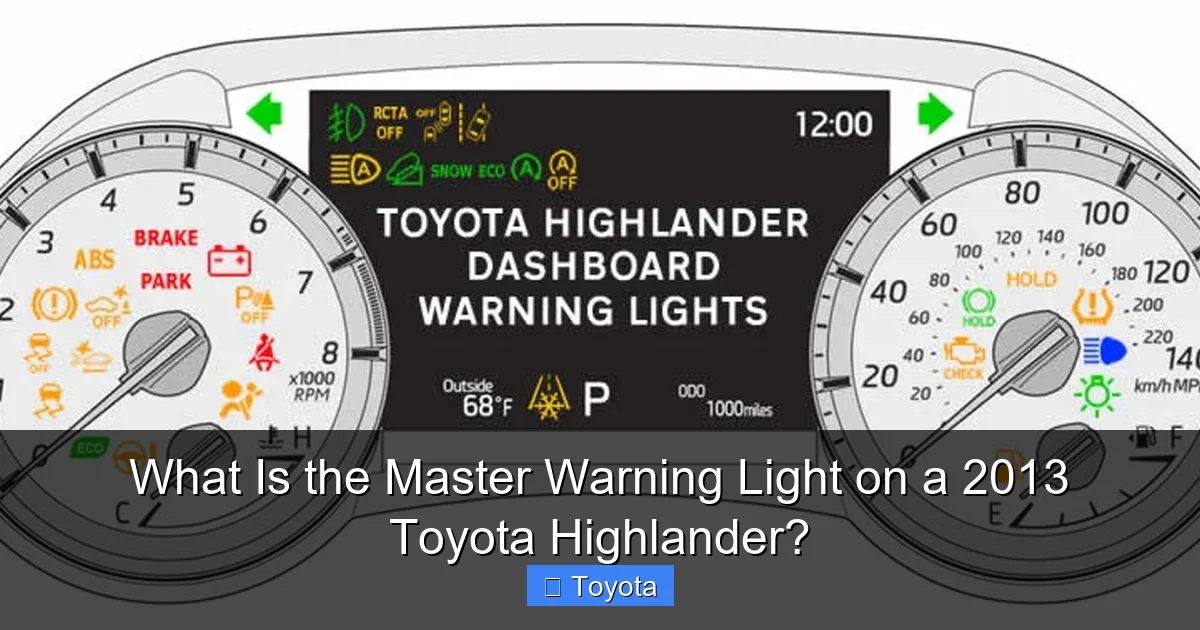
Visual guide about What Is the Master Warning Light on a 2013 Toyota Highlander?
Image source: dash-lights.com
The “Simple Oversight” Category (Easy Fixes)
Before you assume the worst, check these first. They are the most common and simplest to resolve:
- An Unlatched Door, Hood, or Liftgate: This is the #1 cause. If any door, the hood, or the rear liftgate isn’t fully closed and latched, the system detects it and triggers the Master Warning. The message will clearly say “DOOR OPEN” or “HOOD OPEN.” Simply close the door firmly until you hear the latch click.
- Low Windshield Washer Fluid: The washer fluid reservoir has a sensor. When it gets low, the Master Warning illuminates with the message “LOW WASHER FLUID.” Pop the hood, find the blue-capped reservoir (usually near the radiator), and top it up with washer fluid. Pro Tip: You can find the exact location of the rear window washer fluid reservoir in your Highlander by consulting your owner’s manual or a dedicated guide.
- The “Maintenance Required” Light: This is a huge one for Highlanders. Your vehicle has a built-in maintenance scheduler. When it’s time for oil change, tire rotation, or other scheduled service, the “MAINTENANCE REQUIRED” message appears, and it triggers the Master Warning Light. This is not an emergency, but a polite reminder from your car to schedule service. Resetting this light after the service is complete is a common procedure. You can learn the exact steps for your 2013 model in our detailed reset guide.
- Low Fuel Level: While there’s a dedicated low fuel light, some systems may also trigger the Master Warning if you’re on empty. The message will say “REFUEL” or similar.
The “System Fault” Category (Needs Diagnosis)
These are more serious and require investigation:
- Low Engine Oil Pressure: This is a critical issue. If oil pressure drops dangerously low, the Master Warning will illuminate, often with a red oil pressure icon or the message “ENGINE OIL PRESSURE LOW.” Stop the engine immediately in a safe place, check the oil level with the dipstick, and do not restart the engine if oil is low or the light persists. Driving with low oil pressure can destroy the engine in minutes.
- Brake System Warnings: Issues like worn brake pads, low brake fluid, or a problem with the Anti-lock Braking System (ABS) can activate the Master Warning, usually with a specific brake-related message. The separate brake warning light (red) will also likely be on.
- Charging System Failure: If the alternator fails and the battery is not being charged, you might see the Master Warning along with a battery icon. The “CHARGE” message may appear. Electrical systems will slowly shut down.
- Failed Sensors or Modules: A malfunctioning sensor (like a tire pressure sensor, oxygen sensor, or steering angle sensor) or a fault in a body control module can set a code that triggers the master alert. The stored trouble code will point to the faulty component.
- Smart Key System or Immobilizer Issues: Problems with the key fob recognition or the engine immobilizer can sometimes cause a master warning, often with a key-shaped icon or “KEY NOT DETECTED” message.
How to Diagnose the Master Warning Light on Your 2013 Highlander
So, the light is on. Now what? Don’t just guess. Follow a systematic diagnostic approach. Your 2013 Highlander gives you tools to figure this out.
Visual guide about What Is the Master Warning Light on a 2013 Toyota Highlander?
Image source: carscounsel.com
Step 1: Read the Message on the Multi-Information Display
The very first thing you must do is look at the small LCD screen in your instrument cluster. It will almost always display a text message explaining what system triggered the warning. Is it “DOOR OPEN”? “LOW OIL PRESSURE”? “SERVICE BRAKE”? “MAINTENANCE REQUIRED”? This message is your roadmap. Write it down or take a photo. It narrows down the possibilities from hundreds to one or two. If the message is vague or says “SEE OWNER’S MANUAL,” your next step is essential.
Step 2: Perform a Basic Visual and Physical Check
Based on the message (or lack thereof), do a quick walk-around and under-hood inspection:
- Check all doors, hood, and liftgate. Physically push and pull on each to ensure they are securely latched.
- Check fluid levels: Engine oil (dipstick), coolant (reservoir), brake fluid (master cylinder reservoir), and windshield washer fluid. Top up any that are low. Low oil or coolant is a serious issue that needs immediate service.
- Check tire pressure. Use a gauge. A significant drop in one tire can trigger TPMS warnings, which may activate the master light.
- Look for obvious damage or leaks under the vehicle.
Step 3: Use an OBD2 Scanner for Definitive Codes
If the message is unclear or points to an engine/electrical system fault, you need the trouble code. Any generic OBD2 scanner (available at auto parts stores for $20-$60) will plug into the Data Link Connector (DLC) under your dashboard (left of the steering column). Turn the ignition to “ON” (do not start) and scan for codes. You’ll get a code like “P0420” or “B0028.” This code tells you exactly which system and component the computer has flagged as faulty. For example, a “P0523” code points to an engine oil pressure sensor issue. You can look up the code online or in a repair manual. For complex issues, a professional-grade scan tool is needed to access all Toyota-specific systems. If you’ve addressed a simple issue like an open door, the light and message should go off immediately after closing it. If it’s a maintenance reminder, you’ll need to follow the reset procedure.
Step-by-Step: How to Reset the Master Warning Light
Resetting the light is the final step after you have fixed the underlying problem. If you reset it without fixing the cause, it will simply come back on, often within seconds or minutes of driving. Resetting is essentially telling the car’s computer, “I’ve taken care of the issue you warned me about, you can clear that alert now.” The method depends entirely on what triggered it.

Visual guide about What Is the Master Warning Light on a 2013 Toyota Highlander?
Image source: i.ytimg.com
Resetting a “Maintenance Required” Trigger
This is the most common reset for Highlanders. The process uses the trip meter reset button on the dashboard. Here is the general procedure for a 2013 Highlander (always confirm with your owner’s manual):
- Turn the ignition to the “OFF” position.
- Press and hold the trip meter reset button (usually on the instrument cluster, near the odometer).
- While holding the button, turn the ignition to the “ON” position (the position right before starting, where all dash lights come on).
- Continue holding the button. The odometer display will change, showing dashes or a resetting countdown.
- After a few seconds, the “MAINTENANCE REQUIRED” message should disappear, and the normal odometer reading will return.
- Release the button. Start the engine to confirm the light and message are off.
If this doesn’t work or your model has a slightly different procedure, you can find the precise, step-by-step guide with pictures for your exact model year here. For other Highlander model years, the process is often similar, and you can refer to a general Highlander maintenance reset guide.
Resetting After Other Fixes (Door, Fluid, etc.)
For simple oversights like an open door or low washer fluid, the system should automatically reset once the condition is corrected. Close the door firmly, and the “DOOR OPEN” message and Master Warning Light should extinguish within a few seconds. Top up the washer fluid, and the “LOW WASHER FLUID” alert should clear. If it doesn’t, there may be a faulty sensor or switch that needs replacement. For issues like low oil pressure, you cannot and should not simply reset the light. You must repair the cause (e.g., add oil, fix a leak, replace a sensor). After the repair, the light may go off on its own after a few drive cycles, or you may need a mechanic to clear the code with a scanner.
When a Simple Reset Won’t Work
If you’ve fixed the obvious problem (like adding oil) and the Master Warning Light stays on, or if it comes back on immediately after resetting, the computer is still detecting a fault. This means:
- The repair was not adequate (e.g., a leak wasn’t fully fixed).
- A component is faulty and needs replacement (e.g., a bad oil pressure sensor).
- The trouble code is stored and requires a professional scan tool to clear, and the system needs to complete a successful “drive cycle” to verify the fix.
At this point, it’s time to seek professional diagnostics. Continuing to drive with a persistent Master Warning, especially for critical systems like oil pressure or brakes, is dangerous and can cause catastrophic damage.
When to Seek Professional Help Immediately
Your safety is paramount. Some Master Warning triggers are not DIY fixes. Stop the vehicle in a safe, legal location as soon as possible and turn off the engine if you experience any of the following alongside the Master Warning Light:
- Red Oil Pressure Warning Light (usually an oil can icon) is also on, or the message says “ENGINE OIL PRESSURE LOW.”
- Red Brake Warning Light (exclamation point in a circle) is on, or the message says “SERVICE BRAKE” or “BRAKE FLUID LOW.” Your brakes may feel soft or unresponsive.
- Steering becomes difficult or you hear grinding/screeching noises.
- You see smoke from the engine bay or smell burning.
- The engine is overheating (temperature gauge in the red zone).
- You experience a complete loss of power or strange vibrations.
In these scenarios, do not attempt to drive the vehicle. Call for a tow. For less urgent but persistent warnings (like a recurring sensor code or a light that won’t reset after a maintenance service), schedule an appointment with a trusted mechanic or a Toyota dealership. They have the advanced diagnostic computers to communicate with all your Highlander’s electronic control modules and pinpoint the exact faulty component.
Preventive Maintenance to Avoid Master Warnings
The best way to deal with a Master Warning Light is to prevent it from coming on in the first place. A well-maintained 2013 Highlander is less likely to throw unexpected alerts.
Stick to the Factory Maintenance Schedule
This is the single most important thing. Your owner’s manual outlines a schedule for oil changes, fluid flushes, filter replacements, and component inspections. When the “MAINTENANCE REQUIRED” light comes on, it’s based on this schedule. Getting that service done on time—and resetting the light properly afterward—keeps this common trigger at bay. Regular oil changes prevent low oil pressure and engine wear. Brake inspections prevent brake system warnings. Following the schedule is proactive care.
Perform Regular Fluid Checks
Get in the habit of checking your engine oil level at least once a month and before long trips. Also, periodically check coolant, brake fluid, and washer fluid levels. Catching a slow leak or natural consumption early prevents low-level warnings and, more importantly, prevents damage. Low brake fluid can indicate worn pads or a leak in the hydraulic system.
Address Minor Issues Immediately
That intermittent chime? The brief “DOOR OPEN” message when going over a bump? That slight vibration? Don’t ignore it. A door latch that doesn’t fully engage can wear out and fail. A loose battery cable can cause charging system warnings. A small coolant leak becomes a big overheating problem. Catching these small issues during routine checks or at your first sign of a warning prevents them from escalating into major, expensive repairs that trigger more severe Master Warnings.
Use Quality Parts and Fuel
Using the correct oil viscosity (SAE 0W-20 for the 2013 Highlander’s 3.5L V6) and a reputable brand helps prevent engine sludge and wear, which can cause oil pressure issues. Using good quality fuel from top-tier stations helps keep the fuel system and emissions sensors clean, preventing fault codes.
Conclusion: Knowledge is Your Best Tool
The Master Warning Light on your 2013 Toyota Highlander is a valuable communication tool from your vehicle. It’s not meant to scare you, but to inform you. By understanding that it’s a general alert, learning to read its accompanying message, and knowing the difference between a simple fix (like a door or maintenance reminder) and a serious hazard (like low oil pressure), you empower yourself as a car owner. You’ll no longer feel that knot of anxiety when the triangle appears. Instead, you’ll have a clear plan: read the message, do the basic checks, decide if it’s a DIY reset or a trip to the shop. Remember, for the common “Maintenance Required” trigger, a proper reset after your service is crucial. For all other persistent or serious warnings, err on the side of caution and consult a professional. Your Highlander is a durable, reliable SUV, and with this knowledge, you can help keep it that way for many more miles and memories.
Frequently Asked Questions
What does the Master Warning Light look like on a 2013 Toyota Highlander?
It is a yellow or amber triangle with an exclamation point (!) inside it, located on the instrument panel. It will often be accompanied by a text message on the multi-information display screen.
Is it safe to drive my Highlander with the Master Warning Light on?
It depends entirely on the cause. If it’s for an open door or low washer fluid, it’s safe to drive a short distance to fix it. However, if it’s for low oil pressure, brake failure, or overheating, you must stop driving immediately and safely pull over. Always read the text message first to assess the severity.
How do I turn off the Master Warning Light after an oil change?
The Master Warning Light itself does not turn off automatically after an oil change unless the underlying issue was low oil level. If the light was on due to the “MAINTENANCE REQUIRED” reminder, you must perform the specific reset procedure using the trip meter button. The oil change does not automatically reset the maintenance scheduler.
Why did my Master Warning Light come on after I filled my washer fluid?
It should turn off automatically within a few seconds after the fluid level rises enough to satisfy the sensor. If it stays on, the sensor itself may be faulty, or there could be an issue with the washer fluid pump or wiring, which would require diagnosis.
Can a bad battery cause the Master Warning Light to come on?
Yes. A weak or failing battery can cause voltage fluctuations that trigger various electrical system warnings. It may also cause the “CHARGE” message to appear if the alternator is struggling. A battery and charging system test is recommended.
What’s the difference between the Master Warning Light and the Check Engine Light?
The Check Engine Light (engine-shaped) is specific to engine, transmission, and emissions faults monitored by the OBD system. The Master Warning Light is a broader alert for issues in other vehicle systems like body electrical, safety features, fluid levels, and the maintenance reminder system. They can sometimes illuminate together if a problem is severe enough.