What Is the Maintenance Schedule for a 2017 Toyota Highlander?

Contents
- 1 Key Takeaways
- 2 📑 Table of Contents
- 3 Understanding the 2017 Highlander Maintenance Schedule Framework
- 4 Mileage-Based Service Intervals: The Complete Breakdown
- 5 Severe vs. Normal: Why the Schedule Matters for Your Highlander
- 6 DIY vs. Professional Service: What Can You Do Yourself?
- 7 Common Highlander-Specific Questions & Pro Tips
- 8 Conclusion: A Proactive Approach Pays Off
- 9 Frequently Asked Questions

Waterless Car Wash Spray

LED Emergency Road Flares

Carburetor Cleaner

Anti Rust Spray
Adhering to the 2017 Toyota Highlander’s maintenance schedule is crucial for its longevity, reliability, and resale value. The schedule is primarily mileage-based, with key services at 5,000, 15,000, 30,000, and 60,000 miles, and includes critical items like oil changes, tire rotations, and fluid flushes. Understanding the difference between “normal” and “severe” driving conditions is key, as severe conditions require more frequent service to protect your investment.
Congratulations on your 2017 Toyota Highlander! It’s a fantastic, reliable family SUV that can easily surpass 200,000 miles with proper care. The single most important thing you can do to ensure it delivers that reliability is to follow a strict maintenance schedule. But what exactly does that schedule look like? It’s more than just “change the oil.” Let’s break down everything you need to know, from factory recommendations to real-world owner tips, to keep your Highlander running smoothly for years to come.
Toyota, known for its durability, provides a detailed maintenance guide in your owner’s manual. It’s your bible. The schedule is primarily based on mileage milestones, with some time-based items for vehicles that sit idle. However, the real-world application depends heavily on your driving style. Toyota defines two schedules: “Normal” and “Severe.” Spoiler alert: almost everyone falls into the “severe” category, which requires more frequent service. We’ll explain why and how that changes your routine.
Key Takeaways
- Follow the Odometer, Not Just the Calendar: Your Highlander’s maintenance is driven by mileage intervals (5k, 15k, 30k, 60k, etc.), not just time. However, if you don’t drive much, annual inspections are still vital.
- “Severe” Driving is Common: Most owners fall into the “severe” category (short trips, extreme temps, dusty roads, towing). This means you’ll need more frequent oil changes and inspections.
- The Maintenance Light is a Mileage Counter: The light on your dash reminds you it’s time for service based on your driving habits, not a sensor. You can reset it yourself after the work is done.
- Critical 30k & 60k Services: The 30,000-mile service includes air filter, cabin filter, and fluid checks. The 60,000-mile service is major, adding spark plugs, transmission fluid, and a thorough brake system inspection.
- Tire Health is Non-Negotiable: Regular rotations (every 5k-7.5k miles) and pressure checks are essential. Always consult your manual for the correct cold pressure, which is often similar for other Toyota SUVs like the Sienna.
- DIY vs. Professional: Simple tasks like oil changes (if equipped), wiper blades, and air filters can be DIY. Complex items like transmission fluid, coolant, and brake fluid should be left to professionals for safety and proper disposal.
- Keep All Records: Whether you do work yourself or at a shop, maintain detailed receipts and records. This is essential for warranty claims and boosts your vehicle’s resale value.
📑 Table of Contents
- Understanding the 2017 Highlander Maintenance Schedule Framework
- Mileage-Based Service Intervals: The Complete Breakdown
- Severe vs. Normal: Why the Schedule Matters for Your Highlander
- DIY vs. Professional Service: What Can You Do Yourself?
- Common Highlander-Specific Questions & Pro Tips
- Conclusion: A Proactive Approach Pays Off
Understanding the 2017 Highlander Maintenance Schedule Framework
Before we list the specific mileage points, you must understand the two driving condition categories. This isn’t about your skill; it’s about the environment your vehicle operates in.
Normal vs. Severe Driving Conditions
Normal Driving is a bit of a myth for most. It means mostly highway driving, in moderate temperatures (above 20°F and below 100°F), on clean, paved roads, with no heavy loads or trailer towing. If this sounds nothing like your life, you’re in the “severe” camp.
Severe Driving includes any of the following:
- Trips of less than 5 miles in normal temperatures, or less than 10 miles in freezing temperatures.
- Extremely hot or cold temperatures.
- Extensive idling or stop-and-go traffic.
- Driving on dusty, muddy, snowy, or salt-treated roads.
- Towing a trailer or carrying heavy cargo.
- Driving on mountainous or hilly terrain.
If you recognize your routine in the severe list—and most suburban and rural drivers do—you should follow the “severe” service intervals. This typically means oil changes and tire rotations every 5,000 miles instead of 7,500, and more frequent inspections of belts, hoses, and fluids. Adopting the severe schedule is the safest way to protect your engine and components from premature wear.
The Role of the Maintenance Required Light
Your 2017 Highlander is equipped with a “Maintenance Required” light on the instrument cluster. This is not a warning light for an immediate problem; it’s a friendly reminder based on your mileage and driving data. It illuminates after you’ve driven approximately 5,000 miles since the last reset. It’s a simple mileage counter. When you get your service done, the technician (or you) will need to reset this light. It’s a straightforward process that takes 30 seconds, and you can learn how to reset the maintenance light on your 2017 Toyota Highlander from our dedicated guide.
Mileage-Based Service Intervals: The Complete Breakdown
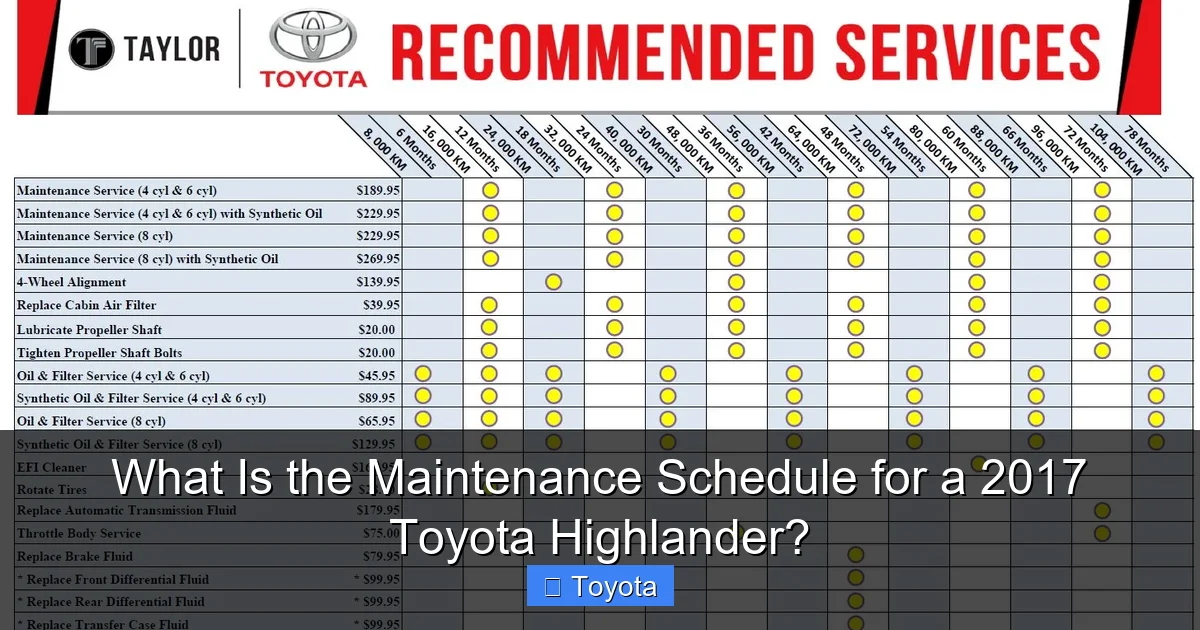
Now, let’s get to the nuts and bolts. Here is a consolidated view of the factory-recommended services for your 2017 Highlander, combining both normal and severe intervals. We’ll list the severe interval first, as it’s the most applicable.

Visual guide about What Is the Maintenance Schedule for a 2017 Toyota Highlander?
Image source: lh6.googleusercontent.com
Every 5,000 Miles (Severe) / 7,500 Miles (Normal)
This is your most frequent and critical service. Think of it as the foundation.
- Oil & Filter Change: Non-negotiable. The 3.5L V6 engine (standard) requires 0W-20 full synthetic oil. Using the correct oil is vital for fuel economy and engine protection. Toyota’s own “Toyota Genuine Motor Oil” or any certified 0W-20 full synthetic meeting Toyota specs is perfect.
- Tire Rotation: Essential for even tire wear. The Highlander’s front tires wear differently than the rears due to steering and power delivery. Rotate them every service. Check your manual for the correct rotation pattern, which is typically “front-to-rear” on AWD models.
- Multi-Point Inspection: A good technician will check: tire pressure and condition, all fluid levels (coolant, brake, washer), battery health, lights, wiper blades, and look for any leaks or loose components.
Every 15,000 Miles (Severe) / 15,000 Miles (Normal)
At this interval, you’re adding filter replacements and cabin air quality.
- Engine Air Filter: A clogged air filter chokes your engine, reducing power and fuel economy. It’s cheap and easy to replace. Inspect it at 15k, replace if dirty.
- Cabin Air Filter: This filters the air you and your passengers breathe. A dirty filter strains your HVAC system and lets pollen/dust into the cabin. Replace it at 15k, or more often if you drive in dusty areas.
- Inspect Brake Linings/Discs: Have a pro measure the brake pad thickness. Don’t wait for the squealer tab to screech; proactive inspection prevents rotor damage.
Every 30,000 Miles (Severe) / 30,000 Miles (Normal)
The 30k service is a significant checkpoint. Beyond the 5k items, you’ll address fuels and fluids that degrade over time.
- All items from 5k & 15k services.
- Replace Engine Air Filter (if not done at 15k).
- Fuel System Inspection: Includes checking the fuel cap seal and fuel lines. The fuel filter is often considered “lifetime” on many modern Toyotas, but a severe-service inspection is wise.
- Inspect/Replace Spark Plugs (if needed): On the 3.5L V6, platinum spark plugs can last 60k miles, but a severe schedule might inspect them at 30k.
- Inspect All Fluid Levels & Conditions: This goes beyond just checking levels. A technician should look at the color and smell of transmission fluid (should be red/pink, not brown or burnt), differential fluid, and power steering fluid (if equipped).
- Inspect Drive Belts: Look for cracks, fraying, or glazing. The accessory drive belt and timing chain cover are critical. While a timing chain is designed to last the engine’s life, the tensioner and guides can wear.
- Lubricate Propeller Shaft & Drive Shaft (AWD models): This is a key maintenance item for AWD systems to prevent U-joint wear.
Every 60,000 Miles (Severe) / 60,000 Miles (Normal)
The 60k service is a major milestone. It builds on all previous items and adds long-life component replacements.
- All items from previous services.
- Replace Spark Plugs: For the 3.5L V6, this is the standard replacement interval. It’s a moderately involved job (requires removing the intake plenum), best left to a professional unless you’re very experienced.
- Replace Engine Coolant: Coolant degrades, losing its anti-corrosive and anti-freeze properties. Toyota’s Super Long Life Coolant (pink) is rated for 10 years/150,000 miles, but a severe schedule may still recommend inspection and potential change at 60k. Never mix coolants.
- Replace Transmission Fluid & Filter (if equipped): This is a hotly debated topic. Toyota’s manual states the Aisin-sourced 6-speed automatic transmission fluid is “lifetime” for normal driving. However, for severe conditions (towing, heat), changing it every 60,000-80,000 miles is a highly recommended best practice by independent mechanics. Fresh fluid prevents varnish buildup and ensures smooth shifts. The filter (if serviceable) should be changed with the fluid.
- Replace Brake Fluid: Brake fluid is hygroscopic—it absorbs moisture from the air over time. This lowers its boiling point, which can lead to brake fade or failure in hard stops. Change it every 2-3 years, which will often coincide with a 60k mile visit.
- Inspect/Replace Accessory Drive Belt: If it wasn’t replaced earlier, the 60k service is the time. A broken belt means no alternator, water pump, or power steering.
- Inspect Valve Clearance: While the 3.5L V6 uses hydraulic lifters (generally “lifetime”), a severe-service inspection at high mileage is prudent to check for any noise or wear.
Every 100,000 Miles (Severe) / 100,000 Miles (Normal)
At this ultra-high mileage point, you’re focusing on the engine’s long-term health and major fluids.
- All items from 60k service.
- Replace Timing Chain Components? The timing chain itself is designed to last the engine’s life. However, the chain tensioner, guides, and sprockets are wear items. Listen for a rattling noise on cold start (the “cold start rattle” is common but should subside quickly). A professional inspection is wise at 100k+.
- Replace Differential Fluid (AWD): If not done at 60k, this is a must for AWD models. The fluid in the rear differential breaks down.
- Replace Spark Plugs (if not done at 60k).
- Comprehensive System Inspection: This includes checking the suspension components (bushings, struts/shocks), exhaust system for rust/leaks, and all hoses for brittleness.
Severe vs. Normal: Why the Schedule Matters for Your Highlander
Let’s connect this to real-world examples. If you use your Highlander as a true family hauler—school runs, grocery trips, soccer practice—you’re doing short trips where the engine and cabin never fully warm up. Condensation builds in the oil, fuel dilution occurs, and the battery never gets a full charge. This is the definition of “severe” service. Following the normal, longer intervals in this scenario is a recipe for sludge buildup and premature wear.

Visual guide about What Is the Maintenance Schedule for a 2017 Toyota Highlander?
Image source: trustmymechanic.com
Similarly, if you live in a climate with harsh winters or scorching summers, your fluids and belts are under extreme stress. Road salt in winter accelerates corrosion. Dusty, unpaved roads in summer clog filters. If you tow a small trailer or a jet ski on weekends, you’re adding immense heat and load to the transmission and engine. In all these cases, adhering to the severe schedule—or even creating a “super-severe” schedule with even more frequent fluid checks—is the smart owner’s play.
Consider the transmission fluid again. Toyota’s “lifetime” claim is based on ideal, normal driving conditions. For a family towing a 3,500 lb camper up a mountain in 95°F heat, that fluid is overheating and breaking down chemically. Changing it proactively at 60k miles is cheap insurance against a $3,500+ transmission rebuild. The same philosophy applies to coolant and brake fluid in these conditions.
DIY vs. Professional Service: What Can You Do Yourself?
Knowing what you can tackle at home saves money and builds a deeper connection with your vehicle. However, knowing your limits is crucial for safety and preventing costly mistakes.
Visual guide about What Is the Maintenance Schedule for a 2017 Toyota Highlander?
Image source: d1l9oib0dboqqi.cloudfront.net
Excellent DIY Candidates
- Oil & Filter Change: If you have a lift or safe jack stands, this is the #1 DIY job. Use only Toyota-spec 0W-20 full synthetic and a high-quality filter (Toyota OEM, Wix XP, Mobil 1). Dispose of old oil properly.
- Cabin Air Filter: Usually located behind the glovebox. It’s a simple clip-out, clip-in job that takes 10 minutes and costs $15-$30 for a quality filter.
- Engine Air Filter: Typically in a black box under the hood. Unclip, swap, reclip. Takes 5 minutes.
- Wiper Blades: Both front and rear. Just match the hook size.
- Bulb Replacement: Headlights, taillights, and fog lights are generally accessible.
- Reset Maintenance Light: As mentioned, this is a simple button-press sequence on your odometer. Follow our step-by-step guide for your specific model year.
Leave It to the Pros (Usually)
- Transmission Fluid Drain & Fill: While a simple drain and fill is possible, a true “flush” requires specialized equipment. The filter on many 6-speed automatics is internal and requires pan removal. The risk of contamination or improper fill is high.
- Brake Fluid Flush: Requires a specific procedure to bleed air from the system. Improper bleeding leads to spongy brakes. Also, brake fluid is corrosive and must be disposed of correctly.
- Coolant Flush: Requires complete drainage, system bleeding to remove air pockets (which can cause overheating), and proper mixing. Mixing wrong types of coolant can cause gelling and block cooling passages.
- Spark Plug Replacement: On the V6, this is a 3-4 hour job for a pro due to the intake manifold removal. Doing it incorrectly can damage intake components or cause vacuum leaks.
- Major Suspension/Steering Work: Ball joints, tie rods, struts require alignment and safety-critical torque specs.
A good middle ground is to purchase your own fluids and filters (oil, air, cabin, coolant) and have a trusted independent mechanic install them for a reduced labor rate. This ensures quality parts are used.
Common Highlander-Specific Questions & Pro Tips
Let’s address some unique aspects of the 2017 Highlander.
The “Snow Button” and AWD System
Your Highlander’s AWD system is sophisticated. The “Snow” button on the dash (often with a snowflake icon) modifies the throttle response and AWD torque split to be more gentle and proactive for slippery starts. It’s not a “lock” for deep snow; it’s a drive-mode selector for low-traction conditions. For owners in snowy climates, understanding this and your snow button’s function is part of routine seasonal preparation. Remember, good all-season or winter tires are the single most important factor for snow safety—far more important than the Snow mode.
Tire Pressure and TPMS
The Highlander’s Tire Pressure Monitoring System (TPMS) will alert you if a tire is significantly underinflated. Don’t ignore it! Underinflated tires wear prematurely, overheat, and hurt fuel economy. The correct cold pressure is on a sticker inside the driver’s door jamb. It’s typically 33 PSI for the 2017 Highlander, but always verify for your specific trim and tire size. If you’re swapping wheels or have aftermarket tires, ensure you know the correct pressure. For reference, the tire pressure for a Toyota Sienna is often the same or very similar, as it shares the same platform and intended use.
Using the Correct Fluids
This cannot be overstated. Your 2017 Highlander requires specific fluids:
- Engine Oil: 0W-20, Toyota Genuine Motor Oil or equivalent meeting Toyota WS specification.
- Coolant: Toyota Super Long Life Coolant (pink) or equivalent. Do not use green universal coolant.
- Transmission Fluid: Toyota WS (World Standard) automatic transmission fluid.
- Differential Fluid (AWD): Toyota Hypoid GL-5 or equivalent.
- Brake Fluid: SAE J1703 or FMVSS No.116 DOT 3.
Using the wrong fluid can cause catastrophic damage. When in doubt, consult your manual or a Toyota dealer parts department.
Conclusion: A Proactive Approach Pays Off
Your 2017 Toyota Highlander is an investment in reliable transportation. By following a diligent, mileage-based maintenance schedule—preferably using the “severe” service intervals—you are not just spending money; you are protecting a major asset. You’re ensuring that minivan full of kids gets to soccer practice safely, that the family road trip to the Grand Canyon doesn’t end with a breakdown, and that your SUV provides years of trouble-free service.
Think of maintenance as a contract with your future self. A $100 oil change today prevents a $4,000 engine rebuild tomorrow. A $200 transmission fluid service at 60k miles is a bargain against a $4,500 transmission replacement. Keep a digital or physical log of every service, no matter how small. When it comes time to sell, a complete, documented service history will command a higher price and give any buyer confidence.
Finally, build a relationship with a trusted mechanic—either at a Toyota dealership or a reputable independent shop. They know your vehicle’s common quirks and can provide honest advice. Use the factory schedule as your baseline, adjust for your “severe” driving reality, and enjoy your Highlander for the long haul.
Frequently Asked Questions
What happens if I ignore the Maintenance Required light?
Ignoring the light means you’re extending service intervals beyond what’s recommended. For oil changes, this can cause engine sludge, increased wear, and potential failure. For other systems, it means critical components aren’t being inspected, which could lead to a breakdown or unsafe condition (like worn brakes). The light is a reminder, not a suggestion.
Should I reset the Maintenance Required light before or after the service?
Always reset it after the maintenance is completed. Resetting it beforehand defeats the purpose of the reminder system. The light should be turned off by the technician as a final step to confirm all required work was done. If you perform the service yourself, you can reset it using the trip meter button on your odometer.
My Highlander has the 3.5L V6. Is the “lifetime” transmission fluid really lifetime?
In Toyota’s engineering context, “lifetime” means the life of the vehicle under “normal” driving conditions. For most drivers, especially those with severe driving habits or who tow, this is not realistic. We strongly recommend changing the transmission fluid and filter (if serviceable) every 60,000-80,000 miles as a preventative measure. It’s the single best thing you can do for transmission longevity.
What is the correct tire pressure for my 2017 Toyota Highlander?
The correct cold tire pressure for your specific Highlander is listed on a yellow and white sticker on the driver’s side door jamb. It is typically 33 PSI for all four tires for most trims, but always verify your sticker. This pressure is for the factory-sized tires. Do not use the pressure molded on the tire sidewall itself.
How often should I replace the cabin air filter?
The factory schedule recommends every 15,000 miles under normal conditions. However, if you have allergies, drive in dusty areas, or experience heavy city pollution, consider replacing it annually or every 10,000 miles. A clogged cabin filter reduces HVAC airflow and can strain the blower motor.
What octane fuel should I use in my 3.5L V6 Highlander?
Your owner’s manual states that 87 octane (regular unleaded) is the minimum requirement and is sufficient for normal driving. The engine has knock sensors that will adjust timing if lower-quality fuel is used. However, for maximum performance and fuel economy, especially when towing or driving in hot conditions, using 89 octane (mid-grade) can provide a slight benefit. Using premium (91 octane) is not necessary and offers no measurable benefit.