What Is the Maintenance Schedule for a 2017 Toyota Camry

Contents
- 1 Key Takeaways
- 2 📑 Table of Contents
- 3 Why a Strict Maintenance Schedule is Your Camry’s Best Friend
- 4 Decoding the Two Schedules: Severe vs. Normal Driving
- 5 The 15,000-Mile / 12-Month Service
- 6 The Major Milestones: 30,000, 60,000, and 90,000 Miles
- 7 The 100,000-Mile Service & Beyond: The Century Club
- 8 DIY vs. Professional Service: What Can You Handle?
- 9 Frequently Asked Questions

Car Vacuum Cleaner (Portable)

Brake Cleaner Spray

Car Storage Net

Car Fog Light Bulb
Following the factory-recommended maintenance schedule for your 2017 Toyota Camry is non-negotiable for ensuring its legendary reliability and maximizing resale value. This comprehensive guide breaks down every service interval, from the critical first oil change to long-term 100,000-mile checks, using Toyota’s official Severe and Normal driving condition guidelines. Adhering to this structured plan prevents costly repairs, maintains fuel efficiency, and keeps your Camry running smoothly for years to come.
Key Takeaways
- Two Schedules Exist: Your Camry follows either a “Severe” or “Normal” driving schedule; most drivers fall under the more frequent Severe schedule.
- Oil Changes Are Pivotal: The 5,000-mile/6-month service is the cornerstone, involving oil, filter, and a multi-point inspection.
- Tire Rotation Is Mandatory: Rotate tires every 5,000-7,500 miles to ensure even wear and extend tire life, a key step often missed.
- The Maintenance Light Is Your Friend: The dashboard wrench icon signals an overdue service; reset it only after the work is complete.
- Long-Term Items Matter: Major services at 30k, 60k, 90k, and 100k miles involve spark plugs, fluids, and inspections that prevent breakdowns.
📑 Table of Contents
- Why a Strict Maintenance Schedule is Your Camry’s Best Friend
- Decoding the Two Schedules: Severe vs. Normal Driving
- The 15,000-Mile / 12-Month Service
- The Major Milestones: 30,000, 60,000, and 90,000 Miles
- The 100,000-Mile Service & Beyond: The Century Club
- DIY vs. Professional Service: What Can You Handle?
Why a Strict Maintenance Schedule is Your Camry’s Best Friend
Let’s be real. Your 2017 Toyota Camry isn’t just a car; it’s a trusted member of the family. It’s the silent partner that gets you to work, hauls the kids to soccer practice, and embarks on road trip adventures without complaint. But even the most reliable machinery needs consistent, planned care to perform at its peak. Think of the maintenance schedule as the ultimate wellness plan for your vehicle. It’s a detailed roadmap provided by Toyota’s engineers, designed to address wear and tear before it becomes a catastrophic (and expensive) failure.
Skipping or delaying services is like skipping your annual physical because you “feel fine.” Small issues—slightly degraded fluid, a marginally worn belt, a slowly leaking seal—can compound silently. By the time you notice a symptom like an odd noise, poor gas mileage, or a warning light, the underlying problem has often caused collateral damage. Sticking to the schedule is the single most effective way to protect your investment, ensure your safety, and maintain that buttery-smooth Camry ride you love. It directly translates to a longer vehicle lifespan, consistently better fuel economy, and a higher trade-in value when the time comes.
Decoding the Two Schedules: Severe vs. Normal Driving
Before we dive into mileage-specific items, you must understand this critical distinction. Your owner’s manual outlines two separate maintenance timelines: Normal and Severe. Most owners mistakenly assume they fall under “Normal.” In reality, the vast majority experience Severe driving conditions. Toyota defines Severe conditions as:

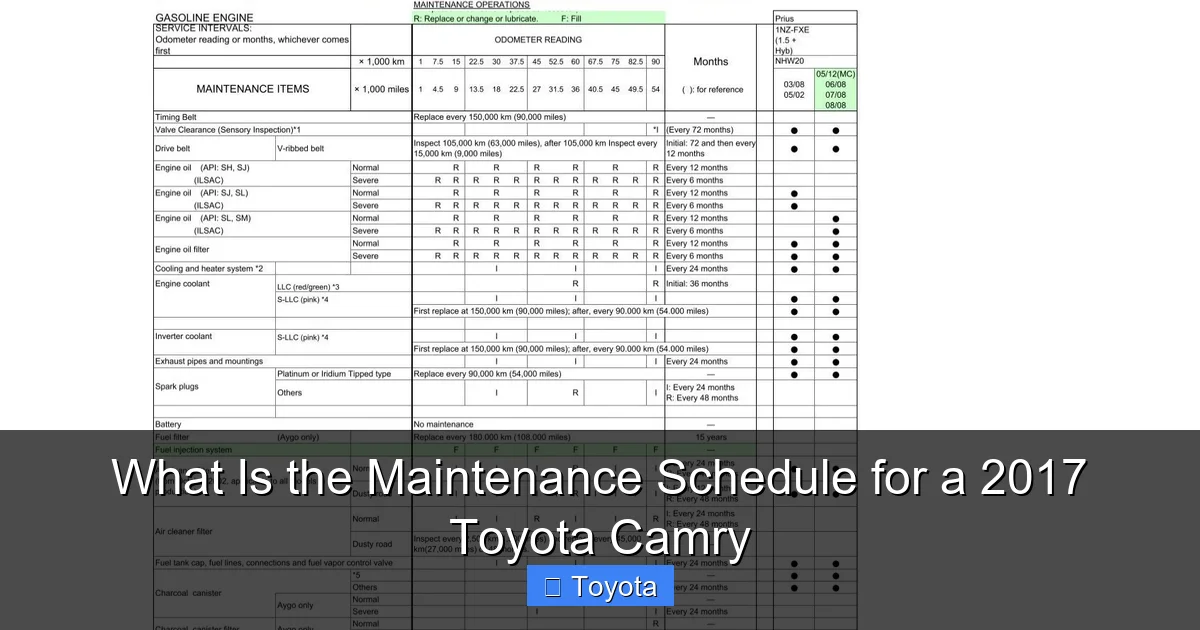
Visual guide about What Is the Maintenance Schedule for a 2017 Toyota Camry
Image source: scout.customerscout.net
- Driving primarily in heavy city traffic with frequent stops.
- Extremely hot or cold ambient temperatures (consistently over 90°F or below 10°F).
- Driving on dusty, sandy, or muddy roads.
- Repeated short trips where the engine doesn’t fully warm up (less than 5 miles, especially in cold weather).
- Driving in mountainous areas or hilly terrain.
- Extended idling or extensive towing/hauling.
If you recognize even one of these from your daily life, you should follow the Severe schedule. Its intervals are shorter. For example, an oil change on the Normal schedule might be every 10,000 miles, but on the Severe schedule, it’s every 5,000 miles. The differences are significant. From here on out, we will focus on the Severe schedule intervals, as they are the safest and most common recommendation. Always consult your specific owner’s manual, as hybrid models (like the 2017 Camry Hybrid) have some unique requirements, particularly regarding the hybrid system inspection.
The Foundation: The 5,000-Mile / 6-Month Service
This is the bedrock of your Camry’s maintenance life. It’s not just an oil change; it’s a comprehensive health check. Whether you drive 5,000 miles or six months pass, this service is due. Here’s the full breakdown:
- Engine Oil & Filter: Use Toyota-approved oil (typically 0W-20 synthetic for 2017 models). This viscosity is critical for cold starts and fuel efficiency. Never use conventional oil in a modern Camry designed for synthetic.
- Tire Rotation: This is non-negotiable for even tread wear. Front tires on a front-wheel-drive Camry wear faster due to steering and power transfer. Rotating them to the rear promotes uniform longevity. While you’re at it, this is the perfect time to check your tire pressure. Proper inflation is crucial for safety, handling, and fuel economy. If you’re unsure about the correct PSI for your specific trim and tire size, a reliable resource is our guide on what size tires for a 2017 Toyota Camry, which includes pressure specifications.
- Multi-Point Inspection: A good technician will check: brake pad/shoe thickness, brake fluid level and condition, all fluid levels (coolant, transmission, power steering, windshield washer), battery health and connections, belts and hoses for cracks/leaks, and exterior lights.
- Windshield Wiper Blades: Inspect them. Rubber hardens and cracks over time, especially in sun-heavy climates. Replace if streaking occurs.
Pro Tip: Keep a small notebook or use a smartphone app to log every service with the date, mileage, and what was done. This history is gold for future owners and for troubleshooting patterns.
The 15,000-Mile / 12-Month Service
At this interval, you’re essentially repeating the 5,000-mile service but adding a few more critical items. Again, this is on the Severe schedule. On the Normal schedule, this might be combined with the 10,000-mile mark.
- All items from the 5,000-mile service: Oil/filter change, tire rotation, multi-point inspection.
- In-Cabin Air Filter Replacement: This is your health filter. It traps pollen, dust, and pollutants before they enter the cabin. A clogged filter reduces HVAC airflow and air quality. It’s an easy, inexpensive DIY job if you’re handy, or a quick professional swap.
- Engine Air Filter Inspection: The engine’s breathing filter. A dirty air filter chokes your engine, reducing power and fuel economy. It will be inspected and replaced if necessary, often at 30k miles under normal conditions but checked at 15k under severe.
This service reinforces the habit of regular check-ups. By now, you should be familiar with your car’s normal sounds and behaviors. If anything feels different—a new vibration, a slight hesitation—mention it to your technician during the inspection.
The Major Milestones: 30,000, 60,000, and 90,000 Miles
These are the big ones. They build upon the foundational services but introduce component replacements and deep inspections that are vital for long-term reliability. Missing these can lead to sudden failures.
The 30,000-Mile Service: The First Major Check-Up
This is a comprehensive service that includes all previous items plus:
- Transmission Fluid: For the 6-speed automatic in most 2017 Camrys, Toyota’s manual states the fluid is “lifetime.” However, for Severe driving and ultimate longevity, many independent shops and experts recommend a drain-and-fill (not a full flush) around 30k-60k miles. This is a debated point; discuss it with your trusted mechanic based on your driving habits. For the hybrid model, the hybrid transmission fluid has a specific interval.
- Fuel System Inspection: Checking the fuel lines, filter (if equipped—some 2017 models have an in-tank filter designed to last the life of the car), and injectors for performance.
- Brake System Deep Dive: Beyond pad thickness, this includes inspecting rotors for scoring/warping, brake lines for corrosion/leaks, and the brake fluid itself. Brake fluid is hygroscopic—it absorbs moisture from the air over time, lowering its boiling point and compromising braking performance, especially under hard use. Many shops recommend a fluid flush/blood test at 30k or 36k miles.
- Coolant System: Check the level and condition. The factory coolant is designed for a long life (often 100k+ miles), but hoses and the thermostat should be inspected for wear.
- Spark Plug Replacement: This is a key item at 30k miles for the 2.5L 4-cylinder. Iridium plugs are long-lasting, but replacing them at this interval ensures optimal combustion, fuel economy, and performance. The V6 model may have a different interval.
The 60,000-Mile Service: The Half-Century Mark
Double the mileage, double the attention. This service includes all prior items and adds:
- Differential Fluid (AWD Models): If you have the All-Wheel Drive Camry, the rear differential fluid must be replaced. This is critical for the longevity of the AWD clutch packs and gears.
- Another Transmission Fluid Consideration: If you haven’t done it at 30k, now is the time to strongly consider a transmission fluid service for the automatic.
- Serious Battery Check: A battery that’s 4+ years old is living on borrowed time. Have it load-tested. A failing battery can leave you stranded and strain the alternator. Understanding your car’s car battery voltage is a simple skill that can diagnose issues early.
- Comprehensive Belt & Hose Inspection: The serpentine belt and all critical coolant and vacuum hoses should be scrutinized for cracks, glazing, or soft spots. Replacing a failed belt can leave you stranded with a dead alternator or overheating engine.
- Power Steering Fluid (if applicable): Check level and condition. While many modern Camrys use electric power steering, some trims may still have hydraulic.
The 90,000-Mile Service: Preparing for the Long Haul
At this stage, your Camry is a high-mileage veteran. This service is about preservation and replacing wear items that have a finite lifespan.
- All Previous Services: Yes, all of them. The pattern of oil changes, rotations, and inspections continues.
- Spark Plugs (V6 Models): If you have the 3.5L V6, its spark plugs often have a 60k-mile interval. If you haven’t changed them at 60k, do it now.
- Engine Coolant Flush: Even “long-life” coolant degrades. A complete system flush and refill with Toyota-approved Super Long Life Coolant (SLLC) is recommended at 90k-100k miles to prevent corrosion, overheating, and heater core failure.
- Brake Fluid Flush: This is arguably one of the most important safety services at this mileage. Old, moisture-laden brake fluid compromises stopping power. It should be replaced every 2-3 years regardless of mileage.
- Thorough Suspension & Steering Inspection: Check ball joints, tie rod ends, control arm bushings, and struts/shocks for wear and leaks. Worn suspension components lead to poor handling, uneven tire wear, and unsafe driving dynamics.
The 100,000-Mile Service & Beyond: The Century Club
Reaching 100,000 miles is a testament to your maintenance diligence. The service at this mark is the capstone, addressing everything to set you up for the next 100k.
- Complete History Review: A good shop will look at your service log. What hasn’t been done? This is the time to address any deferred items.
- Timing Belt/Chain Verification: This is THE MOST CRITICAL CHECK for a 2017 Camry. The 2.5L 4-cylinder uses a timing chain, which is designed to last the life of the engine with proper oil changes. The 3.5L V6 also uses a chain. However, the chain tensioners and guides are wear items. A mechanic should inspect these for any signs of wear or noise. There is no scheduled “replacement” for the chain itself, but listening for rattling on cold start (a classic sign of a worn tensioner) is key. This is a major difference from older Camrys with timing belts.
- Major Fluid Flushes: Beyond coolant and brake fluid, consider a transmission fluid service if it hasn’t been done, and possibly a power steering fluid flush (for hydraulic systems).
- Full Vehicle Inspection: This goes beyond the multi-point. It includes checking for any stored trouble codes in the computer (even if the check engine light isn’t on), inspecting the underbody for rust/damage, and a very detailed look at all suspension, steering, and drivetrain components.
- Battery Replacement: At 5+ years old, proactively replace it. Don’t wait for a failure.
Beyond 100k miles, revert to the Severe schedule intervals (every 5k miles) for oil changes and inspections, but remain vigilant about the major items you’ve addressed. Your Camry’s reliability story is now in your hands.
DIY vs. Professional Service: What Can You Handle?
Not every service needs a professional mechanic. Here’s a realistic breakdown:
- Excellent DIY Projects: Oil & filter change (with proper tools and disposal), tire rotation (requires torque wrench for lug nuts), cabin air filter replacement, engine air filter replacement, windshield wiper blades, battery terminal cleaning, and checking all fluid levels.
- Professional Recommended: Brake fluid flush, coolant flush, transmission fluid service, spark plug replacement (on the V6, access is difficult), any timing chain-related inspection, suspension component replacement, and any diagnosis of warning lights or drivability issues. The cost of professional service is an insurance policy against a costly mistake.
A Final Pro-Tip on the Maintenance Light: Your Camry’s maintenance required light (wrench icon) is a simple mileage counter. It illuminates after a set interval (usually 5,000 miles) after the last reset. It does not know if you actually performed the service. You must reset it after completing the work. The process is usually: turn key to “On” (not start), turn odometer to “Trip A,” turn key off, then hold the trip/reset button while turning key back to “On” until the light blinks. For the exact procedure on your 2017 model, a specific guide on how to reset the maintenance light on a 2017 Toyota Highlander is often identical, as Toyota uses the same system across many models. Confirm in your manual.
Frequently Asked Questions
How often should I change the oil in my 2017 Toyota Camry?
Under Severe driving conditions (which most drivers experience), change the oil and filter every 5,000 miles or 6 months. Under true Normal conditions, it may be extended to 10,000 miles, but 5,000 miles is the safest, most common recommendation for long engine life.
Do I really need to rotate my tires every 5,000 miles?
Yes. Front tires on your front-wheel-drive Camry wear significantly faster due to steering and torque. Rotating them to the rear every 5,000-7,500 miles ensures even wear, maximizes the life of your tire set, and maintains optimal handling and safety.
How do I reset the maintenance required light after an oil change?
The light is a mileage counter. After your service, turn the ignition to “On” (do not start). Ensure the odometer displays “Trip A.” Turn the ignition off. Then, hold the “Trip/Reset” button while turning the ignition back to “On.” Continue holding until the light blinks and goes out, then release. The exact button sequence is in your owner’s manual.
What’s the difference between “Severe” and “Normal” driving for my Camry?
“Normal” is mostly highway driving in mild weather. “Severe” includes frequent short trips, extreme temperatures, heavy traffic, dusty roads, hilly terrain, or towing. Since most drivers experience at least one Severe condition, following the Severe schedule (shorter intervals) is the prudent choice to protect your engine and components.
Can I perform the 30,000-mile service myself?
You can handle simpler parts like the oil change, air filter, and cabin filter. However, the 30k service often includes transmission fluid checks, brake fluid assessment, and spark plug replacement (especially on the V6, which is difficult). These are best left to professionals to ensure correct procedures and torque specs, preventing damage.
Does the 2017 Camry have a timing belt or chain?
The 2017 Camry’s 2.5L 4-cylinder and 3.5L V6 engines both use a timing chain. There is no scheduled timing belt replacement. However, the chain tensioners and guides are wear items that should be inspected for noise or wear during major services (60k+ miles), especially if you hear a rattling on cold starts.