
Can Toyota Extended Warranty Be Used at Any Dealership?

Yes, in most cases, a Toyota extended warranty (specifically a Toyota Protection Plan) can be used at any authorized Toyota dealership across the United States. This nationwide coverage is a major benefit of purchasing the warranty directly from Toyota. However, if you have a third-party extended warranty, your network of approved repair shops may be more limited and requires prior authorization. Always confirm your specific contract’s terms for absolute clarity.
You’re on a cross-country road trip, hundreds of miles from your home dealership. Suddenly, a warning light illuminates your dash. Your heart sinks. You just bought an extended warranty for peace of mind, but a nagging question pops up: Can Toyota extended warranty be used at any dealership? It’s one of the most common and crucial questions for any warranty holder. The short answer is usually yes for plans from Toyota itself, but the full answer has important details that can save you from a major headache and unexpected out-of-pocket costs. Let’s break down everything you need to know, so you’re never left stranded with confusion.
Key Takeaways
- Nationwide Coverage is Standard: A genuine Toyota Protection Plan (Toyota’s own extended warranty) is honored at every authorized Toyota dealership in the continental U.S., giving you freedom and flexibility.
- Third-Party Plans Have Networks: Warranties from companies like Endurance or CARCHEX work with a network of repair shops and may require pre-approval for work at a Toyota dealer, which isn’t always guaranteed.
- Transferability Adds Value: Most Toyota extended warranties are transferable to a new owner, which can increase your vehicle’s resale value, though a fee may apply.
- Pre-Authorization is Usually Required: Regardless of the dealer you choose, you must call the warranty administrator for a claim number and approval before any covered repair work begins.
- Maintenance is Mandatory: Failing to follow Toyota’s recommended maintenance schedule can void your warranty coverage, so keep all service records meticulously.
- Read Your Contract: The definitive answer for your specific situation is always in your warranty agreement document. Terms, exclusions, and procedures vary.
📑 Table of Contents
- Understanding the Two Main Types of “Extended Warranty”
- The Nationwide Coverage of a Genuine Toyota Protection Plan
- Third-Party Warranties: Networks, Restrictions, and Prior Authorization
- Transferability: Your Warranty as a Selling Point
- Step-by-Step: Using Your Warranty at Any Toyota Dealership
- Common Misconceptions and Pitfalls to Avoid
- The Bottom Line: Your Path to Peace of Mind
Understanding the Two Main Types of “Extended Warranty”
First, we need to clarify terminology. What people commonly call an “extended warranty” is technically a “vehicle service contract.” More importantly, there are two primary sources for these contracts, and they operate under fundamentally different rules. This distinction is the key to answering your question.
The Toyota Protection Plan (Factory-Backed)
This is the plan you buy directly from Toyota Financial Services or through a Toyota dealership at the time of purchase or shortly after. It’s an extension of the original new vehicle warranty. Because it’s backed by the manufacturer, it’s designed to integrate seamlessly with the entire Toyota dealer network. This is the plan that offers true, nationwide “any dealer” convenience.
Third-Party or Aftermarket Extended Warranties
These are sold by independent companies not affiliated with Toyota. You might purchase them from a dealership’s finance office, an online provider, or through a telemarketer. While they can offer similar coverage levels, they are a separate financial product. Their network of approved repair facilities is a critical factor. Some may have direct relationships with Toyota dealers, but many primarily work with independent mechanics. Using a specific Toyota dealer may require special arrangements or prior authorization.
So, before you even think about where to go, you must first know what you have. Check your contract. Who is the administrator? Is it “Toyota Motor Insurance Services” or another company? This is your first and most important clue.
The Nationwide Coverage of a Genuine Toyota Protection Plan
If you have a Toyota Protection Plan, you have a significant advantage. Toyota designed this program with the mobile American consumer in mind. Your coverage travels with your vehicle.
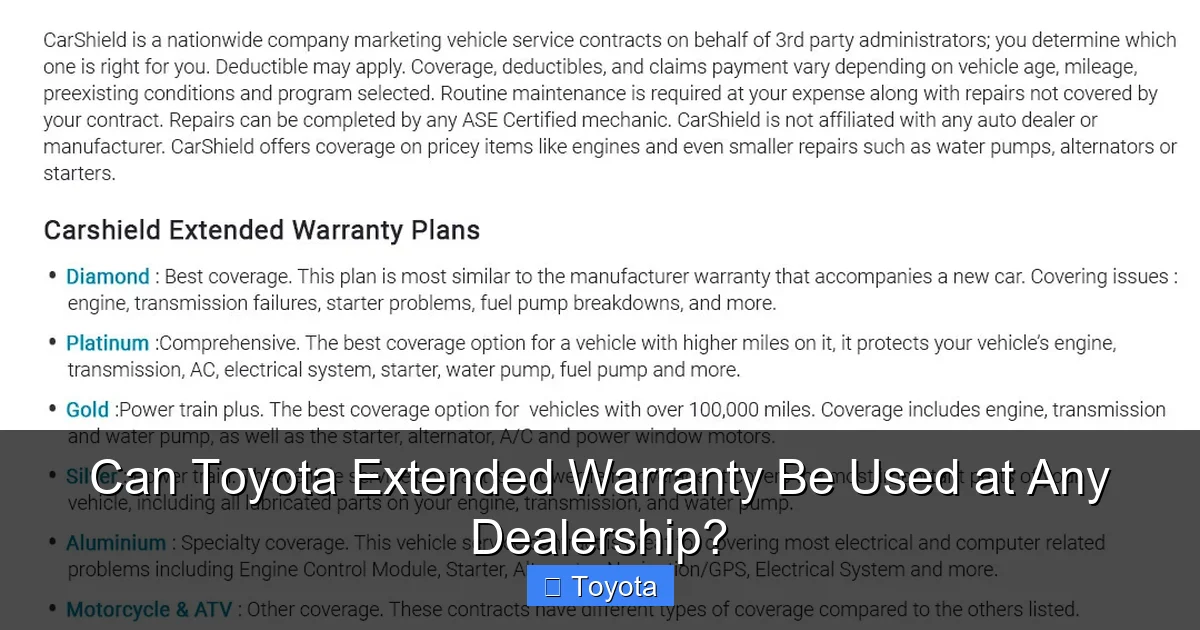
Visual guide about Can Toyota Extended Warranty Be Used at Any Dealership?
Image source: toyota-extended-warranty-plans.autowarrantynowlm.com
No “Home Dealer” Requirement
One of the biggest myths is that you must return to the dealership where you bought the car or the warranty. This is false for factory plans. You can walk into any authorized Toyota dealership’s service department in the 50 states, present your vehicle and your warranty information, and they are contractually obligated to handle the covered repair. This is incredibly valuable if you move, take a job in a new state, or are traveling. For more on the flexibility of Toyota’s service policies, you can read about whether you can take your Toyota to any dealer for service.
How It Works in Practice: A Simple Process
Using your Toyota warranty at an unfamiliar dealer is straightforward, but it requires you to be proactive. Here is the typical process:
- 1. Call the Administrator: Before any work is done, you must call the Toyota warranty administrator (the phone number is on your contract or insurance card). Explain the issue and get a claim number.
- 2. Schedule with the Dealer: Call the Toyota dealership’s service department, inform them you have a Toyota Protection Plan, and provide the claim number. They will schedule you.
- 3. Dealer Handles the Paperwork: The dealer’s service advisors are well-trained on the Toyota warranty process. They will submit the repair authorization and invoice directly to Toyota’s administrator. You typically pay only your deductible, if applicable.
- 4. Keep Records: Get a copy of the repair order and final invoice for your files.
The system is built for this exact scenario. The dealer gets paid by Toyota, so they have no incentive to refuse the work, provided the issue is covered under your contract’s terms.
Third-Party Warranties: Networks, Restrictions, and Prior Authorization
This is where things get trickier and the answer to “any dealership?” becomes a firm “it depends.” Third-party providers manage risk by controlling costs, often through a preferred network.

Visual guide about Can Toyota Extended Warranty Be Used at Any Dealership?
Image source: warrantyextender.co.za
The “Direct Repair Program” or “Preferred Network”
Many third-party warranties require you to use a shop from their approved network to get the highest level of coverage with the least hassle. If you want to use a specific Toyota dealer, you must first verify if that dealer is in the network. If they are not, the provider may still approve the repair, but they might require you to get a written estimate and submit it for pre-approval, a process that can take days and may be denied if they deem the shop’s rates too high.
The Importance of “Prior Authorization”
This is non-negotiable. With a third-party plan, you must call the administrator for a claim number and authorization before any diagnostic work or repairs. If you skip this step, the dealer will bill you directly, and the warranty company will almost certainly deny your claim, leaving you with the full bill. The dealer’s service department will often insist on this call upfront.
Potential for “Direct Pay” Issues
Some third-party plans require you to pay the repair shop out-of-pocket and then submit a claim for reimbursement. This can be a financial burden. Others offer “direct pay” to the shop, but this arrangement must be confirmed with the administrator and the shop beforehand. A Toyota dealer may be reluctant to wait for reimbursement from a third party they don’t have a direct relationship with.
In short, while you might be able to use a third-party warranty at a Toyota dealership, it is not an automatic, guaranteed process like it is with a Toyota Protection Plan. You must do your homework first. For broader context on servicing, understanding if a Toyota dealer can service a Lexus highlights how dealer networks and manufacturer affiliations work.
Transferability: Your Warranty as a Selling Point
An often-overlooked benefit of a Toyota extended warranty is its ability to transfer to a second owner. This is a powerful tool when it’s time to sell your car.

Visual guide about Can Toyota Extended Warranty Be Used at Any Dealership?
Image source: galaxytoyota.in
How Transfer Works
When you sell your Toyota, the remaining term and mileage of your Toyota Protection Plan can be transferred to the new owner. This provides the buyer with added peace of mind and can make your listing more attractive, potentially fetching a higher price. The process is simple: you (the seller) contact Toyota Financial Services, provide the buyer’s information, and pay a small administrative transfer fee (typically $50-$100). The new owner then becomes the contract holder.
Important Exceptions and Fees
Not all plans are transferable. Some basic powertrain warranties or very old plans may have restrictions. The transfer fee is almost always the responsibility of the seller or is negotiated in the sale. The new owner will need to contact the administrator to update their information. This feature is a clear advantage of the factory plan over many third-party options, which may have more restrictive or costly transfer policies.
Step-by-Step: Using Your Warranty at Any Toyota Dealership
Let’s assume you have a Toyota Protection Plan and need service at a dealership that isn’t your local one. Here is your action plan to ensure a smooth, successful visit.
Step 1: Confirm Your Coverage
Locate your warranty contract or the “Owner’s Warranty & Maintenance” booklet in your glovebox. Verify the plan name (e.g., Platinum Vehicle Service Agreement) and the administrator’s contact number. Know your VIN and current mileage.
Step 2: Describe the Problem Accurately
When you call the administrator, be clear and detailed about the symptoms (noises, leaks, warning lights). This helps them assign the correct claim number and can speed up diagnosis. Do not tell the dealer you “just want it checked” under warranty without a specific concern; they may argue it’s an inspection, not a covered repair.
Step 3: Call the Dealership’s Service Department
Don’t just show up. Call the service department of the Toyota dealership you wish to use. Say: “I have a Toyota extended warranty and need service. I have a claim number from the administrator.” This allows them to schedule a bay and check their workload. It also confirms they accept your specific plan—which they should, but it’s good to verify.
Step 4: Bring All Documentation
On the day of your appointment, bring: your driver’s license, vehicle registration, the warranty contract/insurance card, the claim number, and a complete history of maintenance and repairs. This last point is critical. If the dealer questions whether your vehicle has been properly maintained, your records are your defense. Speaking of maintenance, knowing what voids a Toyota warranty is essential knowledge for every owner.
Step 5: Understand Your Deductible
Most Toyota extended warranties have a deductible per visit (e.g., $0, $50, $100). The dealer will collect this from you at checkout for covered repairs. Be prepared for this cost. Non-covered items or “wear and tear” parts (like brakes or tires, unless your plan specifically includes them) will be your responsibility.
Common Misconceptions and Pitfalls to Avoid
Even with a solid plan, owners can stumble. Here are the most frequent mistakes.
Myth: “All Extended Warranties Are Created Equal”
This is the biggest trap. Coverage varies wildly. A “Power Train” plan only covers the engine, transmission, and drivetrain. A “Comprehensive” or “Platinum” plan covers thousands of parts, including electronics and air conditioning. Your ability to get a repair covered depends entirely on whether that component is listed in your contract’s “Covered Parts” section. Never assume.
Pitfall: Failing to Get Pre-Authorization
We’ve said it before, but it bears repeating: NO AUTHORIZATION, NO PAYMENT. This is the #1 reason for denied claims. If a dealer says “we’ll start diagnosing and you can worry about the warranty later,” politely insist on calling the administrator first. Get the claim number in writing.
Misconception: “The Dealer Has to Use Genuine Toyota Parts”
For repairs under a Toyota Protection Plan, the dealer will almost always use genuine Toyota parts because they are performing the work. However, the warranty contract’s obligation is to repair or replace the covered part. In some cases, with a third-party warranty, a non-OEM (Original Equipment Manufacturer) part might be used if it meets quality standards. If you have a strong preference for OEM parts, confirm this in your contract’s terms.
Pitfall: Ignoring Maintenance Requirements
Your warranty is a contract. You must hold up your end. This means following the severe or normal maintenance schedule in your owner’s manual. Failure to change oil, replace timing belts at the recommended interval, or flush fluids can be grounds for a claim denial if the administrator can link the failure to lack of maintenance. Keep every receipt and record.
The Bottom Line: Your Path to Peace of Mind
So, can your Toyota extended warranty be used at any dealership? For holders of a genuine Toyota Protection Plan, the answer is a resounding yes. The nationwide network of Toyota dealers is your oyster, offering convenience and consistent service standards. The process is designed to be simple: call the administrator, get a claim number, and schedule with any Toyota service department.
For those with a third-party plan, the answer is a cautious “probably, but with conditions.” Your primary duty is to understand your network and secure prior authorization. The onus is on you to navigate your provider’s rules.
The single best piece of advice is this: Read your contract. It is the final authority. Highlight the sections on “Where Repairs May Be Made,” “Prior Authorization,” and “Exclusions.” When in doubt, call your warranty administrator’s customer service line. A 10-minute phone call before a repair can save you from a $3,000 surprise bill. Your extended warranty is a valuable financial safety net—treat it with the respect and understanding it deserves, and it will serve you well, wherever you and your Toyota may roam.
Frequently Asked Questions
Can I use my Toyota extended warranty at a Toyota dealership I didn’t buy it from?
Absolutely. A Toyota Protection Plan is valid at any authorized Toyota dealership in the United States, regardless of where you purchased the vehicle or the warranty. The network is nationwide by design.
What if I have a third-party warranty? Can I still use a Toyota dealer?
You can, but it’s not automatic. You must first check if the Toyota dealer is in your third-party provider’s approved network. If not, you will need to get a repair estimate and submit it for pre-approval. The provider may deny the claim if they find the dealer’s rates excessive or if the repair isn’t clearly covered.
Will there be a fee to transfer my Toyota extended warranty to a new owner?
Yes, typically. Toyota charges a administrative transfer fee (usually between $50 and $100). This fee is often paid by the seller but can be a point of negotiation in the vehicle sale. The transfer process is simple and adds value to your sale.
Do I need to get a repair estimate before calling the warranty company?
No, for a Toyota Protection Plan, you should call the administrator first to report the issue and get a claim number. They will guide you. For third-party plans, getting an estimate from the shop first is often a required step before seeking authorization, so check your specific contract.
If I miss an oil change, will my Toyota extended warranty be void?
It can be. Failing to follow the factory-recommended maintenance schedule is a common reason for warranty claim denials. You must be able to prove you’ve maintained the vehicle as specified. Keep all service records and receipts, regardless of where you get the work done.
What should I do if a Toyota dealership refuses to honor my extended warranty?
First, remain calm and ask for the specific reason in writing. If they claim the issue isn’t covered, refer to your contract’s covered parts list. If they claim a maintenance issue, provide your records. The most powerful step is to have your claim number from the administrator. If the dealer still refuses, call the warranty administrator’s customer service; they can often intervene and clarify the coverage to the dealer.
