What Is the Maintenance Schedule for a 2016 Toyota Camry

Contents
- 1 Key Takeaways
- 2 📑 Table of Contents
- 3 Understanding the Two-Tiered Maintenance System
- 4 Mileage-Based Service Intervals: The 5,000 to 60,000-Mile Roadmap
- 5 The Critical Role of Tire Maintenance & TPMS
- 6 Fluids, Filters, and Belts: The Unsung Heroes
- 7 DIY vs. Professional Maintenance: What’s Realistic?
- 8 Conclusion: Your Investment in Peace of Mind
- 9 Frequently Asked Questions


Adhering to the 2016 Toyota Camry maintenance schedule is crucial for its longevity, fuel efficiency, and reliability. Toyota provides two standard schedules: one for “normal” driving and a more frequent “severe” schedule for harsh conditions like extreme temperatures, stop-and-go traffic, or dusty environments. Key services include regular oil changes every 5,000-10,000 miles, tire rotations at the same interval, and comprehensive multi-point inspections at 15,000, 30,000, 45,000, and 60,000-mile marks. Ignoring these intervals can lead to premature wear, costly repairs, and voided warranties, making a consistent routine your Camry’s best friend.
Let’s talk about your 2016 Toyota Camry. You bought it because it’s reliable, comfortable, and holds its value. But that stellar reputation doesn’t happen by accident. It’s built on a foundation of smart engineering and, just as importantly, a disciplined maintenance schedule. Think of this schedule as your Camry’s personal health plan. Skipping it is like skipping your annual physical—things might seem fine for a while, but hidden problems can grow into major, expensive issues. This guide will walk you through every mile, every service, and every “why” behind the 2016 Toyota Camry maintenance schedule, turning you from a casual owner into a informed caretaker.
Key Takeaways
- Dual Schedules Exist: Your Camry has both a “Normal” and a more frequent “Severe” maintenance schedule. Most drivers should follow the Severe schedule for optimal protection.
- Oil Changes are Foundational: Engine oil and filter changes are the most critical recurring service, typically every 5,000-10,000 miles, depending on your driving conditions and oil type.
- Tire Rotation is Non-Negotiable: Rotate your tires every 5,000-8,000 miles to ensure even tread wear, extend tire life, and maintain safe handling. Proper inflation is equally vital; you can find the correct specs in your owner’s manual or on the driver’s door jamb sticker.
- Fluids and Filters are the Lifeblood: Beyond oil, regular checks and replacements of engine coolant, brake fluid, transmission fluid (in some models), cabin air filter, and engine air filter are essential for all systems to function correctly.
- Major Services at Key Milestones: The 30,000, 45,000, and 60,000-mile services are comprehensive, involving spark plug replacement, fuel system cleaning, and thorough inspections of belts, hoses, and suspension components.
- Keep Meticulous Records: Document all maintenance, whether done at a dealer or independently. This boosts resale value and is essential for warranty claims.
- Use Genuine Toyota Parts and Fluids: For critical components like filters, spark plugs, and fluids, OEM (Original Equipment Manufacturer) parts are engineered specifically for your Camry, ensuring compatibility and performance.
📑 Table of Contents
- Understanding the Two-Tiered Maintenance System
- Mileage-Based Service Intervals: The 5,000 to 60,000-Mile Roadmap
- The Critical Role of Tire Maintenance & TPMS
- Fluids, Filters, and Belts: The Unsung Heroes
- DIY vs. Professional Maintenance: What’s Realistic?
- Conclusion: Your Investment in Peace of Mind
Understanding the Two-Tiered Maintenance System
Before we dive into mileage markers, you must understand a critical concept: Toyota, like all major manufacturers, provides two different maintenance schedules. Your owner’s manual has a chart, and choosing the right one is the first step.
The “Normal” Schedule
The “Normal” or “Standard” schedule is designed for ideal conditions. This means mostly highway driving, consistent speeds, mild temperatures (not extreme heat or cold), and clean, paved roads. If your driving perfectly fits this description, you’ll follow slightly longer intervals between some services. However, in the real world, this is a rare scenario for most daily drivers.
The “Severe” Schedule (The One You Probably Need)
The “Severe” schedule is not for aggressive driving; it’s for common, real-world conditions that put extra stress on your vehicle. You should follow this schedule if you frequently:
- Drive in extremely hot (above 90°F/32°C) or cold (below 20°F/-7°C) temperatures.
- Make short trips (less than 5-10 miles) where the engine doesn’t fully warm up.
- Drive in stop-and-go traffic for extended periods (city commuting).
- Drive on dusty, sandy, or muddy roads.
- Tow a trailer or carry heavy loads regularly.
- Idle for long periods (like a taxi or security vehicle).
For the vast majority of owners, the Severe Schedule is the correct and more prudent choice. It shortens intervals for oil changes, tire rotations, and other wear-and-tear items, ultimately saving you money by preventing premature component failure. The 2016 Camry’s schedule is clearly laid out in your owner’s manual booklet—find it, bookmark it, and use it as your bible.
Mileage-Based Service Intervals: The 5,000 to 60,000-Mile Roadmap
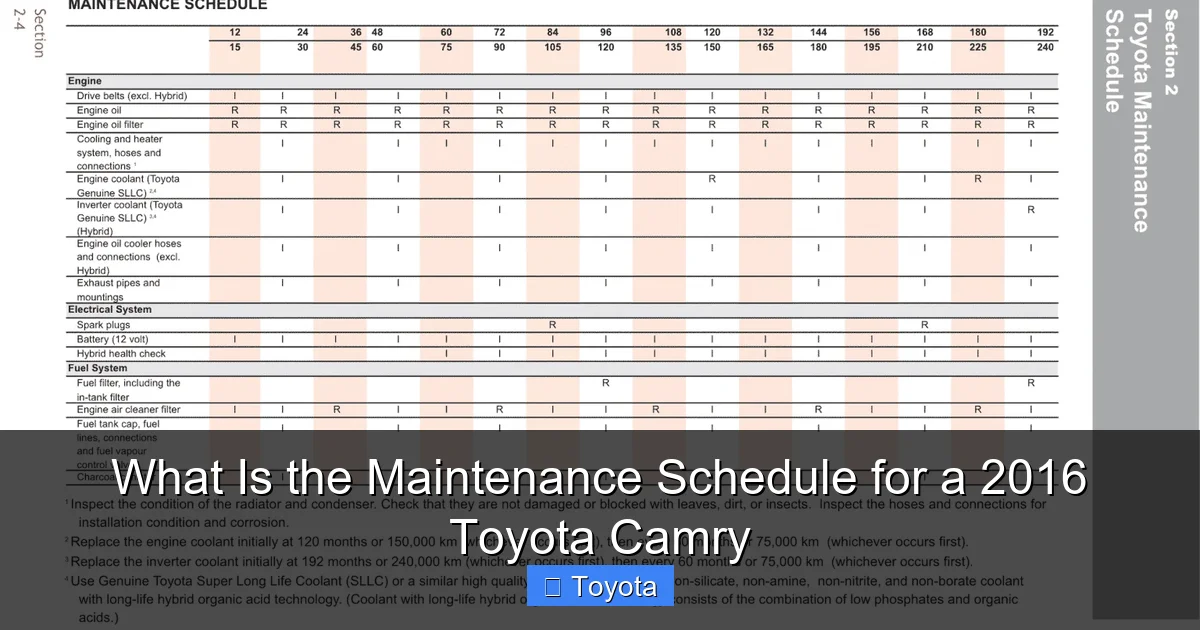
Let’s break down the schedule by the odometer reading. We’ll focus on the Severe Schedule intervals, as they are the most commonly applicable. Remember, these are cumulative; each service includes checks from previous intervals unless a part was already replaced.

Visual guide about What Is the Maintenance Schedule for a 2016 Toyota Camry
Image source: i.pinimg.com
5,000 Miles / 6 Months
This is your first and most frequent checkpoint. It’s the bedrock of Camry care.
- Engine Oil & Filter Change: This is #1. Fresh oil lubricates, cools, and cleans your engine. Synthetic oil, which is standard for the 2016 Camry’s 2.5L 4-cylinder and 3.5L V6 engines, allows for longer intervals, but under severe conditions, 5,000 miles is a safe bet. Never exceed 10,000 miles.
- Tire Rotation: Front tires on a front-wheel-drive Camry wear faster on the edges due to steering. Rotating them to the rear promotes even wear. Do this every time you get an oil change for simplicity.
- Multi-Point Visual Inspection: A technician (or you, if DIY) should check fluid levels (coolant, brake, washer), tire pressure and condition, lights, wipers, and belts.
- Brake Inspection: Check pad thickness and rotor condition. Brakes are a wear item; catching them early prevents rotor damage.
10,000 Miles / 12 Months
If you changed oil at 5k, this is essentially a repeat of the 5,000-mile service. Continue the pattern of oil/filter changes and tire rotations. At this interval, pay extra attention to:
- Cabin Air Filter: This filter cleans the air you breathe inside the car. In severe conditions (dusty, high pollen), it can clog faster. Replace it if airflow from vents is weak or musty.
- Engine Air Filter: A clogged air filter reduces fuel efficiency and power. Inspect it; replace if dirty.
15,000 Miles / 18 Months
Everything from the 5k/10k services continues. Now we add:
- Inspect All Fluid Levels: Top off washer fluid. Check power steering fluid (if applicable), coolant, and brake fluid levels.
- Check Battery: Test battery health and clean terminals. A weak battery is a leading cause of breakdowns. If you need a new one, research the best battery for a 2016 Toyota Camry to ensure you get a compatible, high-quality unit.
- Inspect Suspension & Steering: Look for leaks in shock absorbers/struts and check ball joints and tie rods for wear.
30,000 Miles / 36 Months
This is a major service milestone. In addition to the standard oil change and rotation:
- Replace Engine Air Filter: Definitely replace it now if not done sooner.
- Replace Cabin Air Filter: A must for air quality.
- Inspect and Flush Engine Coolant: Coolant degrades over time, losing its anti-corrosive and anti-freeze properties. Toyota recommends testing/replacing at this interval to prevent overheating and engine corrosion.
- Inspect Brake Fluid: Brake fluid is hygroscopic (absorbs moisture). Water in the system lowers boiling point, risking brake failure. It should be tested and often replaced at this point.
- Inspect/Replace Spark Plugs (Iridium): The 2016 Camry uses long-life iridium spark plugs, typically rated for 120,000 miles. However, under the severe schedule, a quick inspection at 30k is wise to check for fouling or wear.
- Fuel System Inspection: Check fuel lines, tank, and cap for leaks.
- Thorough Underbody Inspection: Look for rust, damaged exhaust components, and fluid leaks.
45,000 Miles / 54 Months
Another substantial service. Repeat the 30k items, plus:
- Transmission Fluid Inspection (Automatic): This is a big one. The 2016 Camry’s 6-speed automatic transmission fluid is “lifetime” by Toyota’s definition, meaning for the life of the vehicle under normal conditions. However, many mechanics and the severe schedule recommend inspecting it at 45k and considering a fluid and filter change every 60,000-100,000 miles for ultimate longevity, especially if you tow or drive hard. Consult your manual’s specific wording.
- Inspect Drive Belts: Check the serpentine belt for cracks, glazing, or wear. Replace if needed.
- Inspect PCV Valve: A clogged Positive Crankcase Ventilation valve can cause oil leaks and rough idle.
60,000 Miles / 72 Months
The big six-zero. This is a comprehensive “major” service that includes everything from previous intervals.
- Replace Timing Belt (If Applicable): IMPORTANT: The 2016 Camry’s 4-cylinder engine (2.5L) uses a timing chain, which is generally considered “lifetime” and does not require scheduled replacement. The V6 (3.5L) also uses a timing chain. This is a key difference from older models. No belt change is needed.
- Replace All Filters Again: Engine air, cabin air.
- Replace Spark Plugs (if not done): Even long-life plugs are worth inspecting/replacing at this high mileage.
- Replace Fuel Filter: If your model has an external fuel filter (some do not), it should be replaced.
- Fluid Flushes: Consider transmission fluid exchange (as noted above), and possibly differential fluid (if AWD, but 2016 Camry is FWD).
- Comprehensive Brake System Service: Inspect pads, rotors, calipers, and hardware. Lubricate caliper slides.
- Full Suspension & Steering Inspection: Check all bushings, ball joints, tie rod ends, and shock absorbers/struts for wear. Replace as needed.
- Battery Replacement Consideration: Most car batteries last 3-5 years. At 60k miles/6 years, your original battery is likely at the end of its life. Proactively test it.
The Critical Role of Tire Maintenance & TPMS
Your tires are the only part of your Camry touching the road. Neglecting them compromises safety, fuel economy, and ride comfort. The maintenance schedule emphasizes rotation and pressure checks, but there’s more.
Rotation and Pressure
As stated, rotate every 5,000-8,000 miles. Also, check pressure monthly and before long trips. The correct pressure for your specific 2016 Camry trim (LE, SE, XLE, etc.) is on a sticker on the driver’s door jamb, not on the tire sidewall. Under-inflation causes poor fuel economy, overheating, and premature wear on the outer edges. Over-inflation causes a harsh ride and center-tread wear. If your TPMS (Tire Pressure Monitoring System) light illuminates, check all tires (including the spare, if equipped) for proper inflation. If you need to reset the TPMS after rotating or inflating, you’ll need to know where the TPMS reset button is on your Toyota Camry. It’s typically located under the dashboard, near the steering column.
Understanding Tire Size and Wear
Using the correct tire size is paramount. The 2016 Camry came with various tire sizes depending on the trim and wheel size (e.g., 215/65R16, 225/50R17, 235/45R18). Installing the wrong size can affect speedometer accuracy, handling, and even cause interference with body parts. If you’re replacing tires, confirm your size. For reference, the following model year had similar fitments; you can look up what size tires for a 2017 Toyota Camry as a general guide, but always verify your specific vehicle’s door jamb sticker. Uneven wear patterns (cupping, feathering, one-sided wear) are signs of alignment issues, worn suspension parts, or improper inflation—address these immediately during an inspection.
Fluids, Filters, and Belts: The Unsung Heroes
Oil gets all the attention, but your Camry runs on a complex cocktail of fluids and relies on clean filters and intact belts.
Essential Fluids
- Engine Oil: Use Toyota-approved 0W-20 synthetic oil for all 2016 Camry engines. It’s designed for fuel efficiency and engine protection.
- Engine Coolant: Toyota Super Long Life Coolant (pink) is used. It’s designed to last 10 years/150,000 miles but should still be tested for potency and contamination.
- Brake Fluid: Toyota Genuine Brake Fluid or equivalent DOT 3. Hygroscopic nature means it absorbs water from the air, lowering its boiling point. Flush/replace every 2-3 years under severe use.
- Windshield Washer Fluid: Use a fluid with anti-freeze properties in winter.
- Transmission Fluid: Toyota WS (World Standard) fluid. As mentioned, “lifetime” but inspect and consider service for severe use.
Critical Filters
- Engine Air Filter: Prevents dirt from entering the engine. A clogged one strangles performance and economy.
- Cabin Air Filter: Traps pollen, dust, and pollutants. A must for allergy sufferers and interior air quality.
- Fuel Filter: Keeps contaminants out of the fuel system. If external, replace per schedule.
Belts and Hoses
The serpentine belt drives the alternator, water pump, power steering, and A/C compressor. Inspect it for cracks, glazing, or fraying at every major service. The timing chain (in your Camry) is lubricated by engine oil and doesn’t have a service interval, but the chain tensioners and guides can wear over very high mileage. Radiator and heater hoses should be inspected for swelling, cracks, or leaks.
DIY vs. Professional Maintenance: What’s Realistic?
Not every service requires a dealership technician. Knowing what you can safely handle empowers you and saves money.
Perfect for the Enthusiastic DIYer
- Oil & Filter Changes: With basic tools, jack stands, and proper disposal methods, this is the quintessential DIY task. Use the exact oil filter (Toyota part number or high-quality equivalent) and torque the drain plug correctly.
- Tire Rotations: Simple if you have a jack and lug wrench. Remember to torque lug nuts in a star pattern to the manufacturer’s spec (usually ~80 ft-lbs).
- Air Filter Replacements: Both engine and cabin filters are usually held on by simple clips or screws. Takes 5-15 minutes. Check your owner’s manual for exact locations.
- Wiper Blade Replacement: A quick snap-in process.
- Battery Terminal Cleaning: Use a battery terminal brush and baking soda solution.
- Fluid Top-Offs: Regularly check and add washer fluid, coolant (when engine is cold), and oil.
Best Left to the Professionals
- Transmission Fluid Service: While a drain-and-fill is possible, a proper machine flush requires specialized equipment to remove all old fluid from the torque converter and cooler lines.
- Brake Fluid Flush: Requires a specific procedure to bleed air from the system, often using a pressure bleeder or scan tool.
- Major Timing Chain/Belt Work: Even though your Camry has a chain, the labor involved is immense. This is a pro job.
- Suspension Overhaul: Replacing struts, control arms, or ball joints requires alignment afterward and specific tools.
- Complex Diagnostics: Check Engine Lights, electrical gremlins, or drivetrain issues need advanced scan tools and expertise.
Pro Tip: Even if you DIY some items, keep all receipts and note the mileage. A professional shop can perform the major interval services (30k, 60k) while you handle the simple 5k/10k oil changes in between.
Conclusion: Your Investment in Peace of Mind
The 2016 Toyota Camry maintenance schedule is not a suggestion from the manufacturer to sell more services; it’s a meticulously engineered roadmap based on exhaustive testing of wear patterns, fluid degradation, and component lifespans. Following it—especially the more protective Severe Schedule—is the single most effective way to ensure your Camry delivers the smooth, trouble-free, and economical driving experience it was designed for for 200,000 miles or more. It protects your investment, ensures your safety, and makes your car a reliable companion for years to come. Print that schedule, stick it on your fridge, and treat it as a non-negotiable part of your car ownership journey. Your future self, stranded on the side of the road with a preventable breakdown, will thank you for it.
Frequently Asked Questions
What happens if I skip an oil change on my 2016 Camry?
Skipping oil changes allows engine oil to break down, lose its lubricating properties, and accumulate sludge. This leads to increased friction, excessive heat, and accelerated wear on critical engine components like bearings and piston rings, potentially resulting in catastrophic engine failure and a bill far exceeding the cost of several oil changes.
Do I really need to rotate my tires every 5,000 miles?
Yes, for a front-wheel-drive car like the Camry, front tires wear much faster on the edges due to steering and braking forces. Rotating them every 5,000-8,000 miles ensures all four tires wear evenly, maximizing their lifespan, maintaining balanced handling, and preventing the need to replace tires in pairs prematurely.
Does my 2016 Camry have a timing belt that needs replacing?
No. All 2016 Toyota Camry engines—both the 2.5L 4-cylinder and the 3.5L V6—use a timing chain system. Timing chains are designed to last the life of the engine under normal conditions and do not have a scheduled replacement interval, unlike timing belts which typically need changing every 60,000-100,000 miles.
When should I replace the brake fluid in my Camry?
While the owner’s manual may not list a strict interval, brake fluid is hygroscopic and absorbs moisture over time, which lowers its boiling point and can lead to spongy brakes or brake fade. For optimal safety and performance, especially under the Severe Schedule, have your brake fluid tested and replaced (flushed) every 2-3 years.
How long should the original battery in a 2016 Camry last?
A typical car battery lasts 3-5 years. The original equipment battery in your 2016 Camry is likely reaching the end of its reliable life at 6-7 years old (2022-2023). Have it tested annually after the 3-year mark. A weak battery can leave you stranded and will eventually fail, often in extreme cold or heat.
Can I use aftermarket parts instead of genuine Toyota parts?
You can, but with caution. For critical wear-and-tear items like oil filters, air filters, spark plugs, and wiper blades, high-quality aftermarket parts from reputable brands (like Bosch, NGK, Denso) are often excellent and more affordable. For complex components like brake pads, consider OEM or premium aftermarket to ensure proper fit and performance. Avoid cheap, no-name parts for critical systems. Always ensure any part meets or exceeds Toyota’s specifications.