
What Is the Fair Market Value of a 2009 Toyota Camry

The 2009 Toyota Camry remains a benchmark for reliability and value in the used sedan market. Its fair market value today, typically between $4,000 and $8,000, is heavily influenced by mileage, condition, trim level, and local demand. Understanding these factors and using the right pricing tools is key to getting a fair deal, whether you’re buying or selling.
Key Takeaways
- Reputation Drives Value: The 2009 Camry’s legendary reliability and low cost of ownership are the primary reasons it retains value so well over 15 years.
- Condition is King: A well-maintained, accident-free example with complete service records can command a premium of 20-30% over a neglected vehicle with the same mileage.
- Mileage Matters Most: For a car of this age, mileage is the single biggest factor. Expect a significant price drop for every 50,000 miles above the national average of ~120,000 miles for this model year.
- Trim Levels Create Gaps: The difference in value between a base CE model and a top-tier XLE can be $1,500 to $2,500, reflecting added features like leather, sunroofs, and upgraded audio.
- Local Market is Everything: Prices can vary by 15-25% between regions. A Camry will fetch more in the Sun Belt than in the Rust Belt, where salt corrosion is a concern.
- Know Your Sources: Rely on a combination of valuation tools (Kelley Blue Book, NADA) and real-world sales data (eBay, Facebook Marketplace) to find the true fair market value.
- Pre-Purchase Inspection is Non-Negotiable: Spending $150 on a professional inspection can save you thousands by revealing hidden issues that drastically affect a vehicle’s true value.
📑 Table of Contents
- Understanding Fair Market Value for a 2009 Toyota Camry
- The Core Factors That Swing the Price
- What’s the Number? Pricing Ranges for 2009 Toyota Camry
- How to Determine the Actual Fair Market Value Yourself
- Buying vs. Selling: Actionable Tips for Both Sides
- The Long-Term Value Perspective: Is It a Good Investment?
- Conclusion: Finding Your Number
Understanding Fair Market Value for a 2009 Toyota Camry
So, you’re looking at a 2009 Toyota Camry. Maybe it’s your first car, a reliable commuter, or a budget-friendly family hauler. Whatever the reason, you’ve made a solid choice. The Camry, especially from this generation, is famous for its “go anywhere, do anything” reliability. But before you hand over any cash or list your own for sale, you need to understand one critical number: the fair market value.
Fair market value isn’t just a guess. It’s the price a knowledgeable, willing buyer would pay a knowledgeable, willing seller, both acting in their own best interest and without any pressure to buy or sell. For a 2009 Toyota Camry, this number isn’t pulled from thin air. It’s a calculated estimate based on hundreds of recent, actual sales of similar vehicles. Getting this number right is the difference between overpaying, underselling, or striking a deal you can feel good about.
Why the 2009 Camry Holds Its Value So Well
To understand its value, you first have to understand the car. The 2009 Camry was part of the XV40 generation, produced from 2007-2011. It was a complete redesign that emphasized fuel efficiency, a quiet cabin, and that trademark Toyota dependability. It came with several engine options: a fuel-sipping 2.4L 4-cylinder (the most common), a powerful 3.5L V6, and even a hybrid variant. This was the car that cemented the Camry’s reputation as the unflappable, comfortable, and incredibly durable choice for millions of drivers.
This reputation is its superpower in the used market. A 2009 Camry with 150,000 miles that has been regularly serviced is often viewed as being in better shape, mechanically, than a 2015 model from a less reliable brand with 80,000 miles. Buyers are willing to pay for that peace of mind. That’s why, despite being 15 years old, a clean 2009 Camry still has tangible value. It’s not just a used car; it’s a proven, low-risk transportation solution.
The Core Factors That Swing the Price
You can’t just say “a 2009 Camry is worth $X.” That’s too vague. The fair market value is a spectrum, and your specific car lands somewhere on that line based on several key pillars. Think of them as levers that pull the price up or down.
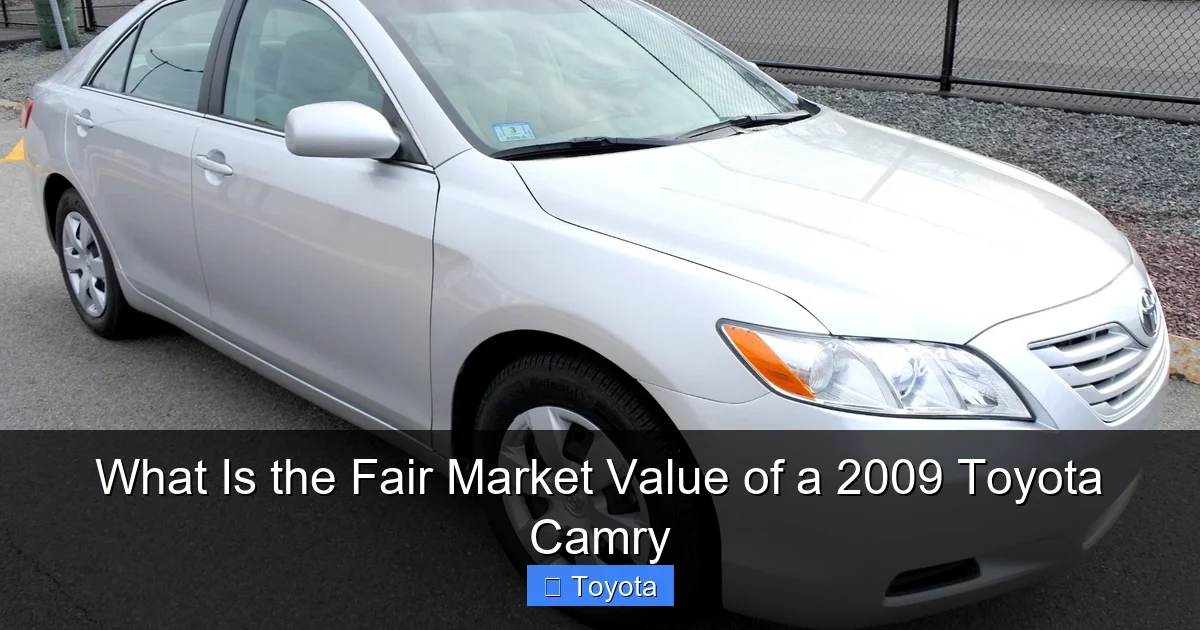
Visual guide about What Is the Fair Market Value of a 2009 Toyota Camry
Image source: metrowestmotorcars.com
1. Mileage: The Heavyweight Champion
For a vehicle this old, mileage is the undisputed king of value determinants. The national average annual mileage is about 12,000 miles. For a 2009 model, that means a “typical” car would have around 168,000 miles by 2024. However, many well-preserved examples sit between 100,000 and 150,000 miles.
Here’s a practical way to look at it: for every 50,000 miles a 2009 Camry has above the 120,000-mile mark, you should expect a deduction of roughly $1,000 to $1,500 from the base value of a similarly conditioned, lower-mileage example. Conversely, a pristine example with under 90,000 miles can command a significant premium. A car with 200,000+ miles is a different beast entirely; its value is based almost solely on its immediate utility and remaining lifespan, often dipping below $4,000 unless it’s a rare, perfect-condition survivor.
2. Condition: The Telltale Signs
Condition goes far beyond “does it run?” It’s the total package of maintenance history, interior wear, exterior health, and mechanical soundness. A fair market value assumes an “average” condition for its age and mileage. To command top dollar, your car needs to be in “above average” or “excellent” condition.
- Mechanical: Has it had its timing belt/water pump service? (This is a major service item for the 4-cylinder around 90,000-100,000 miles). Are there any check engine lights? How do the brakes, tires, and suspension feel? A car with a documented major service history is worth more.
- Exterior: Look for rust, especially on the rocker panels, rear wheel arches, and under the trunk lid. Original, undamaged paint is a plus. Any history of major accidents will be a huge red flag and value-killer. You can often spot poorly repaired paint or misaligned panels.
- Interior: Is the driver’s seat bolster worn down to the foam? Are the carpets stained? Is the headliner sagging? Is all the equipment—power windows, locks, HVAC, stereo—working perfectly? A clean, odor-free, fully functional interior signals a caring owner and adds real value.
3. Trim Level & Optional Features
The 2009 Camry came in several trims: the base CE, the popular LE, the sporty SE, and the luxurious XLE. The XLE, with its leather seats, woodgrain trim, sunroof, and premium JBL audio system, will always be worth more than a bare-bones CE model with the same miles. Key options that boost value include:
- Power moonroof/sunroof
- Leather seating surfaces
- Upgraded audio system (JBL)
- Navigation system (less common, adds value)
- Heated front seats
- Alloy wheels (vs. steel wheels with hubcaps)
When comparing two cars, a fully loaded LE might be priced closer to a base XLE. It’s important to compare apples to apples.
4. Geographic Location & Seasonality
Where you live dramatically changes the price. In warm-weather states like Arizona, Florida, or Texas, where rust is minimal, clean 2009 Camrys are plentiful and prices are stable. In the “Salt Belt” states of the Northeast and Midwest, a rust-free example is a unicorn and will sell for a premium. Conversely, a car with visible rust will struggle to find a buyer regardless of price.
Seasonality also plays a minor role. Convertibles (the Camry didn’t have one, but this applies broadly) and sports cars sell for more in summer. Reliable, all-weather sedans like the Camry see a slight bump in demand and price during fall and winter as people prepare for commuting in poor weather.
What’s the Number? Pricing Ranges for 2009 Toyota Camry
Now, let’s talk numbers. These are general national averages as of late 2023/early 2024. Your local market will vary. Always use these as a starting point for your research.
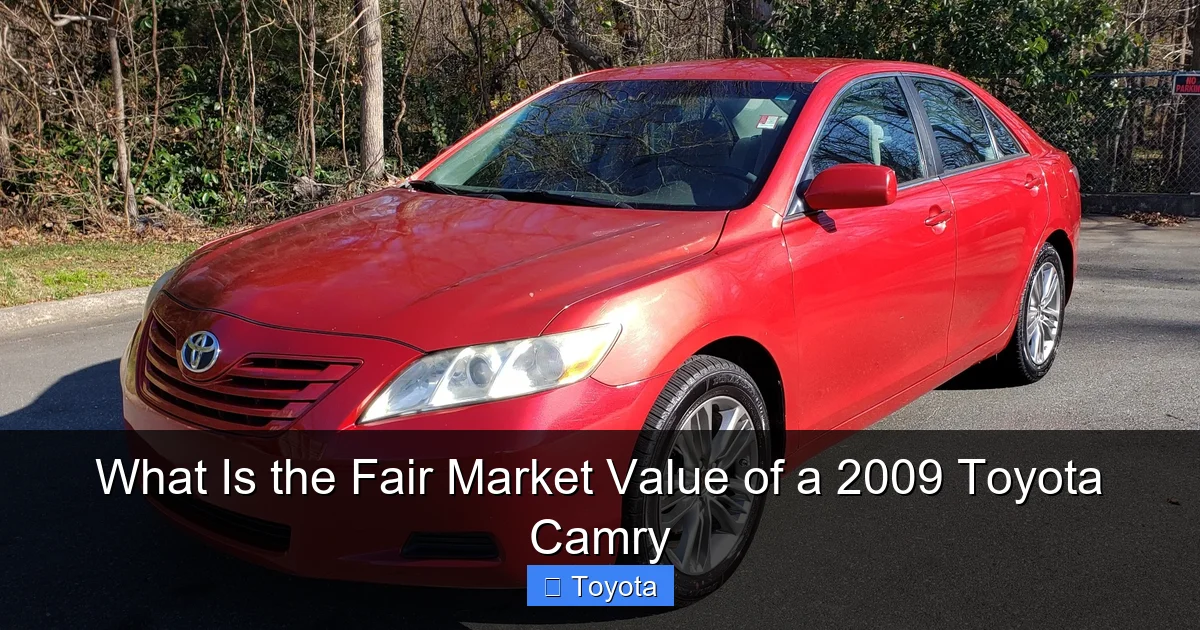
Visual guide about What Is the Fair Market Value of a 2009 Toyota Camry
Image source: formulaimports.com
Base Model (CE) – The Budget Workhorse
This is the no-frills, 4-cylinder, steel-wheeled model. Value here is all about mechanical soundness and mileage.
- High Mileage (180,000+ miles), Fair Condition: $2,500 – $4,000. These are project cars or high-mileage daily drivers. Expect to need repairs soon.
- Average Mileage (120,000-160,000 miles), Good Condition: $4,000 – $5,500. The most common segment. Runs well, may have minor cosmetic issues. Needs a clean history report.
- Low Mileage (under 100,000 miles), Excellent Condition: $5,500 – $7,000. Rare find. Meticulously maintained with full records. Feels like a much newer car.
Popular Model (LE) – The Sweet Spot
The LE is the volume seller, typically with alloy wheels, power accessories, and air conditioning. It represents the best balance of features and value.
- High Mileage, Fair Condition: $3,500 – $4,500
- Average Mileage, Good Condition: $5,000 – $6,500. This is the heart of the market.
- Low Mileage, Excellent Condition: $6,500 – $8,000. A fantastic buy for someone wanting a reliable, feature-packed sedan for years to come.
Top Trim (SE/XLE) & V6 Models – The Premium Pick
The SE (sport-tuned) and XLE (luxury) trims, especially with the 3.5L V6 engine, hold the highest values. The V6 offers smooth, powerful acceleration that the 4-cylinder can’t match, and the XLE’s amenities are substantial.
- High Mileage, Fair Condition: $4,000 – $5,500
- Average Mileage, Good Condition: $6,000 – $7,500
- Low Mileage, Excellent Condition: $7,500 – $9,500+. A pristine, low-mileage V6 XLE can approach the $10,000 mark, a testament to its enduring appeal.
Important Note on the Hybrid: The 2009 Camry Hybrid is a separate category. Its battery system’s health is paramount. A working, documented hybrid battery adds complexity but also value for the eco-conscious buyer. Prices range from $5,000 for a high-mileage example to $8,000+ for a low-mileage, battery-healthy model.
How to Determine the Actual Fair Market Value Yourself
You don’t have to take my word for it. You can find the real, actionable number with a few simple steps. This is your homework before any purchase or sale.
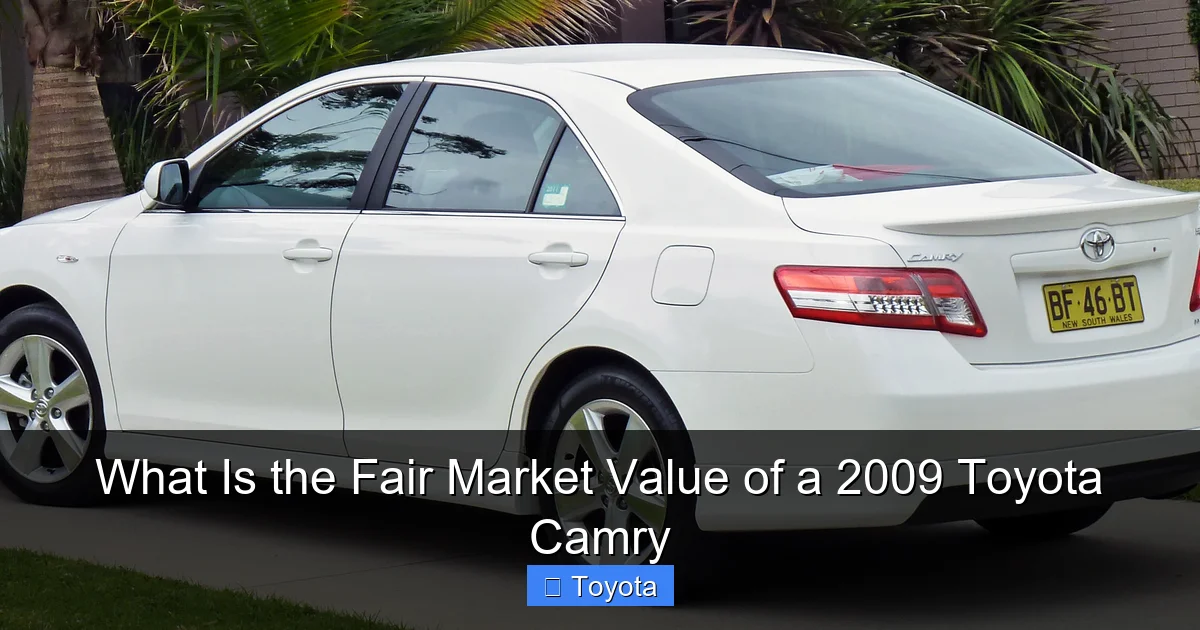
Visual guide about What Is the Fair Market Value of a 2009 Toyota Camry
Image source: autodetective.com
Step 1: Use the Online Valuation Tools (The Starting Point)
Go to Kelley Blue Book (KBB.com) and NADAguides.com. Input the exact details: 2009 Toyota Camry, your specific trim (CE/LE/SE/XLE), engine (2.4L or 3.5L), mileage, and your ZIP code. Select the condition that best fits the car—be brutally honest. “Good” is the most common and realistic for a 15-year-old car. These tools will give you a “Trade-In Range” (what a dealer might offer) and a “Private Party Range” (what you should expect to pay/get). This private party range is your fair market value baseline.
Step 2: Scour the Real-World Listings (The Reality Check)
Tools are guides; real sales are truth. Go to Facebook Marketplace, Craigslist, and eBay Motors. Filter for 2009 Toyota Camrys in your area and nationwide. Don’t just look at asking prices; on eBay, look at the “Sold” listings. What are similar cars actually selling for? You’ll see that cars with detailed descriptions, many photos, and clean titles sell faster and for closer to the KBB “Private Party” high end. Listings with blurry photos and “needs work” descriptions sit unsold or sell below the low end. This research tells you the current market sentiment.
Step 3: Get a Vehicle History Report (The Non-Negotiable)
For any serious purchase, get a Carfax or AutoCheck report using the VIN. Look for:
- Title Issues: Salvage, rebuilt, flood damage. These are massive red flags and kill value.
- Accident History: Even minor accidents can affect structural integrity. Major ones are deal-breakers.
- Service Records: Some reports include maintenance history from dealerships or shops. This is gold.
- Number of Owners: One careful owner is generally preferred over multiple short-term owners.
A clean report won’t guarantee a good car, but a bad report guarantees a problem. It directly impacts the fair market value downward, often by $1,000 or more.
Step 4: The Pre-Purchase Inspection (The Ultimate Value Verifier)
This is the most important step, whether you’re buying or setting a selling price. For $100-$200, a trusted, independent mechanic will put the car on a lift. They check for:
- Rust severity and location.
- Timing belt/water pump condition (critical for the 4-cylinder).
- Transmission fluid condition and any signs of slipping.
- Suspension and brake wear.
- Any hidden leaks, frame damage, or computer codes.
The inspection report gives you an objective, professional assessment of the car’s actual condition. If the inspection finds $2,000 in needed repairs, you can confidently subtract that from the asking price to arrive at your fair offer. For a seller, a recent, clean inspection report is a powerful sales tool that justifies a higher asking price and builds buyer trust.
Buying vs. Selling: Actionable Tips for Both Sides
Knowing the number is one thing; using it effectively is another. Here’s how to apply that fair market value in a real transaction.
For the Buyer: How to Negotiate from a Position of Strength
You’ve done your research. KBB says the private party value is $5,500 for a specific LE model. The seller is asking $6,200. Here’s your playbook:
- Lead with Facts, Not Emotion: “I’m interested in your Camry. Based on my research on KBB and recent sold listings on eBay for similar 2009 Camrys in the LE trim with this mileage in our area, the fair market value is in the $5,500 range. I’m prepared to offer $5,400 cash today.” This shows you’re serious and informed.
- Use the Inspection as Leverage: “I had my mechanic look at it, and he noted the timing belt is original and due for replacement soon at a cost of ~$800. Given that, I’m comfortable at $5,000.” This turns a potential negative into a reasoned negotiation point.
- Walk Away Power: Always be prepared to walk away. There are dozens of other 2009 Camrys for sale. If the seller won’t come down to a reasonable price based on your research, move on. Your research gives you the confidence to do this.
Avoid getting emotionally attached to one specific car. Have 2-3 candidates you’re looking at. This keeps negotiations competitive.
For the Seller: How to Price to Sell Quickly and Fairly
You want to sell your 2009 Camry. Don’t just guess. Here’s how to price it to attract buyers and avoid lowball offers:
- Price it Slightly Above Your “Bottom Line”: If your research says the fair market value is $6,000, price it at $6,495. This leaves room for a buyer to “get a deal” by negotiating you down to $6,000, making them feel victorious while you still hit your target.
- Over-Pricing is the Biggest Mistake: A car listed at $7,500 when the market is $6,000 will sit for weeks. Buyers will assume you’re unrealistic and skip it. You’ll eventually have to drop the price, and the long listing time will make people wonder what’s wrong with it.
- Document Everything: In your listing, mention the clean title, accident-free Carfax, and—most importantly—all maintenance records. “Timing belt and water pump replaced at 95k miles,” “New tires 10k miles ago,” “Regular oil changes every 5k miles.” This justifies your price and filters out tire-kickers. If you’ve had a recent pre-purchase inspection, say so and offer to share the report. This is a huge trust-builder.
- Be Responsive and Flexible: Answer questions quickly. Be open to reasonable, cash offers. A buyer who feels heard and respected is more likely to close the deal at a fair price.
The Long-Term Value Perspective: Is It a Good Investment?
Let’s be clear: a 15-year-old economy sedan is not a financial investment that appreciates. However, it can be one of the smartest depreciation plays you can make. The 2009 Camry has already endured its steepest value drop, which happens in the first 3-5 years. The curve is flattening.
If you buy a well-maintained example for $5,500, you can likely drive it for 3-4 more years with only regular maintenance (oil changes, brakes, tires) and sell it for $3,000-$4,000. Your cost of ownership—the depreciation you “lose”—could be as little as $500-$750 per year. That’s an incredible number for reliable transportation. Compare that to buying a new $28,000 Camry and losing $5,000 in value the first year.
Furthermore, the car’s simplicity is its strength. The 2.4L 4-cylinder engine (the 2AZ-FE) is a known quantity. Parts are abundant and cheap at junkyards and online. A skilled mechanic can fix almost anything on this car without exotic diagnostic tools. This predictability and low cost of repair is baked into its fair market value. Buyers are paying for that certainty.
When evaluating a specific car, think beyond the purchase price. A $1,000 cheaper car that needs a $1,500 timing belt job immediately is not a better value than a $1,000 more expensive car with that service already done. The fair market value should reflect the car’s total cost of immediate ownership. A pre-purchase inspection is the only way to see that total cost clearly.
Conclusion: Finding Your Number
The fair market value of a 2009 Toyota Camry isn’t a single number on a sticker. It’s a range, a negotiation starting point, and a reflection of a specific vehicle’s unique story. It’s built on the foundation of the model’s stellar reputation, then carved by the specifics of its mileage, its condition, its features, and its home region.
Your mission is simple: research, verify, and inspect. Use KBB and NADA for the baseline. Validate with real-world sold listings. Verify with a vehicle history report. And finally, confirm with a professional mechanical inspection. This three-step process moves you from a guesser to an informed participant.
Whether you end up with a base-model commuter for $4,000 or a low-mileage V6 XLE for $8,500, you’ll know you paid a fair price. That knowledge is worth more than any single dollar amount. It brings confidence to the buyer and respect to the seller. In the end, for a car as proven as the 2009 Toyota Camry, arriving at the fair market value means you’re not just buying or selling a piece of metal—you’re exchanging a piece of reliable motoring history at a price that makes sense for everyone involved.
Frequently Asked Questions
What is the typical price range for a 2009 Toyota Camry with average mileage?
For a 2009 Toyota Camry in “good” condition with average mileage (120,000-160,000 miles), the fair market value typically falls between $4,000 and $6,500. The specific price depends heavily on the trim level (LE, SE, XLE), engine (4-cylinder vs. V6), and geographic location.
How much does a new timing belt service affect the value of a 2009 Camry?
A documented timing belt and water pump replacement (a major service for the 2.4L 4-cylinder engine) can add $800 to $1,200 to the car’s value. Buyers are willing to pay a premium for this critical maintenance item, which is due around 90,000-100,000 miles and costs $800-$1,200 to perform. A car with an original, high-mileage timing belt will be priced significantly lower to account for this imminent expense.
Is a 2009 Toyota Camry Hybrid worth more than the standard 4-cylinder model?
Yes, but with a caveat. A 2009 Camry Hybrid in good working condition with a healthy battery system typically commands a $1,000 to $2,000 premium over a comparable 4-cylinder model. However, its value is entirely dependent on the hybrid battery’s health and warranty status. A car with a weak or failed battery can be worth less than a standard 4-cylinder, as a replacement battery can cost $2,000-$3,000.
What are the biggest red flags that would lower the fair market value?
The biggest value-killers are: a salvage or rebuilt title (reduces value by 50%+), evidence of major accident repair (frame damage), severe rust on structural components, an original timing belt on a high-mileage 4-cylinder, and a non-functional hybrid system in a Hybrid model. Any of these issues can drop the price by thousands and should be thoroughly investigated with a vehicle history report and pre-purchase inspection.
How does the condition of the interior affect the price?
Significantly. A worn-out driver’s seat, stained carpets, broken controls (like the power window switches or HVAC fan), or a persistent odor (smoke, mildew) can easily deduct $500 to $1,500 from the value. A clean, fresh, fully functional interior signals a well-cared-for vehicle and supports a price at the higher end of the range. For example, you can check how to access the trunk from the back seat to ensure all interior features work as intended.
Should I pay more for a one-owner 2009 Camry?
Generally, yes. A one-owner car with complete service records from that owner is highly desirable and typically worth 5-10% more than a similar car with three or four owners. It suggests consistent, known maintenance history and reduces the risk of neglect or hidden problems. However, the condition and maintenance records are more important than the owner count alone. A well-maintained two-owner car is better than a neglected one-owner car.
