What Is the Difference Between the 2024 and 2023 Toyota Highlander

Contents
- 1 Key Takeaways
- 2 📑 Table of Contents
- 3 Introduction: A Tale of Two (Very Similar) Years
- 4 Exterior & Design: Spot the Difference (If You Can)
- 5 Interior, Comfort & Cargo: A Familiar, Premium Space
- 6 Powertrain & Performance: Unchanged and Unwavering
- 7 Features, Technology & Safety: Incremental Updates
- 8 Pricing, Value & Which Model Year Should You Buy?
- 9 Conclusion: The Verdict on Similar Siblings
- 10 Frequently Asked Questions

LED Emergency Road Flares

Pressure Washer for Car

Car Seat Organizer

Liquid Car Polish
The difference between the 2024 and 2023 Toyota Highlander is surprisingly minimal for a new model year. The 2024 model receives only a handful of updates, most notably a new exterior color (Wind Chill Pearl), a standard 12.3-inch digital gauge cluster on more trims, and slightly revised infotainment software. Mechanically, the powertrain, fuel economy, passenger capacity, and core design remain identical. For most buyers, a well-equipped 2023 Highlander will offer nearly identical value, while the 2024’s changes are largely incremental. The best choice often comes down to dealer inventory, specific trim availability, and minor price adjustments.
Key Takeaways
- Minimal Changes: The 2024 Highlander is a carryover with minor tweaks, not a full redesign. The core vehicle is the same as the 2023 model.
- New Color & Tech: Key 2024 updates include the Wind Chill Pearl paint and expanded availability of the 12.3-inch digital driver display.
- Same Powertrain: Both years use the same reliable 2.4L turbocharged 4-cylinder engine (in most trims) and hybrid system, with identical performance and fuel economy.
- Pricing & Value: The 2023 model will likely offer better value as dealers clear inventory, while the 2024 may have a slightly higher MSRP.
- Identical Interior & Cargo: No changes to the three-row seating layout, cargo space dimensions, or overall interior design and materials.
- Safety Suite Standard: Toyota Safety Sense 3.0 remains standard on all trims for both model years, with no significant feature additions for 2024.
- Choose Based on Deal: With so few differences, your decision should prioritize finding the best price, available incentives, and the specific trim/features you want, regardless of model year.
📑 Table of Contents
- Introduction: A Tale of Two (Very Similar) Years
- Exterior & Design: Spot the Difference (If You Can)
- Interior, Comfort & Cargo: A Familiar, Premium Space
- Powertrain & Performance: Unchanged and Unwavering
- Features, Technology & Safety: Incremental Updates
- Pricing, Value & Which Model Year Should You Buy?
- Conclusion: The Verdict on Similar Siblings
Introduction: A Tale of Two (Very Similar) Years
If you’re shopping for a Toyota Highlander, you’re likely looking at one of the most popular and competent three-row SUVs on the market. It’s a smart choice, known for its reliability, comfortable ride, and family-friendly features. But when you start comparing the 2024 and 2023 model years, you might be surprised to find a story of remarkable continuity rather than dramatic change. Toyota has kept its popular midsize SUV largely the same, making the differences between these two years subtle and specific. This article will dissect every nuance, from the newest paint color to the smallest infotainment tweak, to help you understand exactly what—if anything—is different and which model year might be the smarter buy for your budget and needs.
Think of the 2024 Highlander not as a new car, but as a carefully curated refresh of the 2023 model. Toyota’s philosophy often involves making significant investments in a redesign (like the complete overhaul the Highlander received for the 2020 model year) and then implementing small, annual updates to keep the model fresh and competitive. That’s precisely what we see here. The bones, the engine, the cabin layout, and the fundamental character of the vehicle are shared. The variations lie in the details—the proverbial “icing on the cake.” For a buyer, this is actually good news: it means you can’t really make a wrong choice between these two years, and your focus should shift to dealer pricing, available inventory, and which specific trim level offers the features you desire. To understand the broader context of how Toyota structures its lineup, you can explore resources that explain the Toyota Convenience Package, which often appears on various trims across different models.
Exterior & Design: Spot the Difference (If You Can)
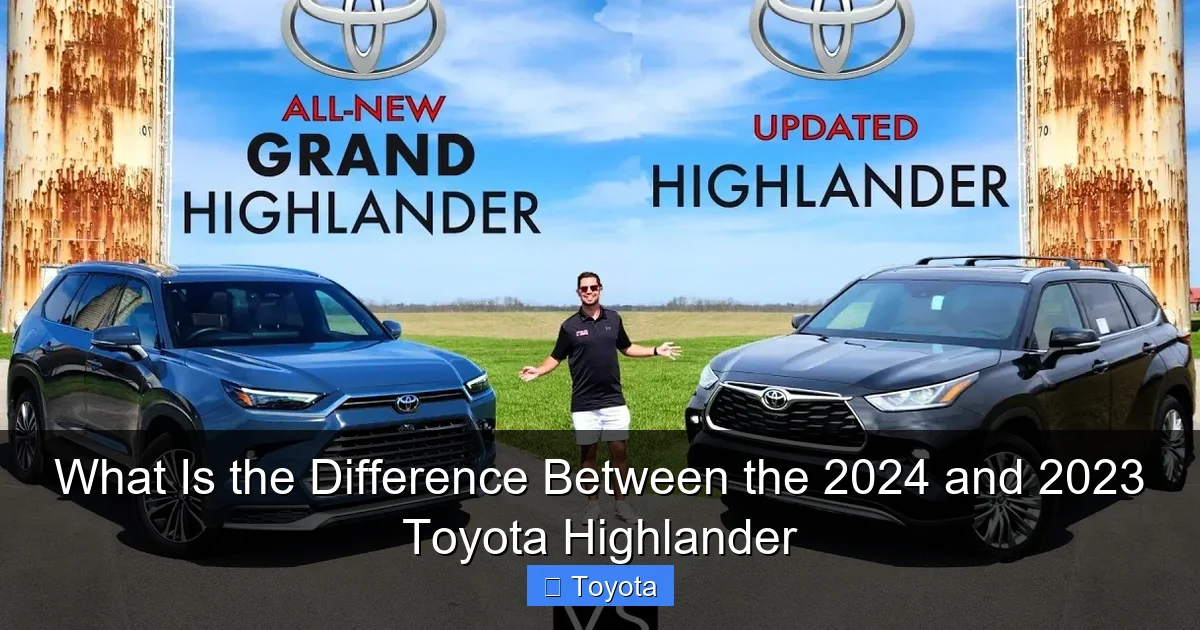
At a glance, you would be hard-pressed to tell a 2024 Highlander from a 2023. They share the same muscular, sculpted bodywork, the same aggressive front grille with its layered design, and the same sleek roofline that gives it a more car-like stance than many boxier competitors. The overall dimensions—length, width, height, and wheelbase—are identical. This means passenger space and cargo capacity are exactly the same, a critical factor for families.
Visual guide about What Is the Difference Between the 2024 and 2023 Toyota Highlander
Image source: carconfections.com
The One Significant Visual Change: Wind Chill Pearl
The headline exterior update for 2024 is the addition of Wind Chill Pearl to the color palette. This is a stunning, multi-coat pearl white with subtle blue and silver flakes that give it a depth and richness that standard white paints lack. It joins the existing palette, which includes classics like Super White, Magnetic Gray Metallic, and Celestite Gray Metallic, as well as bold options like Lunar Rock and Cavalry Blue. For the 2023 model year, Wind Chill Pearl was not an option. If this specific, eye-catching shade is at the top of your list, the 2024 model is your only choice. Otherwise, the exterior color selection remains virtually unchanged.
Wheels & Trim Packages
Wheel designs across corresponding trims (LE, XLE, Limited, Platinum) are the same. There have been no official announcements of new wheel styles exclusive to 2024. The same goes for exterior styling elements like roof rails, lower body cladding, and grille designs—they are carried over directly from the 2023 model. The 1794 Edition concept, which is a special trim on the Tundra, doesn’t apply here, but it illustrates how Toyota sometimes uses special editions to add flair. For Highlander, the special editions (like the Bronze Edition for 2023) are also carried over without change into 2024.
Interior, Comfort & Cargo: A Familiar, Premium Space
Step inside, and the sense of familiarity is even stronger. The interior architecture—the dashboard layout, the position of the climate controls, the storage cubbies, the second-row seat mechanisms—is carried over without alteration. Toyota nailed the interior design and quality with the current generation, and they see no need to fix what isn’t broken.

Visual guide about What Is the Difference Between the 2024 and 2023 Toyota Highlander
Image source: i.gaw.to
Materials & Seating Configurations
The quality of soft-touch materials, available leather or fabric upholstery, and woodgrain or metal accents are identical. You will get the same excellent front seats with available heating and ventilation, and the same remarkable second-row captain’s chairs (on most trims) that offer superb comfort and easy third-row access. The crucial fact that the Highlander is an 8-passenger vehicle (with the optional 2nd-row bench) or a 7-passenger vehicle (with standard captain’s chairs) remains true for both years. The third-row space, while best suited for children or occasional adult use, is exactly the same. Cargo volume behind the third row (16.0 cu ft), second row (48.4 cu ft), and first row (84.7 cu ft) is a constant between 2023 and 2024.
The Infotainment Screen: A Subtle But Important Shift
This is where one of the more meaningful changes occurs, but it’s nuanced. For 2023, the standard infotainment screen was an 8-inch touchscreen on base trims (L, LE), with a larger 12.3-inch screen available on XLE, Limited, and Platinum. For 2024, Toyota has made the 12.3-inch digital gauge cluster (the screen directly behind the steering wheel) standard on more trims. Specifically, it’s now standard on XLE and above, whereas in 2023 it was primarily a Limited and Platinum feature. The central infotainment touchscreen sizes remain the same by trim: 8-inch on base, 12.3-inch on upper trims. However, the software interface for the 12.3-inch screen has been slightly updated for 2024 with new graphics and menu flows, but the core functionality—Apple CarPlay, Android Auto, built-in navigation on higher trims, and connected services—is identical. If you’re someone who values a large, crisp digital driver display, the 2024 XLE gives you that standard, which is a tangible upgrade from the 2023 XLE’s analog gauges with a small digital center screen.
Powertrain & Performance: Unchanged and Unwavering
Here is the area with absolutely zero differences. The heart of the Highlander is its powertrain, and Toyota did not touch it for 2024. This is great news for reliability and consistency.

Visual guide about What Is the Difference Between the 2024 and 2023 Toyota Highlander
Image source: motorbiscuit.com
The Standard Turbocharged Engine
For both 2023 and 2024, the standard engine across most trims (L, LE, XLE, Limited) is a 2.4-liter turbocharged 4-cylinder. It produces 265 horsepower and 310 lb.-ft. of torque. This engine replaces the old 3.5L V6 and is more fuel-efficient while providing stronger low-end torque. It is paired with an 8-speed automatic transmission. Driving impressions, acceleration times, and towing capacity (up to 5,000 lbs) are identical.
The Hybrid Powertrain
The hybrid model, available on LE, XLE, and Limited trims, also remains unchanged. It uses a 2.5-liter 4-cylinder engine paired with two electric motors for a total system output of 243 horsepower. Its legendary fuel economy—an EPA-estimated 36 MPG combined (34 city / 35 highway) for FWD models—is the same. The seamless, quiet operation of the hybrid system is a constant between both years. Whether you choose gas or hybrid, your driving experience will be the same in a 2023 or 2024.
All-Wheel Drive
The AWD system, which is optional on most trims and standard on Platinum, is also identical. It’s a capable system for light snow and unpaved roads, and it functions the same way in both model years. For deeper technical insights into how Toyota’s all-wheel-drive systems work, you might read about the DAC button in a Toyota 4Runner, though the Highlander’s system is more streamlined for on-road use.
Features, Technology & Safety: Incremental Updates
This category holds the bulk of the differences, but even here, they are small and targeted. The overarching theme is that Toyota Safety Sense 3.0 is standard on all trims for both years, providing a robust suite of active driver-assist features like Pre-Collision System with Pedestrian Detection, Full-Speed Range Dynamic Radar Cruise Control, Lane Departure Alert with Steering Assist, and Road Sign Assist.
Infotainment & Connectivity
As mentioned, the central screen sizes are trim-dependent and unchanged. However, for 2024, the software for the 12.3-inch touchscreen has been revised. This is a behind-the-scenes update that users might notice in slightly different menu layouts, graphics, and potentially improved response times. The functionality—wireless Apple CarPlay and Android Auto, Amazon Alexa compatibility, Bluetooth streaming, and the available navigation system—remains the same. The number of USB ports (two front, two second-row) is also identical. A useful feature to investigate on any Highlander is the snow button, which modifies the throttle response for more predictable starts on slippery surfaces; this feature is present and unchanged on AWD models for both years.
Convenience & Comfort Features
Most convenience features are carryover. This includes the available panoramic moonroof, heated and ventilated front seats, heated second-row seats (on Limited/Platinum), a power liftgate, and a hands-free power liftgate kick sensor (on Platinum). The key difference here circles back to the digital gauge cluster. Getting that large, customizable driver display as standard on the 2024 XLE is a notable feature upgrade over the 2023 XLE. For the 2023 Limited and Platinum, they already had it, so no change there. Other small changes are potential minor revisions to available color combinations for interior trim (e.g., new shades of leather) that may not be widely advertised.
Pricing, Value & Which Model Year Should You Buy?
This is the most critical section for your wallet. With so few substantive changes, the value proposition becomes the deciding factor.
MSRP and Invoice Price
Toyota typically implements a modest price increase from one model year to the next, even for a refresh with minimal changes. For the 2024 Highlander, the increase is estimated to be in the range of $500 to $1,000 across the lineup compared to the 2023 MSRP. This means the starting MSRP for a 2024 L FWD might be around $37,000, while a 2023 of the same spec would have been closer to $36,500. However, the invoice price (what dealers pay the manufacturer) and the actual transaction price are what truly matter. You can learn more about how to find the real cost in our guide on what is the invoice price of a Toyota RAV4, as the principles are identical for the Highlander.
The 2023 Advantage: Clearance Incentives
As dealers and Toyota work to move remaining 2023 inventory to make room for 2024 models, you can expect to see better dealer discounts, low-interest financing offers, and cash rebates on 2023 Highlanders. This can easily eclipse the $500-$1,000 MSRP gap, making the 2023 model the clear value winner. You are essentially getting a nearly identical vehicle for less money. The 2023 model also benefits from a full year of real-world reliability data and owner reviews, which, while likely identical, provide some buyers with extra peace of mind.
The 2024 Argument: “Newer” & Slightly Better Equipped
The case for a 2024 is more about specific features and psychology. If you absolutely want the Wind Chill Pearl paint, you must get a 2024. If you are looking at an XLE trim and want the 12.3-inch digital gauge cluster, the 2024 gives you that standard without needing to step up to a Limited. You are also getting the absolute latest infotainment software iteration. For some, the “newer” model year holds intangible value, even if the differences are small. However, you will likely pay a premium for this newness, as significant incentives on 2024 models may be limited initially.
Practical Buying Tip
Focus on the specific vehicle, not just the model year. A well-optioned 2023 Limited with a great dealer discount might be a better buy than a base 2024 LE at MSRP. Use online pricing tools like Edmunds True Market Value or Kelley Blue Book to see what people are actually paying for both the 2023 and 2024 Highlander in your area with your desired trim and options. Compare the out-the-door prices. Also, investigate if there are any Toyota Vehicle Protection Packages or other dealer-installed accessories that might sway your decision. Always test drive both years if possible to confirm there is no perceptible difference in driving feel.
Conclusion: The Verdict on Similar Siblings
After a thorough, side-by-side examination, the conclusion is clear: the 2024 Toyota Highlander is an evolution, not a revolution. The differences between it and the superb 2023 model are confined to a single new exterior color, the standardization of a 12.3-inch digital driver display on more trims, and slight infotainment software updates. The fundamental package—the capable and efficient turbocharged or hybrid powertrain, the spacious and versatile three-row interior, the comprehensive Toyota Safety Sense 3.0 suite, and the overall design and build quality—is carried over unchanged. This makes both model years excellent choices.
For the pragmatic buyer, the 2023 Highlander emerges as the likely value champion. As dealers aim to clear lots, expect to find better deals, more aggressive financing, and a wider selection of pre-owned (but still new) 2023 models. Unless your heart is set on the Wind Chill Pearl paint or you are cross-shopping an XLE trim and desire the standard digital gauge cluster, there is no compelling reason to pay a premium for the 2024 model. The differences are simply not significant enough to outweigh a potential savings of thousands of dollars. Your energy is better spent negotiating the best possible price on the specific trim and feature set you want, regardless of whether it has a 2023 or 2024 badge on the trunk. Both will deliver the reliable, comfortable, and capable family SUV experience that has made the Highlander a perennial favorite.
Frequently Asked Questions
Is there any performance difference between the 2024 and 2023 Highlander?
No. Both model years use the exact same powertrain options: a 2.4L turbocharged 4-cylinder engine or the 2.5L hybrid system. Horsepower, torque, acceleration, fuel economy, and towing capacity are identical.
Which model year is more fuel-efficient?
>Neither. The EPA fuel economy estimates are exactly the same for both years. For example, the hybrid AWD model is rated at 35 MPG combined for both 2023 and 2024.
Did the price go up for 2024?
Yes, but only slightly. The Manufacturer’s Suggested Retail Price (MSRP) increased by an estimated $500 to $1,000 across the lineup. However, the final sale price will depend on dealer discounts and incentives, which may be better on the outgoing 2023 models.
Is the 12.3-inch infotainment screen standard on all 2024 trims?
No. The 12.3-inch screen remains an upper-trim feature. The key change is that the 12.3-inch digital gauge cluster (driver’s display) is now standard on XLE and higher for 2024, whereas it was limited to Limited and Platinum for 2023.
Should I wait for a 2025 model if the 2024 changes are so small?
Probably not. The current generation (launched for 2020) is nearing the end of its life cycle. A significant redesign for 2025 is possible, but not officially confirmed. If you want a Highlander now, the 2023 offers the best value. If you want the absolute latest of this generation, the 2024 has minor updates. Waiting for an all-new model means an unknown timeline and likely higher initial pricing.
Are there any discontinued features from 2023 to 2024?
No major features were discontinued. All core equipment, safety tech, and option packages from 2023 carry over to 2024. The only “change” is the addition of the new Wind Chill Pearl color and the gauge cluster standardization.