
What Is the Difference Between Jeep Wrangler and Rubicon
Contents
- 1 Key Takeaways
- 2 📑 Table of Contents
- 3 Understanding the Basics: Model vs. Trim
- 4 The Heart of the Matter: Standard Off-Road Hardware
- 5 Performance and On-Road Behavior
- 6 Pricing, Value, and Target Audience
- 7 Can You Make a Standard Wrangler a Rubicon?
- 8 Conclusion: Which One Should You Choose?
- 9 Frequently Asked Questions
The Jeep Wrangler is the overall model name for Jeep’s iconic off-road SUV, while the Rubicon is its most capable, off-road-focused trim level. Think of the Wrangler as the entire product line, and the Rubicon as the top-tier, hardcore version within that line. The main differences lie in standard off-road equipment like locking differentials, heavy-duty axles, and specialized tires, which come standard on the Rubicon but are optional or unavailable on base Wrangler models. This makes the Rubicon significantly more expensive but ready for extreme trails straight from the factory.
Key Takeaways
- The Rubicon is a trim, not a separate model: The Jeep Wrangler is the vehicle. The Rubicon is the highest, most off-road-capable trim level you can buy within the Wrangler family.
- Off-road hardware is the core difference: Rubicons come standard with front/rear locking differentials, heavy-duty Dana 44 axles, and 33-inch all-terrain tires, which are extras or unavailable on base Wranglers.
- Price reflects the standard equipment: A Rubicon costs thousands more than a base Sport Wrangler because you’re paying for all that heavy-duty off-road gear included as standard.
- Both are phenomenal off-road: Even a base Wrangler is incredibly capable. The Rubicon simply removes almost all factory limitations for serious rock crawling and trail conquering.
- Consider your primary use: Choose a base or mid-level Wrangler (like Sahara) for mostly on-road driving with occasional dirt roads. Choose a Rubicon if your main goal is dedicated, challenging off-roading.
- Fuel economy is nearly identical: Since both use the same engine and similar weight, real-world MPG is virtually the same between comparable Wrangler and Rubicon models.
- Resale value is strong for both: Wranglers, especially Rubicons, historically hold their value exceptionally well. You can explore historical value trends in our analysis of how much a 2002 Jeep Wrangler is worth.
📑 Table of Contents
Understanding the Basics: Model vs. Trim
Let’s clear up the biggest point of confusion right away. When people ask about the “difference between a Jeep Wrangler and a Rubicon,” they’re often thinking of two different vehicles. That’s not the case. The Jeep Wrangler is the name of the entire vehicle model—the iconic, boxy, go-anywhere SUV that’s been a symbol of adventure for decades. The Rubicon is not a separate model; it’s the name of the most extreme, off-road-focused trim level within the Wrangler lineup.
Think of it like this: The Wrangler is the family name. Within that family, you have different members (trims) with varying levels of equipment. You have the basic “Sport” member, a more refined “Sahara” member, and then the ultra-capable “Rubicon” member who trains for the Olympics every day. They all share the same fundamental DNA—the same body style, the same core engine options, the same legendary solid axles—but the Rubicon comes from the factory with a specific, comprehensive set of upgrades aimed solely at maximizing off-road traction, durability, and control. This distinction is crucial because it means your choice isn’t between two vehicles, but between one vehicle configured for general adventure or configured for extreme off-roading.
This structure isn’t unique to Jeep. Many brands use trim levels to package features. You can see a similar approach in other brands’ lineups, like the differences between various Dodge Charger and Challenger trims, where certain packages dramatically change the car’s character and capability.
The Wrangler Trim Ladder: Where Rubicon Fits In
For the current generation (JL Wrangler), the trim ladder typically looks something like this, from base to top:
- Sport/Sport S: The bare-bones, value-oriented starting point. Focused on being a capable, no-frills tool.
- Sahara: Adds significant comfort, style, and technology features. Think upgraded interior, premium audio, and nicer wheels. It’s the “lifestyle” Wrangler.
- Rubicon: The off-road king. It takes the Sahara’s comfort and replaces its on-road-oriented hardware with serious off-road kit, as standard.
- 4xe (Hybrid): Available in Sport, Sahara, and Rubicon trims. This is a plug-in hybrid powertrain, not a separate trim. A “Rubicon 4xe” is the most capable off-road hybrid.
- Unlimited (4-door): This isn’t a trim, but a body style. Every trim above (Sport, Sahara, Rubicon, 4xe) is available as a 2-door or a 4-door “Unlimited.” The Rubicon Unlimited is the ultimate factory-built off-road family hauler.
The Rubicon sits at the pinnacle of the standard gas-powered (non-hybrid) Wrangler hierarchy. Its mission is singular: dominate the toughest trails without requiring the owner to buy aftermarket parts.
The Heart of the Matter: Standard Off-Road Hardware
This is where the rubber meets the rock. The differences between a standard Wrangler (like a Sport or Sahara) and a Rubicon are almost entirely about the mechanical components that grip the earth. A base Wrangler is profoundly capable off-road thanks to its solid front and rear axles, short overhangs, and impressive approach/departure angles. However, the Rubicon removes the last few factory limitations.

Visual guide about What Is the Difference Between Jeep Wrangler and Rubicon
Image source: jeepmodified.com
Locking Differentials: The Traction Game-Changers
This is the single most important feature. A standard Wrangler typically has an open rear differential and an open front differential (on 4×4 models). When one wheel loses traction, it spins freely, and all power goes to that spinning wheel. A Rubicon comes standard with electronic locking front and rear differentials. With the push of a button, you can mechanically lock both axles, ensuring that power is sent equally to both wheels on an axle, regardless of traction. This is indispensable for rock crawling, deep mud, or steep, loose hills. While you can add an aftermarket locker to a standard Wrangler, having it factory-integrated, warranted, and perfectly matched to the vehicle’s systems is a huge advantage.
Heavy-Duty Axles and Gear Ratios
The Rubicon uses stronger Dana 44 rear axles with larger, more robust axle shafts and a standard 4.10:1 gear ratio. The standard Wrangler often uses a lighter-duty axle (though still Dana 44 in many cases) and a higher numerical gear ratio like 3.45:1 or 4.10 depending on the package. The lower 4.10 gears in the Rubicon provide more torque at the wheels, which is better for low-speed crawling and for turning larger tires without re-gearing. The heavy-duty axle shafts are also more resistant to breaking under the extreme stress of rock crawling with large tires.
tires, Wheels, and Suspension
Rubicons roll off the lot on 33-inch BFGoodrich All-Terrain T/A KO2 tires mounted on 17-inch black aluminum wheels. These are serious, durable all-terrain tires with aggressive tread patterns. A base Wrangler usually comes with all-season or smaller all-terrain tires on 17 or 18-inch wheels. The Rubicon also has a slightly taller suspension lift (about 1 inch more) and specialized FOX® brand shocks on newer models, tuned for better damping over harsh impacts. The suspension includes disconnecting front sway bars (on newer Rubicons), which allow for greater front axle articulation when off-roading, a feature not found on standard Wranglers.
Performance and On-Road Behavior
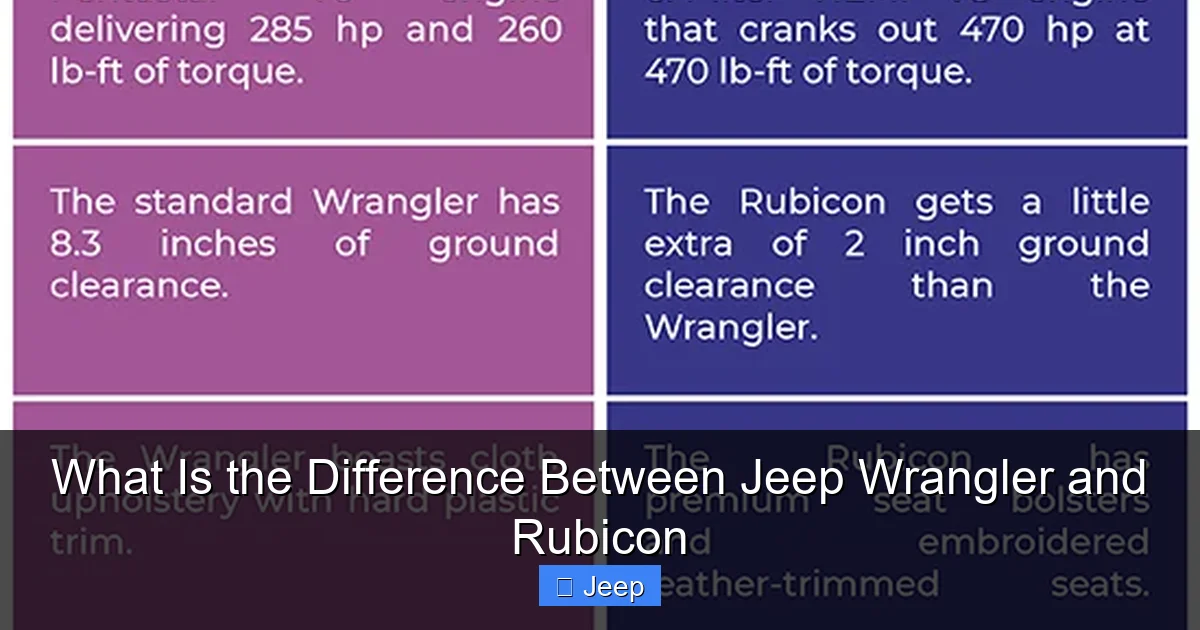
Under the hood, the choices are largely the same. Both Wrangler and Rubicon models are available with the standard 3.6L V6 engine (285 hp, 260 lb-ft of torque) and the Turbo 2.0L 4-cylinder (270 hp, 295 lb-ft). The high-performance 392 Hemi V6 (470 hp) is exclusively available on the Rubicon and Sahara trims. So, in terms of straight-line power and acceleration, a Rubicon with the same engine as a Sport Wrangler will feel identical on pavement.
Visual guide about What Is the Difference Between Jeep Wrangler and Rubicon
Image source: jeepoffroads.com
The differences become apparent in low-range gearing (the Rubicon’s 4.10s feel more torquey in 4-Lo) and in some subtle NVH (Noise, Vibration, Harshness). The Rubicon’s heavier-duty off-road tires are louder and less comfortable on long highway drives. Its stiffer suspension, while better for off-road control, can feel a bit more jiggly on rough pavement compared to the Sahara’s more comfort-oriented setup. Fuel economy, as mentioned in the key takeaways, is nearly identical because the core powertrain and vehicle weight are so similar. Your driving style and tire choice will affect MPG more than the trim badge.
Pricing, Value, and Target Audience
This is the practical reality check. The Rubicon’s extensive standard equipment comes at a significant premium. As of recent model years, the starting MSRP for a Rubicon is typically $10,000 to $15,000 higher than a base Sport Wrangler 2-door. You are essentially paying for thousands of dollars in off-road hardware that you may never fully use.
Visual guide about What Is the Difference Between Jeep Wrangler and Rubicon
Image source: jeepoffroads.com
Who is a standard Wrangler (Sport/Sahara) for? The buyer who loves the Wrangler’s iconic style, open-air experience, and light-to-moderate off-road capability. Think forest service roads, sandy beaches, muddy trails, and snowy mountains. They prioritize on-road comfort, daily drivability, and a lower entry price. The Sahara is perfect for someone who wants the Wrangler lifestyle with a much nicer interior and tech.
Who is a Rubicon for? The dedicated off-roader. The person who seeks out difficult rock gardens, technical climbs, and deep-water fordings. The Rubicon owner wants a vehicle that is already built to a high standard, requiring minimal modification to tackle serious trails. It’s for the enthusiast who plans to use every bit of its capability. The Rubicon’s higher initial cost can sometimes be offset by its exceptionally strong resale value; if you’re curious about long-term worth, our piece on how much a 1998 Jeep Wrangler is worth demonstrates the legendary value retention of the platform.
For those concerned about the financial commitment, exploring Jeep Wrangler lease deals can be a smart way to drive a new Rubicon for a lower monthly payment, though lease terms often have mileage restrictions that might not suit hardcore off-roaders.
Can You Make a Standard Wrangler a Rubicon?
This is a common question. The short answer is: yes, but not easily or cheaply. The aftermarket off-road world is massive for the Wrangler. You can certainly buy and install locking differentials, larger tires, suspension lifts, and stronger axles on a Sport Wrangler. However, you will be paying a premium for aftermarket parts and labor, and the result will likely cost more than the factory Rubicon’s price premium. More importantly, you lose the factory integration, warranty coverage on those modified components, and the engineering harmony that Jeep’s engineers build into the Rubicon from the ground up. The Rubicon’s axles, for instance, are specifically designed and built to handle the stress of its standard tires and lockers. Swapping in aftermarket lockers on a stock axle is a path to potential breakage. For most people, if you know you want that level of capability, buying the Rubicon from the start is the more sensible, reliable, and ultimately cost-effective path.
Conclusion: Which One Should You Choose?
The choice between a Jeep Wrangler and a Rubicon boils down to a very personal assessment of your intended use and budget. If your Wrangler dreams involve weekend camping on dirt roads, beach cruising, light trail rides, and making a statement with the top down, a Sport or Sahara Wrangler is an absolutely brilliant, capable, and more affordable choice. You’ll get 95% of the Wrangler experience for less money and often with a more comfortable ride.
However, if your heart beats for crawling over granite boulders, navigating steep, loose hill climbs, and tackling the most challenging trails in the country without hesitation, the Rubicon is the definitive factory tool for the job. It’s an investment in a no-compromise off-road machine that you can drive straight from the dealer to the trailhead and feel completely confident. The extra cost buys you a comprehensive, warrantied package of heavy-duty hardware that would be expensive and complex to replicate yourself.
Our strongest advice? Test drive both back-to-back. Drive a Sahara on the highway, then a Rubicon. Feel the difference in ride quality and hear the difference in tire noise. Then, if possible, take both on a moderate off-road course. You’ll immediately understand where that Rubicon premium is going. The Wrangler, in any trim, is a special vehicle. The Rubicon is simply the most extreme expression of that specialness, purpose-built for those who seek to use it to its absolute limit.
Frequently Asked Questions
Is the Rubicon just a Wrangler with bigger tires?
No. While the Rubicon does come with larger all-terrain tires, the differences run much deeper. It includes standard front and rear locking differentials, heavy-duty Dana 44 axles, a taller suspension with FOX shocks, and a disconnecting front sway bar—all mechanical parts not found on a standard Wrangler. These are fundamental hardware changes for extreme traction and articulation.
Is a Rubicon worth the extra money over a Sahara?
It depends entirely on your off-road goals. For a driver who will mostly stay on pavement and graded dirt roads, a Sahara offers far more comfort and features for the money. The Rubicon’s premium is for dedicated off-road hardware you may rarely use. If you plan to regularly tackle difficult rock crawls or technical trails, the Rubicon’s standard equipment is absolutely worth it, as adding it later to a Sahara would cost more.
Can a regular Wrangler go off-roading?
Absolutely. Even the base Sport Wrangler is one of the most capable off-road vehicles sold new today. Its solid axles, short wheelbase, and excellent approach/departure angles allow it to handle a huge range of terrain. The Rubicon simply extends that capability to the most extreme, low-traction scenarios like multi-rear axle articulation on huge boulders.
What is the main advantage of the Rubicon’s locking differentials?
Locking differentials mechanically connect both wheels on an axle, forcing them to turn at the same speed. This ensures that even if one wheel is completely off the ground or on ice, the wheel with traction still receives power. This is the single most effective tool for maintaining momentum in severe off-road conditions where a standard open differential would spin the lone wheel with no grip.
Which is better for daily driving and fuel economy?
A non-Rubicon Wrangler, especially the Sahara trim, is better for daily driving. It typically rides smoother, is quieter on the highway due to its all-season or smaller all-terrain tires, and often has a more refined interior. Fuel economy is nearly identical between a Wrangler and Rubicon with the same engine, as the weight and powertrain are very similar. The Rubicon’s more aggressive tires can slightly reduce MPG.
Does the Rubicon have more power than other Wranglers?
No. With the same engine choice (e.g., the 3.6L V6), a Rubicon produces identical horsepower and torque as a Sport or Sahara Wrangler. The only exception is the high-output 392 Hemi V6 engine, which is exclusively available on Rubicon and Sahara trims. The Rubicon’s advantage is in torque multiplication through its lower gear ratios and superior traction, not in raw engine power.