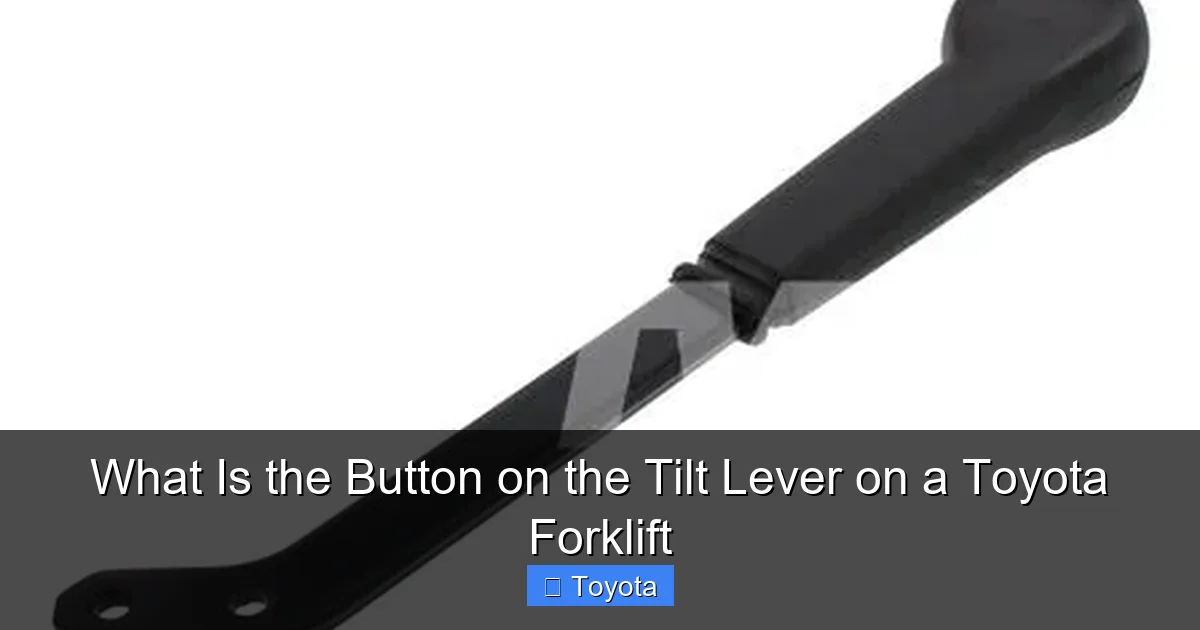
What Is the Button on the Tilt Lever on a Toyota Forklift

Contents
- 1 Key Takeaways
- 2 📑 Table of Contents
- 3 The Core Purpose: Precision and Safety in Your Hands
- 4 How It Works: A Journey Through the Hydraulics
- 5 Common Issues and Troubleshooting: When the Button Misbehaves
- 6 The Critical Importance of Proper Use: Beyond Just a Button
- 7 Maintenance and Best Practices: Keeping Your Button Reliable
- 8 Conclusion: The Small Button, Big Impact
- 9 Frequently Asked Questions


The button on the tilt lever of a Toyota forklift is a critical safety and control feature, typically used for fine-tuning tilt speed or engaging a neutral position. It prevents sudden mast movements, protects loads, and enhances operator precision. Proper use and maintenance of this button are essential for safe, efficient material handling and compliance with workplace safety standards.
If you’ve ever stepped into the cab of a Toyota forklift, you know it’s a command center of levers, pedals, and buttons. Each control has a specific, vital job. Among them, the tilt lever is your primary tool for raising and lowering the mast—the backbone of every lifting task. But nestled right on that lever, often within easy reach of your thumb or forefinger, is a small button. This isn’t just a random piece of plastic; it’s a sophisticated control that significantly impacts how you handle loads, your safety, and the longevity of your equipment. So, what is the button on the tilt lever on a Toyota forklift? Let’s pull back the curtain on this essential but often overlooked component.
In simple terms, this button is a secondary control that modifies the primary function of the tilt lever. While the main lever directs hydraulic fluid to tilt the mast forward or backward, the button adds a layer of modulation. Its core jobs are to enable fine, precise control for delicate tasks and to act as a safety interlock that prevents full, unrestricted tilt speed. Think of it like the difference between slamming a door and closing it softly with a doorstop—the button gives you that soft, controlled touch. For an operator, mastering this button is a key step in moving from simply operating a forklift to truly *controlling* it with skill and confidence.
Key Takeaways
- The button controls tilt speed or function: It often moderates hydraulic flow for smoother, more precise tilting operations.
- It is a primary safety feature: The button helps prevent accidental or jerky movements that could destabilize a load or the forklift itself.
- Location and design are ergonomic: Positioned for thumb or finger access on the lever, it allows operation without releasing the main grip.
- Failure requires immediate attention: A stuck, broken, or unresponsive button compromises control and must be repaired before operating the forklift.
- Function can vary by model and attachment: Its exact purpose may differ slightly between Toyota forklift series or when using specialized carriages.
- Regular inspection is part of pre-use checks: Operators should test the button during daily safety inspections to ensure proper functionality.
- It integrates with the hydraulic system: The button acts as a secondary control valve, modulating pressure to the tilt cylinders.
📑 Table of Contents
- The Core Purpose: Precision and Safety in Your Hands
- How It Works: A Journey Through the Hydraulics
- Common Issues and Troubleshooting: When the Button Misbehaves
- The Critical Importance of Proper Use: Beyond Just a Button
- Maintenance and Best Practices: Keeping Your Button Reliable
- Conclusion: The Small Button, Big Impact
The Core Purpose: Precision and Safety in Your Hands
At its heart, the button on the tilt lever exists to solve two fundamental problems in material handling: precision and safety. A hydraulic system is powerful and relatively binary—fluid flows or it doesn’t, leading to a mast that can tilt with significant force and speed. For many everyday jobs, like moving a pallet of uniform boxes across a smooth floor, that raw power is fine. But what about when you’re placing a fragile glass display onto a shelf? Or when you’re stacking unstable bags of grain? Sudden, full-speed tilting can shift the center of gravity, causing a load to swing, tip, or collapse. This is where the tilt lever button becomes your best friend.
Enabling Fine, Micro-Movements
When you press and hold the button while moving the tilt lever, you’re essentially telling the hydraulic system to restrict flow. This dramatically slows the tilt speed, often to a crawl. This “creep mode” allows for minute adjustments. You can nudge the mast forward an inch to perfectly seat a load on a rack or back-tilt just enough to settle a wobbly stack. Without this function, achieving such precision would require immense, fatigue-inducing finesse on the main lever, and even then, it’s nearly impossible to be that exact. It transforms a coarse tool into a delicate instrument.
Acting as a Mandatory Safety Interlock
On many Toyota forklift models, particularly those in higher capacity ranges or with specific attachments, the button serves as a mandatory interlock. In these systems, you must press and hold the button to engage any tilt function at all. This design philosophy ensures the operator is consciously engaging in a tilt action, reducing the chance of an accidental bump on the lever causing a dangerous movement. It’s a physical and mental pause button. Furthermore, in some configurations, the button might be linked to other systems; for instance, it might need to be engaged before the auxiliary hydraulic functions for a clamp or rotator become active, creating a logical sequence that prevents misuse. This integrated safety approach is a hallmark of Toyota’s engineering, focusing on preventing errors before they happen, much like how other Toyota vehicle systems, such as the Trac system, are designed to maintain control.
How It Works: A Journey Through the Hydraulics
To truly appreciate the button, it helps to understand the simple yet brilliant hydraulic ballet it conducts. Your Toyota forklift’s hydraulic system is a closed loop of pump, valves, cylinders, and fluid. The tilt lever is connected to a directional control valve. When you move the lever forward, that valve ports high-pressure fluid from the pump to the bottom of the tilt cylinders, extending them and tilting the mast forward. Pulling the lever back ports fluid to the top of the cylinders, retracting them and back-tilting the mast.
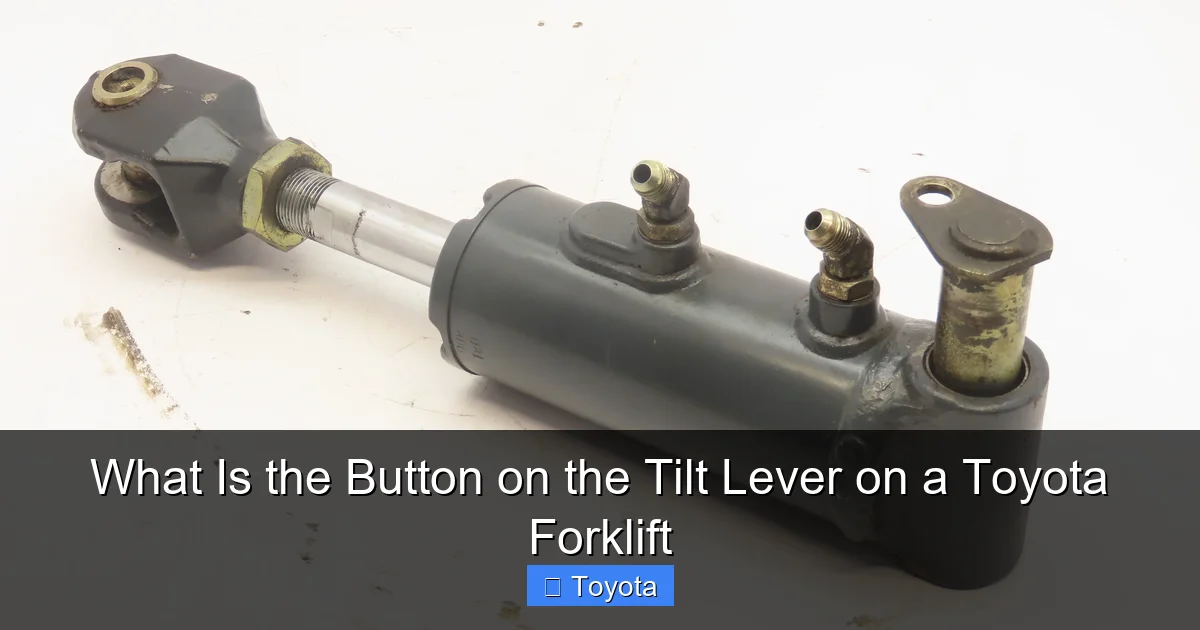
Visual guide about What Is the Button on the Tilt Lever on a Toyota Forklift
Image source: assets.mysuredone.com
The button on the lever doesn’t create this flow by itself. Instead, it’s connected to a secondary, smaller valve or a metering orifice within the main control valve assembly. When you depress the button, it mechanically or electrically (in more advanced models) actuates this secondary component. This secondary valve partially restricts the flow path, creating a bottleneck. Instead of a wide-open pipe, the hydraulic fluid must pass through a narrow aperture. This restriction reduces the volume of fluid moving per second, which directly translates to a slower, more controlled movement of the tilt cylinders. It’s a beautifully simple application of fluid dynamics to achieve a complex need for control. When you release the button, the restriction is removed, and full flow—and full tilt speed—returns.
Mechanical vs. Electronic Activation
On older or simpler Toyota forklift models, the button is a purely mechanical linkage. Pressing it physically pushes a rod that engages the metering valve. There are no electronics involved, which means exceptional reliability but also a direct, firm feel. On newer, more technologically advanced models, the button may be an electronic switch. Pressing it sends a signal to the forklift’s electronic control unit (ECU), which then commands a solenoid valve to create the flow restriction. This electronic approach allows for more programmable features, such as having different restriction levels based on the selected performance mode (e.g., a “Power” mode vs. an “Eco” mode), or integrating the function with other electronic safety systems. The feel might be a bit softer, but the principle remains the same: controlled restriction.
Common Issues and Troubleshooting: When the Button Misbehaves
Like any mechanical or electronic part, the tilt lever button can fail. Recognizing the symptoms and knowing how to respond is crucial for safety and preventing costly damage. A malfunctioning button isn’t just an inconvenience; it’s a direct compromise on your operational control.
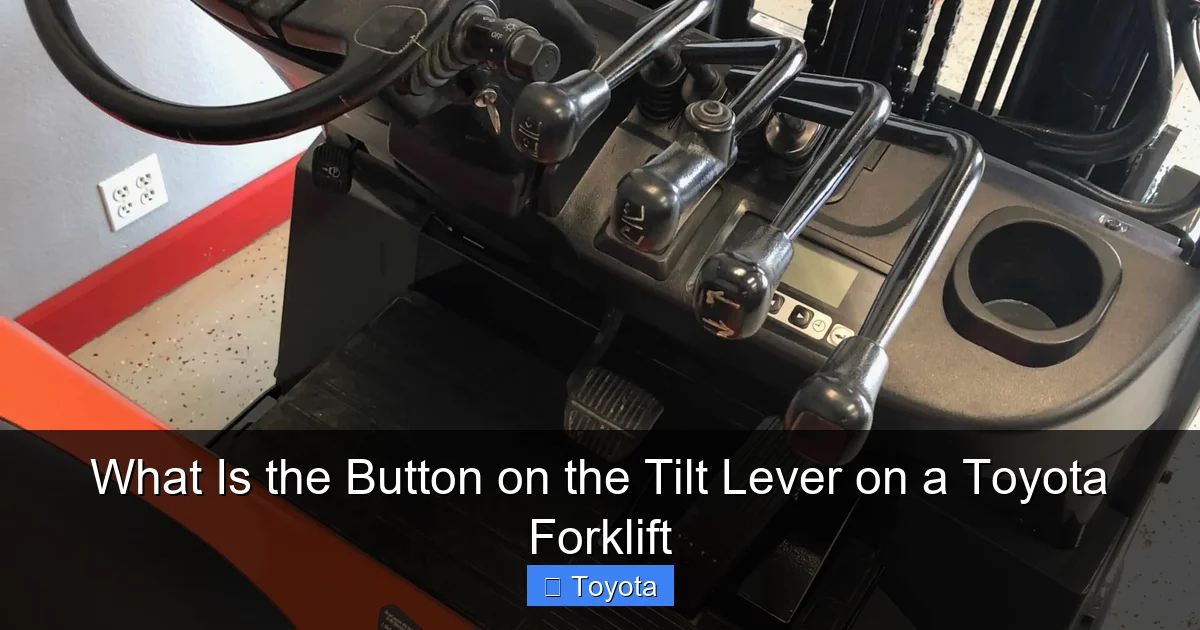
Visual guide about What Is the Button on the Tilt Lever on a Toyota Forklift
Image source: coronadoequipmentsales.com
Symptom: The Button is Stuck or Won’t Depress
This is often a mechanical issue. Debris, dust, or dried hydraulic fluid can gum up the button’s pivot point or the internal valve it operates. The button may feel gritty or simply refuse to move. Action: Do not force it. With the forklift off and the mast lowered, carefully clean around the button with a soft brush and a mild solvent. If it remains stuck, the internal valve may be corroded or the mechanical linkage bent. This requires a qualified technician to disassemble the lever control and clean or replace the components. Operating the forklift with a stuck button that’s supposed to be an interlock is unsafe and should never be done.
Symptom: The Button Has No Effect (Tilt Speed Doesn’t Change)
You can press the button, but the mast tilts at full speed regardless. This indicates the restriction mechanism isn’t engaging. For a mechanical button, the linkage may be disconnected or broken. For an electronic button, the switch itself might be failed, the wiring harness damaged, or the solenoid valve it controls is faulty. Action: Perform a visual inspection of the lever assembly for obvious broken parts. Check for any error codes on the forklift’s display if it’s an electronic system. This diagnosis typically requires a technician with a multimeter and schematics to test the circuit and valve operation.
Symptom: The Tilt Function Only Works When the Button is Pressed (On Interlock Models)
On forklifts where the button is a mandatory interlock, this is the correct, intended behavior. However, if the button becomes extremely sensitive—activating with the lightest touch or intermittently—it can be frustrating and unsafe. Action: The switch is likely failing or the adjustment mechanism is out of spec. The lever assembly will need adjustment or switch replacement. Never attempt to bypass or wire around this safety interlock; it exists for critical protection.
It’s important to remember that troubleshooting internal hydraulic valve components is complex. If you’re not a certified Toyota forklift technician, your best course of action upon detecting any issue is to tag the forklift “Do Not Operate” and contact your service department. For basic access to inspect the control lever assembly, you might need to refer to guides on how to open the hood on a Toyota forklift to reach the valve mounts or connections behind the operator’s console.
The Critical Importance of Proper Use: Beyond Just a Button
Understanding the button’s function is one thing; using it correctly is another. Proper technique with this control separates competent operators from experts and is a cornerstone of a safe workplace. Misuse or disregard for this control leads to damaged products, strained equipment, and a higher risk of accidents.
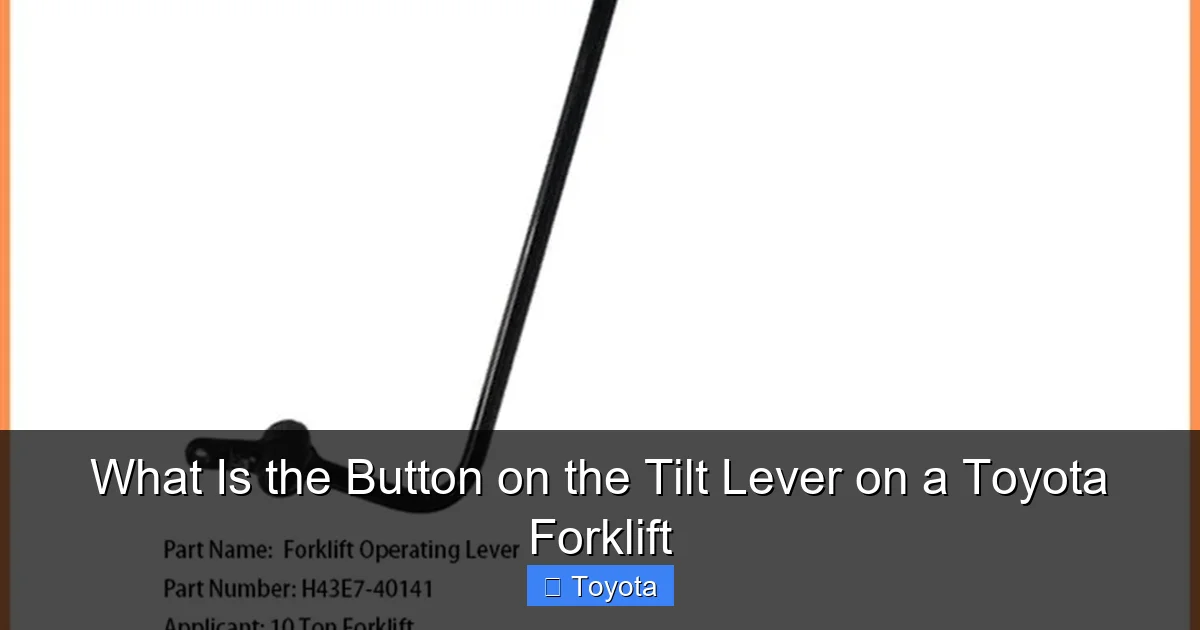
Visual guide about What Is the Button on the Tilt Lever on a Toyota Forklift
Image source: leadingforkliftparts.com
Protecting Your Load
Imagine you’ve just slid a pallet of electronics onto a rack. A full-speed back-tilt to free the forks could easily jolt the pallet, causing boxes to shift and products to fall. By using the button to execute a slow, deliberate back-tilt, you keep the load stable and secure. This is equally vital with bagged goods, barrels, or any load with a high center of gravity. The button gives you the finesse to “walk” the mast, not yank it.
Preserving Forklift Components
Full-speed tilting, especially when the mast is fully extended, puts immense shock loads on the tilt cylinders, pivot pins, and the mast structure itself. This hydraulic shock accelerates wear and can lead to premature failure of seals or even bent components. Using the button for smoother movement reduces this stress, extending the service life of some of the most expensive parts on your forklift. It’s a simple habit that saves thousands in repair costs over the life of the machine.
Enhancing Operator Comfort and Reducing Fatigue
Fighting the lever to make tiny adjustments without the slow-speed function is a workout for the arm and shoulder. It leads to fatigue over a long shift. The button allows for a relaxed grip and minimal effort for fine positioning. A comfortable operator is a more alert, productive, and safer operator. This focus on ergonomics is part of Toyota’s broader design philosophy, seen in the comfortable cabins and intuitive controls of their vehicles, from the Camry’s hold button to the forklift’s tilt lever.
Maintenance and Best Practices: Keeping Your Button Reliable
Your Toyota forklift is an investment, and like any investment, it needs regular care. The tilt lever button, while robust, is exposed to the elements, dust, and constant use. A proactive maintenance routine ensures it’s always ready when you need it.
Daily Pre-Use Inspection
This is non-negotiable. During your circle check, after checking fluid levels and tires, physically test the button. With the engine running and the mast at a safe height, gently tilt the mast forward and back using the lever while holding the button. You should feel and see a distinct difference in speed. The movement should be smooth and creep-like. Then, try tilting without the button to confirm normal speed returns. Listen for any unusual hydraulic noises (whining, grinding) during this test, as they could indicate a restriction or valve issue.
Regular Cleaning and Lubrication
Dust and grime are the enemies of any moving part. Periodically, with the forklift off and the key removed, clean around the base of the tilt lever and the button itself. Use a small brush and a lint-free cloth. Avoid spraying cleaners directly into the button gap; instead, apply to the cloth. For mechanical linkages, a technician may apply a tiny amount of specified lubricant to pivot points during scheduled service—never use WD-40 or general oils, as they can attract more dirt.
Professional Scheduled Service
During your forklift’s regular maintenance intervals (e.g., every 500 hours), a certified technician will perform a deeper inspection. This includes checking the internal valve stack for wear, testing solenoid operation on electronic models, and verifying the correct pressure settings for the slow-speed circuit. They will also inspect the lever assembly for cracks or fatigue. This is your opportunity to address developing issues before they cause downtime. Always use genuine Toyota parts for any replacements to ensure compatibility and reliability.
Conclusion: The Small Button, Big Impact
So, what is the button on the tilt lever on a Toyota forklift? It is the embodiment of controlled power. It’s the difference between brute force and skilled craftsmanship. It’s a safeguard for your loads, your equipment, and yourself. While it may seem like a minor detail in the grand scheme of the machine, its impact on daily operational safety, efficiency, and cost of ownership is enormous. Understanding its purpose, recognizing signs of trouble, and committing to its proper use and maintenance is what separates a routine operator from a true professional. The next time you place your hand on that lever, remember that small button under your thumb—it’s your direct line to precision, safety, and mastery over the load. Treat it with respect, inspect it regularly, and use it wisely. Your back, your product, and your forklift will thank you for it.
Frequently Asked Questions
What does the button on the tilt lever of a Toyota forklift do?
It reduces the tilt speed for precise, controlled movements, which is essential for placing delicate loads or making fine adjustments. On some models, it also acts as a mandatory safety interlock that must be pressed to initiate any tilt function.
What happens if the tilt lever button is broken or stuck?
If broken, you lose slow-speed control, making precise work difficult and increasing the risk of load damage. If it’s a mandatory interlock model and stuck “in,” you may not be able to tilt at all. If stuck “out,” you lose the interlock safety feature. In any case, the forklift should be taken out of service until repaired by a technician.
Is the function of this button the same on all Toyota forklift models?
The core purpose of providing slow-speed control is consistent. However, the exact implementation—whether it’s purely mechanical, electronic, or a mandatory interlock—can vary by forklift series, capacity, and year of manufacture. Always consult your specific model’s operator manual.
Can I operate the forklift without using the tilt lever button?
For non-interlock models, you *can* operate without using it, but you will sacrifice all precision and safety benefits. For interlock models, you *cannot* operate the tilt function without engaging the button. Even on non-interlock models, using the button for slow tilking is a best practice for load protection.
How do I test if my tilt lever button is working correctly?
During your pre-use inspection, with the mast at a safe height, tilt forward and back while holding the button. The movement should be significantly slower than when you tilt without pressing it. The change should be immediate and consistent in both directions.
Is a stuck tilt lever button a common problem, and how is it fixed?
It can occur due to dirt, debris, or dried fluid ingress. Fixing it usually involves carefully cleaning and lubricating the lever mechanism or, in more severe cases, replacing the internal valve or the entire lever assembly. This is a standard repair for a qualified service technician.