
What Is the Blue Book Value of a 2018 Toyota Camry Le

The Blue Book value for a 2018 Toyota Camry LE is not a single number but a range typically between $14,500 and $19,500, depending heavily on mileage, condition, and your geographic location. Kelley Blue Book (KBB) calculates this value by analyzing millions of sales transactions and market trends to provide a realistic price for private party sales, trade-ins, and certified pre-owned purchases. To get the most accurate estimate for your specific car, you must honestly assess its condition and input precise details into KBB’s online tool, as a well-maintained, low-mileage example will command a price at the top of the range, while a high-mileage vehicle with wear will be at the bottom.
Key Takeaways
- Value is a Range, Not a Fixed Number: The 2018 Camry LE’s Blue Book value varies significantly based on mileage, overall condition (from Excellent to Fair), and your local market demand.
- Three Main Price Points: KBB provides separate values for Private Party (what you’ll likely selling for), Trade-In (what a dealer offers), and Certified Pre-Owned (retail price at a dealership).
- Condition is King: A car with a clean history, full service records, and no cosmetic damage in “Excellent” condition can be worth $2,000-$3,000 more than the same car in “Good” or “Fair” condition.
- Mileage Matters Greatly: The national average mileage is about 13,500 miles per year. A 2018 Camry with 60,000 miles will be valued much higher than an identical one with 100,000 miles.
- Location Impacts Price: Values are higher in regions where sedans are in greater demand (e.g., suburban and urban areas) compared to areas where trucks and SUVs dominate.
- Use KBB as a Negotiation Tool: Whether buying or selling, the KBB value is a powerful starting point for negotiations, but be prepared to justify your price with the car’s specific features and history.
- Get a Vehicle History Report: For any used 2018 Camry LE, a report from Carfax or AutoCheck is essential. A clean report supports a higher price, while any accident history can drastically reduce value.
📑 Table of Contents
- Introduction: More Than Just a Number
- What Exactly *Is* the Blue Book? Demystifying Kelley Blue Book
- What’s the Actual Number? A 2018 Toyota Camry LE Value Breakdown
- How to Get Your Own Accurate Blue Book Value: A Step-by-Step Guide
- Beyond the Blue Book: Other Tools and Real-World Considerations
- Selling or Buying? Actionable Strategies Using the Blue Book Value
- Conclusion: Your Blue Book Value is Your Negotiation Foundation
Introduction: More Than Just a Number
So, you’re looking at a 2018 Toyota Camry LE. Maybe you’re thinking about selling yours, or perhaps you’re in the market to buy one. Either way, the first question that pops up is, “What’s it worth?” That’s where the legendary “Blue Book” comes in. But here’s the thing: the Blue Book value isn’t a magic figure pulled from thin air. It’s a sophisticated, data-driven estimate designed to give you a realistic price range in an often confusing used car market. For a perennial favorite like the Toyota Camry, which is known for its reliability and strong resale value, understanding this number is your secret weapon. This guide will walk you through everything you need to know about the Blue Book value for a 2018 Toyota Camry LE, from how the number is calculated to how you can use it to get the best possible deal, whether you’re on the buying or selling side of the transaction.
What Exactly *Is* the Blue Book? Demystifying Kelley Blue Book
When people say “Blue Book value,” they are almost always referring to the valuation from Kelley Blue Book. Founded in 1926, KBB started as a printed guide for dealers. Today, it’s a massive online database and analytics powerhouse. Their core mission? To track actual vehicle sales data from across the country and use that information to predict what a car should sell for. They don’t guess; they analyze millions of transactions each month, factoring in make, model, year, trim, mileage, condition, and regional demand. For a 2018 Toyota Camry LE, this means KBB looks at what similar Camrys with similar miles in your zip code actually sold for recently.

Visual guide about What Is the Blue Book Value of a 2018 Toyota Camry Le
Image source: file.kelleybluebookimages.com
The Five Pillars of a KBB Estimate
When you input your vehicle’s information into the KBB valuation tool, the algorithm considers five critical factors:
- Vehicle Details: Year, make, model, and exact trim (LE, SE, XLE, etc.). The 2018 Camry LE is the base model, so its value starts lower than the sportier SE or premium XLE trims.
- Mileage: This is a huge variable. A car with 30,000 miles will have a significantly higher value than one with 90,000 miles, all else being equal.
- Condition: You must honestly rate your car from “Excellent” down to “Fair.” This includes mechanical soundness, interior and exterior wear, and any damage or needed repairs.
- Equipment & Options: Did your LE have the optional moonroof, upgraded audio system, or navigation? These add value. Standard features like Toyota Safety Sense™ (TSS-P) are already factored in but note any additional packages.
- Location (Zip Code): A 2018 Camry LE might be in higher demand and sell for more in a densely populated area with high used car prices than in a rural region where pickup trucks rule the road.
The Three Values You Need to Know
KBB doesn’t give you one price; it gives you three, each for a different selling scenario. Understanding the difference is crucial:
- Private Party Value: This is what you can realistically expect to get if you sell the car yourself to an individual. It’s the highest of the three values because there’s no dealer overhead or profit margin. This is the number most people think of when they ask for the “Blue Book value.”
- Trade-In Value: This is what a dealership will offer you for your car as a trade-in towards a new purchase. It’s lower than the private party value because the dealer must recondition the car, warrant it, and make a profit when they resell it. This value is what you’d see on a dealership’s appraisal sheet.
- Certified Pre-Owned (CPO) Value: This is the suggested retail price for a 2018 Camry LE that has been reconditioned by a Toyota dealer to meet strict CPO standards and comes with an extended warranty. It’s the highest value, reflecting the added peace of mind and dealer backing.
What’s the Actual Number? A 2018 Toyota Camry LE Value Breakdown
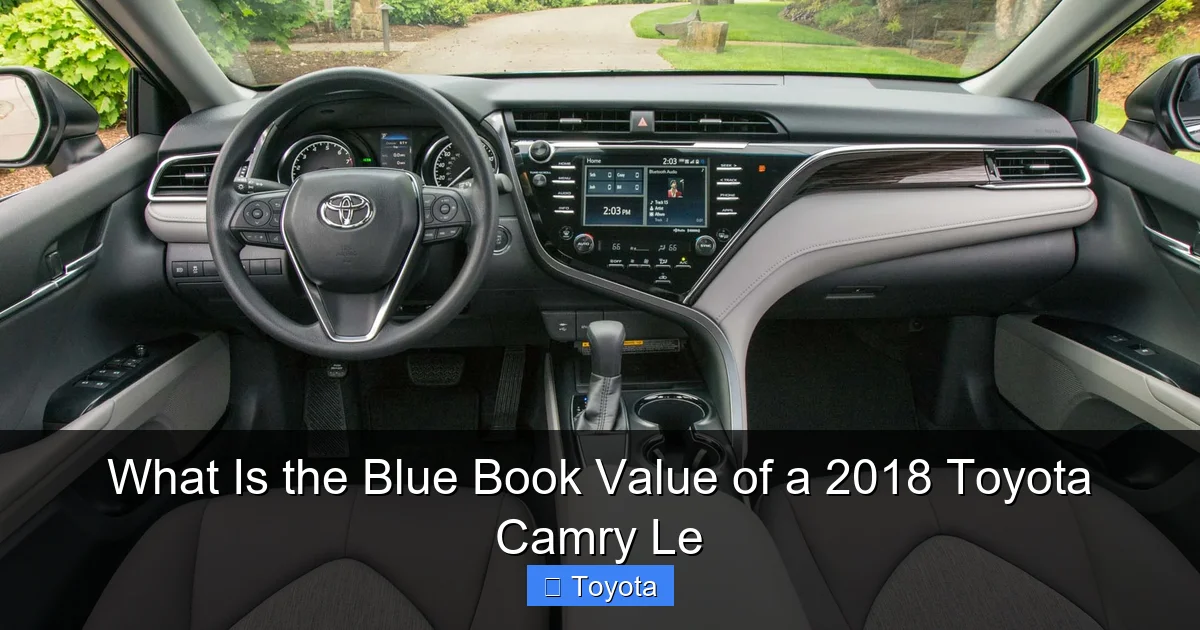
Now, for the meat of the question. As of early 2024, the KBB values for a base 2018 Toyota Camry LE with a 2.5L 4-cylinder engine and automatic transmission look like this, assuming average mileage (roughly 12,000-15,000 miles per year, so 60,000-75,000 miles) and “Good” condition (normal wear and tear, no major issues):
Visual guide about What Is the Blue Book Value of a 2018 Toyota Camry Le
Image source: st.motortrendenespanol.com
- Private Party Value: Approximately $16,500 – $17,500
- Typical Trade-In Value: Approximately $14,500 – $15,500
- CPO Retail Value: Approximately $18,500 – $19,500
But these are just starting points. Let’s see how the value shifts with real-world scenarios.
Scenario 1: The Pristine, Low-Mileage Gem
Imagine a 2018 Camry LE with only 40,000 miles, a clean Carfax, full service records from a Toyota dealer, and immaculate interior and exterior. It’s in “Excellent” condition. This car is a catch. Its value jumps because it’s essentially a 4-year-old car with the wear of a 3-year-old. For this example:
- Private Party Value: Could reach $18,000 – $19,000.
- Trade-In Value: A dealer might pay $16,500 – $17,500 because they know they can easily retail it as a CPO or premium used unit.
Pro Tip for Sellers: If you have this car, you can confidently price it at the top of the private party range. Document everything—service records, original window sticker, photos—to justify your premium asking price.
Scenario 2: The Average, Well-Maintained Daily Driver
This is the most common case: a 2018 Camry LE with 70,000 miles, regular oil changes, maybe a minor door ding, and normal seat and steering wheel wear. It’s in “Good” condition, mechanically sound with no warning lights. This is your baseline:
- Private Party Value: $16,000 – $17,000
- Trade-In Value: $14,500 – $15,500
Pro Tip for Buyers: Use this range as your anchor. Start negotiations for a private sale around $16,000, but be ready to pay a little more for a certified pre-owned version at a dealership, which will be in the $18,000-$19,000 range but includes a warranty and inspection.
Scenario 3: The High-Mileage or “Needs Work” Example
Now, consider a 2018 Camry LE with 120,000 miles. The tires are original, the interior is stained, and it has a few dents. Maybe the check engine light is on for a minor issue. This falls into “Fair” or even “Poor” condition. Value drops off a cliff here:
- Private Party Value: Might be as low as $12,000 – $14,000, depending on the exact issues.
- Trade-In Value: A dealer might offer $10,500 – $12,000 or simply decline to make an offer.
Cautionary Note: For cars in this bracket, the KBB value becomes less reliable. You must get a pre-purchase inspection from a trusted mechanic to uncover any expensive hidden problems. The value is based on what the car is worth *as-is*.
How to Get Your Own Accurate Blue Book Value: A Step-by-Step Guide
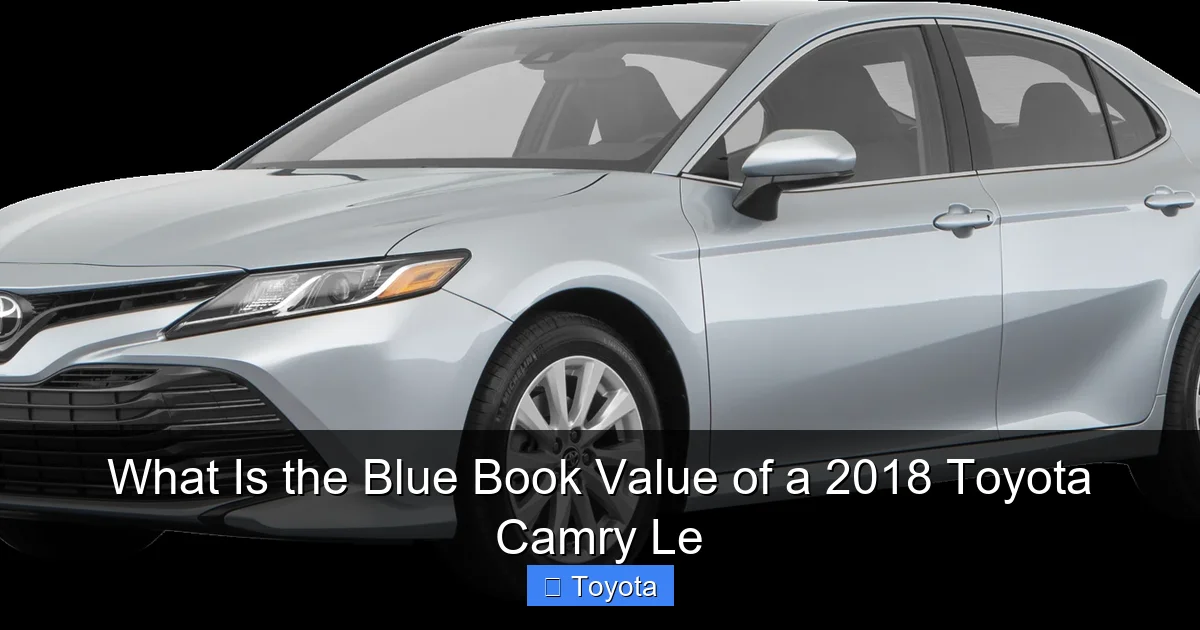
Don’t just take our word for it. Getting your personalized estimate is fast, free, and essential. Here’s how to do it right.
Visual guide about What Is the Blue Book Value of a 2018 Toyota Camry Le
Image source: file.kelleybluebookimages.com
Step 1: Gather Your Vehicle’s Exact Information
Before you go to the KBB website, have this info ready:
- VIN (Vehicle Identification Number): Found on the driver’s side dashboard or door jamb. The VIN tells KBB the exact factory options.
- Current Mileage: Be precise.
- Zip Code: Use the zip code where the car will be sold or titled.
- Honest Condition Assessment: This is the hardest part. Read KBB’s condition definitions carefully. “Excellent” means the car looks and drives like new, with no cosmetic defects and all maintenance up to date. “Good” means normal wear for its age. “Fair” means significant wear, damage, or mechanical issues.
Step 2: Navigate and Input Data
Go to KelleyBlueBook.com. Use the main “Price a Car” or “My Car’s Value” tool. Select “2018,” “Toyota,” “Camry,” and then “LE.” Input your VIN or manually select engine (2.5L 4-cylinder is standard) and any known options. Enter your mileage and zip code.
Step 3: The Critical Condition Selection
This is where people cheat themselves. You might think your car is “Excellent,” but does it have a single door scratch? A worn driver’s seat bolster? If so, it’s likely “Very Good” or “Good.” Be brutally honest. The difference between “Excellent” and “Good” can be $1,500 or more. If you’re unsure, lean toward the lower rating. It’s better to be pleasantly surprised than disappointed later.
Step 4: Review and Compare All Three Values
KBB will present you with a range for Private Party, Trade-In, and CPO. Look at the low, average, and high ends of each range. The “Typical” value is your best benchmark. Also, pay attention to the “Instant Cash Offer” option—this is a guaranteed offer from a local dealer, which can be a quick way to sell but is often at the lower end of the trade-in range.
Beyond the Blue Book: Other Tools and Real-World Considerations
KBB is the industry standard, but it’s not the only tool. Smart buyers and sellers cross-reference.
Cross-Checking with Edmunds and NADA
Edmunds uses a different algorithm that includes more dealer transaction data and often provides a “True Market Value” (TMV) that can be slightly lower or higher than KBB. NADAguides (from the National Automobile Dealers Association) is heavily used by dealers and often shows higher “Clean Retail” and “Clean Trade-In” values. Checking all three gives you a value spectrum. For our 2018 Camry LE, you might find KBB’s private party at $16,800, Edmunds at $16,500, and NADA at $17,200. The consensus is your sweet spot.
The Power of Local Listings
This is your most important real-world check. Go to Autotrader, Cars.com, and Facebook Marketplace. Search for 2018 Toyota Camry LE models in your zip code and within 100 miles. Filter by mileage and condition. What are they actually listed for? What have they been on the market for? A car listed at $18,000 that’s been there for 60 days is probably overpriced. One listed at $16,500 that sold in a week was likely priced right. This live market data trumps any book value. It tells you what buyers in your specific area are willing to pay right now.
Understanding Depreciation and Market Trends
All cars depreciate, but the Camry does it slowly. The biggest drop happens in the first 2-3 years. By year 5 (2023 for a 2018 model), depreciation starts to flatten. However, market forces can cause temporary spikes or dips. During times of economic uncertainty or high gas prices, fuel-efficient sedans like the Camry can see increased demand and slightly higher values. Conversely, a booming SUV market can suppress sedan prices. Always consider the current economic climate when using your Blue Book value as a baseline.
Selling or Buying? Actionable Strategies Using the Blue Book Value
Knowing the number is one thing; using it effectively is another.
For the Seller: Pricing to Sell, Not to Sit
If you’re selling your 2018 Camry LE, start with your KBB “Private Party” value for your specific condition and mileage. Let’s say it’s $17,000. Now, look at your local comps. If most similar cars are listed at $17,500, you might price yours at $17,200 and highlight why it’s a better value (newer tires, full service history). If they’re all at $16,800, you need to price at $16,900 or lower to be competitive. Always price your car slightly above what you want to leave room for negotiation. Buyers expect to haggle. A car priced at “firm” KBB average will attract lowball offers. In your listing, mention you’re priced according to KBB—it adds credibility. Also, if your Camry has a feature covered in another article, like the gas tank size, mentioning its efficiency can be a selling point that supports your price.
For the Buyer: Negotiating from a Position of Knowledge
As a buyer, your goal is to pay less than the KBB “Private Party” value. Find the car you want, get its VIN, and run your own KBB check before you ever call the seller. If they’re asking $18,000 for a car with a KBB range of $16,000-$17,500, you have a strong case to offer $16,500. Use the KBB printout as a tool. Say, “I’m a cash buyer, but my research shows the Blue Book value for this car in this condition is $X. Can you do better?” For dealer purchases, the KBB “Trade-In” value is your starting point. If they offer you $14,000 for your trade, but KBB says $15,500, counter with the KBB printout and ask for $15,000. They will often meet you in the middle. Remember, a dealer’s initial offer is almost never their best offer.
The Certified Pre-Owned (CPO) Advantage
If buying from a Toyota dealer, a CPO 2018 Camry LE will cost more—often 5-10% over a standard used car. But you get a 7-year/100,000-mile limited warranty (from the original in-service date), a 150+ point inspection, and roadside assistance. For a car that’s already 6 years old, that remaining warranty can be worth the premium. The KBB CPO value gives you a fair retail price for this package. Compare it to a non-CPO car with similar miles that’s $1,500 cheaper. Ask yourself: is the warranty worth the extra cost? For a reliable car like the Camry, many buyers decide the extra cost isn’t necessary, but for peace of mind, it can be.
Conclusion: Your Blue Book Value is Your Negotiation Foundation
So, what is the Blue Book value of a 2018 Toyota Camry LE? It’s a dynamic, educated estimate that sits somewhere in the $14,500 to $19,500 spectrum, shaped by your car’s unique story—its miles, its maintenance, its scratches, and its location. It is not an appraisal, nor is it a guaranteed sale price. It is, however, the most respected and widely used benchmark in the automotive industry. By understanding how it’s calculated, honestly assessing your own vehicle, and cross-referencing with live local listings, you transform that number from a vague suggestion into a powerful negotiation tool. Whether you’re walking into a dealership with a trade-in or listing your car online for a private sale, walking in with your KBB knowledge means you’re no longer guessing. You’re negotiating from a position of strength. Now, go get that fair price.
Frequently Asked Questions
How often does Kelley Blue Book update its values?
KBB updates its values weekly based on the latest sales data and market trends. This means the value of your 2018 Camry LE can fluctuate slightly from month to month based on supply, demand, and seasonal factors.
What’s the real difference between Private Party and Trade-In value?
The Private Party value is what you can expect selling to an individual, with no dealer warranty or reconditioning costs factored in. The Trade-In value is what a dealer will offer you; it’s lower because the dealer must cover the cost of inspecting, reconditioning, warrantying, and ultimately reselling the car for a profit.
Will an accident on the Carfax lower the Blue Book value?
Yes, significantly. KBB’s condition assessment includes vehicle history. A reported accident, even if properly repaired, typically moves a car from “Good” to “Fair” condition in their system, which can reduce the value by 10-20% or more. Minor, unreported cosmetic damage has less impact than a major structural repair.
How does the Camry LE’s value compare to the SE or XLE trims?
The LE is the base model, so it has the lowest starting value. The sportier SE trim, with its black exterior accents, sport seats, and paddle shifters, typically commands a $1,000-$1,500 premium over a comparable LE. The premium XLE, with leather seats, sunroof, and more advanced features, can be $2,000-$3,000 higher than the LE for the same year and mileage.
Can I use the Blue Book value for insurance or tax purposes?
For insurance “actual cash value” (ACV) settlements, insurers use their own proprietary valuation systems, which may differ from KBB. For tax purposes when donating a car, the IRS may require an independent appraisal or use the vehicle’s fair market value, where a KBB estimate can be a supporting document, but it’s not the sole determinant.
My 2018 Camry LE has aftermarket parts. Does that affect the value?
It can, but not always positively. High-quality, professional upgrades like a premium sound system or performance suspension can add value for the right buyer. However, cheap modifications, especially those that alter the engine or drivetrain, can actually *decrease* value for most mainstream buyers who prefer stock, reliable cars. Always remove personal modifications before selling to get the best standard Blue Book value.
