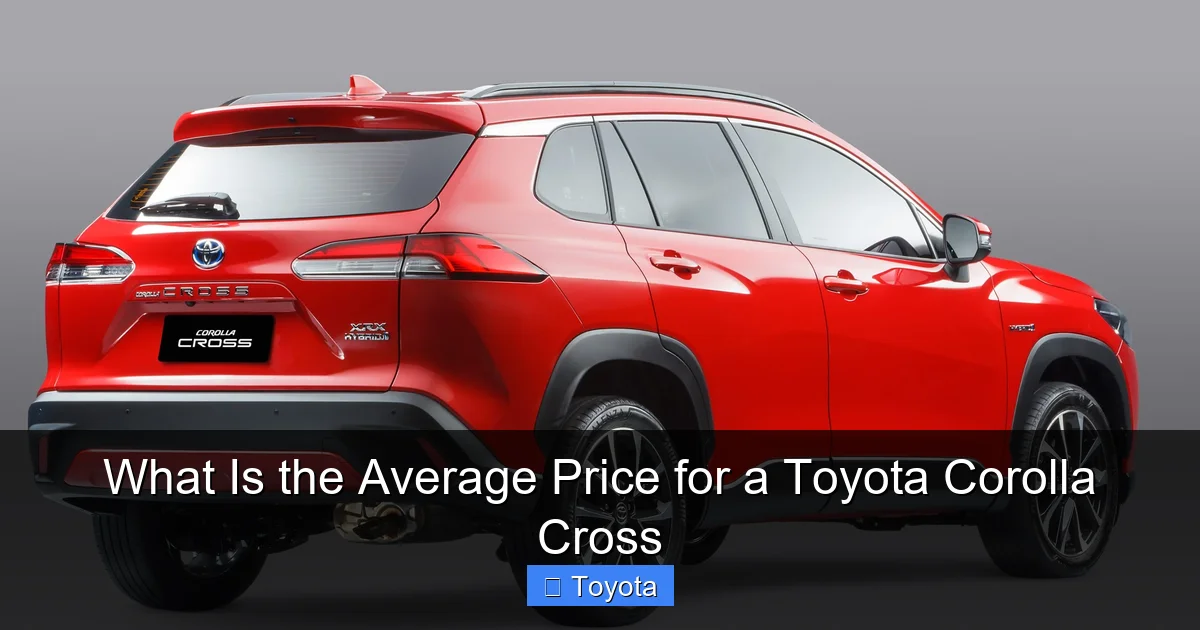
What Is the Average Price for a Toyota Corolla Cross

Contents
- 1 Key Takeaways
- 2 📑 Table of Contents
- 3 Understanding the Sticker: MSRP vs. Real-World Cost
- 4 Factors That Change the Price: Options, Packages, and Fees
- 5 How to Find the True “Average” Transaction Price
- 6 Smart Buying Strategies: How to Get the Best Price
- 7 The Used Corolla Cross: A Path to Even Greater Value
- 8 Conclusion: Your Next Step
- 9 Frequently Asked Questions

Car Body Cover

Engine Flush Cleaner

Trunk Organizer

Liquid Car Polish
The average price for a new Toyota Corolla Cross typically ranges from $23,000 to $33,000 MSRP, depending heavily on the trim level and optional packages. The base L model starts around $23,000, while the top-tier XSE AWD can exceed $32,000. Final out-the-door costs are higher due to destination fees, taxes, and dealer-installed options. Understanding these price tiers and doing thorough research is key to finding the right value.
So, you’re eyeing the Toyota Corolla Cross. It’s easy to see why. It packs the legendary Toyota reliability and hybrid efficiency (in some models) into a compact, SUV-like package that’s perfect for city streets and weekend adventures. But before you fall in love with the sleek lines or the spacious interior, the big question comes up: “What is the average price for a Toyota Corolla Cross?” It’s a smart question, but the answer isn’t a single number. Think of it more as a price spectrum. In this complete guide, we’ll slice and dice every factor that influences the cost of a new or used Corolla Cross. We’ll break down the MSRP by trim, explore how options change the math, and talk about the real-world “out-the-door” price you’ll actually pay. By the end, you’ll know exactly what to expect and how to negotiate like a pro.
Key Takeaways
- Base Price Range: The 2024 Toyota Corolla Cross has a manufacturer’s suggested retail price (MSRP) starting near $23,000 for the front-wheel-drive L trim and reaching approximately $32,000-$33,000 for the fully-equipped XSE AWD.
- Trim Levels Dictate Price: Price increases step-wise through the trims: L (base), LE, S, and XSE (top). Each successive trim adds significant features and cost, typically a $2,000-$3,000 jump.
- AWD is a Major Cost Add-On: Adding all-wheel drive (AWD) to compatible trims (LE, S, XSE) costs an additional $1,400-$1,600 over the front-wheel-drive version.
- The “Average” is a Moving Target: The national average transaction price often exceeds the MSRP “average” due to high demand, dealer markups on popular trims, and the near-universal addition of destination freight charges (~$1,300).
- Options and Packages Inflate Price Rapidly: Popular option packages (like the Convenience Package or Audio Package) can add $1,000-$2,500. Individual options like a sunroof or premium audio also increase cost substantially.
- Destination Fee is Non-Negotiable: All MSRP figures exclude the mandatory destination and delivery charge, which is approximately $1,300 and must be added to the vehicle’s base price.
- Used Market Offers Significant Savings: A lightly used 2023 Corolla Cross can be found for 10-15% below the new MSRP of a comparable 2024 model, providing excellent value.
📑 Table of Contents
Understanding the Sticker: MSRP vs. Real-World Cost
Let’s get our terminology straight first. The Manufacturer’s Suggested Retail Price (MSRP) is the number Toyota puts on the window sticker. It’s a starting point. The “average price” people often quote is a simple average of all those starting MSRPs across the lineup. But here’s the catch: almost no one pays just the MSRP. You have the mandatory destination charge (about $1,300), which is added on top. Then there are taxes, title, and license fees, which vary wildly by state. On top of that, dealers often add market adjustment fees or mandatory packages for high-demand vehicles, though the Corolla Cross is generally not subject to extreme markups. The number you write a check for is the “out-the-door” (OTD) price. Our “average” discussion will cover the MSRP range first, then we’ll talk about what pushes that final number up.
The 2024 Model Year Lineup and Pricing
For the 2024 model year, Toyota offers the Corolla Cross in four main trims: L, LE, S, and XSE. Both front-wheel drive (FWD) and all-wheel drive (AWD) are available on most trims. There is also the Corolla Cross Hybrid, which is its own separate, slightly more expensive lineup with different trim names (LE, S, XSE). For clarity, we’ll focus on the gas-powered models first, then touch on the hybrid premium.
- Toyota Corolla Cross L FWD: Starting MSRP ~$23,210. This is your bare-bones model. It comes well-equipped with Toyota Safety Sense 3.0, an 8-inch infotainment screen, and Apple CarPlay/Android Auto. It’s a fantastic value proposition.
- Toyota Corolla Cross LE FWD: Starting MSRP ~$25,110. The LE adds keyless entry, push-button start, a power driver’s seat, and additional USB ports. It’s the popular “sweet spot” for many buyers.
- Toyota Corolla Cross S FWD: Starting MSRP ~$27,210. The S trim focuses on style with a unique front grille, black exterior accents, and sportier interior details like synthetic leather (SofTex) seats.
- Toyota Corolla Cross XSE FWD: Starting MSRP ~$29,910. The top trim adds a power moonroof, premium JBL audio, heated front seats, and a digital key.
Adding AWD to the LE, S, or XSE costs an additional $1,400. You cannot get AWD on the base L trim. So, the absolute highest MSRP you can build on a non-hybrid Corolla Cross is an XSE AWD, which starts at about $31,310 before any options.
The Hybrid Premium: Is It Worth It?
The Corolla Cross Hybrid is a compelling alternative. It uses a 2.0-liter four-cylinder engine paired with an electric motor for a combined 196 horsepower and excellent fuel economy (an EPA-estimated 50 mpg combined). The hybrid models have their own trim structure: LE, S, and XSE. Their starting MSRPs are about $2,000 higher than their gas counterparts.
- Corolla Cross Hybrid LE FWD: Starts ~$27,750
- Corolla Cross Hybrid XSE FWD: Starts ~$31,750
All hybrids are FWD only; there is no AWD hybrid variant. So, the “average” price shifts upward if you’re shopping the hybrid lineup. The $2,000 premium can be recouped in fuel savings over time, especially for high-mileage drivers, but you must do the math based on your local gas prices and annual mileage.
Factors That Change the Price: Options, Packages, and Fees
This is where the sticker price starts to balloon. Toyota offers several option packages, especially on the mid and upper trims. Let’s look at what’s available and how it affects your bottom line.
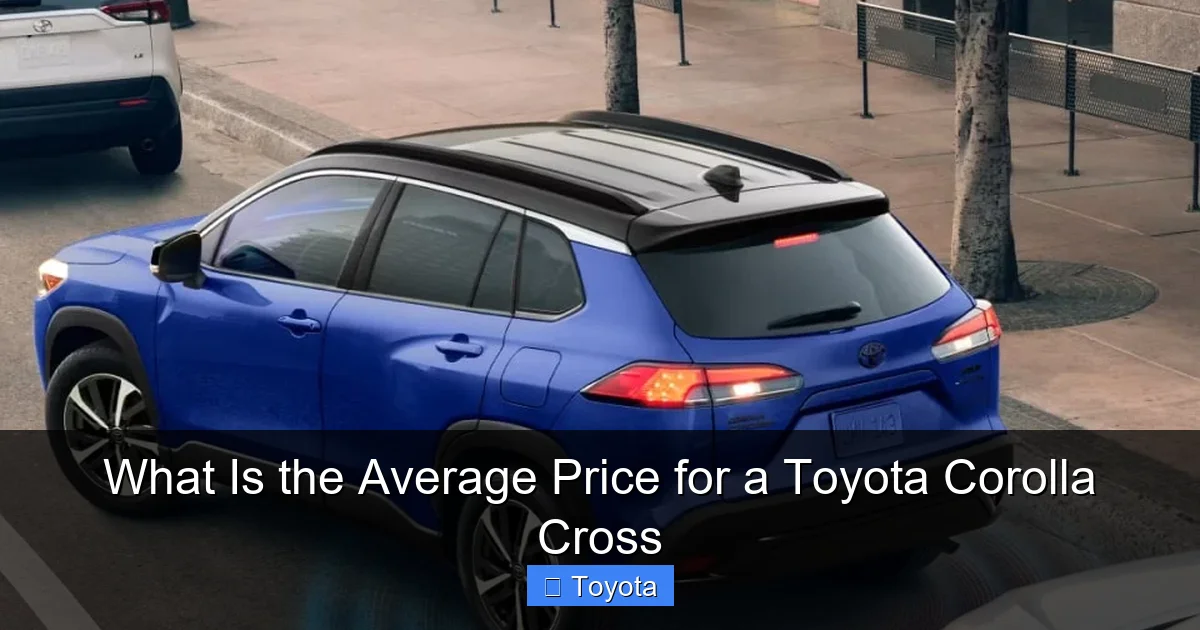
Visual guide about What Is the Average Price for a Toyota Corolla Cross
Image source: garagem360.com.br
Popular Option Packages
For the 2024 gas models, two packages are particularly common on dealer lots:
- Convenience Package ($1,000 – $1,200): Often bundled on LE and S trims. It typically adds a power rear liftgate with kick sensor, a 360-degree camera system, and a digital key. It’s a very popular and useful bundle.
- Audio Package ($1,500 – $1,800): Available on LE and S, this adds the premium JBL audio system and a wireless charging pad. Note that the XSE already includes the JBL system as standard.
The Hybrid models have similar package structures. Choosing a package is rarely a “per-item” decision; dealers often pre-install them on vehicles to increase profit, a practice called “dealer accessorizing.” This is a key negotiation point.
Standalone Options and Accessories
You can also add items à la carte. A panoramic moonroof (if not already included), all-weather floor mats, roof rails, or a tow hitch are common. These can add hundreds to thousands. Be ruthless here. Do you *need* the $500 carpeted floor mats, or will the $150 rubber ones work just fine? This is your money, and every option adds to the final finance payment or total cost.
The Unavoidable Fees
Remember the destination charge? It’s about $1,300 and is part of the MSRP calculation but listed separately. Then come the state-mandated fees: sales tax (which can be 6-10% of the vehicle price), registration, title, and license plates. These are not negotiable with the dealer but are part of your OTD cost. Always ask the dealer for an OTD quote early in your conversations.
How to Find the True “Average” Transaction Price
Websites like Kelley Blue Book (KBB) and Edmunds track what people are actually paying for cars. Their “Average Paid” or “Market Price” data is more useful than the MSRP average. As of early 2024, for the Corolla Cross:

Visual guide about What Is the Average Price for a Toyota Corolla Cross
Image source: images.carexpert.com.au
- Base L FWD models often sell at or very near MSRP.
- Mid-trim LE and S models with common packages might sell for 1-3% above MSRP in high-demand areas.
- XSE models, being the most desirable, can sometimes carry a small premium (1-2%) or sell at a slight discount if supply is good.
So, a realistic “average” transaction price for a *well-equipped* Corolla Cross (e.g., an LE AWD with Convenience Package) might land you in the $28,000-$30,000 OTD range before financing. A basic L FWD might be around $25,000 OTD. Always check the latest KBB 5-Year Cost to Own Awards or TrueCar market data for your specific zip code, as regional demand varies greatly. For instance, demand in snow-belt states for AWD models can push prices higher than in Sun Belt states.
Smart Buying Strategies: How to Get the Best Price
Knowing the price is one thing; getting a great deal is another. Here’s your action plan.
Visual guide about What Is the Average Price for a Toyota Corolla Cross
Image source: di-sitebuilder-assets.dealerinspire.com
1. Research and Configure Online First
Go to the Toyota.com build-and-price tool. Build the exact car you want—trim, color, drivetrain, packages. Note the final MSRP. This is your baseline. Then, use pricing sites like KBB, TrueCar, and Edmunds to see the estimated market price for that *exact configuration* in your area. This gives you a powerful data point. You can also research the invoice price of a Toyota RAV4 to understand the profit margins in the compact SUV segment, which gives you context for the Corolla Cross negotiations.
2. Contact Multiple Dealerships
Don’t just walk into one lot. Email or use online chat from the dealer’s website to contact the internet sales departments of at least 3-5 dealerships within a reasonable radius (50-100 miles). Send them your configured vehicle’s VIN or exact specs and ask for their best “out-the-door” price. This creates competition. You’ll be surprised at the variance. Some might be $500 below invoice just to move metal, especially at month/quarter/year-end.
3. Understand Dealer Add-Ons and Say “No”
When you get that OTD quote, dissect it. Look for lines like “Dealer Installed Options,” “Market Adjustment,” “Premium Package,” or “Protection Package.” These are often high-margin items like fabric protection, window etching, or nitrogen-filled tires. Many are unnecessary. Politely but firmly state you are only interested in the factory-configured vehicle and ask for a quote without any dealer accessories. This is a major area where you can save $1,000-$3,000.
4. Consider Timing
The best times to buy are at the end of the month, quarter, or year when dealers are trying to meet sales goals. Also, model year changeovers (usually late summer/fall) are prime times to get deals on outgoing models. While the Corolla Cross is perennial, a 2024 model in August might have better incentives than a 2025 model in January.
5. Don’t Forget Financing and Trade-In
You can often save more by securing your own financing from a credit union or bank before going to the dealer. Get pre-approved. This gives you a baseline rate to beat. For your trade-in, check KBB and Edmunds for your car’s private-sale and trade-in value. Have that number in mind. Sometimes, it’s better to sell your old car privately for more money and use the cash as a down payment.
The Used Corolla Cross: A Path to Even Greater Value
If your budget is tight or you simply hate taking the biggest depreciation hit, a used Corolla Cross is a brilliant move. These cars hold value exceptionally well due to Toyota’s reputation, but a 1-2 year old model can save you a substantial sum.
Price Drops and Value Retention
A new car loses about 20% of its value the moment it’s driven off the lot. For a $28,000 Corolla Cross, that’s $5,600 gone instantly. A certified pre-owned (CPO) 2023 model with low miles might be listed for $23,000-$25,000. A non-CPO private party sale could be even lower. You get a vehicle that is still under the original 5-year/60,000-mile powertrain warranty and looks and feels nearly new, for significantly less money. This is where the “average price” gets really interesting—you can often get a higher trim (like an XSE) used for the price of a new LE.
Where to Shop and What to Look For
Shop CPO programs at Toyota dealers for the best warranty coverage (7-year/100,000-mile powertrain, 12-month/12,000-mile bumper-to-bumper extension). Also check reputable used car sites. Always get a vehicle history report (Carfax or AutoCheck) to check for accidents and maintenance records. Look for models with low miles and a full service history. Since the Corolla Cross is relatively new, you won’t find many high-mileage examples, but you will find plenty of 2022-2023 models with under 30,000 miles.
For any Toyota, routine maintenance is key. If you’re considering a used model and want to check its service history, you might even look into a resource like what is the oil in a car for to understand the importance of documented oil changes, a common maintenance item that speaks to overall care.
Conclusion: Your Next Step
So, what is the average price for a Toyota Corolla Cross? For a new 2024 model, plan on a base MSRP between $23,000 and $31,500. Your real-world, out-the-door cost for a reasonably equipped model will likely land between $26,000 and $32,000. For a hybrid, add about $2,000 to those figures. For a used model, subtract 10-20%.
The Corolla Cross’s strength is that it offers tremendous value at every price point. The base L is a no-frills but exceptionally competent small SUV. The XSE feels almost luxurious. Your job is to figure out which features matter most to you, find the trim that fits, and then use the strategies above to pay as little as possible for it. Do your homework, negotiate from a position of knowledge, and don’t be afraid to walk away. The perfect Corolla Cross at the right price is out there. Now you have the map to find it.
Frequently Asked Questions
What is the cheapest Toyota Corolla Cross you can buy?
The absolute cheapest is the 2024 Corolla Cross L FWD with no options. Its MSRP is about $23,210, but the out-the-door price with destination, fees, and taxes will be closer to $25,000 in most states. This model still comes extremely well-equipped with standard Toyota Safety Sense and modern infotainment.
Is the Toyota Corolla Cross Hybrid worth the extra cost?
It depends on your driving. The Hybrid starts about $2,000 more but offers significantly better fuel economy (an EPA-rated 50 mpg combined vs. ~31 mpg for the gas model). If you drive 15,000 miles or more per year and gas is expensive, you could save $500-$800 annually on fuel, meaning the hybrid premium pays for itself in 3-4 years. For low-mileage drivers, the gas model is fine.
What is the most popular Corolla Cross trim?
Based on dealer inventory and sales data, the LE trim (often with AWD and the Convenience Package) is consistently the most popular. It hits the sweet spot of features, comfort, and price. The XSE is also very popular for buyers who want all the available tech and comfort features.
Should I buy a new or used Corolla Cross?
Buy new if you want the latest warranty, the ability to customize every option, and peace of mind of being the first owner. Buy used (look for Certified Pre-Owned) if you want to save 10-20% and don’t mind a slightly older model year. A 1-2 year old CPO Corolla Cross offers outstanding value and is still covered under much of the original warranty.
How much does it cost to add all-wheel drive?
Adding AWD to a compatible trim (LE, S, or XSE) costs $1,400 on the MSRP. This is a fixed cost from Toyota. It does not change based on other options. Remember, AWD is not available on the base L trim.
Are there any hidden fees I should watch for?
The main “hidden” fees are dealer-installed accessories and market adjustment fees. Always ask for an itemized, out-the-door quote. Scrutinize any line items for “Dealer Prep,” “Etching,” “Fabric Protection,” or “Window Tint.” These are often high-profit add-ons you can negotiate to be removed or installed cheaper elsewhere. The destination charge (~$1,300) and government fees (tax, title, registration) are not hidden—they are standard and must be paid.