
What Is the Actual Cash Value of a 2013 Toyota Corolla

The Actual Cash Value (ACV) of a 2013 Toyota Corolla is its fair market value at the time of a loss, considering its age, mileage, condition, and local demand. It’s not the original price or the cost to replace it new. This value fluctuates and is typically lower than a trade-in or private party sale price because it accounts for depreciation. To find an accurate ACV, you must use valuation tools and adjust for your vehicle’s specific history and upkeep.
Key Takeaways
- ACV is Depreciated Market Value: It’s what a typical buyer would pay for your specific 2013 Corolla in its current condition on the open market, not its replacement cost.
- Mileage and Condition are King: High mileage or unrepaired damage drastically reduces ACV. Excellent maintenance records and low miles significantly boost it.
- Location Matters: ACV varies by region due to climate, demand, and local market prices for comparable sedans.
- It’s Used Primarily for Insurance: ACV is the standard metric insurance companies use to determine payout for a totaled vehicle or certain claims.
- You Must Prove Your Car’s Value: Insurers use their own guides. Compiling your own research with photos, receipts, and comparable listings is crucial for a fair settlement.
- Trim Level and Optional Features Add Value: A well-equipped 2013 Corolla (like an LE or S trim with alloy wheels, sunroof) will have a higher ACV than a base model.
- Aftermarket Parts Can Hurt Value: Non-factory modifications often decrease ACV, as insurers and buyers may view them as risks or undesirable.
📑 Table of Contents
- Understanding Actual Cash Value: It’s Not What You Think
- The Big Five: Core Factors That Determine Your 2013 Corolla’s ACV
- How to Calculate the ACV: A Practical, Step-by-Step Guide
- Getting an Accurate Estimate: Tools and Professional Help
- Maximizing Your Corolla’s ACV: Proactive Steps You Can Take Today
- Conclusion: Knowledge is Your Greatest Asset
Understanding Actual Cash Value: It’s Not What You Think
Let’s cut through the confusion right away. The Actual Cash Value (ACV) of your 2013 Toyota Corolla is not what you paid for it a decade ago. It’s not the price of a brand-new Corolla today, either. It’s a very specific financial term that means the fair market value of your exact vehicle—with its exact mileage, its exact condition, and its exact history—at the precise moment a value is needed, usually after an accident or for a loan.
Think of it like this: if you were to sell your 2013 Corolla to a neighbor today, in a private party sale, what would a fair, agreed-upon price be? That’s the core concept. However, in the insurance world, this number is calculated using standardized guides (like Kelley Blue Book or NADA) and then adjusted for your car’s unique story. For an 11-year-old car like a 2013 Corolla, depreciation is the biggest factor shaping this number. The goal of this guide is to demystify that calculation so you know what to expect and how to advocate for the fairest value.
ACV vs. Other Values: Trade-in, Private Party, Replacement Cost
This is where most people get tripped up. The automotive world is full of different “values,” and they all serve different purposes.
- Actual Cash Value (ACV): The insurance industry’s benchmark for a totaled car. It’s a theoretical market value.
- Trade-in Value: What a dealership offers you for your car as a credit toward a new purchase. This is always lower than private party value because the dealer must recondition and resell the car for a profit.
- Private Party Value: What you can realistically sell your car for to an individual. This is typically the highest achievable price for a standard sale.
- Replacement Cost: The cost to buy a new vehicle of the same make, model, and trim. This is rarely used for older cars unless you have a special “new car replacement” insurance endorsement.
For your 2013 Corolla, the ACV will almost always fall somewhere between the low trade-in value and the high private party value for its condition. Insurers often start with the average of the two or use a specific guide’s “Cash Value” rating.
The Big Five: Core Factors That Determine Your 2013 Corolla’s ACV
Your car’s value isn’t pulled from thin air. Appraisers and valuation algorithms weigh several key factors. Understanding these gives you power. You can’t change the year, but you can optimize everything else.

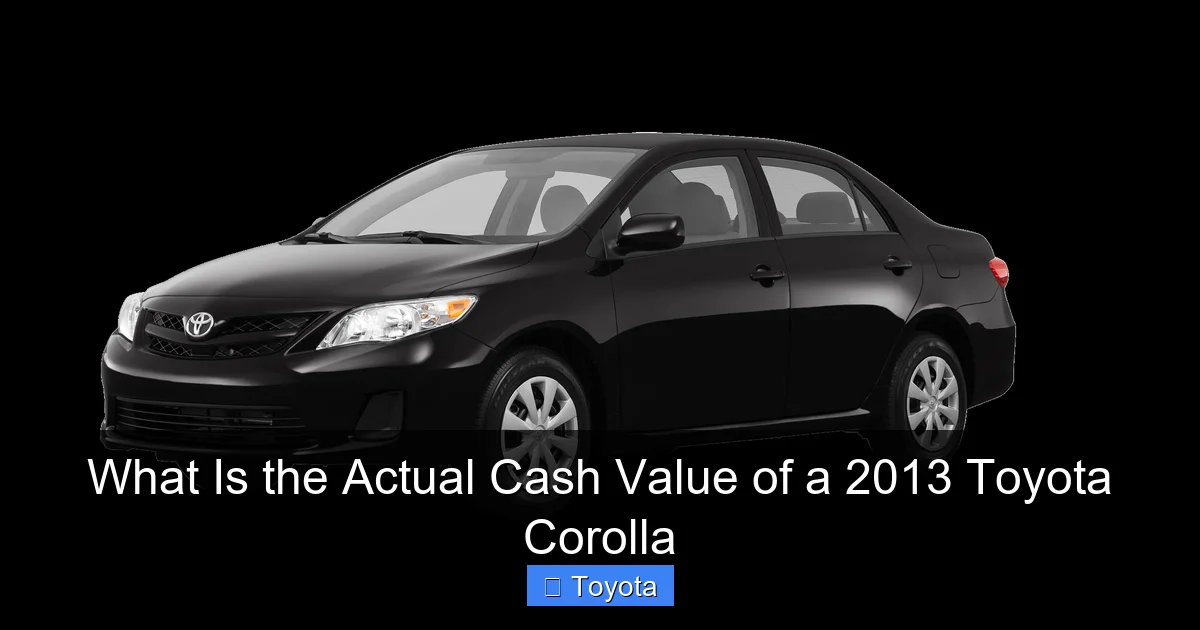
Visual guide about What Is the Actual Cash Value of a 2013 Toyota Corolla
Image source: file.kelleybluebookimages.com
1. Mileage: The Single Most Powerful Number
The average American drives about 12,000-15,000 miles per year. For a 2013 model, that means a “typical” mileage range for 2024 would be between 132,000 and 165,000 miles. Every single mile over that average subtracts value. Every mile below it adds value. A 2013 Corolla with 80,000 miles is a unicorn and will command a premium ACV. One with 220,000 miles is in a different, much lower valuation bracket. When you get a valuation, always compare your car to listings with similar mileage, not just similar year and model.
2. Condition: The Fine Details Make or Break Value
Condition is broken down into tiers by valuation guides.
- Excellent: No accidents, flawless interior/exterior, all maintenance up to date with records, all original parts, no rust.
- Good: Normal wear for its age. Minor cosmetic issues (small door ding, worn driver’s seat bolster), all major maintenance performed.
- Fair: Needs some non-mechanical repairs. Minor accidents reported, some rust, worn tires, or interior stains.
- Poor: Significant mechanical issues, major accident history, severe rust, interior damage.
Be brutally honest with yourself. A 2013 Corolla with a cracked windshield, worn-out suspension, and a history of a fender bender is not “Good” condition. That honesty is critical for an accurate ACV figure.
3. Trim Level and Optional Equipment
Not all 2013 Corollas are created equal. The base “L” trim is the most common and lowest valued. The “LE” added comfort features. The sporty “S” trim came with body kits, spoilers, and alloy wheels. A well-optioned LE or S with a power sunroof, upgraded audio, and leather-wrapped steering wheel will have a higher ACV than a bare-bones L model. When researching, ensure you are comparing your exact trim. You can find your trim by checking the vehicle’s window sticker (Monroney label) if you have it, or by decoding the VIN online.
4. Vehicle History: The Invisible Value Killer
A clean Carfax or AutoCheck report is worth money. One accident report, especially if it involved airbag deployment or structural damage, can slash the ACV by 10-25% or more. Multiple accidents are a huge red flag. Title status is paramount. A “Clean” title is standard. A “Salvage” or “Rebuilt” title will reduce value dramatically, often by 50% or more, because it affects insurability and financing. Always run a history report on your own vehicle before claiming a value.
5. Local Market Demand and Geography
Value is local. A 2013 Corolla in snowy Minnesota, where front-wheel-drive sedans are in high demand and rust is a concern, may have a different value than the same car in sunny Arizona, where rust is negligible but the market might be more saturated with imports. Supply and demand in your specific zip code or region matters. National guides are a starting point, but you must look at local listings on sites like Craigslist, Facebook Marketplace, or Autotrader to see what identical cars are actually selling for near you.
How to Calculate the ACV: A Practical, Step-by-Step Guide
Now, let’s get our hands dirty with the math. There is no single “ACV calculator,” but the process is standardized. Here’s how you do it yourself to verify an insurer’s offer.
Visual guide about What Is the Actual Cash Value of a 2013 Toyota Corolla
Image source: file.kelleybluebookimages.com
Step 1: Find Your Car’s Baseline Value
Go to the free, authoritative valuation websites:
- Kelley Blue Book (KBB): The most widely recognized by insurers. Select “2013 Toyota Corolla,” enter your exact zip code, mileage, and condition (be harsh). Look at the “Cash Value” or “Typical Value” range. Note the “Trade-in” and “Private Party” numbers.
- NADA Guides: Often favored by banks and some insurers. Enter the same details. It will give you a “Clean Retail” and “Clean Trade-in” value.
- Edmunds True Market Value (TMV): A strong third option that aggregates real sales data.
Write down the “Average” or “Typical” cash value from each source. They should be relatively close.
Step 2: Adjust for Your Car’s Specifics
This is the art. Take your baseline average and apply adjustments based on the “Big Five” factors above.
- Mileage Adjustment: If your car has 20,000 miles more than the “average” for its year, subtract a predetermined amount (guides often have a per-mile adjustment, e.g., -$0.15 per mile over). If it has 20,000 miles less, add that amount.
- Condition Adjustment: If your car is in “Good” condition but the guide baseline is for “Very Good,” subtract 5-10%. If it’s “Excellent,” add 5-10%.
- Equipment Adjustment: Add value for major options (sunroof: +$300-$500, premium audio: +$200-$400). Subtract for missing common features (if your base model lacks A/C, that’s a major deduction).
- History Adjustment: Deduct for reported accidents (a minor one: -$500 to -$1500; a major one: -$2000+). A salvage title is a massive, often non-negotiable deduction.
Step 3: The Sample Calculation
Let’s estimate the ACV for a 2013 Toyota Corolla LE with these specs:
Zip Code: 90210 (high-demand area)
Mileage: 110,000 (below average)
Condition: Good (normal wear, all maintenance done)
History: Clean Carfax, no accidents
Options: Power sunroof, alloy wheels
Baseline from KBB (Cash Value): $8,500
NADA (Clean Retail): $8,200
Average Baseline: ($8,500 + $8,200) / 2 = $8,350
Adjustments:
– Mileage: 110,000 is ~25,000 miles below average. At $0.15/mile, that’s a +$3,750 adjustment? Wait, that can’t be right. This is a common mistake. Per-mile adjustments are small and capped. A more realistic adjustment for significantly lower miles is a 5-8% premium over baseline. Let’s apply a 7% premium: $8,350 * 0.07 = +$585.
– Condition: “Good” vs. baseline “Very Good” is a minor hit. -3%: $8,350 * 0.03 = -$250.
– Options: Sunroof and alloys. Add +$400.
– History: Clean. No adjustment.
Estimated ACV: $8,350 + $585 – $250 + $400 = $9,085
This is a simplified example. Real-world adjustments are nuanced. This exercise, however, shows you how the sausage is made and gives you a defensible number to present to an insurance adjuster.
Getting an Accurate Estimate: Tools and Professional Help
Doing your own homework is non-negotiable. But sometimes you need a second opinion.

Visual guide about What Is the Actual Cash Value of a 2013 Toyota Corolla
Image source: file.kelleybluebookimages.com
The Big Three Valuation Guides (KBB, NADA, Edmunds)
Use all three. They have slightly different methodologies. KBB is consumer-focused and often a bit higher. NADA is dealer-focused and can be more conservative. Edmunds uses actual recent sales data. If all three are within $500 of each other for your car’s specifics, you have a very solid range. If they vary widely, it signals your car might be in a tricky condition bracket (e.g., “Good” vs. “Fair”) and you need to scrutinize your condition assessment.
What Your Insurance Adjuster Will Do
When you file a total loss claim, the insurer will assign an adjuster. They will run your VIN through their proprietary system (often a version of CCC One or Mitchell). This system pulls a national average value and applies standard mileage and condition deductions. They will not drive to your house to inspect your car’s pristine undercarriage or note the new battery you just installed. Their initial offer is a starting point, often on the lower end of the spectrum. Your job is to counter with your documented research (the comps from KBB/NADA/Edmunds, local listings, maintenance records, photos of your clean car).
When to Get a Professional Appraisal
For a standard 2013 Corolla, a DIY valuation is usually sufficient. However, if your car is a rare variant (like a 2013 Corolla with a manual transmission in a market of automatics), has a very low or very high mileage that skews the algorithms, or you are in a dispute with an insurer, a certified auto appraiser can provide a formal, court-admissible report. This costs $200-$400 but can be worth it if it increases your settlement by thousands. For most people, thorough self-education is the better first step.
Maximizing Your Corolla’s ACV: Proactive Steps You Can Take Today
You don’t have to accept a lowball offer. Your car’s value is a story. You need to tell that story compellingly with evidence. Here’s how to build the strongest case for the highest possible ACV.
Document Everything: The Maintenance Holy Grail
The single best thing you can do for your car’s value—both for selling and for an insurance claim—is keep every single maintenance and repair receipt. An oil change receipt every 5,000 miles? Gold. Timing belt service at 90,000 miles? Priceless. New set of tires? Absolutely. Organize these in a folder or digitally scan them. When an adjuster sees a complete, consistent service history from a reputable shop, it powerfully argues for a “Good” or “Excellent” condition rating, directly increasing the ACV. If you’ve neglected this, start now. Get a full service from a trusted mechanic and keep that receipt. It’s an investment in your car’s documented health.
The Pre-Claim Inspection: Know Your Car’s True State
Before you ever need to make a claim, get a pre-purchase inspection (PPI) from an independent mechanic. Have them write a detailed report on the car’s condition—brakes, suspension, engine, transmission, any rust, any hidden damage. This report is objective, third-party evidence of your car’s condition. It’s worth the $100-$200. It can reveal issues you didn’t know about (allowing you to fix them proactively) and provides a clean bill of health that boosts your value argument. If you have a specific feature like the Hold button on a Toyota Corolla or the Eco Heat Cool system, ensure these are noted as functioning in the report, as they are valuable features.
Cosmetic Perfection: The Low-Hanging Fruit
Before seeking a valuation or listing the car for sale:
- Fix all minor cosmetic damage: small dents, scratches, chipped paint. A $500 paintless dent repair can add $1,000 to the perceived value.
- Detail the car inside and out. A professionally cleaned car looks and smells like a well-cared-for car. Clean every nook, condition the leather, remove all stains.
- Replace worn items: wiper blades, burnt-out bulbs, cracked dashboard pads, torn floor mats. These are cheap fixes that signal neglect if missing.
- Ensure all electronics work: power windows, locks, infotainment system, climate control. Test the hood release and all buttons. A single non-working feature can be used by an adjuster to downgrade condition.
Time Your Request Strategically
Car values are seasonal and cyclical. The ACV of a 2013 Corolla is highest in spring and early summer (March-June) when used car demand spikes. It’s lowest in deep winter (January-February) and after major new model year releases (fall). If you have flexibility, schedule your valuation or sale during the high-demand season. Also, monitor fuel prices. As a highly fuel-efficient sedan, the Corolla’s value increases when gas prices are high.
Conclusion: Knowledge is Your Greatest Asset
Determining the Actual Cash Value of your 2013 Toyota Corolla is not a passive activity. It requires you to step into the role of an informed advocate. The number isn’t a secret code; it’s a calculation based on public data and your car’s unique biography. By understanding the five pillars of value—mileage, condition, trim, history, and location—and by proactively documenting your car’s care, you transform from a passive recipient of an insurance offer into an active participant in the valuation process.
Start today. Run your car through KBB and NADA. Be honest about its condition. Gather your service records. Look at local listings. Form your own evidence-based opinion. When the time comes—whether for an insurance claim, a sale, or a refinance—you will not only know what your 2013 Toyota Corolla is worth, you will have the proof to back it up. That is the power of understanding ACV. Your reliable Corolla has served you well for over a decade; make sure its final financial chapter reflects the true value of that dependable service.
Frequently Asked Questions
What is the main difference between ACV and trade-in value for a 2013 Toyota Corolla?
ACV is the theoretical fair market value used by insurers, while trade-in value is what a dealership offers you as credit toward another car. Trade-in value is always lower because the dealer must account for reconditioning costs and profit margin when they resell the vehicle.
How much does an accident on the Carfax report lower the ACV of a 2013 Corolla?
It depends on the severity. A minor fender-bender with no airbag deployment might reduce ACV by 5-10%. A major accident with structural damage or airbag deployment can lower value by 15-25% or more. A salvage title reduces value by 50% or more.
Can I negotiate the ACV offered by my insurance company for my totaled 2013 Corolla?
Absolutely, and you should. The initial offer is often a low starting point. You negotiate by presenting your own research: valuation printouts from KBB/NADA/Edmunds, a list of comparable local sales (comps), photos of your well-maintained car, and all your service records. Be polite, firm, and evidence-based.
Do aftermarket upgrades like new rims or a stereo increase the ACV of my 2013 Corolla?
Usually, no. Insurance ACV calculations are based on the vehicle’s factory configuration. Aftermarket parts are often seen as a liability (they may not be covered, or could be stolen) and may not appeal to the average buyer. They rarely add dollar value and can sometimes decrease value if they are poorly installed or non-standard.
Is the ACV of my 2013 Corolla the same in every state?
No. ACV is calculated using your specific zip code. Value fluctuates based on local supply and demand, cost of living, climate (rust in snowy states vs. sun in desert states), and regional preferences for certain vehicle types. A Corolla will generally hold value better in urban areas with high fuel costs and demand for economical sedans.
What’s the fastest way to get a ballpark ACV for my 2013 Toyota Corolla?
The quickest method is to use Kelley Blue Book (KBB). Go to their website, enter your vehicle’s exact details (year, make, model, trim, mileage, zip code), and honestly select the condition. The “Cash Value” or “Typical Value” they provide is a very reliable and widely accepted estimate of the ACV. Always cross-check with NADA for a second opinion.