
How Many Miles Can a Toyota Tacoma Go on a Full Tank

The Toyota Tacoma’s range on a full tank typically falls between 350 and 460 miles, but this number is not set in stone. Your specific range depends heavily on your truck’s configuration—the engine size, transmission, drivetrain (2WD or 4WD), and bed length all play major roles. A 2023 Tacoma with the 2.4L 4-cylinder and 2WD can achieve the upper end of that spectrum, while a heavier 4WD Access Cab with the older V6 will be on the lower end. Understanding your truck’s exact fuel tank capacity and EPA-estimated MPG is the first step to calculating your personal maximum range.
So, you’re behind the wheel of your trusty Toyota Tacoma, the low-fuel light flickers to life, and a familiar question pops into your head: “Just how many more miles can I actually go?” It’s a crucial question for any truck owner, whether you’re using your Tacoma for daily commuting, rugged off-road adventures, or tough job site work. The answer isn’t a single number you can look up in a manual. It’s a calculation unique to your specific truck, your driving style, and the terrain you’re conquering. This guide will break down everything you need to know to determine exactly how many miles your Toyota Tacoma can go on a full tank, from the factory specs to the real-world variables that make all the difference.
Key Takeaways
- Range is highly configuration-dependent: A 2024 Tacoma with the efficient 2.4L 4-cylinder and 2WD will travel significantly farther on a tank than a 2016-2023 model with the 3.5L V6 and 4WD, due to differences in both tank size and fuel economy.
- Fuel tank size varies by generation and trim: The 2024+ Tacoma has a 17.8-gallon tank, while 2014-2023 models generally have an 18.1-gallon tank (SR5) or 21.1-gallon tank (TRD Pro, Limited). Always verify your specific model’s capacity.
- EPA ratings are a baseline, not a guarantee: Real-world MPG is influenced by driving habits, terrain, cargo weight, and weather. Heavy city driving, mountainous terrain, or constant towing can reduce your actual miles per gallon by 20% or more compared to the highway estimate.
- The “reserve” fuel is a myth with a purpose: When the fuel light comes on, you typically have 2-3 gallons left, giving you roughly 40-80 miles of additional range. However, consistently driving on empty risks damaging the fuel pump and is not recommended.
- Calculation is simple but personal: To find your truck’s maximum range, multiply your specific fuel tank capacity (in gallons) by your real-world average MPG. For a precise estimate, track your fuel economy over several fill-ups in your typical driving conditions.
- Maximizing range is about smart habits: Maintaining proper tire pressure, reducing excess weight, using cruise control on flat highways, and avoiding aggressive acceleration can noticeably extend your distance between fill-ups.
- Your Tacoma’s range is a tool for planning: Knowing your realistic range helps with long-distance trips, remote area adventures, and work site logistics, ensuring you never run out of fuel in an inconvenient or unsafe location.
📑 Table of Contents
Understanding the Core Variables: Tank Size & Fuel Economy
To calculate range, you need two fundamental pieces of information: how much fuel your truck can hold (fuel tank capacity) and how efficiently it uses that fuel (miles per gallon, or MPG). The formula is beautifully simple: Range (miles) = Fuel Tank Capacity (gallons) x Average MPG. However, finding the precise numbers for your *specific* Tacoma requires a bit of detective work, as Toyota has used different tanks and engines across generations and trims.
Fuel Tank Capacity: It’s Not One-Size-Fits-All
Contrary to what you might think, not all Tacomas share the same gas tank size. The capacity has changed based on the model year, cab configuration (Access Cab vs. Double Cab), and trim level. For example, the current fourth-generation Tacoma (2024+) comes standard with a 17.8-gallon tank. For the immensely popular third generation (2014-2023), the story splits:
- SR5, TRD Sport, TRD Off-Road (Double Cab Short Bed): 18.1 gallons
- TRD Pro, Limited (Double Cab Long Bed): 21.1 gallons
- Access Cab models: Typically 18.1 gallons
This is a critical first step. If you own a long-bed TRD Pro from 2020, your 21.1-gallon tank gives you a massive potential advantage over a short-bed SR5 with its 18.1-gallon tank. You can often find your tank capacity in your owner’s manual, etched on the fuel filler door, or through a quick VIN-specific search online. For a detailed breakdown of your Tacoma’s specific tank size, resources like our article on how many gallons a Toyota Tacoma holds can be a helpful reference point.
Fuel Economy (MPG): The Biggest Variable
This is where things get really interesting. The EPA provides estimated MPG ratings for every vehicle, and these are your starting point. However, these are optimized lab numbers—they represent the *best-case scenario* under controlled conditions. For the Tacoma, the EPA ratings vary dramatically by engine and drivetrain. Let’s look at some recent examples:
- 2024 Tacoma 2.4L 4-cylinder, 2WD: Up to 23 city / 28 highway / 25 combined (for the i-Force Max hybrid-assisted version, it’s even higher).
- 2023 Tacoma 3.5L V6, 2WD: 20 city / 23 highway / 21 combined.
- 2023 Tacoma 3.5L V6, 4WD: 18 city / 21 highway / 19 combined.
See the pattern? Adding 4WD and the older, thirstier V6 changes the math significantly. The newer 2024+ models with the standard 2.4L 4-cylinder are notably more efficient. Your personal, real-world MPG is what truly determines your range. To get an accurate figure, you must do the old-fashioned math: Miles Driven ÷ Gallons Added = Your Actual MPG. Reset your trip odometer at each fill-up, drive normally, and record the gallons it takes to fill back up. Do this for 3-5 tanks to get a reliable average that reflects your life, not the EPA’s lab.
Generation-by-Generation Range Estimates
Now, let’s plug some typical numbers into our formula to give you ballpark figures. Remember, these are *estimates* based on EPA combined ratings and standard tank sizes. Your actual results will vary.

Visual guide about How Many Miles Can a Toyota Tacoma Go on a Full Tank
Image source: autozonic.com
Third Generation (2014-2023) with the 3.5L V6
This is the engine most people think of when they hear “Tacoma V6.” It’s powerful and reliable but not the most fuel-thrifty.
- 2WD, 18.1-gallon tank (most common): 18.1 gal x 21 MPG (combined) = ~380 miles.
- 4WD, 18.1-gallon tank: 18.1 gal x 19 MPG (combined) = ~344 miles.
- 4WD, 21.1-gallon tank (TRD Pro/Long Bed): 21.1 gal x 19 MPG = ~401 miles.
Realistically, if you do a lot of city driving or off-roading, you should expect closer to 300-350 miles on a tank for a 4WD V6 model. The long-bed Pro’s extra 3 gallons helps offset the lower MPG, giving it one of the best ranges of this generation.
Fourth Generation (2024+) with the 2.4L 4-Cylinder
The all-new Tacoma has moved to a standard 2.4L 4-cylinder (with a hybrid-assisted version available). The efficiency jump is noticeable.
- 2WD, 17.8-gallon tank, standard 2.4L: 17.8 gal x 23 MPG (combined) = ~409 miles.
- 4WD, 17.8-gallon tank, standard 2.4L: 17.8 gal x 21 MPG (combined) = ~374 miles.
- 4WD, 17.8-gallon tank, i-Force Max hybrid: 17.8 gal x ~26 MPG (est. combined) = ~463 miles.
The hybrid-assisted model is the clear range champion, easily pushing past 450 miles on the highway under ideal conditions. Even the standard 4WD 2.4L model sees a range improvement over the outgoing V6 4WD.
The Real-World Factors That Change Everything
Now we get to the heart of the matter. The EPA and our simple calculations give you a baseline, but your actual “miles to empty” display (if equipped) and your personal experience are shaped by these powerful variables. Ignoring them is why many Tacoma owners feel their range is “less than advertised.”

Visual guide about How Many Miles Can a Toyota Tacoma Go on a Full Tank
Image source: i0.wp.com
Driving Style: Lead Foot vs. Grandma
This is the single biggest factor you control. Aggressive acceleration, hard braking, and speeding are fuel economy killers. The Tacoma’s powerful engine can make it tempting to drive fast, but every 5 mph you drive over 60 mph increases aerodynamic drag and fuel consumption significantly. Gentle acceleration, anticipating stops, and using cruise control on flat highways can improve your real-world MPG by 3-5 MPG or more. That’s an extra 50-100 miles on a tank for some drivers.
Terrain and Elevation: Mountains and Off-Roads Drain Fast
If your Tacoma spends its time in the hills, towing a trailer, or crawling over rocks, your range will plummet. Climbing grades forces your engine to work much harder, drastically reducing efficiency. Off-roading in low range, with tires digging into dirt and constant throttle inputs, can cut your MPG in half compared to highway cruising. A trip through the Rockies or a day at the off-road park might see your range drop to 200 miles or less on a full tank, regardless of your configuration. For those who regularly tow, the impact is even more severe. You can learn more about the Tacoma’s towing capabilities and their impact on fuel use in our guide to how much a 2023 Toyota Tacoma can tow.
Cargo and Passenger Weight: Every Pound Counts
Tacomas are built to carry and haul, but a heavy bed full of tools, a fully loaded roof rack, or a crew of friends adds rolling resistance and mass your engine must move. The impact is most noticeable in city driving and acceleration. A 100-pound roof rack alone can reduce highway MPG by 1-2%. If your Tacoma is your workhorse, carrying 500 lbs of gear daily, you should subtract 10-15% from your calculated highway range.
Weather and Climate: Cold is the Enemy
Cold weather is brutal on fuel economy. The engine takes longer to reach optimal operating temperature, using more fuel. Winter blend gasoline has less energy content. You’re likely using the heater and defroster constantly. All of this can reduce your MPG by 15-20%. Similarly, running the air conditioning in hot, humid climates also increases fuel consumption, though typically by a smaller margin (5-10%). If you live in a northern climate, your “winter range” on a full tank could be 50-80 miles less than your summer range.
Tire Pressure and Type: The Rolling Resistance Factor
Under-inflated tires are a silent efficiency killer. They increase rolling resistance, forcing your engine to work harder. The Tacoma’s recommended PSI is usually found on a sticker inside the driver’s door jamb. Check it monthly, especially with temperature changes. Furthermore, the type of tires matters. Aggressive all-terrain or mud-terrain tires have deep, chunky treads that create more friction than standard highway all-season tires, often reducing MPG by 1-3 MPG. If you have a set of heavy aftermarket wheels, that adds unsprung weight, too.
Calculating *Your* Personal Maximum Range
Enough with the generalities. Let’s build a personalized range calculator for your truck.
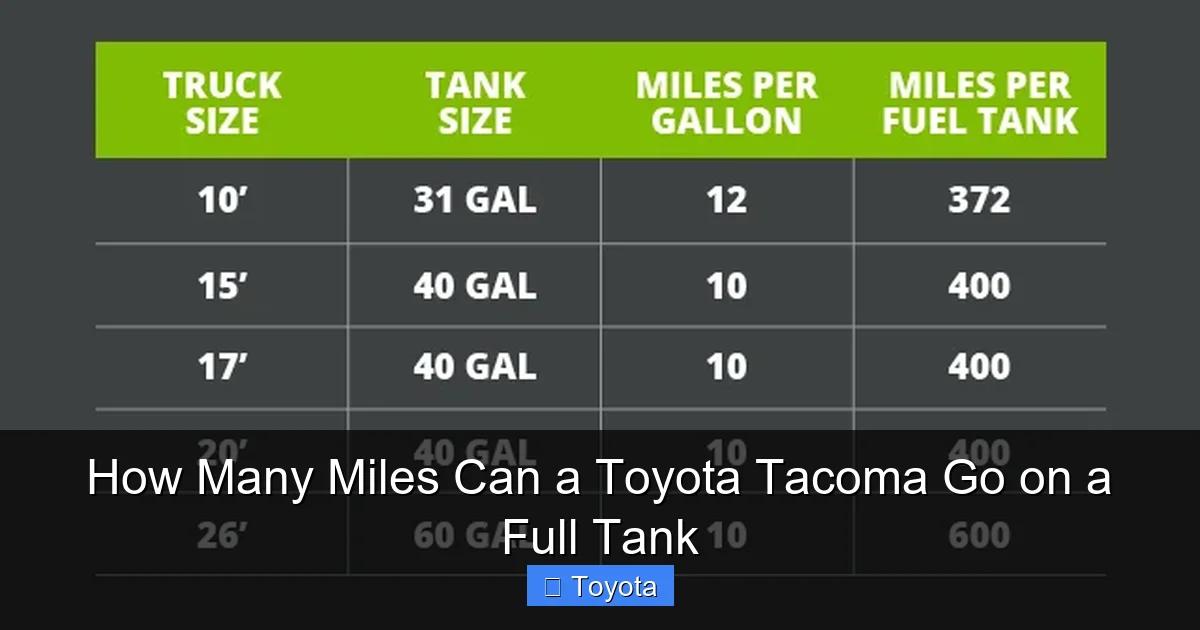
Visual guide about How Many Miles Can a Toyota Tacoma Go on a Full Tank
Image source: upack.com
Step 1: Confirm Your Exact Fuel Tank Capacity
As established, this is not a guess. Look in your owner’s manual. Check the fuel filler door. If you’re unsure, a reputable online VIN decoder or a forum for your specific model year (e.g., Tacoma4G, ToyotaNation) is an invaluable resource. Be precise: is it 18.1 or 21.1 gallons? This number is your multiplier.
Step 2: Determine Your Real-World Average MPG
This is the most important step. Do not rely on the trip computer’s “average MPG” display for accuracy—many are optimistic. Use the manual fill-up method for at least three tanks of fuel, covering a mix of your typical driving (city, highway, etc.). Calculate your average. Let’s say your real-world average, after tracking, is 19.5 MPG.
Step 3: Do the Math and Apply a Safety Buffer
Formula: Tank Capacity (gal) x Your Avg MPG = Maximum Theoretical Range.
Example: 18.1 gal x 19.5 MPG = 353 miles.
Now, apply a 10-15% safety buffer. Why? Because your MPG will drop on a long highway trip with a roof rack, in stop-and-go traffic, or when the weather turns. Your “comfortable range” before you start looking for a gas station should be closer to 300-320 miles for this example. This prevents you from getting into a stressful situation where you’re pushing the “reserve” fuel too often.
Understanding the Fuel Light and Reserve Fuel
When that low-fuel warning illuminates, it’s not “empty.” Tacomas generally have a 2 to 3-gallon reserve after the light comes on. That’s an extra 30-60 miles (at 15-20 MPG) of range. Some models with a “Distance to Empty” readout will show it dropping rapidly once the light is on. While it’s good to know this buffer exists for emergencies, consistently driving until the light is on (or beyond) is bad practice. It can cause sediment from the tank bottom to be sucked into the fuel system and, more critically, cause the in-tank fuel pump to overheat and fail prematurely, as the pump relies on fuel for cooling and lubrication. If you want to know the typical reserve for other Toyota models, you might read about how many miles you can drive when the gas light comes on in a Toyota Camry, which follows a similar engineering principle.
Maximizing Your Tacoma’s Range: Practical Tips
You can’t change your tank size or engine, but you can optimize everything else to squeeze every last mile from each fill-up.
Maintenance is Non-Negotiable
A well-maintained Tacoma is an efficient Tacoma. Stick to your oil change schedule. Use the correct oil viscosity (thicker oil in summer, thinner in winter can help, but follow manual specs). Replace air filters regularly—a clogged air filter starves the engine of air, reducing efficiency. Ensure your spark plugs are in good condition. A tune-up if you notice poor performance or bad MPG can work wonders.
Driving Habits for Efficiency
- Use Cruise Control on Flats: Maintaining a steady speed is far more efficient than constant acceleration and braking.
- Plan Your Trips: Combine errands. A series of short trips with a cold engine uses more fuel per mile than one longer trip where the engine is fully warmed up.
- Reduce Idling: Modern engines don’t need long warm-ups. 30 seconds is plenty. If you’re stopped for more than 60 seconds (not in traffic), turn the engine off.
- Drive Sensibly: Avoid jackrabbit starts. Accelerate smoothly. Look ahead and coast when you see a red light or stop sign coming up.
Weight and Aerodynamics: Lighten the Load
Do you have a heavy steel bumper, a full-sized spare tire and carrier on the back, or a toolbox you rarely use? Consider if it’s truly necessary for your daily drive. Remove roof racks when not in use. Clean out the bed and cab of unnecessary items. Every 100 pounds of cargo reduces MPG by about 1-2%. It adds up.
Smart Trip Planning for Long Distances
Before a long road trip, especially through remote areas, plan your fuel stops. Don’t wait for the low-fuel light. Use apps or websites to map out gas stations along your route. In mountainous or desert regions, stations can be 100+ miles apart. Your goal is to refill when you still have a comfortable 100-mile buffer, not when you’re down to your last 50 miles of range.
Conclusion: Your Tacoma’s Range is a Personal Number
So, how many miles can a Toyota Tacoma go on a full tank? The honest answer is: it depends on your unique truck and how you use it. The factory provides the blueprint—the tank size and EPA estimates—but you write the final chapter with your driving habits, your cargo, and your terrain. For the average owner of a recent-model V6 4WD Tacoma, planning for a comfortable range of 300-350 miles is wise. For a new 2WD 2.4L model, 400+ miles on the highway is very achievable. The key is to move beyond the sticker and understand your truck’s real-world behavior. Track your fuel economy, respect the reserve fuel, and drive efficiently. By doing so, you’ll not only know your truck’s true range with confidence but also save money at the pump and reduce the stress of finding a gas station in the middle of nowhere. Your Tacoma is built for adventure and capability; understanding its range is a fundamental part of mastering that capability, mile after mile.
Frequently Asked Questions
How many miles can I drive after the gas light comes on in my Tacoma?
Typically, you can expect 30-60 miles after the fuel light illuminates, as you usually have 2-3 gallons of reserve fuel remaining. However, this is an emergency buffer only—driving this low frequently can damage your fuel pump.
Does towing a trailer drastically reduce my Tacoma’s range?
Yes, absolutely. Towing adds significant aerodynamic drag and weight, which can reduce your MPG by 30-50% or more. Always calculate your range with a substantial safety margin when towing, and plan fuel stops much more frequently.
My Tacoma’s trip computer says “400 miles to empty,” but I only get 350. Why?
>Trip computers are often optimistic and base calculations on recent driving style. They also don’t account for future terrain or traffic. Your real, conservative range should be based on your long-term average MPG multiplied by your tank capacity, minus a safety buffer.
Is the fuel tank larger on long-bed or TRD Pro Tacomas?
For the 2014-2023 generation, yes. The TRD Pro and Limited trims with the Double Cab Long Bed came standard with a larger 21.1-gallon tank, compared to the 18.1-gallon tank in most other models. The 2024+ Tacoma uses a standardized 17.8-gallon tank across all trims.
How can I improve my Tacoma’s real-world MPG and range?
Focus on maintenance (proper tire pressure, clean air filter, timely oil changes) and driving habits (gentle acceleration, using cruise control, removing excess weight). These changes can improve your MPG by several points, directly increasing your miles per tank.
Should I use regular or premium fuel in my Tacoma?
For all Tacoma engines, Toyota specifies and recommends regular unleaded 87-octane fuel. Using premium offers no benefit in power or MPG for the standard engines and is not required. The only exception is if your specific owner’s manual states otherwise for high-altitude or extreme conditions, which is rare.