What Is Evidence of Excellence in a Tesla Job Application

Contents
- 1 Key Takeaways
- 2 📑 Table of Contents
- 3 What Is Evidence of Excellence in a Tesla Job Application?
- 4 Pillar 1: Mastery of Tesla’s Core Principles
- 5 Pillar 2: Quantifiable, High-Impact Achievement
- 6 Pillar 3: Deep, Practical Technical Proficiency
- 7 Pillar 4: Relentless Problem-Solving and Bias for Action
- 8 Pillar 5: Tailoring and Authenticity – The Final Filter
- 9 Conclusion: Building Your Case
- 10 Frequently Asked Questions

Car Vacuum Cleaner (Portable)

Reflective Stickers

Car Hydraulic Jack

Multipurpose Lubricant Spray
Landing a job at Tesla requires more than a standard resume; it demands a clear demonstration of “evidence of excellence.” This means providing concrete, quantifiable proof of your skills, a deep understanding of Tesla’s core principles, and a history of solving complex problems. Your application must move beyond listing duties to telling a compelling story of impact, innovation, and a relentless drive to accelerate the world’s transition to sustainable energy. Tailoring every document to Tesla’s unique culture is non-negotiable for success.
Key Takeaways
- Evidence of Excellence is Quantifiable Impact: It’s not about your job title, but the measurable results you achieved, using metrics like percentages, dollar values, and efficiency gains.
- First-Principles Thinking is Critical: Tesla values candidates who can deconstruct problems to their fundamental truths and rebuild solutions from the ground up, not those who rely on analogies.
- Technical Depth Must Be Demonstrated: Whether for engineering, software, or production roles, you must show hands-on, practical knowledge of relevant systems, from battery chemistry to software architecture.
- Cultural Alignment is a Filter: You must explicitly connect your past work and personal drive to Tesla’s core mission of sustainability, innovation, and challenging the status quo.
- Problem-Solving Stories are Currency: Use the STAR method to structure narratives about times you identified a hidden problem, devised an innovative solution, and executed it under constraints.
- Your Resume is a Technical Document: It should be a lean, metric-driven list of achievements, not a biography. Every line should answer “What did you build, fix, or improve?”
- Preparation Extends Beyond the Job Description: Research Tesla’s specific projects, patents, and public challenges. Your questions in an interview should reflect this deep dive, showing you’re already thinking like a team member.
📑 Table of Contents
- What Is Evidence of Excellence in a Tesla Job Application?
- Pillar 1: Mastery of Tesla’s Core Principles
- Pillar 2: Quantifiable, High-Impact Achievement
- Pillar 3: Deep, Practical Technical Proficiency
- Pillar 4: Relentless Problem-Solving and Bias for Action
- Pillar 5: Tailoring and Authenticity – The Final Filter
- Conclusion: Building Your Case
What Is Evidence of Excellence in a Tesla Job Application?
So, you want to work at Tesla. You’re fascinated by electric vehicles, inspired by Elon Musk’s vision, and you’re a talented professional in your field. You update your resume, apply online, and wait. And wait. Maybe you get a generic rejection. What happened? The gap often lies in a fundamental misunderstanding of what Tesla, more than almost any other company, truly requires from its candidates. They don’t just want competent employees. They demand evidence of excellence.
This isn’t corporate jargon. At Tesla, “evidence of excellence” is the specific, provable proof that you are not just good at your job, but that you operate at a level of exceptionalism that aligns with their obsessive, fast-paced, and mission-driven culture. It’s the antithesis of a resume filled with fluffy responsibilities. It’s a forensic-grade account of your intellectual horsepower, your executional grit, and your unwavering commitment to the improbable. In a company that aims to revolutionize transportation and energy, mediocrity isn’t a career-limiting move—it’s a non-starter. Your application must scream, without saying it outright, “I am one of the people who will make the impossible, possible.”
This article is your decoder ring. We will dissect exactly what “evidence of excellence” means in the context of a Tesla application, broken down by the cultural pillars, core competencies, and practical demonstrations they scrutinize. We’ll move from theory to actionable tactics, showing you how to transform your past experiences into the compelling, metric-laden narrative that Tesla recruiters and hiring managers are hard-wired to spot. Forget generic advice. This is about engineering your application to the exact specifications of one of the world’s most demanding and innovative organizations.
The Tesla Filter: Why “Evidence” is the Only Currency That Matters
To understand the evidence they seek, you first must understand the filter. Tesla operates on a different plane. Their hiring bar is famously high because their challenges are uniquely monumental. They are not just building cars; they are redefining manufacturing, solving battery chemistry at scale, writing software that controls a physical product, and building a global charging network from scratch. The cost of a hiring mistake isn’t just a missed deadline; it’s a delay in the mission.
This creates a culture that values first-principles reasoning over analogical thinking. They don’t care if you did something “like this before.” They care if you can break the current problem down to its fundamental physics, economics, or logic and rebuild a better solution from those base components. Your evidence must showcase this ability. It must show you are a builder, a debugger, and a systems thinker. They are looking for the person who, when faced with a production line stoppage, doesn’t just call maintenance but understands the torque specs, the software interlocks, and the supply chain implication of a single faulty sensor. That person provides evidence of excellence.
Pillar 1: Mastery of Tesla’s Core Principles
Before you write a single line on your resume, you must internalize Tesla’s operating doctrines. Your evidence must be framed through these lenses.
Visual guide about What Is Evidence of Excellence in a Tesla Job Application
Image source: techvigas.com
The Obsession with the Product (First-Party)
At Tesla, there is no “second-party” or “third-party” perspective. Everyone is a user and a critic. You must demonstrate an intimate, almost obsessive, understanding of the product—be it a vehicle, a Powerwall, or the Autopilot stack. This goes beyond being a fan. It’s about understanding the trade-offs: why the Model 3’s interior is minimalist, the engineering brilliance of the structural battery pack, or the software logic behind a specific UI animation.
How to demonstrate this: In your cover letter or interview, reference specific Tesla product details. “I’ve studied the Gigapress casting process and its implications for part consolidation and structural rigidity. My experience in high-pressure die casting at [Previous Company] directly translates to optimizing this new technology.” This shows you think about Tesla’s product as an engineer, not a customer. If you’re in software, discuss the challenges of over-the-air (OTA) updates for safety-critical systems. Link this to real-world Tesla issues; for instance, understanding the complexity behind a 503 server maintenance error on Tesla shows you grasp the integrated nature of their hardware and software ecosystem.
First-Principles Thinking in Action
This is Tesla’s secret weapon. It means boiling a problem down to its fundamental truths and building up from there, ignoring what “has always been done.” Evidence of this is gold. It’s not enough to say you “improved a process.” You must explain how you questioned the fundamental assumptions of the old process.
Example: Instead of: “Reduced production waste by 10%.” Write: “Deconstructed the wire harness assembly process, identifying that 30% of connector pins were being pre-installed based on legacy platform requirements no longer applicable to the new model. By applying first-principles analysis to the electrical schematic, I eliminated redundant pins, reducing material cost by $2.1M annually and assembly time by 45 seconds per unit.” This tells a story of intellectual curiosity and fundamental re-engineering.
Intense Focus on the Long-Term Mission
You are not just applying for a job; you are volunteering for a decade-long (or longer) sprint to a sustainable future. Tesla will see through anyone motivated primarily by prestige or compensation. Your evidence must show a track record of choosing hard, meaningful problems over easy, lucrative ones.
How to demonstrate this: Highlight projects where you took a risk or worked on something with a long gestation period because it was technically important. “Chose to lead the development of the company’s first silicon anode test line, a high-risk project with a 3-year horizon, over a safer role optimizing existing graphite anode production, because I believed silicon was the necessary next step for energy density.” This aligns your personal ambition with Tesla’s timeline.
Pillar 2: Quantifiable, High-Impact Achievement
This is the meat of your evidence. Tesla operates on metrics: cost per kWh, vehicle range, production rate (vehicles/hour), software deployment frequency, defect rate. Your resume must speak this language fluently.
Visual guide about What Is Evidence of Excellence in a Tesla Job Application
Image source: i.ytimg.com
The “So What?” Test for Every Bullet
Read every line on your resume. Ask “So what?” If the answer isn’t a clear, quantifiable business impact, rewrite it. “Responsible for battery pack testing” fails. “Designed and implemented a new battery pack thermal validation protocol that reduced test cycle time by 22% while improving failure detection sensitivity by 15%, accelerating cell qualification by 3 weeks” passes.
Use the formula: Action Verb + Technical Task + Quantified Result + Business Impact.
- Weak: “Worked on the Model Y production line.”
- Strong: “Optimized the Model Y rear underbody weld sequence by analyzing robotic path data, eliminating 8 seconds of cycle time per station and increasing line throughput by 4% without capital expenditure.”
- Weak: “Managed a team of software engineers.”
- Strong: “Led a team of 7 engineers to develop the vehicle preconditioning feature, shipping it to 500k+ vehicles in 6 months and achieving a 95% user satisfaction rating in initial telemetry.”
Every number must be real. If you don’t know the exact figure, estimate conservatively and be prepared to explain your methodology. “Approximately 15%” is better than “significantly.” Precision implies rigor.
Showing Scale and Scope
The size of the problem you’ve solved matters. Tesla builds hundreds of thousands of cars. They deal in gigawatt-hours of energy. Evidence that you’ve operated at a similar scale is powerful. This doesn’t mean you must have worked at a giant corporation. It means articulating the scale of your previous projects.
How to demonstrate scale:
- “Managed a $5M annual budget for component procurement.”
- “Oversaw a production line running 24/7 with 200+ associates.”
- “Developed software processing 1TB of vehicle telemetry data daily.”
- “Led a project affecting 3 global manufacturing facilities.”
Even if your previous company was small, focus on the proportional impact: “Single-handedly built and maintained the entire backend infrastructure for a startup that scaled from 0 to 50,000 users.”
Pillar 3: Deep, Practical Technical Proficiency
For Tesla, “technical” isn’t just for engineers. It’s for everyone. The finance analyst must understand battery cost curves. The recruiter must understand the skills landscape for battery chemists. The factory planner must understand the cadence of a stamping press. You must prove you have the tangible, hands-on knowledge to contribute from day one.
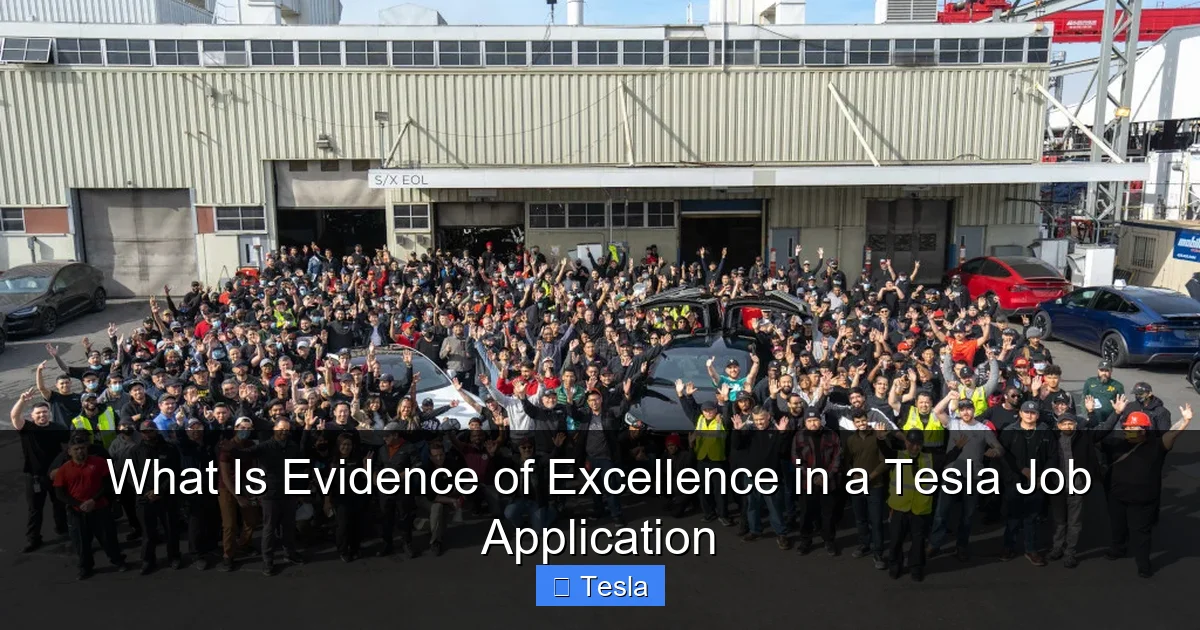
Visual guide about What Is Evidence of Excellence in a Tesla Job Application
Image source: digitalassets.tesla.com
Beyond the Tool: Understanding the System
It’s not enough to list software packages or machinery you’ve operated. Tesla wants to know that you understand the underlying systems those tools interact with. A CAD jockey who doesn’t understand DFM (Design for Manufacturing) is useless in Tesla’s integrated design studio. A coder who doesn’t understand real-time operating systems (RTOS) or CAN bus protocols will struggle with vehicle software.
How to demonstrate systems thinking:
- For Mechanical/Manufacturing: Discuss material properties (e.g., aluminum 6000-series vs. steel), joining techniques (Gigapress vs. traditional welding), and how design choices affect yield, cycle time, and cost. Show you understand the entire value stream.
- For Software: Mention specific architectures (microservices, event-driven), languages (C++, Python, React), and constraints (low-latency, safety-critical ISO 26262 standards). Discuss your experience with CI/CD pipelines and OTA deployment challenges.
- For Battery/Energy: Talk about cell formats (cylindrical, prismatic, pouch), cathode chemistries (NCA, NMC, LFP), thermal management strategies (coolant vs. air), and degradation mechanisms. This is where foundational knowledge of something like what kind of acid is in a car battery—while for lead-acid, not lithium-ion—shows you have a baseline understanding of electrochemistry that you’ve built upon. It demonstrates you can learn the specifics of Tesla’s lithium-ion systems because you grasp the fundamental principles.
Hands-On “Maker” Evidence
Tesla loves builders. If you have a portfolio—GitHub repos with active contributions, a personal project involving Arduino/Raspberry Pi and mechanical design, a patent, a published paper, or even a well-documented restoration of a classic car—it is powerful evidence. It proves initiative, passion, and practical skill beyond your paid job.
How to include this: Create a simple, clean personal website. Link to it on your resume under a “Projects” or “Portfolio” section. For each project, state the problem, your solution (with tech stack), and the result. “Built a DIY battery management system (BMS) for a used EV conversion, implementing cell balancing and CAN communication, which maintained pack voltage within 50mV across all 96 cells.” This is gold for battery or power electronics roles.
Pillar 4: Relentless Problem-Solving and Bias for Action
In a company that moves at “ludicrous speed,” analysis paralysis is fatal. Tesla needs people who see a problem, formulate a hypothesis, test it rapidly, and iterate. Your evidence must showcase this loop in action.
The STAR Method, Tesla-Style
Use the STAR (Situation, Task, Action, Result) framework, but infuse it with Tesla’s culture. The “Action” section is where you prove your first-principles thinking and bias for action. Don’t just say “I analyzed data.” Say “I physically walked the production line for 3 shifts, timing each operator’s motion with a stopwatch, and cross-referenced it with the CAD model to identify 12 seconds of non-value-added motion caused by tool placement.”
The “Result” must be quantified and tied to the mission. “Result: Redesigned workstations, reducing ergonomic injury reports by 40% and increasing output by 3%.” The best stories also include a learning component: “The failure taught us that our quality checkpoint was in the wrong place, leading us to implement inline vision systems at three earlier stations.” This shows growth and systems thinking.
Examples of Tesla-Style Problem Solving
- Diagnosing a “Ghost” Problem: “Investigated intermittent vehicle error codes with no consistent pattern. Built a custom data logger to capture raw CAN bus traffic during the fault, discovered a rare race condition in the gateway firmware during a specific thermal ramp, and proposed a patch that was deployed via OTA to 50,000+ vehicles.”
- Resource Constraint Innovation: “Faced with a 6-month delay on a critical component due to supplier issues, reverse-engineered an alternative design using in-house machined parts and off-the-shelf sensors, validating it in 8 weeks and preventing a 3-week production shutdown.”
- Challenging the “Immutable” Requirement: “Questioned the 100kg weight reduction target for the new platform. Used a physics-based model to show that a 60kg reduction, achieved through material substitution in the rear underbody, would yield 92% of the range benefit at 40% of the cost, allowing budget reallocation to battery optimization.”
Pillar 5: Tailoring and Authenticity – The Final Filter
You can have all the evidence in the world, but if it’s presented generically, it will fail. Tailoring is not about keyword stuffing. It’s about curating your evidence to match the specific role and team.
Decoding the Tesla Job Description
Read it 10 times. Highlight every noun (software, hardware, system, material) and every adjective (scalable, robust, innovative, efficient). Your resume must contain these exact terms in context. If the JD for a Battery Engineer mentions “anode slurry rheology” and you have that experience, use those exact words. If it mentions “high-volume manufacturing,” ensure your bullet points reflect that environment.
Research the team. Use LinkedIn. Find the hiring manager and team members. What are their backgrounds? What projects have they worked on (patents, publications)? Your cover letter and interview talking points should nod to this lineage. “I saw that [Team Lead]’s work on [specific patent] was foundational for the 4680 cell design. My experience in [related field] with [specific achievement] taught me similar principles about electrode coating uniformity, which I’m eager to apply to the next phase of scaling.”
Authenticity Over Acting
Tesla’s interview process is designed to sniff out fraud. They will ask deep, technical follow-ups. If you claim you “optimized a thermal model,” be prepared to discuss the specific heat transfer equations you used, the assumptions you made, and the validation data. Do not exaggerate. It’s better to have one truly deep, authentic achievement than five shallow, questionable ones. Your evidence must be something you can defend at a whiteboard for an hour.
Finally, your motivation must be authentic. When asked “Why Tesla?” an answer about “being part of the future” is weak. An answer about “the specific, audacious engineering challenge of vertical integration in the energy business, and how my background in [X] can directly contribute to solving the [Y] problem” is strong. Connect your personal “why” to Tesla’s mission in a specific, technical way.
Conclusion: Building Your Case
Evidence of excellence is not a list. It is a case. You are the plaintiff, and your case is that you are one of the rare individuals capable of contributing to Tesla’s impossible goals. You build this case with:
- Foundational Knowledge: Demonstrated understanding of Tesla’s products, principles, and the underlying physics of their domain.
- Irrefutable Metrics: A resume that is a lean, powerful document of quantified achievements, where every bullet point answers “What did you actually do?” and “What was the measurable outcome?”
- Proof of Thinking: Narratives that showcase first-principles reasoning, systems thinking, and a bias for action under pressure.
- Perfect Alignment: A tailored presentation that shows you have done your homework on the specific role, team, and challenges.
This is a high bar. It requires introspection, rigorous self-assessment, and often, a rewrite of your entire professional narrative. But for a company that is literally trying to change the world on a deadline, it’s the only bar that exists. Your task is not to ask for a job. It is to provide such overwhelming evidence of your excellence that not hiring you becomes a risk they cannot afford to take. Now go build that case.
Frequently Asked Questions
What is the single most important thing Tesla looks for in a candidate?
Beyond specific skills, Tesla prioritizes evidence of first-principles thinking. They need people who can deconstruct complex problems to their fundamental truths and rebuild innovative solutions, not those who simply apply past analogies. Your application must prove you think this way.
How do I quantify achievements for a non-engineering role at Tesla, like Finance or HR?
Focus on metrics that impact Tesla’s core mission: speed, cost, and scale. For Finance: “Restructured the vendor payment model, improving cash flow by $15M annually.” For HR: “Reduced time-to-hire for critical battery engineering roles from 90 to 45 days by building a targeted talent pipeline.” Always tie your result to business velocity or mission acceleration.
Should I include personal projects like my Tesla vehicle or a solar project on my application?
Absolutely, but frame them professionally. A personal Tesla project shows deep product passion. “Documented and analyzed the long-term battery degradation curve of my personal Model 3, creating a predictive model with 98% accuracy against manufacturer data” is powerful evidence of analytical skill and product obsession. Link it to the role you want.
Is it okay to use Tesla’s jargon and buzzwords in my resume and interview?
Yes, but only if you genuinely understand and can apply them. Using terms like “Gigapress,” “4680 cells,” “FSD stack,” or “vertical integration” correctly demonstrates fluency. Misusing them is a quick way to fail. Research is non-negotiable.
How do I talk about a failure or mistake in a Tesla interview?
Use it as the centerpiece of a first-principles story. “We failed because we assumed X based on industry standard Y. I dug into the fundamental physics and discovered Tesla’s unique Z parameter invalidated that assumption. Here’s how I redesigned the test, what we learned, and how we implemented a new standard that prevented future failures.” This shows intellectual humility, curiosity, and problem-solving.
What if my experience is in a completely different industry (e.g., aerospace, medical devices)?
This can be an advantage if framed correctly. Focus on transferable first-principles skills: working with safety-critical systems (like ISO 26262 in automotive), high-precision manufacturing, or complex system integration. “My experience certifying life-support systems for spacecraft taught me rigorous fault-tree analysis, which I am eager to apply to ensuring the absolute reliability of Tesla’s Full Self-Driving stack.” Draw direct, technical parallels.