What Is Considered High Mileage for a Toyota Tundra?

Contents
- 1 Key Takeaways
- 2 📑 Table of Contents
- 3 Understanding Tundra Generations: The Foundation of the Mileage Question
- 4 It’s Not Just the Odometer: Critical Factors That Define “High”
- 5 Maintenance Secrets for Achieving High Mileage: Your Action Plan
- 6 Buying a High-Mileage Tundra: The Smart Shopper’s Checklist
- 7 Common High-Mileage Issues & What They Cost to Fix
- 8 The Future is Long: Resale Value and Parts Availability
- 9 Conclusion: Redefining What “High Mileage” Really Means
- 10 Frequently Asked Questions

Car Phone Holder

Anti-Slip Dashboard Mat

Tire Repair Kit

Engine Oil Additive
Defining “high mileage” for a Toyota Tundra isn’t a one-number-fits-all answer. It depends heavily on the truck’s generation, model year, and, most critically, its maintenance history. While a 2007-2021 model with 200,000+ miles might be considered high, a well-maintained 2022+ hybrid could easily surpass 300,000. The legendary Tundra’s reliability means mileage is just one piece of the puzzle; service records and overall condition are far more telling indicators of a truck’s future.
So, you’re eyeing a used Toyota Tundra. It’s a smart move. The Tundra has earned its stripes as one of the most reliable full-size pickups on the planet, known for conquering mile after mile with proper care. But then you see the odometer: 180,000 miles. 220,000 miles. Is that a red flag or a badge of honor? The question “What is considered high mileage for a Toyota Tundra?” doesn’t have a single, simple answer. It’s a nuanced question that blends engineering, history, and real-world usage. Let’s pop the hood and break it down, piece by piece.
First, let’s get one myth out of the way. For decades, the general rule of thumb for any gas-powered car was that 100,000 miles was a psychological barrier. For a Toyota Tundra? That number is almost laughably low. These trucks are built to work. The real conversation starts much, much higher. But where exactly? That depends on which Tundra you’re talking about. The model’s evolution has been dramatic, and a mile on a 2005 Tundra is not the same as a mile on a 2023 Tundra. We need to look at this through the lens of generations.
Key Takeaways
- Generation Matters: A 200,000-mile 2014+ Tundra is in a different league than a 200,000-mile 2000-2006 model due to significant engineering improvements over the years.
- Maintenance Trumps Miles: A truck with 150,000 miles and a flawless service history is almost always a better buy than a 100,000-mile truck with patchy maintenance records.
- Drivetrain is Key: The condition of the engine, transmission, and differentials (like those managed by the Auto LSD system) is the ultimate determinant of longevity, not just the odometer reading.
- Usage Profile is Crucial: A truck used for frequent heavy towing or harsh off-road duty will wear out faster at lower mileage than one used primarily as a family hauler on paved roads.
- Specific Trims & Packages: Certain editions, like the premium 1794 Edition, often see more gentle use and meticulous care, potentially affecting their mileage narrative and value retention.
- Modern Tundras Go Further: The 2022+ model with its twin-turbo V6 or i-FORCE MAX hybrid powertrain is engineered for greater longevity, redefining what “high mileage” means for new generations.
- Inspect, Don’t Just Count: A pre-purchase inspection by a trusted mechanic is non-negotiable for any high-mileage Tundra, as it reveals the true story behind the numbers.
📑 Table of Contents
- Understanding Tundra Generations: The Foundation of the Mileage Question
- It’s Not Just the Odometer: Critical Factors That Define “High”
- Maintenance Secrets for Achieving High Mileage: Your Action Plan
- Buying a High-Mileage Tundra: The Smart Shopper’s Checklist
- Common High-Mileage Issues & What They Cost to Fix
- The Future is Long: Resale Value and Parts Availability
- Conclusion: Redefining What “High Mileage” Really Means
Understanding Tundra Generations: The Foundation of the Mileage Question
To truly grasp what constitutes high mileage, we must segment the Tundra’s history. Toyota has produced three distinct generations, each with its own engineering philosophy, known weaknesses, and durability benchmarks.
First Generation (2000-2006): The Pioneer
This is the truck that put Toyota on the map in the full-size segment. It was robust, simple, and borrowed heavily from Toyota’s global truck knowledge. The 4.7L V8 (2UZ-FE) and the optional 5.7L V8 (3UR-FE) introduced in 2007 were workhorses. For this era, crossing the 200,000-mile threshold was a significant achievement and a clear indicator of either a exceptionally well-cared-for vehicle or a truck that had already consumed multiple engines and transmissions. High mileage here is often defined as 250,000+ miles, and at that point, major component wear is a near certainty. Finding one with original, un-rebuilt major components over 200,000 miles is a rare gem, but not impossible with meticulous maintenance.
Second Generation (2007-2021): The Refinement & Powerhouse Era
This generation, especially the 2014 facelift, is where the Tundra truly matured. The 5.7L i-FORCE V8 became the standard and legendary workhorse. This engine, paired with the 6-speed automatic, is arguably one of the most proven and durable gasoline truck powertrains ever made. For a 2007-2013 model, 200,000 miles is a serious milestone. For a 2014-2021 model, the bar raises. These later models benefited from refined timing chains, better oiling systems, and improved transmission calibration. For this generation, 250,000 to 300,000 miles is where we start to use the term “high mileage” with serious consideration. Many of these trucks, with regular service, are still on the road at these figures, testament to their overbuilt nature.
Third Generation (2022-Present): The Hybrid Revolution
The all-new Tundra for 2022 changed the game. It ditched the old V8s for a twin-turbo 3.5L V6 (V35A-FTS) standard, with the revolutionary i-FORCE MAX hybrid system as an option. This is a completely new architecture. While long-term data is still being gathered, early signs and Toyota’s engineering pedigree suggest these powertrains are designed for extreme longevity. The hybrid system’s reduced strain on the gasoline engine could theoretically lead to even longer engine life. For these models, calling 150,000 miles “high mileage” would be premature. We are likely looking at a new baseline where 300,000+ miles becomes the new benchmark for high mileage, similar to how the Prius redefined hybrid longevity. The limiting factors may shift from powertrain wear to complex electronics and hybrid battery longevity far down the road.
It’s Not Just the Odometer: Critical Factors That Define “High”
Now that we’ve segmented by generation, let’s rip out the real heart of the matter. A mileage number is a lazy identifier. It’s a single data point. You must investigate the story behind it. These are the factors that turn a 200,000-mile number from a deal-breaker into a potential steal.

Visual guide about What Is Considered High Mileage for a Toyota Tundra?
Image source: askingyard.com
The Unquestioned King: Maintenance History
This is the single most important factor, bar none. A truck with 200,000 miles and a thick, complete stack of receipts for every single service—oil changes every 5,000 miles, transmission fluid and filter changes every 60,000, differential fluid changes, coolant flushes, timing belt/chain inspections—is a trophy. That truck has been loved. Conversely, a truck with 120,000 miles and a mysterious service history, with the last oil change sticker from 2018, is a ticking time bomb regardless of the lower number. Always, always ask for records. Look for consistency. Was it serviced at a dealership or a reputable independent shop? Generic “lube, oil, and filter” shops are fine, but detailed records from specialists are gold.
Driving Conditions & Usage: The Hidden Wear Factor
How a truck was driven matters immensely. A Tundra that spent its life as a contractor’s workhorse, towing a 9,000 lb trailer daily in the Texas heat, will have endured stresses that a family truck used for weekend trips to the hardware store simply did not. Severe duty cycles—constant stop-and-go city driving, extreme temperatures (both hot and cold), dusty environments, and frequent towing—accelerate wear on everything from engine oil to transmission clutches to brake components. A high-mileage truck from a mild climate with a docile usage profile (e.g., farm truck used for light hauling) can be in dramatically better shape than a lower-mileage truck from a major metro area that was constantly in traffic and used for ridesharing.
The Importance of Original Major Components
When evaluating a high-mileage Tundra, your first questions should be: Is the engine original? Has the transmission been rebuilt or replaced? What about the differentials? For the second-gen trucks, the 5.7L V8 is known for timing chain issues if neglected (water pump failure can lead to chain damage), and the 6-speed automatic can suffer from solenoid and valve body wear. A truck that has had a transmission rebuild at 180,000 miles with a lifetime warranty from a reputable shop might be in better shape than an “original” transmission at 200,000 miles that’s on its last legs. The key is documentation of these major repairs. A rebuilt component with receipts is better than an unknown original component.
Drivetrain Systems and Their Role
Modern Tundras are packed with sophisticated drivetrain management systems that contribute to longevity when they work correctly. For example, the Auto LSD (Limited Slip Differential) system on many Tundras automatically manages wheel spin by braking a slipping wheel and sending torque to the one with grip. This system relies on wheel speed sensors and the ABS module. If this system is malfunctioning, it can lead to uneven tire wear and increased strain on the differential gears during slippery conditions, potentially leading to premature wear. Understanding the status of these electronic aids is part of assessing a high-mileage truck’s health. A diagnostic scan to check for stored codes in the ABS and traction control modules is a wise step.
Maintenance Secrets for Achieving High Mileage: Your Action Plan
If you own a Tundra or plan to buy one with high miles, your goal is to make it a “low-mileage” truck in terms of *condition*. This requires aggressive, proactive maintenance. Here’s the blueprint.
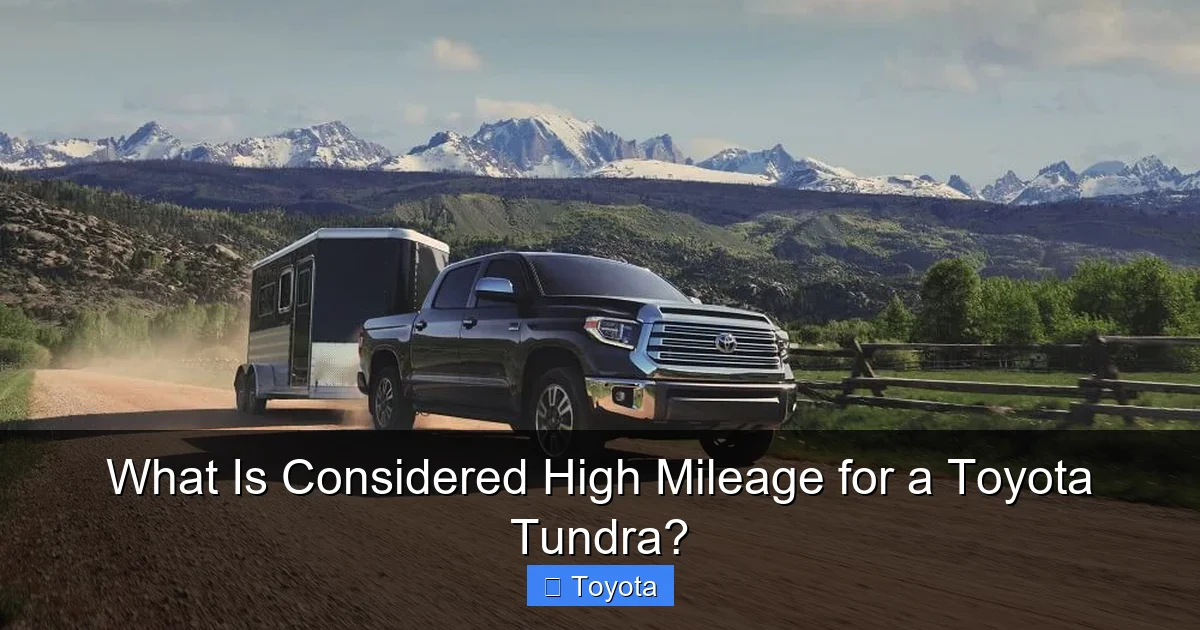
Visual guide about What Is Considered High Mileage for a Toyota Tundra?
Image source: andymohrtoyota.com
Fluids Are the Lifeblood: Never Skip a Change
This cannot be stressed enough. Oil changes are just the start.
- Engine Oil: Use a high-quality full synthetic oil (like those rated for Toyota’s specifications) and change it every 5,000-7,500 miles, not the 10,000-mile interval some manufacturers suggest. For high-mileage engines, consider a high-mileage oil formulation with seal conditioners.
- Transmission Fluid: This is critical. For the 6-speed automatic (2007-2021), a drain and fill every 30,000-40,000 miles is a smart, inexpensive insurance policy. A complete flush (if the service history is unknown) at a reputable shop can remove degraded fluid and varnish. For the new 10-speed and hybrid, follow Toyota’s severe service schedule, which often calls for changes every 60,000 miles.
- Differential Fluids: Both front and rear differentials (and the transfer case on 4×4 models) need fluid changes every 60,000-100,000 miles. Use the exact Toyota-specified gear oil (usually a hypoid GL-5). Neglecting these leads to gear whine and eventual failure.
- Coolant: Engine coolant degrades. Change it every 100,000 miles or 10 years. A failing water pump (common on early 5.7Ls) can contaminate the oil with coolant, destroying the engine.
Inspect, Listen, and Feel
Become attuned to your truck.
- Listen: Any new whine from the rear end? A clunk on acceleration or deceleration? That’s a differential or U-joint talking.
- Feel: Does the transmission shift smoothly, especially from 1st to 2nd and downshifts when coming to a stop? Hesitation, harshness, or slipping are red flags.
- Inspect: Look for leaks. Check oil level monthly. Look at the color of the differential fluid on the dipstick (if equipped)—it should be clear, not metallic or burnt smelling.
Address Known Weaknesses Proactively
For second-gen Tundras (2007-2021):
- Timing Chain & Water Pump: The water pump is driven by the timing chain. If it fails, coolant goes into the oil. Inspect for coolant in oil (milky sludge on dipstick or under oil cap). Consider a preemptive water pump and thermostat replacement if history is unknown, especially on 2007-2013 models.
- Spark Plugs: The 5.7L V8 has 16 spark plugs. They are not trivial to change. Have them done on schedule (every 30,000 miles). A failed plug can cause misfires and eventually damage the catalytic converter.
- Air Suspension (if equipped): The optional rear air suspension on some trims is a known failure point after 100,000 miles. The bags leak, and the compressor fails. Budget for this or consider a conversion to springs.
For first-gen owners, constant vigilance for frame rust (in salt-belt states) and the health of the 4.7L V8’s timing chain guides is paramount.
Buying a High-Mileage Tundra: The Smart Shopper’s Checklist
You’ve found a Tundra with 220,000 miles that looks clean and is priced well. Now what? Follow this rigorous checklist.

Visual guide about What Is Considered High Mileage for a Toyota Tundra?
Image source: motorbiscuit.com
The Pre-Purchase Inspection (PPI) is Non-Negotiable
Do not buy without it. Spend $150-$250 for a thorough inspection at an independent shop that knows Tundras. Specifically ask them to:
- Check for stored diagnostic trouble codes (DTCs) in all modules, not just the engine. A cleared code can still be in history.
- Perform a compression test and leak-down test on the engine.
- Check transmission fluid condition (look for burnt smell, dark color, particles).
- Inspect differentials for metal shavings in the fluid.
- Check for frame rust, especially behind the front wheels and along the rear rails.
- Test all electrical gadgets, including the Set Button for cruise control and any traction control switches.
Service Records Are Your Best Friend
Ask the seller for every single receipt. Organize them chronologically. Look for gaps. A gap of 20,000 miles with no service record is a major red flag. Look for consistency—was it always the same shop? Were major services like timing belt/chain and water pump done at the recommended intervals? A seller who has kept perfect records is often one who has cared for the truck meticulously.
Test Drive Like a Detective
Go beyond a casual drive.
- Cold Start: Listen for any tapping, knocking, or excessive smoke from the exhaust on a cold start. This can indicate worn cam lobes or piston rings.
- Transmission Behavior: Drive through all gears, including manually selecting 1st and 2nd. Feel for shudder, slipping, or delayed engagement. Shift from Drive to Reverse and back while stopped. It should be firm and immediate, not sloppy.
- Under Load: If possible, find a hill and accelerate uphill. Listen for engine pinging (pre-ignition) and watch the temperature gauge. Does the transmission downshift appropriately?
- Coast Down: Shift to neutral at speed and let the truck coast. Listen for bearing noise in the wheels or differentials that might be masked under power.
Trim Level and Package Considerations
Sometimes, a specific trim can tell a story. A base-model SR5 work truck might have been subjected to more severe duty. A top-tier 1794 Edition or Limited, often purchased as a premium family hauler, might have led a gentler life. This isn’t a rule, but a data point. The 1794, with its leather and upscale features, was less likely to be a dirty-job truck. However, its complex features (like air suspension) can be costly to repair if they fail. Weigh the pros and cons.
Common High-Mileage Issues & What They Cost to Fix
Even the best Tundras develop aches and pains. Knowing the common, costly issues helps you negotiate and plan.
Second-Gen (2007-2021) V8 Powerplants
- Water Pump Failure (2007-2013): As mentioned, this is critical. Failure means coolant in oil, leading to a $5,000-$8,000 engine rebuild or replacement. Prevention is key.
- Spark Plug Failure: A broken plug can cause catastrophic damage to the cylinder head. Cost to replace all 16: $800-$1,200.
- Oil Consumption: Some 5.7Ls, particularly 2010-2014, are known to burn oil. Regular oil level checks are mandatory. Severe cases may need piston rings or a rebuilt long block.
Transmission (6-Speed Automatic)
- Solenoid/Valve Body Wear: Symptoms include harsh 1-2 shift, delayed engagement, or shuddering. A valve body rebuild or replacement costs $1,500-$3,000.
- Torque Converter Clutch Issues: Can cause slipping and overheating. A remanufactured converter and fluid change is $1,200-$2,500.
Drivetrain & Suspension
- Differential Whine/Bearings: A growing whine that changes with speed points to failing pinion or carrier bearings. Rebuilding a differential runs $1,000-$2,000 per axle.
- Air Suspension Failure: If equipped, the air bags and compressor will fail. Converting to coil springs is the most cost-effective fix ($800-$1,500). Factory replacement is much more.
- U-Joints & Driveshaft: High-mileage trucks often need U-joint replacement ($300-$600) and driveshaft balancing.
Frame Rust
For trucks in the “Salt Belt” (Northeast, Midwest), inspect the frame thoroughly. Surface rust is normal. Structural rust through the frame rails is a deal-breaker and often unrepairable to safe standards.
The Future is Long: Resale Value and Parts Availability
Here’s the fantastic news about the Tundra: it holds its value exceptionally well, *especially* the well-maintained, high-mileage examples. Why? Because the market knows these trucks can go the distance. There is a massive, thriving aftermarket and a huge supply of used parts from wrecking yards. Engines, transmissions, and axles are readily available. The sheer volume of Tundras produced means parts are cheap and mechanics know them inside and out. This ecosystem supports a high-mileage future. A 2012 Tundra with 250,000 miles has a known value because people buy and drive them every day. The depreciation curve flattens out. You’re not buying a liability; you’re buying a known quantity with a massive support network.
Conclusion: Redefining What “High Mileage” Really Means
So, what is considered high mileage for a Toyota Tundra? The answer is: It’s a number without context. For a first-gen truck, 200,000 is high. For a meticulously maintained second-gen, 300,000 is just broken in. For a new third-gen, we don’t even know the ceiling yet. The true measure of a high-mileage Tundra is not the number on the odometer, but the story told by its service records, its driving history, and the results of a thorough inspection. A high-mileage Tundra with a perfect pedigree is a better long-term bet than a low-mileage mystery box. These trucks reward owners who treat them right with staggering longevity. Your job as a buyer or owner is to be that kind of owner. Focus on the condition, not the count. Ask the right questions, get the inspection, and you can confidently own a Tundra that has many, many chapters left in its story.
Frequently Asked Questions
Is 200,000 miles too high for a Toyota Tundra?
Not necessarily. For a 2014-2021 model with a 5.7L V8 and a complete service history, 200,000 miles is a reasonable figure. The key is documented maintenance, especially regarding transmission fluid and the timing chain/water pump system. For a 2000-2006 model, 200,000 miles is more significant and warrants extra scrutiny.
What is the most common problem with high-mileage Tundras?
For second-generation (2007-2021) models with the 5.7L V8, the most critical issue is water pump failure, which can lead to coolant contamination and engine destruction if not caught early. Transmission solenoid/valve body wear causing harsh shifting is also very common around the 150,000-200,000-mile mark.
How much does it cost to maintain a Tundra with over 200,000 miles?
Costs vary wildly based on history. A well-maintained truck will need regular fluid changes ($400-$600 every 30k miles) and wear items like brakes and tires. A neglected truck can face a $3,000-$6,000 bill for a transmission rebuild or a $5,000+ engine rebuild. Budgeting $1,500-$2,500 annually for upkeep on a high-mileage Tundra is a safe estimate.
Can a Toyota Tundra last 500,000 miles?
While extremely rare, it is possible with near-perfect maintenance and a bit of luck. The limiting factor is usually the transmission or major engine components. There are documented cases of Tundras with 400,000+ miles on the original powertrain, but 500,000 would be an extraordinary outlier, even for a Toyota.
Should I buy a high-mileage Tundra or a lower-mileage different brand truck?
Generally, a high-mileage Tundra with a stellar service history is a smarter buy than a lower-mileage truck from a brand with poorer long-term reliability ratings (based on data from sources like Consumer Reports). The Tundra’s durability and cheap, abundant parts give it a massive advantage in the long run.
What is the best model year Tundra to buy used for high mileage?
For the best balance of proven reliability and modern features, a 2014-2021 model with the 5.7L V8 is the sweet spot. The 2014 refresh fixed many early-gen issues and introduced a more robust timing chain system. Avoid the earliest 2007-2009 models if you want the most worry-free high-mileage experience, as they had more teething problems.