What Is an Iwe on a Ford F-150?

Contents
- 1 Key Takeaways
- 2 📑 Table of Contents
- 3 What Exactly is IWE on a Ford F-150?
- 4 How Does IWE Work? The Technology Behind the Magic
- 5 The Benefits of IWE: Why F-150 Owners Love It
- 6 Common Issues and Troubleshooting IWE Systems
- 7 Maintaining Your IWE System for Longevity
- 8 The Evolution of IWE: From Concept to Modern Implementation
- 9 Conclusion: Embracing Intelligent Capability
- 10 Frequently Asked Questions
Car Emergency Roadside Kit
Wiper Blade Refills

Jumper Cables

LED Indicator Light
IWE (Intelligent 4WD) is Ford’s advanced, automatic four-wheel drive system for the F-150, designed to engage 4WD seamlessly based on real-time traction needs. It significantly enhances safety and convenience by handling engagement automatically, which is invaluable in unpredictable conditions like snow, mud, gravel, or while towing. Understanding your IWE system helps you maximize your truck’s legendary capability and proactively address any potential maintenance issues.
If you own or are considering a Ford F-150, you’ve likely seen the “IWE” badge on the tailgate or heard the term thrown around in truck forums. But what exactly is IWE on a Ford F-150? It’s not some mysterious extra package or a new type of engine. IWE stands for Intelligent 4WD, and it represents one of the most significant and useful technological evolutions in the F-150’s legendary capability. Think of it as your truck’s built-in, super-smart traction assistant. Instead of you having to manually shift a lever or push a button to engage four-wheel drive when the roads get slick, IWE does it for you, almost magically, the moment it senses the front or rear wheels starting to spin. It’s the difference between reacting to a loss of traction and preventing it entirely. This system transforms the F-150 from a powerful truck into an intuitively capable one, making it a trusted companion for everything from snowy school runs to hauling a boat up a muddy ramp. In this complete guide, we’ll peel back the layers of this clever technology, explaining exactly how it works, why it matters, what can go wrong, and how to keep it running smoothly for years to come.
Key Takeaways
- IWE Stands for Intelligent 4WD: It is not a separate system but Ford’s branding for the automatic, clutch-based 4WD engagement feature found in many F-150 models.
- It’s Fully Automatic: The system uses multiple sensors to detect wheel slip and automatically engages the front axle, requiring no driver input for most situations.
- Primary Benefits are Safety and Convenience: IWE provides instant traction when needed, reduces driver error, and is especially helpful during sudden weather changes or while towing.
- Common Failure Points Include the IWE Actuator and Solenoids: These electro-mechanical components can wear out, leading to noises, failure to engage, or stuck 4WD.
- Regular Maintenance is Key: This includes servicing the front differential fluid and ensuring the system’s electrical connections are clean and secure.
- IWE Works with Other Systems: It collaborates with the truck’s stability control and traction control systems for comprehensive vehicle dynamics management.
📑 Table of Contents
- What Exactly is IWE on a Ford F-150?
- How Does IWE Work? The Technology Behind the Magic
- The Benefits of IWE: Why F-150 Owners Love It
- Common Issues and Troubleshooting IWE Systems
- Maintaining Your IWE System for Longevity
- The Evolution of IWE: From Concept to Modern Implementation
- Conclusion: Embracing Intelligent Capability
What Exactly is IWE on a Ford F-150?
Let’s start with the absolute basics. IWE, or Intelligent 4WD, is Ford’s trademarked name for its automatic four-wheel drive engagement system. It is a feature integrated into the F-150’s electronic powertrain control module. To understand IWE, you first need to know that your F-150’s standard setup is rear-wheel drive (2WD). When you select 4WD (either 4HI or 4LO) via the switch or dial on your dash, you’re physically locking the front and rear driveshafts together, sending power to all four wheels. IWE doesn’t replace this mechanical 4WD system; it automates the decision and action of when to engage it.
Decoding the Acronym: More Than Just a Name
The “Intelligent” part is key. This isn’t a simple on/off switch. IWE is a closed-loop feedback system. It’s constantly listening and watching. It uses a network of sensors—primarily the wheel speed sensors from the anti-lock brake system (ABS)—to monitor the rotational speed of each wheel hundreds of times per second. The system’s computer brain (the PCM) is programmed with a threshold. When it detects that the rear wheels (the driven wheels in 2WD mode) are rotating significantly faster than the front wheels (indicating slip), it triggers a response. That response is to silently and smoothly engage the front axle via an electro-mechanical actuator, shifting the truck from 2WD to 4WD without you having to do a thing. The engagement is so quick and seamless you might only notice the slight change in engine note or the illumination of the 4WD light on your instrument cluster. For a deeper dive into the core technology, you can explore our dedicated article on unveiling the hidden power behind IWE technology.
Where You’ll Find IWE in Your F-150
IWE is not a standalone button. It is the underlying logic behind the standard 4WD selector switch (or rotary dial) in your F-150. When you turn your truck on, the default position is typically 2WD (or “Auto” on some model years, which is actually IWE mode—more on that confusion later). The positions are usually: 2WD, 4AUTO (or AUTO), 4HI, and 4LO. The magic happens in the 4AUTO setting. When your selector is on 4AUTO, the IWE system is armed and active. It will automatically switch between rear-wheel drive and four-wheel drive as needed. If you manually select 4HI or 4LO, you are overriding IWE and locking the truck into permanent 4WD, which is useful for severe conditions but should not be used on dry pavement. So, your IWE system is always “on” when the selector is in the AUTO position, working tirelessly in the background.
How Does IWE Work? The Technology Behind the Magic
Now for the fun part: the nuts and bolts. The IWE system is a beautiful marriage of mechanical hardware and sophisticated software. Its core component is the IWE actuator, a small but powerful electric motor/gearbox unit mounted on the front of the transfer case. This actuator is connected to a shift fork inside the transfer case. When the system’s computer decides 4WD is needed, it sends a signal to this actuator. The actuator’s motor spins, moving the shift fork, which slides a clutch pack or synchronizer inside the transfer case, physically connecting the front output shaft. This engages the front driveshaft and, consequently, the front differential and wheels. The process is designed to be fast, quiet, and smooth, often completing in less than a second.

Visual guide about What Is an Iwe on a Ford F-150?
Image source: f150lab.com
The Sensor Network: The System’s Eyes and Ears
The decision to engage is based on data from several sources:
- Wheel Speed Sensors: The primary data source. A significant difference between average front and rear wheel speeds is the classic sign of rear-wheel slip.
- Steering Wheel Angle Sensor: This tells the system if you’re turning. It helps the computer understand that a difference in wheel speeds during a turn is normal (the inside wheel rotates slower than the outside), preventing false engagement.
- Throttle Position Sensor & Brake Pedal Switch: Aggressive acceleration or heavy braking can influence the system’s logic, as these are common times for wheel slip.
- Yaw Rate Sensor (in some models): Part of the stability control system, it helps detect if the vehicle is beginning to slide or fishtail.
All this data is crunched in milliseconds. The software is tuned to be conservative but effective. It will typically engage 4WD just before a driver would even realize slip is occurring, providing a huge safety margin.
The “Auto” vs. “4HI” Confusion: A Critical Distinction
This is a common point of confusion for F-150 owners. The “4AUTO” (or sometimes just “AUTO”) position is where IWE is active. In this mode, the truck operates as a 2WD vehicle under normal, dry, high-traction conditions. This is fuel-efficient and reduces wear on 4WD components. When slip is detected, it seamlessly transitions to 4WD. The “4HI” position is a manual override. Selecting 4HI locks the system into permanent, full-time 4WD, regardless of conditions. You should use 4HI when you anticipate constant slippery conditions (like deep snow or ice) or when towing on slick surfaces. Never use 4HI on dry pavement for extended periods, as it can cause “wheel binding” or “crow hop” and damage components. IWE in Auto mode prevents you from making this mistake by automatically disengaging when it senses high-traction conditions again.
The Benefits of IWE: Why F-150 Owners Love It
The IWE system isn’t just a fancy gadget; it provides tangible, real-world benefits that enhance the F-150’s utility and safety profile.

Visual guide about What Is an Iwe on a Ford F-150?
Image source: motor.com
1. Unmatched Convenience and Reduced Driver Workload
Before IWE, you had to be a prognosticator. You’d see snow clouds on the horizon and think, “Should I push the 4WD button now, or wait until I’m stuck?” With IWE, you simply leave the selector on 4AUTO and forget it. The truck handles the decision. This is a massive advantage for daily drivers who encounter rapidly changing conditions—a sudden rain shower on a highway merge, a patch of black ice, or an unexpectedly muddy job site entrance. You can focus on steering and braking while the truck manages traction. It eliminates the hesitation and guesswork that can lead to getting stuck.
2. Proactive Safety Enhancement
Reactive 4WD engagement (you *feeling* the slide and *then* engaging) is often too late. By the time you sense loss of traction, momentum may already be lost, or a skid may have begun. IWE is proactive. It can engage before the rear wheels have spun enough to cause a yaw (sideways slide). This is particularly valuable in emergency maneuvers, like swerving to avoid an obstacle on a wet road. By pre-emptively sending power to the front wheels, it helps maintain directional stability and keeps the truck planted. This synergy with the truck’s AdvanceTrac stability control system creates a powerful safety net. For comparison, other manufacturers implement similar automatic AWD logic; for instance, Subaru’s X-Mode system is designed to optimize power distribution for low-traction scenarios, showcasing how this technology has become an industry standard for safety.
3. Optimized Performance for Towing and Hauling
Towing a heavy load puts immense demand on the rear tires. When accelerating from a stop, or climbing a grade with a trailer, the rear wheels can easily break loose, especially if the tongue weight is light or the road is wet. IWE is a game-changer here. As you apply throttle, the system anticipates the strain and often has the front axle engaged before significant spin occurs. This provides a more confident, stable launch and hill climb. It reduces trailer sway caused by rear-wheel slip and makes starting on an incline with a loaded trailer much smoother. The system’s ability to modulate engagement means it’s working constantly to keep all four wheels gripping, which is crucial when your payload is a $50,000 boat or a heavy equipment trailer.
4. Seamless, Driver-Friendly Operation
The engagement of IWE is engineered to be imperceptible. There’s no jarring clunk, no need to stop the truck, and no rev-matching required. You might feel a subtle surge of power or see the 4WD indicator light flash and then stay solid, but the transition is designed to be smooth. This is a stark contrast to older, part-time 4WD systems that required you to stop, shift to neutral, engage 4WD, and then resume driving. That process was cumbersome and often not possible to do once you were already in motion or stuck. IWE allows for on-the-fly engagement at any speed, making it practical for everyday use.
Common Issues and Troubleshooting IWE Systems
For all its brilliance, the IWE system is a complex electro-mechanical assembly, and like any component, it can fail. Understanding the symptoms of IWE problems is crucial for early diagnosis and preventing costly damage.
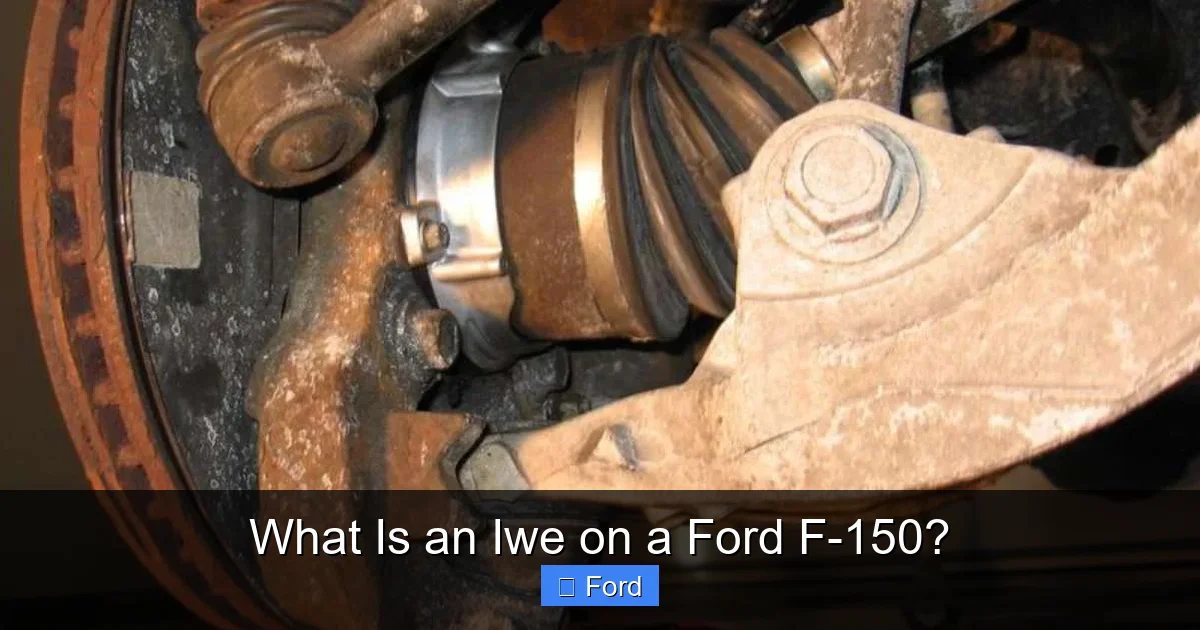
Visual guide about What Is an Iwe on a Ford F-150?
Image source: trucksauthority.com
Symptom: The “IWE Clunk” or Rattle
This is the most famous and common IWE issue. You’ll hear a distinct clunk, rattle, or thump from the front of the truck, typically when making a tight turn at low speed (like in a parking lot) or sometimes just after starting from a stop. This sound is almost always caused by a failing IWE actuator. Inside the actuator are plastic gears that can wear out or break. When the system tries to disengage the front axle after a turn (the computer thinks it’s safe to go back to 2WD), the broken gears cause a loud mechanical clatter as they skip. The truck may still engage 4WD, but the noise is annoying and indicates an impending complete failure. If you hear this, the actuator needs to be replaced.
Symptom: Failure to Engage or Stuck in 4WD
If your truck won’t go into 4WD (the light just blinks or won’t come on) or, conversely, is stuck in 4WD (the 4WD light is on permanently and you can’t select 2WD), the problem could be:
- Faulty IWE Actuator: The motor may have burned out, or its internal clutch pack could be welded.
- Failed Solenoids or Wiring: The transfer case has solenoids that control vacuum or hydraulic pressure for the front axle disconnect. Electrical issues, corroded connectors, or broken wires can prevent the signal from reaching the actuator.
- Transfer Case Internal Failure: Less common, but the shift mechanisms inside the transfer case itself could be damaged.
A diagnostic scan tool is needed to check for fault codes related to the 4WD system, which can point technicians to the specific failed component.
Symptom: Intermittent 4WD Operation
Sometimes 4WD works perfectly, and other times it doesn’t. This often points to a poor electrical connection. The connectors for the IWE actuator and the front axle solenoid on the transfer case are exposed to the elements (road salt, water, mud). Over time, corrosion can build up, creating an intermittent contact. Vibrations from driving can momentarily break or make this connection, causing the system to work or fail unpredictably. Cleaning and securing these connectors is a common and often effective fix.
Diagnostic Steps
If you suspect an IWE issue:
- Listen: Identify the clunk sound pattern. Is it only on tight turns? That’s the classic actuator symptom.
- Check Fuses: Locate the fuse for the 4WD system in your owner’s manual and ensure it’s not blown.
- Visual Inspection: Look at the wiring harnesses near the transfer case and front differential for damage, chafing, or corrosion.
- Professional Scan: A mechanic with a proper Ford diagnostic tool (like IDS) can run a 4WD system self-test and read any stored codes, which is the most reliable way to diagnose.
Ignoring these symptoms can lead to a situation where you have no 4WD when you desperately need it, or worse, could cause damage to the transfer case if components are grinding against each other.
Maintaining Your IWE System for Longevity
The good news is that IWE systems are generally robust. With a little preventative care, you can avoid most major failures. Maintenance focuses on the two key areas: fluid and electricity.
Front Differential Fluid Service
The front differential, which is now being driven whenever IWE engages, needs proper lubrication. Ford’s service interval for front differential fluid varies by model year and usage, but a good rule of thumb is to inspect it at every oil change and change it according to the severe service schedule in your owner’s manual (often every 50,000 miles if towing or using 4WD frequently). Using the correct fluid (usually SAE 75W-90 GL-5 gear oil) is critical. Old, contaminated, or incorrect fluid can cause excessive wear on the differential gears and bearings, and in extreme cases, can even affect the IWE actuator’s operation if the fluid finds its way into the actuator cavity (a known issue on some early models). A simple drain and fill is a cheap insurance policy against a costly differential rebuild.
Electrical Connection Care
Given the exposure to the elements, periodically checking the electrical connections for the IWE actuator and front axle solenoid is wise. When inspecting or having your truck serviced, ask the technician to:
- Unplug the connectors and look for green/white corrosion on the terminals.
- Apply a small amount of dielectric grease to the terminals before reconnecting. This repels moisture and prevents future corrosion.
- Ensure the wiring harness is secured and not rubbing against any metal or sharp edges.
This simple 10-minute task during a routine service can save you from intermittent electrical gremlins later.
Driving Habits That Help
You don’t need to baby your truck, but some habits help:
- Avoid aggressive, full-throttle launches in 2WD on high-traction surfaces. This stresses the IWE system unnecessarily. If you want to play, select 4HI.
- When stuck, try to “rock” the vehicle gently in 2WD before engaging 4HI. This can sometimes free you without excessive wheel spin that heats components.
- If you hear the telltale IWE clunk on tight turns, it’s a sign the system is trying to disengage. In this case, you can manually select 4HI for the duration of the tight maneuver (like in a slow-speed off-road situation) to keep the front axle locked and eliminate the noise, but remember to switch back to Auto for normal driving.
For those who use their F-150 in severe conditions, understanding how systems like Toyota’s Auto LSD manage wheel slip can provide perspective on the different approaches manufacturers take to traction control, though the underlying goal is the same: keep you moving.
The Evolution of IWE: From Concept to Modern Implementation
The IWE system didn’t appear in a vacuum. It was Ford’s answer to a growing industry trend toward more sophisticated, user-friendly 4WD systems. Early F-150s had simple, part-time 4WD systems with manual levers. Then came electronic shift-on-the-fly systems that allowed you to engage 4HI while moving, but you still had to push a button. IWE, introduced in the early 2000s on the 10th-generation F-150 (2004-2008), was the next logical step: automatic shift-on-the-fly. It moved the decision-making from the driver’s brain to the truck’s computer.
Generational Improvements
Early IWE systems (2004-2008) were effective but had some documented weaknesses, particularly with the plastic-geared actuators that were prone to failure. Ford refined the design in subsequent generations. Later models (2015+ with the 13th generation) feature a more robust electro-hydraulic IWE system in many trims. Instead of a purely electric motor, it uses an electric pump to build hydraulic pressure that engages a clutch pack. This design is generally more durable and provides a smoother, firmer engagement. The software logic has also been tuned over the years to be less “trigger-happy,” reducing unnecessary engagements that can cause wear. The core principle—automatic engagement based on slip—remains unchanged, but the execution has matured.
IWE in the Context of Modern Truck Tech
Today, IWE is just one part of the F-150’s comprehensive suite of traction and stability aids. It works hand-in-hand with:
- AdvanceTrac with Roll Stability Control (RSC): Uses brakes and engine power to prevent skids and rolls.
- Trailer Sway Control: Applies brake pressure to individual wheels to dampen trailer sway.
- Hill Start Assist & Hill Descent Control: Helps control speed on grades.
IWE provides the foundational “send power to all wheels” capability, while these other systems manage how that power is used and controlled. This layered approach is what gives the modern F-150 its renowned composure. Looking at the broader automotive landscape, similar automatic AWD logic is now standard in many SUVs and crossovers from brands like Subaru with its X-Mode or even some front-wheel-drive-based cars with advanced torque vectoring. Ford’s implementation in a body-on-frame truck is particularly noteworthy because of the immense stress and variety of conditions a full-size pickup faces.
Conclusion: Embracing Intelligent Capability
So, what is IWE on a Ford F-150? It is the embodiment of intelligent, unobtrusive capability. It’s the quiet guardian that works tirelessly in the background, ensuring your powerful rear-wheel-drive truck transforms into a confident four-wheel-drive hauler the moment the pavement vanishes or the rain begins to fall. It removes the guesswork, the hesitation, and the manual steps from the equation, making legendary F-150 capability accessible to every driver, regardless of their 4WD expertise. While its electro-mechanical nature means it requires awareness—listening for that actuator clunk and staying on top of fluid and electrical maintenance—the benefits far outweigh the potential complexities. For the daily driver, it’s a safety net. For the tower, it’s a performance enhancer. For the off-roader, it’s a seamless transition from pavement to dirt. Understanding your IWE system is the first step to truly mastering your F-150. It’s not just a feature; it’s a fundamental part of what makes the Ford F-150 the best-selling, most trusted truck on the planet. Treat it with respect, listen to its cues, and it will reward you with years of sure-footed, worry-free hauling.
Frequently Asked Questions
What does IWE stand for on a Ford F-150?
IWE stands for Intelligent 4WD. It is Ford’s name for the automatic four-wheel drive engagement system that monitors wheel slip and engages the front axle without driver input when needed.
Is IWE the same as having a traditional 4WD system?
IWE is a feature of the traditional 4WD system. Your F-150 still has a mechanical transfer case and front differential. IWE simply automates the clutch pack that engages the front axle, so you don’t have to manually push a button or move a lever. It’s an “auto” mode within your 4WD system.
Can I use IWE while towing a trailer?
Absolutely. In fact, IWE is highly beneficial while towing. It will automatically engage 4WD when it senses the rear wheels of your truck losing traction, which is common when starting with a heavy load or climbing grades. This provides more stable and confident towing, especially in wet or slippery conditions. Just ensure your trailer’s brakes are properly set up.
Why is my IWE making a loud clunking noise when turning?
The classic “IWE clunk” is almost always caused by a failing IWE actuator. The plastic internal gears in the actuator have worn out or broken. When the system tries to disengage the front axle after a turn, the damaged gears skip and make a loud rattling noise. The fix is to replace the IWE actuator.
How much does it cost to fix a broken IWE system?
Costs vary by model year and the specific failed component. Replacing just the IWE actuator typically ranges from $500 to $1,200 in parts and labor. If the problem is electrical (wiring, connectors, solenoids), it can be less expensive. If the failure has caused damage to the transfer case or front differential, costs can rise significantly. Early diagnosis is key to keeping repairs affordable.
Can I disable or turn off the IWE system?
You cannot permanently disable the IWE logic when the 4WD selector is in the “AUTO” or “4AUTO” position—that’s its entire purpose. However, you can override it by manually selecting “4HI” or “4LO,” which locks the front axle on permanently. There is no “off” switch for the IWE monitoring system itself; it’s always powered when the truck is on and in AUTO mode.