
Are There Any Recalls on a 2008 Ford F-150

Yes, the 2008 Ford F-150 has several open and completed recalls covering critical systems like the throttle, cruise control, and airbags. All recall repairs are performed free by Ford dealers. It’s vital to check your specific VIN for any outstanding recalls and address them promptly to ensure your safety and your truck’s long-term reliability.
Key Takeaways
- Recalls are common: The 2008 F-150, like many vehicles of its era, has multiple recalls for safety and emissions-related components.
- Repairs are always free: Ford is legally required to fix recall defects at no cost to the vehicle owner, regardless of age or mileage.
- Check your VIN: The only way to know your specific truck’s recall status is by entering its 17-digit VIN on the official NHTSA or Ford websites.
- Do not ignore them: Unaddressed recalls can lead to dangerous failures, reduced reliability, and even affect your ability to sell or trade the vehicle.
- Dealers must perform the work: Only authorized Ford dealerships have access to the official recall parts, software, and procedures for proper repair.
- Some recalls have time limits: While most are open-ended, a few older recalls may have expiration dates or require owner action within a specific timeframe.
- Documentation is key: Always get a written repair order after a recall service for your records and future resale.
[FEATURED_IMAGE_PLACEHOLDER]
📑 Table of Contents
Why Recalls Matter for Your 2008 Ford F-150
Owning a 2008 Ford F-150 means you have a capable, popular truck. But popularity also means when a design or parts flaw is discovered, it can affect a huge number of vehicles. A recall is the manufacturer’s official acknowledgment that a defect exists which poses a risk to safety or violates emissions standards. For your 2008 F-150, understanding recalls isn’t just paperwork—it’s about keeping you, your passengers, and your investment safe. Ignoring a recall is like driving with a known time bomb in your system. It might not fail today, but when it does, it could be catastrophic, costly, and completely avoidable.
Think of a recall as a free, mandatory insurance policy from the manufacturer. Ford has identified a problem, and they are on the hook to fix it. This applies to every owner, from the original buyer to someone who bought the truck yesterday from a private party. The system is designed to protect everyone on the road. For a 2008 model, many recalls are for components that age and wear, like electrical connectors or throttle bodies, making them even more relevant today than when the truck was new. Proactively managing recalls is a non-negotiable part of responsible truck ownership. It directly impacts your truck’s reliability, its resale value, and most importantly, your peace of mind every time you turn the key.
The Legal and Safety Imperative
Recalls are not suggestions; they are federal mandates issued by the National Highway Traffic Safety Administration (NHTSA). When a recall is issued, Ford must notify all registered owners and provide a remedy. This remedy is almost always a repair, replacement, or sometimes a refund for a specific part. The law is clear: you should not have to pay a dime to make your vehicle compliant with federal safety standards. This is a consumer protection measure born from decades of automotive history where manufacturers sometimes chose profit over safety. For your 2008 F-150, this means if there’s a faulty airbag inflator or a throttle that can stick, Ford technicians will replace it for free. It’s a powerful right you have as an owner.
Beyond the legal requirement, there’s a profound safety reason. The defects leading to recalls are not hypothetical; they are proven failure modes. Engineers and crash data analysts have traced real-world incidents back to a specific part or software glitch. For example, a recall might stem from reports of sudden unintended acceleration or airbags that deploy with excessive force. Addressing these recalls removes those known failure points. It transforms your truck from a potential hazard into a machine that meets the safety standards it was originally designed to meet. In the context of a heavy-duty truck like the F-150, which is often used for towing and hauling, a sudden loss of power or control from an unaddressed recall could be especially disastrous.
Impact on Value and Long-Term Reliability
Let’s talk money. A vehicle with an open recall is a red flag for any savvy buyer. When you go to sell or trade your 2008 F-150, the first thing a dealership or private buyer will do is run a recall check. Open recalls can tank your offer because the new owner inherits the problem and the responsibility to get it fixed. They know they’ll have to waste a day at the dealer. A truck with a fully documented recall history, showing all repairs were completed, is far more attractive. It signals that the previous owner was diligent and transparent. You can often command a higher price simply by having your recall status clean.
Long-term reliability is the other side of the coin. The components targeted by recalls are often under immense stress. A recalled throttle body sensor, for instance, might work fine for a while but then fail at the worst moment, leaving you stranded. By getting the recall done, you’re not just fixing a current problem; you’re preventing a future breakdown that could cost you a tow truck, a rental car, and missed work. It’s the ultimate preventative maintenance. Furthermore, many recall repairs involve updated parts or software that improve the longevity of the affected system. You’re getting an upgrade that Ford developed specifically to correct the flaw, which often improves the overall performance and durability of that system going forward.
Common Recalls on the 2008 Ford F-150
The 2008 model year sits in an interesting period for the F-150. It was the final year of the 11th generation before the major redesign for 2009. As such, it shares many components and potential issues with its 2004-2008 predecessors. Over the years, NHTSA and Ford have issued several recalls for this generation. While not every single 2008 F-150 will be affected by every recall—it depends on specific production dates, engine types, and equipment packages—there are a handful of significant ones that owners must be aware of. We’ll break down the most prevalent and serious recalls, explaining what the problem was, which trucks are affected, and what the fix entails.
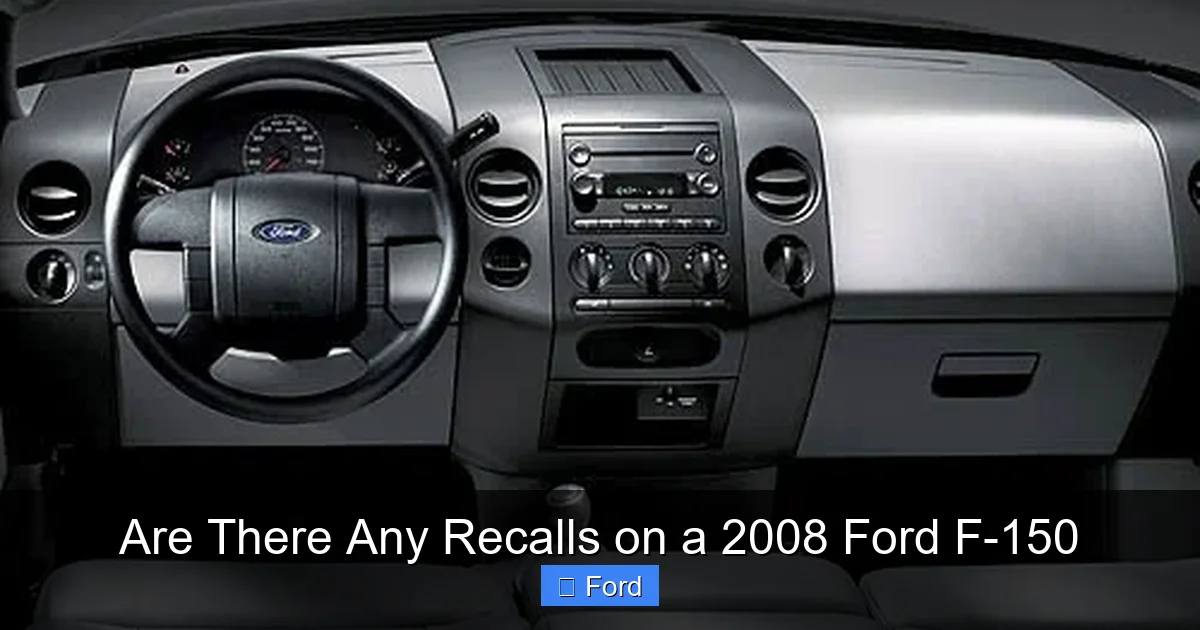
Visual guide about Are There Any Recalls on a 2008 Ford F-150
Image source: autodetective.com
It is crucial to remember: your truck is only subject to recalls for which it is specifically listed. A VIN check is the only way to know for sure. However, knowing the common issues helps you understand what symptoms to watch for and why checking your VIN is so important. These are not minor service bulletins; they are federal safety actions. Let’s dive into the big ones.
Recall: Throttle Control System (Throttle Body) – NHTSA 08V461000
This is one of the most significant and widespread recalls for the 2004-2008 F-150. The problem lies in the electronic throttle body (ETB). The ETB’s internal motor contacts can wear prematurely, leading to a loss of electronic throttle control. What does this mean for you? The truck could suddenly go into a “limp home” mode with reduced power, or in rare cases, the throttle could fail to return to the idle position, causing unintended acceleration. Symptoms might include a rough idle, a flashing check engine light, or a sudden, unexpected surge in speed when cruising.
Affected Vehicles: 2004-2008 F-150s equipped with the 4.6L or 5.4L V8 engines. A huge number of trucks are included. The recall was initially issued in 2008 but was expanded and revised multiple times as more failures were reported. Even if you had it repaired once, there was an extended warranty on the part because failures recurred.
The Fix: Ford dealers replace the entire electronic throttle body assembly with an updated, redesigned part that has more durable contacts. They also update the powertrain control module (PCM) software to better manage a failing ETB and provide more warning to the driver. This is a multi-hour job. If you experience any throttle-related symptoms, get your VIN checked immediately and have the truck towed to a dealer if the issue is severe. Driving with a potentially failing throttle is dangerous.
Recall: Cruise Control – NHTSA 10V436000
Closely related to the throttle issue is a recall for the cruise control system. The problem here is a faulty speed control deactivation switch. In some 2008 F-150s, this switch can fail internally and cause a short circuit. The danger? The short can melt the switch and, in extreme cases, lead to a fire under the hood. Even if it doesn’t cause a fire, it can cause the cruise control to malfunction or become inoperable. This recall often overlaps with the throttle body recall because the systems are integrated.
Affected Vehicles: 2008 F-150s built at certain plants on specific dates. It’s a more limited subset than the throttle recall but still affects many trucks. The VIN is the only way to confirm eligibility.
The Fix: The dealer replaces the faulty speed control deactivation switch assembly with a new, redesigned part that is not susceptible to the internal short. They also inspect the wiring harness for any damage caused by the previous switch failure and repair it if necessary. This is a relatively quick and straightforward repair, but the fire risk makes it a high priority.
Recall: Passenger Airbag Inflator – NHTSA 18V750000 (and others)
This is part of the massive, ongoing Takata airbag inflator recall affecting nearly every automaker. For the 2008 F-150, the passenger side frontal airbag inflator is at risk. The inflator is the small metal canister that, in a crash, rapidly produces gas to fill the airbag. In these recalled inflators, the propellant can degrade over time, especially in hot, humid climates. If the airbag deploys, the inflator casing can rupture explosively, shooting sharp metal fragments into the cabin—essentially turning a safety device into a source of serious injury or death.
Affected Vehicles: Millions of 2008 F-150s across all cab and bed configurations are included in various phases of this recall. The risk is long-term and geographic, but it is a severe, known risk. Ford has been conducting this recall in phases for years.
The Fix: This is a more involved repair. The dealer replaces the entire passenger airbag module (the inflator and the bag itself) with a new, safe inflator from a different manufacturer or with a redesigned Takata unit. This requires disassembling the passenger side of the dashboard. It’s a major safety repair that must be done. If you get a notice, schedule it immediately. Do not delay on this one.
Recall: Fuel Tank Strap / Fuel Tank Integrity – NHTSA 15V246000
A less common but serious recall for some 2008 F-150s involves the fuel tank. The metal straps that secure the fuel tank to the vehicle frame can corrode and break, especially in regions that use road salt. If a strap fails, the fuel tank can shift and potentially rupture in a crash, leading to a fire risk. Additionally, there was a concern about the fuel tank filler neck potentially cracking, leading to leaks.
Affected Vehicles: This recall targets a specific production range of 2008 F-150s, primarily those sold in states with heavy road salt use (the “salt belt”). The VIN check is essential here.
The Fix: Dealers inspect the fuel tank straps for corrosion. If they are compromised, they replace both straps with new, corrosion-resistant ones. They also inspect the filler neck and related lines for cracks and replace as necessary. This is an under-truck inspection and repair that is critical for structural safety.
Other Notable Recalls and Service Campaigns
Beyond the major NHTSA recalls, there are often manufacturer-sponsored “customer satisfaction” or “safety” campaigns for specific issues. These might not be official NHTSA recalls but are still performed free at dealers. For the 2008 F-150, these have included:
- Battery Cable: Some models had a battery cable that could rub against a bracket, causing a short and fire risk. The fix was a new cable with protective sheathing or a bracket relocation.
- Steering Column Lock: A rare issue where the steering column lock mechanism could fail, making the steering wheel difficult to turn. The lock mechanism was replaced.
- Rear Axle Shaft: On some 4×4 models, the rear axle shaft could fracture. This required a full axle shaft replacement.
These campaigns highlight why a VIN-specific check is so important. Your truck might have a fix available that isn’t part of the big, well-known recalls.
How to Check if Your 2008 F-150 Has Open Recalls
Knowing your truck is subject to recalls is step one. Knowing *which* recalls apply to *your specific vehicle* is the critical step. The process is simple, free, and takes less than five minutes. You must use your Vehicle Identification Number (VIN). This 17-digit code is your truck’s unique fingerprint. It’s located on the driver’s side dashboard at the base of the windshield (visible from outside), on the driver’s side door jamb sticker, and on your title and insurance documents.
Visual guide about Are There Any Recalls on a 2008 Ford F-150
Image source: bidhistory.org
There are two official, government-backed sources for recall information. Using unofficial sites can lead to incomplete or outdated data. Always stick to these primary sources for accuracy.
Using the Official NHTSA Recall Lookup Tool
The National Highway Traffic Safety Administration operates the definitive recall database for all vehicles in the United States. Go to nhtsa.gov/recalls. You’ll see a prominent search box. Enter your 17-digit VIN and submit. The system will instantly tell you if your vehicle has any open recalls. It will list each recall by number, provide a brief description of the defect, and state the status (e.g., “Recall Incomplete,” “Remedy Not Yet Available”). This tool is updated in real-time as manufacturers submit data. It’s the most reliable source. If it shows no open recalls, your 2008 F-150 is currently clear. Bookmark this page and check periodically, especially if you hear news about a new recall for your model year.
Using Ford’s Owner Portal
Ford Motor Company also provides a recall lookup through its owner services website at ford.com/recalls or via the FordPass app. Entering your VIN here will show you the same recall information as NHTSA, but it may also provide additional details specific to Ford’s service process, such as whether parts are in stock at your local dealer or if a loaner vehicle is typically provided for that specific repair. Creating a free account on Ford’s owner portal can be beneficial. It allows you to save your vehicle information, receive email notifications if a new recall is issued for your VIN, and access your vehicle’s service history if it’s been maintained at a Ford dealer.
What the Results Mean: “Open” vs. “Closed”
When you run your VIN, you’ll see recalls labeled with a status. “Recall Incomplete” or “Open” means the repair has not yet been performed on your specific vehicle. This is what you need to act on. “Recall Complete” means the repair was done, and you should have paperwork from the dealer. If you bought the truck used and don’t have the paperwork, you can call a Ford dealer with your VIN, and they can look up the service history in their system. Sometimes, a recall might show as “Remedy Not Yet Available.” This means Ford has acknowledged the defect but is still developing the parts or software fix. In this case, you should follow any interim instructions provided in the recall notice (like not using a certain feature) and monitor the status. Ford is required to provide a remedy within a reasonable time, but complex recalls can take months or even years to develop a final fix.
What to Do If Your 2008 F-150 Has an Open Recall
You’ve checked your VIN. There’s an open recall. Now what? The process is designed to be as frictionless as possible for the consumer, but you have to initiate it. Here is your step-by-step action plan to get the repair done correctly and without cost.
Step 1: Contact a Ford Dealer Immediately
Do not call a generic mechanic or an independent shop. Recalls must be performed by an authorized Ford dealership. Why? Only dealers have direct access to the latest recall-specific parts, technical service bulletins (TSBs), and software updates directly from Ford. An independent shop might not have the correct part or the updated calibration procedures, potentially leaving your truck in an unsafe or non-compliant state. Call the service department of your local Ford dealer. Have your VIN ready. Tell them, “I have an open recall on my 2008 F-150, VIN [your VIN], and I’d like to schedule a recall repair appointment.”
Step 2: Schedule the Repair and Discuss Logistics
The dealer will look up your recall in their system and confirm the exact repair needed. They will then schedule an appointment. For major recalls like the airbag or throttle body, the repair can take several hours or even most of a day. Ask the service advisor:
- How long will the repair take? This helps you plan for a rental car or alternate transportation.
- Will a loaner vehicle be provided? Ford often provides a loaner for lengthy safety recalls, but policies vary by dealer. It’s worth asking.
- Are the parts in stock? For older models like 2008, some recall parts may be low in inventory. Knowing this upfront can prevent delays.
- Is there anything I should do or not do before bringing it in? For example, with the cruise control switch recall, they might advise you not to use the cruise control until it’s fixed.
Get your appointment confirmed and write down the date, time, and advisor’s name.
Step 3: Bring Your Truck and Paperwork
On the day of your appointment, arrive on time. Bring your driver’s license, registration, and insurance card. The dealer will need these for their records. You will likely have to sign a work authorization form. This is standard. Do not sign anything that says you agree to pay for the recall repair. The recall work is free. The form may have a section for “warranty” or “recall” work with a $0.00 charge. You may be asked to sign for other, unrelated services (like an oil change you requested separately), but keep those distinct. Before you leave, get a detailed, itemized repair order that explicitly states the recall number (e.g., “NHTSA 08V461000”) and lists a charge of $0.00 for all parts and labor associated with that recall. This document is your proof of compliance.
Step 4: Follow Up If There Are Issues
After the repair, test your truck carefully. Does the symptom that prompted you to check (like a rough idle or cruise control issue) seem resolved? If not, inform the service advisor immediately. Sometimes a recall repair reveals a pre-existing, unrelated problem. The dealer is only responsible for the recall fix. However, if the recall repair itself was performed incorrectly or the same problem recurs within a short time related to the recalled component, they must fix it again. Keep all your paperwork. If you move or sell the truck, provide the new owner with the recall repair documentation. It adds value and transparency.
Maintaining Your 2008 F-150 After a Recall
Getting a recall fixed is a huge step. But it doesn’t mean your maintenance responsibilities end. In fact, a recall repair often replaces a major component, and you want to protect that new investment. Furthermore, many of the systems involved in 2008 F-150 recalls—like the throttle body, electrical system, and fuel system—are interconnected. Keeping the entire system healthy prevents future problems and ensures the recall fix lasts as long as possible. Think of the recall repair as resetting a critical component to factory-fresh condition. Now, you need to maintain the environment around it.
Electrical System Health is Paramount
Several 2008 F-150 recalls involve electrical components (throttle body, cruise control switch, battery cable). A healthy, robust charging system is the foundation. A weak or failing battery can cause voltage spikes and drops that stress sensitive electronic control modules, including the new throttle body or the powertrain control module (PCM). We strongly recommend having your battery and charging system tested at least once a year, especially after a major electrical recall repair. If your battery is original to the truck or over 4-5 years old, consider a proactive replacement. For the best performance and reliability, check out our comprehensive guide on the best battery for a 2008 Ford F-150, which reviews top options designed to meet the high cranking amps and deep-cycle needs of a modern truck with numerous electronic systems. A quality battery is one of the best insurance policies against future electrical gremlins.
Keep the Engine and Intake System Clean
The throttle body recall fix gives you a brand-new, clean throttle body. But the environment it operates in can quickly soil it again. Oil vapor from the PCV system, fuel varnish, and dust can coat the throttle plate and housing, leading to poor idle, throttle response issues, and accelerated wear on the new motor. Using high-quality fuel with robust detergent additives is your first line of defense. Consider using a fuel system cleaner (like Seafoam or Chevron Techron) in your tank every 3,000-5,000 miles. For a more thorough clean, a professional throttle body service (not a cleaning, as you shouldn’t spray cleaner directly into a electronic throttle body) can be done by a dealer or specialist. They will manually clean the throttle plate and housing with appropriate tools and solvents. This simple maintenance step can extend the life of your new throttle body and maintain optimal engine performance and fuel economy.
Interior Care and Airbag Safety
With the passenger airbag recall addressed, your interior safety is restored. However, maintaining the interior itself protects your investment. The front passenger seat is a high-wear area. While seat covers can protect the upholstery, extreme caution is required if your truck has a passenger-side airbag (which all do). Only use seat covers specifically designed and certified as “airbag safe.” They must have the necessary seams and materials to allow the airbag to deploy through the cover without obstruction. Poorly fitting or heavy-duty covers can turn a life-saving device into a hazard. For recommendations on safe, durable, and well-fitting options, see our roundup of the best seat covers for Ford F-150. Look for covers from reputable brands that explicitly state airbag compatibility. Also, keep the area around the passenger seat and dashboard clear of loose items that could become projectiles in a sudden stop or crash.
Tire Pressure Monitoring System (TPMS) Vigilance
Some 2008 F-150s were subject to recalls or service campaigns for the Tire Pressure Monitoring System (TPMS) sensors. These sensors are mounted inside the wheel and monitor tire pressure. After any TPMS-related recall work, it’s vital to maintain proper tire inflation. Under-inflated tires wear unevenly, generate excessive heat, and can fail. Over-inflated tires reduce traction and wear the center of the tread. Check your tire pressure monthly with a reliable gauge when the tires are cold. The recommended pressure is on a sticker inside the driver’s door jamb. If you replace your wheels or tires, ensure the TPMS sensors are either transferred or replaced with compatible ones, and that the system is relearned by the dealer. For all-season or off-road tire recommendations that fit your 2008 F-150’s TPMS, you can explore guides like our best tires for 2007 Ford F-150 (which shares the same basic platform and sizing as your 2008) to see top-rated models in various categories.
The Long-Term Impact of Addressing Recalls
We’ve focused on the immediate “why” and “how” of recalls. But what about the long game? What does diligently addressing recalls do for you and your 2008 F-150 over the next five, ten, or even fifteen years? The benefits compound. It’s not just about avoiding a single catastrophic failure; it’s about building a foundation of trust and reliability in a vehicle that is now well into its second decade on the road.
First, there is the profound peace of mind. When you drive your family in your F-150, you want to be confident that the critical systems—steering, acceleration, braking, and crash protection—are sound. Knowing that all known, manufacturer-identified defects have been rectified removes a layer of anxiety. You’re not wondering, “Is today the day the throttle sticks?” or “What if the airbag explodes?” You can focus on driving. This mental clarity is a tangible benefit of ownership.
Second, you are actively preserving the truck’s mechanical integrity. A recalled part, by definition, has a higher probability of failure than a properly designed one. Replacing it with the updated, corrected part reduces the overall failure rate of that system. This cascades into other areas. For instance, a healthy throttle body means the engine runs optimally, which puts less stress on the catalytic converter, oxygen sensors, and engine mounts. A solid fuel tank strap means no fuel leaks, which protects the undercarriage from corrosion and eliminates fire risk. You’re not just fixing one part; you’re stabilizing the entire health of the vehicle.
Third, you are directly influencing its future value. The used truck market, especially for reliable models like the F-150, is data-driven. Buyers and dealers use vehicle history reports (like Carfax or AutoCheck). These reports prominently display recall status. A truck with a clean recall history—all repairs completed and documented—will consistently sell for more than an identical truck with open recalls. The difference can be hundreds, even thousands of dollars. For a 2008 model, as it ages, this documentation becomes even more valuable. It tells a story of a conscientious owner who didn’t cut corners. It’s a powerful selling point that justifies a premium price and makes your truck easier to sell quickly.
Finally, you are participating in the system of accountability that makes vehicles safer for everyone. When owners promptly get recalls fixed, it provides data back to the manufacturer and NHTSA about the effectiveness of the repair. It also closes the loop on a known defect in the national fleet. Your individual action contributes to the overall reduction in crashes, injuries, and fatalities caused by vehicle defects. It’s a small but meaningful civic duty of car ownership.
Conclusion
Your 2008 Ford F-150 is a testament to a great era of trucks—powerful, capable, and built to work. But time and engineering realities mean it has some known issues that Ford has a legal and moral obligation to fix. The presence of recalls is not a reflection of poor ownership; it’s a fact of life for any complex machine. The true measure of an owner is how they respond to that information. Ignoring recalls is a gamble with safety, reliability, and finances. Proactively identifying, understanding, and completing all recall repairs is the smart, responsible, and ultimately cheaper path.
Start today. Find your VIN. Run it on NHTSA.gov. Call your Ford dealer for any open items. Get that repair order with the $0.00 charge. Then, adopt a maintenance mindset that protects the work that was just done. A well-maintained 2008 F-150 with a clean recall history is a formidable, reliable, and valuable asset. It can serve you faithfully for years to come, whether as a daily driver, a workhorse, or a weekend warrior. Don’t let a known, fixable defect be the weak link. Take control, get the recalls done, and enjoy your truck with the confidence it deserves.
Frequently Asked Questions
How do I check for recalls on my 2008 Ford F-150?
You can check for free by entering your 17-digit VIN on the official NHTSA recall website (nhtsa.gov/recalls) or Ford’s owner portal (ford.com/recalls). This is the only way to get a complete, accurate list for your specific vehicle.
Are recall repairs really free?
Yes, absolutely. By federal law, all recall-related parts and labor must be provided at no cost to the vehicle owner, regardless of how old the car is or who owns it. The manufacturer foots the bill.
What if my local Ford dealer says they can’t fix my recall?
This is very rare. If parts are unavailable, they should be able to tell you when they expect them. If they refuse to perform a valid recall repair, you can contact Ford Customer Service directly at 1-800-392-3673 to escalate the issue. Dealalers are contractually obligated to perform recall work.
How long does a typical 2008 F-150 recall repair take?
It varies widely. A simple switch replacement might take 1-2 hours. A major airbag or throttle body replacement can take 4-8 hours or even require the truck to be left overnight. The service advisor will give you an estimate when you book the appointment.
Can I sell my 2008 F-150 with an open recall?
Legally, yes, you can sell it. However, it is illegal in many states for a dealer to sell a used vehicle with an open recall without first disclosing it. For private sales, you are ethically and often contractually (if selling through an online platform) required to disclose open recalls. It will significantly reduce the sale price and deter buyers.
Are recalls mandatory to fix?
While the repair itself is free and highly recommended, you are not legally forced by the government to get it done. However, your state may have laws regarding registration or inspection for vehicles with open safety recalls. More importantly, driving a vehicle with a known, unaddressed safety defect is a major risk and could affect your insurance coverage in the event of an accident related to that defect.