
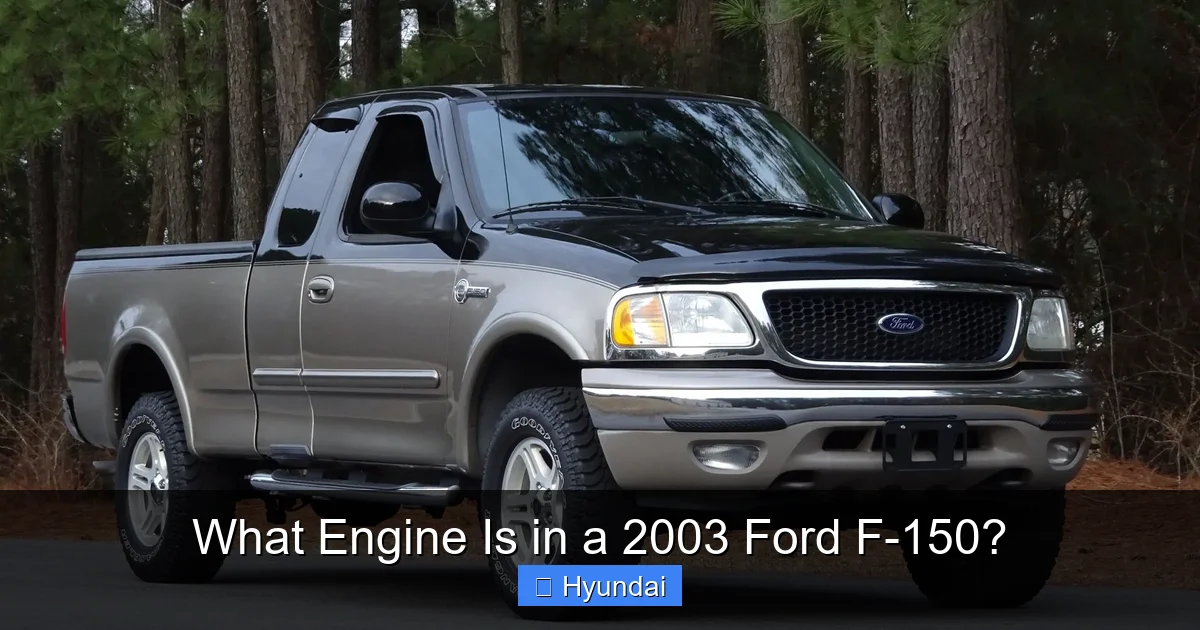
What Engine Is in a 2003 Ford F-150?
Contents
- 1 Key Takeaways
- 2 📑 Table of Contents
- 3 The 2003 Ford F-150 Engine Lineup: An Overview
- 4 The 4.2L V6: The Efficient Workhorse
- 5 The 4.6L Triton V8: The Popular Choice
- 6 The 5.4L Triton V8: The Powerhouse
- 7 Choosing the Right Engine for Your Needs
- 8 Maintenance, Common Issues, and Longevity
- 9 Real-World Performance and Modifications
- 10 Conclusion: Knowing Your Heart
- 11 Frequently Asked Questions
The 2003 Ford F-150 came with three main engine choices: a fuel-efficient 4.2L V6, a reliable 4.6L Triton V8, and a powerful 5.4L Triton V8. Your choice depends on whether you prioritize towing capacity, everyday commuting, or heavy-duty work. Understanding these engines’ specs and common traits is key to maintaining this classic truck.
So, you’re looking at a 2003 Ford F-150, or maybe you already own one and you’re scratching your head. The big question on your mind is, “What engine is in this thing?” It’s a fantastic question to ask. The engine is the heart of any truck, and for a workhorse like the F-150, knowing what’s under the hood tells you a story about its past, its capabilities, and its future needs. The 2003 model year sits in a sweet spot for these trucks—they’re old enough to be affordable and plentiful, yet modern enough to have decent refinement and parts availability. But not all 2003 F-150s are created equal. Ford offered a trio of engines that year, each with its own personality, strengths, and quirks. Let’s pop the hood and take a detailed tour of every engine that could be breathing under the fiberglass of a 2003 Ford F-150.
First, a quick note on the naming. You’ll hear “Triton” thrown around a lot. That’s Ford’s name for their SOHC (Single Overhead Cam) 2-valve V8 engine family. Both the 4.6L and 5.4L in your 2003 are Triton engines. They share a lot of design philosophy and many internal components, but they are not the same. The 4.2L V6 is a completely different engine family, derived from the same basic design as the 4.6L but with two fewer cylinders. Understanding this family tree helps make sense of their behavior and common problems. We’ll break down each one, cylinder by cylinder, bolt by bolt, so you can become an instant expert on what makes your specific truck tick.
Key Takeaways
- Three Engine Options: The 2003 F-150 was available with a 4.2L V6, a 4.6L Triton V8, or a 5.4L Triton V8, each serving different needs.
- Towing King: The 5.4L V8 offered the highest towing and payload capacity, making it ideal for heavy work.
- Balanced Performer: The 4.6L V8 provided a sweet spot of decent power with better fuel economy than the 5.4L.
- Fuel-Sipping Base: The 4.2L V6 was the most fuel-efficient but had limited power, best for light-duty, non-towing use.
- Common Issues: The Triton V8s (4.6L & 5.4L) are known for spark plug blowouts and intake manifold leaks; the V6 is generally simpler.
- Identification is Key: You can identify your engine by the 8th digit of the VIN or by physical size and badging under the hood.
- Maintenance Matters: Regular oil changes with the correct viscosity are critical for longevity, especially for the V8s.
📑 Table of Contents
- The 2003 Ford F-150 Engine Lineup: An Overview
- The 4.2L V6: The Efficient Workhorse
- The 4.6L Triton V8: The Popular Choice
- The 5.4L Triton V8: The Powerhouse
- Choosing the Right Engine for Your Needs
- Maintenance, Common Issues, and Longevity
- Real-World Performance and Modifications
- Conclusion: Knowing Your Heart
The 2003 Ford F-150 Engine Lineup: An Overview
For the 2003 model year, Ford simplified the F-150’s engine options compared to previous years. There were no special high-output versions or diesel options for the standard F-150 line (that would come later with the Super Duty). You had three straightforward choices, and they were paired with specific transmissions and drivetrain configurations. Here’s the high-level view:
- 4.2L V6: The base engine. Available on XL and XLT trims, primarily with the 4×2 drivetrain and the 4-speed automatic transmission (4R75E). It was the entry point, aimed at buyers who wanted the F-150’s utility and space but didn’t need heavy towing.
- 4.6L Triton V8: The volume seller and the workhorse for many. Available across almost all trims (XL, XLT, Lariat, King Ranch, Platinum) and both 4×2 and 4×4 configurations. It was the default “upgrade” from the V6 and powered the vast majority of F-150s sold.
- 5.4L Triton V8: The top-of-the-line gas engine. Primarily reserved for the high-end trims like the Lariat, King Ranch, and Platinum, and almost always mated to the heavier-duty 4R100 transmission behind it, especially in 4×4 models. It was the choice for maximum towing and payload.
It’s important to note that transmission choice was often tied to the engine. The lighter-duty 4R75E 4-speed automatic backed the 4.2L V6 and most 4.6L V8s. The heavier-duty 4R100 4-speed automatic was essential for the 5.4L V8’s higher torque output, especially in 4×4 trucks. This pairing is a critical piece of the truck’s overall capability puzzle. Now, let’s dive deep into each engine’s specifications, character, and real-world performance.
How to Identify Your 2003 F-150’s Engine
Before we get too deep, you need to know how to figure out which engine is sitting in your driveway. There are three foolproof methods:
- The Vehicle Identification Number (VIN): This is the most accurate method. The 8th character in your 17-digit VIN is the engine code. For a 2003 F-150, you’ll want to look it up on a Ford VIN decoder site. Common codes: ‘6’ for 4.2L V6, ‘W’ for 4.6L V8, and ‘Z’ for 5.4L V8 (though there were some variations, like ‘V’ for a 4.6L in certain markets).
- The Engine Bay: Open the hood. The 4.2L V6 is smaller, with a plastic intake manifold and a more compact look. The 4.6L V8 will have “4.6L” or “Triton” cast into the valve covers. The 5.4L V8 is physically larger, with a taller block, and will have “5.4L” or “Triton” on the valve covers. The 5.4L also often has a large, ribbed aluminum intake plenum.
- The Driver’s Door Jamb: Your truck’s door sticker (the white EPA label) should list the engine displacement directly.
Knowing your exact engine is the first step to proper maintenance, diagnosing problems, and buying the right parts. Speaking of maintenance, one of the most critical tasks for any of these engines is monitoring oil levels. The Triton V8s, in particular, can be sensitive. If you’re ever unsure about the signs, it’s worth reading a friendly guide on what happens if engine oil is low in your car. For these Ford V8s, running low on oil can lead to catastrophic failure very quickly.
The 4.2L V6: The Efficient Workhorse
Let’s start with the little guy. The 4.2L V6 was not a new engine in 2003; it was a carried-over, proven unit from the previous generation. It’s a 90-degree V6, essentially a 4.6L V8 with two cylinders removed. This血缘关系 (family lineage) means some parts interchangeability, but it also means it shares some of the V8’s basic architecture.

Visual guide about What Engine Is in a 2003 Ford F-150?
Image source: extremedimensions.com
Specifications and Performance
The 4.2L produced a modest 204 horsepower at 4,400 rpm and 262 lb-ft of torque at 3,000 rpm. These numbers are on the low end for a full-size truck, even by early 2000s standards. It was paired almost exclusively with the 4-speed 4R75E automatic transmission. The result was a truck that could move down the road and handle light loads, but it would struggle with anything heavier than a small trailer or a full bed of mulch. Fuel economy was its primary selling point. An appropriately equipped 4×2 4.2L could achieve around 16 mpg in the city and 21 mpg on the highway. That was significantly better than the V8s, which typically saw 14/18 mpg (4×2) or 13/17 mpg (4×4).
Character and Use Case
Driving a 4.2L F-150 is an exercise in patience. The throttle response is dull, and you’ll hear the engine revving more than you’d like when trying to merge onto a highway or climb a hill. It’s a perfectly adequate engine for a fleet truck that never tows, a basic work truck for a grounds crew, or a family hauler that just needs the bed space. Its strength is its simplicity and relative fuel efficiency. The 4.2L does not have the notorious spark plug issues of the Triton V8s, as it uses conventional, easy-to-replace plugs. Its main weakness is a lack of power; if you ever find yourself needing to tow more than 3,000 lbs, you’ll quickly become frustrated.
The 4.6L Triton V8: The Popular Choice
This is the engine most people think of when they picture a 2003 F-150. The 4.6L Triton V8 was the volume seller, the default upgrade, and for good reason. It offered a significant power bump over the V6 without the fuel consumption penalty of the 5.4L. It was the Goldilocks engine of the lineup: just right for many buyers.
Visual guide about What Engine Is in a 2003 Ford F-150?
Image source: extremedimensions.com
Specifications and Performance
For 2003, the 4.6L Triton produced 231 horsepower at 4,750 rpm and 294 lb-ft of torque at 3,000 rpm (some early 2003 trucks built in 2002 might have the 2002 specs of 231 hp / 305 lb-ft). The power gain over the V6 was noticeable, especially in the torque curve. The 4.6L felt willing and responsive. It was available with either the 4R75E or the 4R100 transmission, depending on the drivetrain and configuration. Towing capacity with the 4.6L typically maxed out around 6,000 lbs for a properly equipped 4×2, which was sufficient for most boat and medium trailer owners.
The Triton’s Reputation: Strengths and Infamous Weaknesses
The 4.6L Triton earned its reputation as a reliable, long-lived engine when properly maintained. Many examples have surpassed 300,000 miles. However, it has two major, well-documented design flaws that every owner or potential buyer must be aware of:
- Spark Plug Ejection: This is the Triton’s most infamous issue. The cylinder heads use aluminum threads for the spark plug inserts. Over time, with heat cycling and improper torque during previous plug changes, the threads can strip. The result is a spark plug that blows out of the head, causing immediate misfires and, if not caught quickly, severe damage from unburned fuel washing oil from the cylinder walls. The fix is expensive—it requires either time-serting the threads or installing aftermarket threaded inserts (like from Heli-Coil or more robust solutions). Prevention is key: using a torque wrench to install plugs to Ford’s exact specification (13-15 lb-ft for 2003 4.6L) and using anti-seize compound on the threads is critical.
- Intake Manifold Cracks:The plastic lower intake manifold on the 4.6L (and 5.4L) is prone to developing cracks, usually around the thermostat housing area or the coolant crossover. This leads to coolant leaks, overheating, and eventually, a mixing of coolant and oil (a “milkshake” condition) if the leak is severe. The fix is to replace the manifold with a revised, more robust version (Ford released a metal crossover redesign) or an aftermarket aluminum manifold.
Beyond these two issues, the 4.6L is a solid engine. It can suffer from oil consumption if piston rings wear, and the plastic valve covers can become brittle and crack. But its overall architecture is sound. A well-maintained 4.6L will provide years of dependable service. If you’re looking at a used 2003 F-150 with a 4.6L, a thorough inspection for these two major issues is non-negotiable.
The 5.4L Triton V8: The Powerhouse
If the 4.6L was the popular kid, the 5.4L Triton was the varsity athlete. It shared the same basic SOHC 2-valve architecture as the 4.6L but with a larger bore and stroke, resulting in significantly more displacement and, consequently, more power and torque.
Specifications and Performance
The 2003 5.4L Triton V8 was rated at 300 horsepower at 5,000 rpm and 365 lb-ft of torque at 3,500 rpm. Those are very healthy numbers for a naturally aspirated gas engine of that era. The torque curve is broader and peaks higher in the RPM range than the 4.6L, giving it a much more muscular feel. You could actually feel the truck being pushed back into the seat. It was almost universally paired with the heavy-duty 4R100 transmission, which had stronger internals and a different torque converter to handle the extra grunt. This combo made the 5.4L F-150 a serious tow vehicle, with maximum towing capacities often exceeding 8,000 lbs when properly equipped with a factory tow package.
Shared DNA, Shared Problems
Because the 5.4L is essentially a bored-and-stroked 4.6L, it suffers from the exact same two major design flaws:
- Spark Plug Ejection: The problem is even more pronounced in the 5.4L due to the higher cylinder pressures. The same thread-stripping issue exists, and the consequences are just as severe.
- Intake Manifold Cracks: The plastic lower intake manifold is identical in design flaw to the 4.6L’s and is equally prone to cracking.
Additionally, the 5.4L has its own unique quirk: cam phaser wear and rattling. The variable cam timing (VCT) system on these engines uses hydraulically actuated cam phasers. Over time, the oil passages can become clogged with sludge (especially if oil changes were neglected), or the phasers themselves can wear. This leads to a distinct rattling noise from the front of the engine on cold startup, often called the “5.4 tick.” While sometimes just a noise, it can progress to a check engine light with camshaft position codes and eventually a loss of power and poor idle if the VCT system fails completely. This is a costly repair.
The 5.4L also drinks more fuel. Expect real-world economy in the low-to-mid teens. But for the person who regularly tows a large boat, a car hauler, or a camper, the 5.4L’s effortless torque is worth every extra penny at the pump. It transforms the F-150 from a truck that *can* tow to a truck that *wants* to tow.
Choosing the Right Engine for Your Needs
So, which one should you seek out? It all comes down to your intended use. Let’s play matchmaker.
The Daily Driver / Light Hauler
If you’re buying a 2003 F-150 as a family truck, to haul occasional home improvement supplies, and you never, ever plan to tow more than a small utility trailer, the 4.2L V6 is a viable and economical choice. It’s cheap to buy, cheap to insure, and gets the best gas mileage. Its limitations are its strengths if your demands are low. Just be aware that on steep hills or when fully loaded, it will be slow.
The All-Around Performer
For the vast majority of buyers—the guy who wants a capable truck for weekend projects, might tow a mid-size boat or jet skis a few times a year, and values a good balance of power and efficiency—the 4.6L Triton V8 is the sweet spot. It provides a noticeable power increase over the V6 without the massive fuel bill of the 5.4L. It’s the most common, so you’ll have the biggest selection to choose from on the used market. However, you must budget for a potential spark plug and intake manifold inspection/repair. Factor that into your purchase price.
The Serious Tower / Hauler
If your life revolves around towing—a large travel trailer, a loaded car trailer, or a heavy-duty work bed—the 5.4L Triton V8 is the only logical choice from this generation. Its torque output is in a different league. The 4R100 transmission it’s paired with is also more robust for sustained heavy loads. You’ll pay more upfront and at the gas pump, but you’ll get the job done without the white-knuckle struggle. Be prepared for the potential cam phaser rattle and the same spark plug/intake issues as the 4.6L, often with higher repair costs due to the larger engine bay.
One final practical tip: regardless of engine, the electrical system on these trucks is aging. A weak battery can cause all sorts of starting and charging problems, and it’s often overlooked. If you’re buying a 2003 F-150, always test the battery thoroughly. For owners, investing in a high-quality replacement is a smart move. You can research the best battery for a 2003 Ford F-150 to ensure you’re getting a unit with enough cold-cranking amps (CCA) to turn over that big V8 on a cold morning.
Maintenance, Common Issues, and Longevity
You cannot talk about these engines without talking about maintenance. The story of the 2003 F-150’s engine longevity is a story of oil changes.
The Oil is Everything
All three engines are interference designs. This means that if the timing belt or chain fails, the pistons will collide with the valves, destroying the engine. The 4.2L V6 and the Triton V8s all use a timing chain (not a belt), which is a major reliability plus—they should last the life of the engine with proper oil pressure. But that’s the key: proper oil pressure. These engines are oil-hungry. The 5.4L, in particular, is known for consuming oil between changes. Using the correct oil viscosity (5W-20 for all three in 2003) and changing it every 5,000 miles (or sooner if you tow or drive in dusty conditions) is not a suggestion; it’s a commandment. Low oil pressure or neglected changes lead to worn piston rings, cam phaser failure (on the 5.4L), and ultimately, the need for a rebuild. Understanding what oil pressure in a car actually means and monitoring it with your gauge is a vital skill for any owner.
The Spark Plug & Intake Manifold Saga
We’ve hammered on these issues, but they bear repeating. If you own a Triton V8 (4.6L or 5.4L):
- When changing spark plugs, use a high-quality plug (like Motorcraft or NGK), apply a thin layer of anti-seize compound to the threads, and torque them to specification with a calibrated torque wrench. Never guess.
- Inspect the lower intake manifold for any signs of coolant leakage (sweet smell, puddles, crusty deposits). If you have a 4.6L or early 5.4L, consider proactively replacing it with the updated metal-crossover version. It’s an expensive job, but it’s cheaper than a tow truck and a ruined engine.
Other Points of Concern
- 4.2L V6: Relatively trouble-free. Watch for head gasket leaks (less common than in some other V6s) and ignition coil failures.
- 4.6L V8: Besides the two big ones, watch for oil pan gasket leaks (the aluminum pans can warp) and plastic valve cover cracks.
- 5.4L V8: In addition to the shared issues and cam phasers, the 5.4L is hard on batteries. The starter motor is also known to fail. Some models have a recall for the secondary ignition coil bracket.
With meticulous care, any of these engines can easily surpass 200,000 miles. The 4.6L, in particular, has a legendary reputation for durability when not plagued by the spark plug issue. The key is preventative maintenance. Don’t wait for a problem to become a disaster.
Real-World Performance and Modifications
Let’s talk about how these engines feel in the real world and what you can do with them.
Driving Impressions
The 4.2L V6 feels adequate in a 2WD, regular cab, short bed configuration. Add 4×4, a crew cab, and a heavy bed liner, and it becomes noticeably strained. It’s not a slowpoke, but it’s not quick. The sound is a coarse, truck-like V6 hum.
The 4.6L V8 is the definition of “adequate with authority.” It pulls strongly from a stop and has enough passing power on the highway. It feels refined and quiet for a truck engine. The sound is a muted, deep V8 burble. It’s the engine that makes you feel like you have a “real truck” without feeling like you’re piloting a fuel tanker.
The 5.4L V8 is an event. The throttle response is immediate, and the torque shoves you back in the seat. It sounds more aggressive, with a deeper, louder rumble. The truck feels planted and confident under acceleration, whether empty or loaded. This is the engine that makes towing feel effortless. The downside is the constant reminder of its thirst at the gas pump.
Popular and Effective Modifications
The aftermarket for these Modular engines (the family name for the 4.6L/5.4L) is enormous. Simple, effective mods include:
- Cold Air Intake: A easy bolt-on that improves throttle response and adds a few horsepower. It also makes the engine sound more aggressive.
- Performance Exhaust: A cat-back or axle-back system reduces backpressure, improves flow, and enhances the V8 soundtrack. For the 5.4L, this is a great way to wake it up. You can explore options for the best exhaust for a Ford F-150 5.0 (though that’s a different engine, the principles for the 5.4L are similar).
- Tuning/Programmer: A simple handheld tuner can optimize the transmission shift points, adjust the idle, and, for the 5.4L, add a noticeable amount of horsepower and torque by optimizing the spark and fuel curves. This is one of the best bang-for-buck mods.
- Gearing: If you have a 5.4L and tow heavily, swapping to a numerically higher rear axle gear (like 4.10 or 4.30) can dramatically improve towing performance and drivability, making the engine feel stronger at lower speeds.
For the 4.2L V6, mods are more limited due to its lesser popularity, but a cold air intake and a tune can help it breathe and respond a bit better. However, there’s only so much you can do with a 4.2L; it’s a torque-challenged engine by design.
Conclusion: Knowing Your Heart
The engine in your 2003 Ford F-150 is more than just a collection of metal and bolts; it’s the defining characteristic of your truck’s capability and personality. The 4.2L V6 is the sensible, budget-friendly choice for light duty. The 4.6L Triton V8 is the all-round champion, offering a fantastic blend of power and practicality for the average owner, provided you’re aware of and prepared for its two major weak spots. The 5.4L Triton V8 is the brute, the tower, the engine for those who need maximum grunt and are willing to pay for it in fuel and potential repair costs.
When buying a used 2003 F-150, identifying the engine is your first task. Then, inspect it thoroughly for the spark plug and intake manifold issues if it’s a V8. Ask for maintenance records, especially oil change history. A truck with a known service history is worth its weight in gold. And once you have it, commit to a strict maintenance regimen. Change the oil on time, use quality filters and oil, and keep an ear and eye out for any signs of trouble. These trucks, with their simple, rugged designs, can be incredibly reliable and rewarding companions for years to come. They just demand a little respect and a lot of oil. Now that you know what’s under the hood of that 2003 F-150, you can shop smart, drive confidently, and keep your truck running strong for the long haul.
Frequently Asked Questions
What engines were available in the 2003 Ford F-150?
The 2003 Ford F-150 came with three gasoline engine options: a 4.2L V6, a 4.6L Triton V8, and a 5.4L Triton V8. No diesel engines were offered in the standard F-150 line that year.
Which 2003 F-150 engine is best for towing?
The 5.4L Triton V8 is the clear winner for towing. With 300 horsepower and 365 lb-ft of torque, it offers significantly more grunt than the other options and is paired with a heavier-duty 4R100 transmission, making it suitable for trailers over 7,000 lbs.
How can I identify which engine my 2003 F-150 has?
You can identify your engine by checking the 8th character in your VIN (a ‘6’ is the 4.2L V6, a ‘W’ is the 4.6L V8, and a ‘Z’ is the 5.4L V8). You can also look at the engine bay—the displacement is cast into the valve covers—or check the engine size listed on the door jamb sticker.
Are there common problems with the 2003 F-150 engines?
Yes. The Triton V8s (4.6L and 5.4L) are notorious for two major issues: spark plugs blowing out due to stripped aluminum head threads, and plastic lower intake manifolds cracking and leaking coolant. The 5.4L also commonly develops a cold-start rattle from worn cam phasers. The 4.2L V6 is generally simpler and more reliable.
What is the fuel economy of each 2003 F-150 engine?
The 4.2L V6 is the most efficient, with EPA ratings around 16 city / 21 highway MPG for 4×2 models. The 4.6L V8 typically gets 14 city / 18 highway MPG (4×2). The 5.4L V8 is the thirstiest, often returning 13 city / 17 highway MPG, with real-world numbers sometimes lower, especially when towing.
Is the 4.6L or 5.4L Triton V8 more reliable?
Both share the same fundamental design flaws (spark plugs, intake manifold). In terms of pure durability, a well-maintained 4.6L often has a slight edge because it’s not working as hard as the 5.4L and doesn’t have the cam phaser rattle issue. However, both can be extremely reliable if serviced meticulously, especially with correct spark plug installation procedures.