
What Does Smart Mode Do on a Hyundai Elantra?

Contents
- 1 Key Takeaways
- 2 📑 Table of Contents
- 3 What Exactly *Is* Smart Mode?
- 4 How Smart Mode Works: The Technology Behind the “Smarts”
- 5 The Real-World Benefits of Using Smart Mode
- 6 Smart Mode vs. Other Drive Modes: When to Use What
- 7 Practical Tips and Scenarios for Using Smart Mode
- 8 Conclusion: Embracing the Intelligent Compromise
- 9 Frequently Asked Questions


Smart Mode in a Hyundai Elantra is an intelligent, automated drive setting that continuously adapts the car’s throttle response, transmission shifts, and steering feel to match your driving style and road conditions. It acts as a “set-and-forget” mode, seamlessly switching between sporty and efficient characteristics without you having to manually choose. This provides a consistently optimized driving experience that balances performance and fuel economy for daily commutes and highway cruising.
Have you ever glanced at the drive mode selector in your Hyundai Elantra and wondered what that mysterious “Smart” option actually does? It sits there alongside Eco, Sport, and maybe Comfort, promising intelligence but offering little explanation. You’re not alone. While the names “Eco” and “Sport” are self-explanatory, “Smart” feels vague. Is it a gimmick? Or is there genuine engineering behind it? Let’s pull back the curtain and explore exactly what Smart Mode does on a Hyundai Elantra, how it works, and why it might be the most useful mode in your car’s arsenal for everyday driving.
At its core, Smart Mode is Hyundai’s answer to a simple question: “What if the car could just figure out what I want?” Instead of forcing you to choose a fixed personality for your Elantra—either a fuel-sipping miser (Eco) or a pretend sport sedan (Sport)—Smart Mode creates a hybrid, adaptive personality. It’s like having a co-pilot that watches how you drive and subtly tweaks the car’s responses to match. This isn’t just a marketing buzzword; it’s a sophisticated software algorithm that manages several critical vehicle systems in harmony. Understanding it can transform your daily commute from a series of mechanical transactions into a more fluid, intuitive experience.
Key Takeaways
- It’s an Adaptive System: Smart Mode uses sensors and software to analyze your driving inputs (like pedal pressure and steering input) and automatically adjusts vehicle dynamics in real-time.
- Balances Performance and Efficiency: The system aims to provide a smooth, responsive drive while maximizing fuel economy, avoiding the extremes of pure Sport or Eco modes.
- Controls Multiple Systems: It simultaneously manages engine/transmission mapping, electric power steering weight, and sometimes even climate control and suspension (if equipped).
- Requires No Driver Input: Once selected, the system works autonomously. You don’t need to “tell” it what you’re doing; it learns and predicts your intent.
- Ideal for Mixed Driving: Perfect for daily driving with a mix of city traffic, suburban streets, and highway lanes where conditions and driver intent change frequently.
- Part of Hyundai’s Drive Mode Suite: Smart Mode is typically one option alongside dedicated Eco, Sport, and Comfort modes (availability varies by model year and trim).
- Enhances Usability: It simplifies the driving experience by removing the guesswork of which mode to select for a given situation, making the Elantra feel intuitive and “smart.”
📑 Table of Contents
What Exactly *Is* Smart Mode?
To understand Smart Mode, it helps to first understand what a traditional “drive mode” does. In most cars, selecting Eco, Sport, or Comfort manually sets predetermined parameters for the engine, transmission, steering, and sometimes other components. Eco mode dulls throttle response, encourages early upshifts, and lightens the steering to save fuel. Sport mode does the opposite: sharpens throttle, holds gears longer for more power, and adds steering weight for a connected feel. Comfort tries to find a neutral, relaxed middle ground.
The “Adaptive” Difference
Smart Mode throws the fixed playbook out the window. It is an adaptive system. When you select Smart Mode, you’re not picking a static setting. You’re activating a program that continuously monitors your driving behavior for a short period, typically a few seconds to a minute. It pays attention to:
- How aggressively you press the accelerator pedal. A slow, gentle press suggests a relaxed, efficiency-minded driver. A quick, deep press indicates a need for performance.
- Your steering input speed and angle. Smooth, gradual steering inputs point to casual driving. Quick, deliberate steering corrections suggest more engaged, spirited driving, possibly on a twisty road.
- Vehicle speed and gradient. The system knows if you’re crawling in traffic or cruising at 70 mph on a highway.
Based on this real-time data, Smart Mode dynamically blends the characteristics of Eco and Sport modes on a spectrum. If you’re driving gently, it will bias toward Eco-like settings—smooth, quiet, and efficient. If you start driving more assertively, it will gradually shift toward Sport-like settings—more responsive and taut. The transition is designed to be seamless and subconscious. You simply press the pedal, and the car responds appropriately without you having to think about which “mode” you’re in.
What Systems Does It Actually Control?
Smart Mode’s magic lies in its integration. It doesn’t just change one thing; it orchestrates multiple systems to create a cohesive feel. The primary systems it influences in a Hyundai Elantra are:
- Engine & Transmission Mapping: This is the heart of the change. Smart Mode adjusts the throttle-by-wire programming (how the computer interprets your pedal position) and the Transmission Control Unit (TCU) shift points. Gentle driving = lazy throttle, early upshifts. Aggressive driving = sharper throttle, delayed upshifts to keep the engine in its power band.
- Electric Power Steering (EPS) Tuning: It alters the amount of assist and the steering ratio feel. Eco-leaning driving results in lighter, easier steering. Sport-leaning driving adds weight and a more direct, connected feel to the road.
- Climate Control (Indirectly): In some model years and trims, Smart Mode may slightly adjust the climate control blower speed or air distribution to prioritize efficiency when driving gently, though this is a secondary effect.
- Active Sound Design (If Equipped): Some newer Elantras with engine sound synthesizers may subtly adjust the artificial engine note in the cabin to match the perceived driving style, enhancing the Sport feel when needed.
It’s important to note that Smart Mode does not typically control the suspension (that’s usually reserved for higher-trim models with adaptive dampers) or the all-wheel-drive system (if equipped). Its domain is primarily powertrain and steering response.
How Smart Mode Works: The Technology Behind the “Smarts”
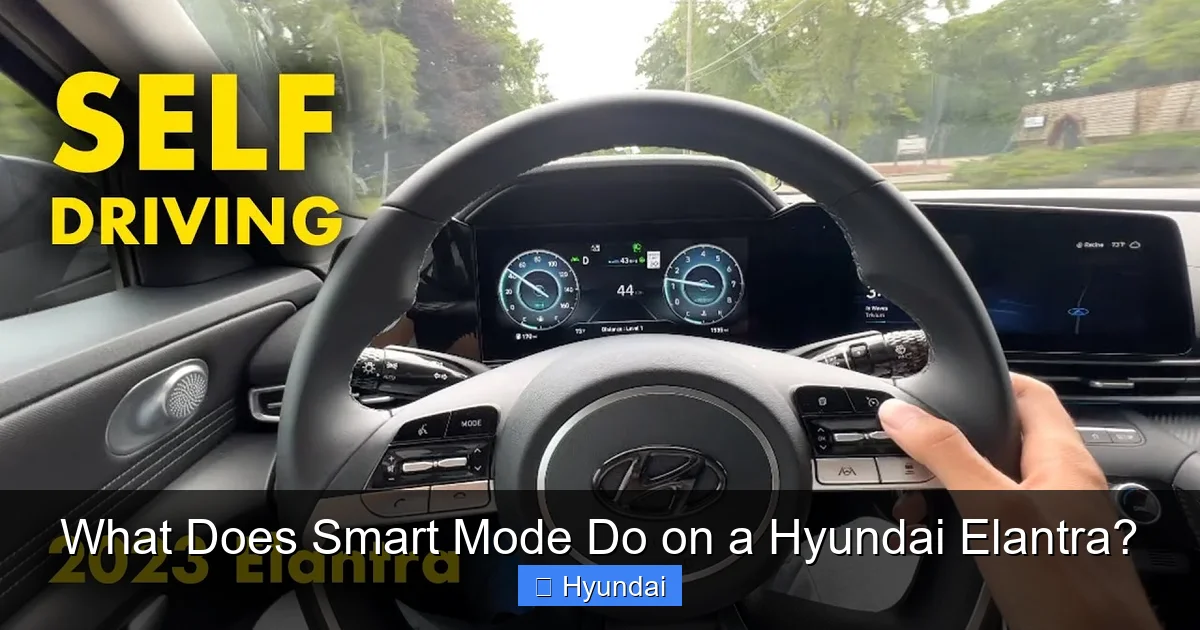
The intelligence of Smart Mode isn’t magic; it’s software running on the Elantra’s network of electronic control units (ECUs). Here’s a simplified look at the process.
Visual guide about What Does Smart Mode Do on a Hyundai Elantra?
Image source: i.ytimg.com
The Sensor Input Loop
The system’s brain—often the Transmission Control Unit or a dedicated vehicle dynamics controller—is constantly fed data from various sensors. For Smart Mode, the key inputs are:
- Accelerator Pedal Position Sensor: Tells the computer not just if the pedal is down, but how fast it was depressed and how far it’s held.
- Steering Angle Sensor & Torque Sensor: Measures both the angle of the wheels and the force applied to the steering wheel. Rapid, large-angle inputs signal an engaged driver.
- Vehicle Speed Sensor: Context is everything. A deep accelerator press at 25 mph is different from one at 70 mph.
- Yaw Rate & Lateral G-Force Sensors (if available): These can detect if the car is cornering aggressively, further signaling a desire for performance.
The Algorithm and Decision-Making
The software contains an algorithm—a set of rules and learning patterns. It doesn’t just look at a single input; it weighs combinations. For example:
- Situation A (Eco-leaning): Slow pedal press + gentle steering + 45 mph = “This driver is cruising. Prioritize smoothness and efficiency.” The system selects shift points for lowest RPM, softens throttle tip-in, and lightens steering.
- Situation B (Sport-leaning): Quick, deep pedal press + rapid steering correction + 60 mph = “This driver wants response now!” The system commands a downshift, sharpens throttle response, and firms up steering.
- Situation C (Transitioning): You’re driving gently in Smart Mode on the highway, then you see a slow-moving truck and need to pass. As you begin to press the pedal more firmly to merge, Smart Mode detects the change and prepares the transmission for a downshift while sharpening the steering. By the time you’re fully committed to the pass, the car feels more responsive without a jarring shift.
This happens in milliseconds. The goal is a driving experience that feels perfectly matched to your immediate intent, without the clunky, delayed feeling of a system that’s always one step behind.
The Real-World Benefits of Using Smart Mode
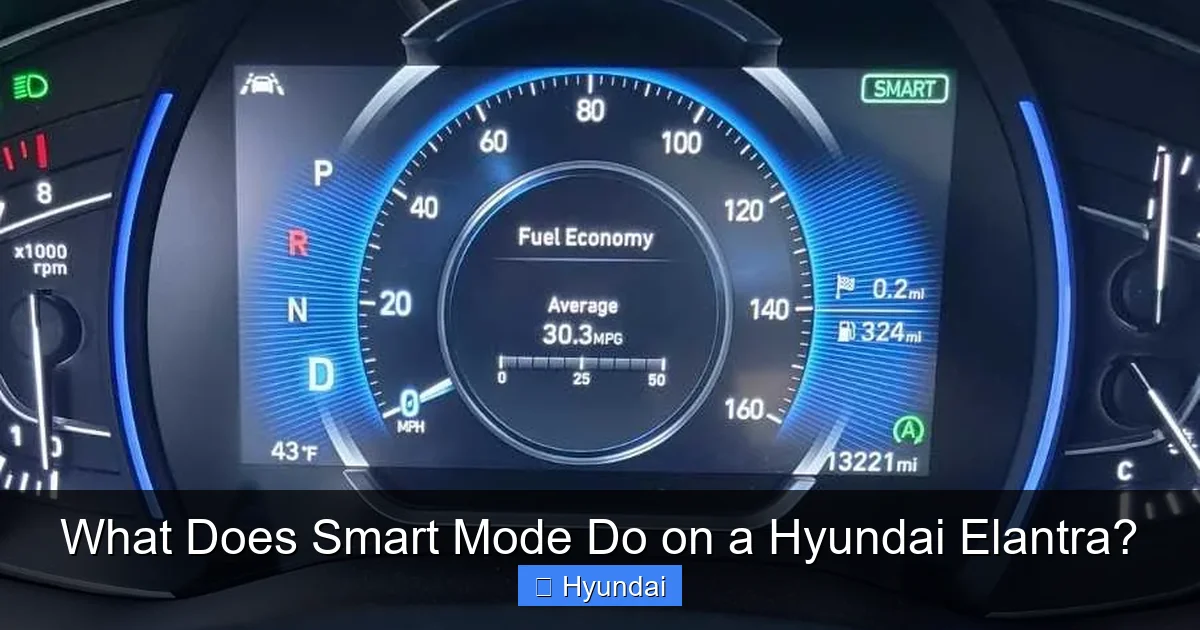
So, why should you bother with Smart Mode? Its value becomes clear when you consider the limitations of fixed modes.
Visual guide about What Does Smart Mode Do on a Hyundai Elantra?
Image source: trucksauthority.com
1. It’s Perfect for Unpredictable Commutes
Let’s be honest: most of our driving isn’t consistently “sporty” or “efficient.” A typical commute involves stop-and-go traffic, a few fast highway merges, some suburban roundabouts, and a final crawl into a parking spot. Using pure Eco mode can leave you feeling underpowered on that highway on-ramp. Using pure Sport mode all day can lead to frustratingly aggressive shifts in traffic and worse fuel economy. Smart Mode is the compromise that works in all these micro-situations. It gives you enough punch when you need it without punishing your fuel tank the rest of the time.
2. It Removes the “Mode Anxiety”
How many times have you been driving and thought, “Should I switch to Sport for this hill?” or “Is it time to go back to Eco now?” Smart Mode eliminates this mental overhead. You select it once and forget it. The car handles the transitions internally. This makes the Elantra feel exceptionally user-friendly, especially for drivers who don’t want to constantly fiddle with settings or who share the car with others who have different driving styles.
3. It Can Improve Real-World Fuel Economy
While dedicated Eco mode is engineered for the absolute best possible MPG in controlled conditions, it can be frustratingly sluggish. Some drivers, finding Eco mode too slow, may actually press the pedal harder to get the response they want, negating its benefits. Smart Mode, by providing a more natural and immediate response even in gentle driving, can encourage a smoother driving style that still prioritizes efficiency. You get the fuel savings of Eco mode with the driveability of Comfort, resulting in better real-world mileage than constantly fighting a numb, disconnected Eco mode pedal.
4. It Makes the Car Feel More “Premium” and Integrated
A car that intelligently adapts to you feels sophisticated. The seamless shifts, the perfectly weighted steering that changes as your driving does—it creates a sense of harmony between man and machine. This is a feature often found in more expensive luxury vehicles, and its presence in an affordable compact sedan like the Elantra adds to the perceived quality and technological advancement of the vehicle.
Smart Mode vs. Other Drive Modes: When to Use What
Understanding Smart Mode’s niche means knowing when the other, fixed modes are still the better choice. Here’s a practical breakdown.

Visual guide about What Does Smart Mode Do on a Hyundai Elantra?
Image source: hyundaicanada.com
Smart Mode vs. Eco Mode
Use Smart Mode for: 90% of your daily driving. Mixed conditions, highway cruising, light city traffic. You want a balanced, efficient, but responsive feel without compromise.
Use Eco Mode for: Dedicated fuel-saving missions. When you are hyper-focused on maximizing MPG for a long highway trip, or in stop-and-go traffic where you can maintain an exceptionally gentle, anticipatory driving style. Eco mode’s more aggressive shift logic and throttle restriction are designed for the sole purpose of efficiency, and in ideal conditions, it will edge out Smart Mode by a small margin.
Smart Mode vs. Sport Mode
Use Smart Mode for: All general driving. It provides adequate response for most passing maneuvers and will give you a firmer steering feel if you start driving actively.
Use Sport Mode for: Enthusiastic driving on winding roads, track days (if the Elantra N is your car), or when you know you’ll be demanding the car’s full performance potential for an extended period. Sport mode holds gears longer, provides maximum throttle sharpness, and offers the heaviest steering setting. It’s a committed, un-adaptive setting that prioritizes driver engagement above all else. Smart Mode might “soften up” during a long, gentle straightaway between corners, which you wouldn’t want in a full-performance context.
Smart Mode vs. Comfort Mode (If Available)
On some Elantra models, Comfort mode is the default “neutral” setting. Smart Mode is essentially a dynamic, smarter version of Comfort. Comfort is static—a fixed, relaxed setting. Smart Mode starts from a Comfort-like baseline but has the ability to climb toward Sport when you drive harder. If your Elantra has both, Comfort is for when you explicitly want a soft, floaty, detached feel regardless of how you drive (e.g., a very relaxed Sunday drive). Smart Mode is for when you want the car to engage with you as your driving intensity changes.
Practical Tips and Scenarios for Using Smart Mode
Getting the most out of Smart Mode is about understanding its behavior and setting expectations.
Give It a Few Seconds to “Learn”
When you first engage Smart Mode or your driving style changes dramatically (e.g., from highway to city), the system needs a moment to assess. Don’t expect an instant, dramatic shift. The adaptation is gradual. If you make a sudden, aggressive move right after selecting Smart Mode, it might not downshift as quickly as Sport mode would because it’s still calibrating. A steady, firm press on the pedal is the best way to “show” the system your intent.
It’s Not a Replacement for Manual Control (in Some Cases)
If you have a steering wheel-mounted paddle shifter or a manual gate in your transmission, Smart Mode will still allow you to take manual control. However, once you manually select a gear, the adaptive logic for the transmission is overridden until you return to full automatic (D). The steering feel, however, will continue to adapt based on your inputs even in manual mode.
Think of It as Your “Default” Setting
For most Hyundai Elantra owners, Smart Mode should be the default. Switch to Eco for a long, steady highway cruise where you can be gentle. Switch to Sport for a fun back-road blast on the weekend. But for the daily grind—the school run, grocery trips, commuting—Smart Mode is the optimal, hassle-free choice that delivers the best blend of traits.
Does It Work with All-Wheel Drive?
In Elantra models equipped with HTRAC all-wheel drive (available on certain trims in recent years), Smart Mode primarily still focuses on the powertrain and steering as described. It does not change the fundamental AWD torque split logic, which is managed by a separate system optimized for traction. However, the more responsive throttle in Sport-leaning scenarios can indirectly cause the AWD system to react more quickly to wheel slip. For dedicated snow or off-road situations, Hyundai often provides a separate “Snow” mode (sometimes a button) that specifically alters AWD and stability control behavior, which is different from Smart Mode’s focus on driving dynamics.
Conclusion: Embracing the Intelligent Compromise
Smart Mode on the Hyundai Elantra is a thoughtful piece of software engineering that solves a real-world problem: the inflexibility of fixed drive modes. It recognizes that our driving is not binary; it’s a spectrum. By creating a mode that listens, learns, and adapts, Hyundai has made the Elantra a more intuitive and satisfying car to live with. It’s not the hardest-hitting mode, nor is it the most miserly, but it is almost always the right mode for the unpredictable rhythm of daily life.
The next time you get in your Elantra, try leaving it in Smart Mode for a full week. Notice how it feels more relaxed on your morning coffee run and slightly more eager when you hit the gas to merge. That’s the system doing its job. It’s a quiet, competent co-pilot that makes the car feel perfectly calibrated to you, the driver, without any need for buttons or guesswork. In a world of complicated tech, that’s a genuinely smart feature.
Frequently Asked Questions
Can I manually override Smart Mode’s decisions?
Yes. You can always press the accelerator harder or steer more sharply to request more performance, and the system will respond. You also have the option to switch to Sport or Eco mode manually at any time, which will take precedence over the adaptive Smart Mode logic.
Is Smart Mode the same as having an automatic transmission?
No. All Elantras have an automatic transmission. Smart Mode is an additional layer of software that tells that automatic transmission how to shift—when to upshift for smoothness or downshift for response—based on your driving style. The transmission itself is still automatic in all modes.
Does Smart Mode save more gas than Eco mode?
Not necessarily. Eco mode is engineered for maximum fuel efficiency and will generally achieve slightly higher MPG in controlled, gentle driving conditions. However, many drivers find Eco mode too sluggish and compensate by pressing the pedal harder, which can reduce its real-world benefit. Smart Mode often delivers better real-world fuel economy than Eco mode because it provides a more natural, responsive driving feel that encourages smoother inputs without the “numb” pedal feel.
Will Smart Mode work if I have a manual transmission Elantra?
No. The Hyundai Elantra is not sold with a manual transmission in the United States in recent model years. Smart Mode is a feature of the automated transmission (dual-clutch or traditional automatic) and steering systems, which are not present in a manual gearbox.
Does using Smart Mode wear out my car faster?
No. The system operates within the designed parameters of the engine, transmission, and steering components. It is not “over-stressing” the car; it is simply selecting different, pre-programmed maps within the normal operating range. In fact, by encouraging smoother shifts and steering inputs during gentle driving, it may reduce wear compared to an aggressive driver manually selecting Sport mode all the time.
Is Smart Mode available on all Hyundai Elantra model years and trims?
Availability varies. Smart Mode became a standard or widely available feature on Elantra models around the 2017-2018 model year refresh and has been present on most subsequent generations, including the current seventh-generation (2021+) models. It is typically found on SEL trims and above, but you should always check your specific vehicle’s owner’s manual or window sticker to confirm your model’s exact drive mode options.


