
What Does “service Advancetrac” Mean on a Ford F-150

Seeing “Service AdvanceTrac” on your Ford F-150’s dashboard is a serious warning, not a simple reminder. It means the vehicle’s critical AdvanceTrac stability control system has detected a fault and is now disabled. This compromises your truck’s traction, stability, and anti-lock braking safety features. The cause is almost always a failed component like a wheel speed sensor, steering angle sensor, or wiring issue, requiring immediate diagnostic scanning and professional repair.
You’re cruising down the highway in your trusted Ford F-150, maybe towing a boat or just running errands, when suddenly the message “Service AdvanceTrac” illuminates on your instrument cluster. Your heart skips a beat. What does it mean? Is it safe to drive? How urgent is it? If you’re asking these questions, you’re not alone. This is one of the more common—and serious—dashboard alerts for Ford truck owners. Unlike a simple “Service Engine Soon” light, which can sometimes be driven on for a short while, a “Service AdvanceTrac” warning demands your immediate attention. It’s your truck’s way of saying a cornerstone of its modern safety architecture has failed. In this comprehensive guide, we’ll break down exactly what AdvanceTrac is, why this message appears, what causes it, and most importantly, what you need to do about it. Think of this as your direct line to understanding what your F-150 is desperately trying to tell you.
Key Takeaways
- It’s a Critical Safety Warning: “Service AdvanceTrac” indicates your F-150’s electronic stability control and related safety systems are offline, significantly increasing the risk of skidding or loss of control.
- Common Causes are Sensor Failures: The most frequent culprits are faulty wheel speed sensors, a malfunctioning steering angle sensor, or damaged wiring to these components.
- Do Not Ignore It: Driving with this message active is unsafe. The system’s absence means your truck lacks vital electronic aids for preventing spins during sudden maneuvers or on slippery surfaces.
- Diagnosis Requires a Professional Scan Tool: A basic code reader won’t suffice. A technician needs an advanced scanner to read the specific AdvanceTrac/ABS module fault codes.
- Repair Costs Vary Widely: A simple wheel speed sensor replacement might cost $150-$300, while a faulty ABS module or extensive wiring harness repair can exceed $1,000.
- A Reset is Only Temporary: Clearing the code without fixing the underlying problem will cause the warning to return, often immediately after driving.
- It May Trigger Related Warnings: Often, this message appears alongside the ABS warning light and/or the traction control light, as these systems are deeply interconnected.
📑 Table of Contents
- What Exactly is AdvanceTrac on a Ford F-150?
- Decoding the “Service AdvanceTrac” Message: What It Truly Means
- The Most Common Causes in Your F-150
- Diagnosing the Problem: From DIY to Professional
- Repair Options and Realistic Cost Estimates
- Resetting the System and Final Verification
- Conclusion: Your Safety Net is Down—Fix It Now
What Exactly is AdvanceTrac on a Ford F-150?
Before we panic about the warning, let’s understand the system itself. AdvanceTrac is Ford’s brand name for its electronic stability control (ESC) system. It’s a sophisticated network of sensors and computers designed to keep your truck stable and pointed where you’re steering, especially during emergency maneuvers or on low-traction surfaces. It’s not just one part; it’s a team. The system primarily uses the Anti-lock Braking System (ABS) wheel speed sensors, a steering angle sensor, and a yaw rate sensor (which detects if the truck is turning more or less than intended). The brain of the operation is the ABS control module, which processes all this data in real-time.
The Core Components Working Together
Imagine you’re driving on a patch of black ice and you need to swerve to avoid an obstacle. Your F-150’s AdvanceTrac system is constantly comparing your steering input (from the steering angle sensor) with the truck’s actual path (from the yaw and wheel speed sensors). If it detects that your truck is beginning to understeer (plow forward) or oversteer (fishtail), it can intervene instantly. It does this by selectively applying brake pressure to individual wheels and, if necessary, reducing engine power. This helps “steer” the vehicle back on its intended path. It’s a life-saving technology that has been mandatory on all new vehicles since 2012. When you see “Service AdvanceTrac,” it means this entire safety net has a hole in it and is currently inactive.
How It Differs from Traction Control
Many people confuse AdvanceTrac with basic traction control. Traction control primarily prevents wheel spin during acceleration by braking a spinning wheel or cutting engine power. AdvanceTrac is the next level up—it’s active during all driving conditions, not just acceleration, and manages both longitudinal (forward/backward) and lateral (side-to-side) stability. When AdvanceTrac is disabled due to a fault, your basic traction control system is also usually offline because they share the same hardware (wheel speed sensors and ABS module). This is why you often see multiple warning lights: the AdvanceTrac message, a “Service Traction Control” message, and a yellow icon of a car with squiggly lines (the stability control symbol) all illuminate together. They are all crying out about the same core problem.
Decoding the “Service AdvanceTrac” Message: What It Truly Means
So, the message is on. The icon is lit. What is your F-150 actually saying? It’s not suggesting a “nice-to-have” service like an oil change. This is a fault code stored in the ABS/AdvanceTrac control module. The system has run its self-diagnostic checks and found a component or circuit operating outside its normal parameters. The primary action the module takes is to disable the AdvanceTrac and traction control functions to prevent the system from making incorrect or dangerous interventions based on bad data. The message is the alert to you, the driver, that these electronic safeguards are now offline.

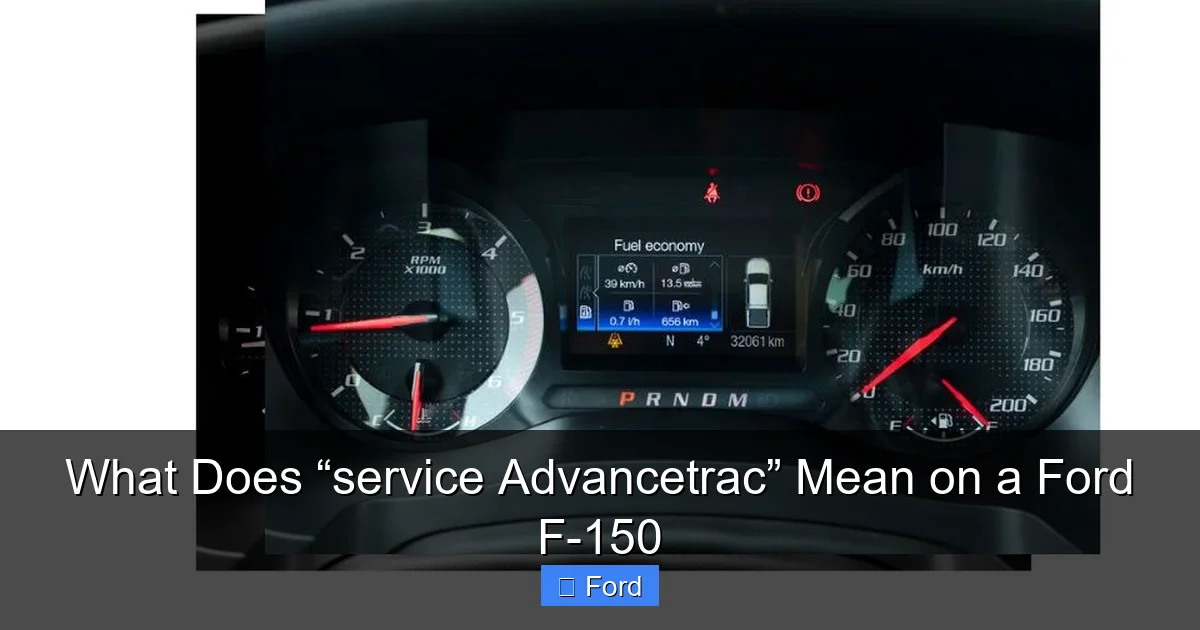
Visual guide about What Does “service Advancetrac” Mean on a Ford F-150
Image source: dealer12507.dealeron.com
Warning Light vs. Service Message: A Critical Distinction
It’s important to note the difference between a simple warning light and a “Service” message. A steady yellow AdvanceTrac icon (the car with squiggly lines) might flash during aggressive driving to show the system is actively intervening. That’s normal. However, the text-based message “Service AdvanceTrac” or a permanently lit AdvanceTrac icon after startup indicates a stored, permanent fault. The system has given up and shut down. This is a non-negotiable repair item. You might also see the anti-lock braking system (ABS) warning light illuminate simultaneously. This is a huge red flag because it means your conventional, hydraulic ABS—which prevents wheel lockup during hard braking—may also be compromised. Driving without any ABS is extremely hazardous on wet or icy roads.
Immediate Actions to Take (and Not Take)
Your first reaction might be to pull over and call a tow truck. That’s not always necessary, but you must adjust your driving immediately. Do not continue driving as if nothing is wrong. You must now drive with heightened awareness, understanding that your truck’s stability aids are gone. Avoid sudden steering, acceleration, or braking. Give yourself much more following distance. If the ABS light is also on, be prepared for the brake pedal to pulse or feel different during an emergency stop, and pump the pedal if you need to stop quickly on a slippery surface (though this is a last-resort technique). Your immediate goal is to get the vehicle to a safe location—your home garage or, preferably, a trusted mechanic or Ford dealership—for diagnosis as soon as possible. This is not a “wait until payday” repair.
The Most Common Causes in Your F-150
What actually breaks to cause this? While any component in the system can fail, decades of Ford truck diagnostics have revealed a clear hierarchy of usual suspects. Understanding these can help you have a more informed conversation with your mechanic.
Visual guide about What Does “service Advancetrac” Mean on a Ford F-150
Image source: f150advisor.com
1. Wheel Speed Sensor Failure (The #1 Culprit)
This is, by far, the most common reason for a “Service AdvanceTrac” warning on any Ford truck, especially the F-150. Each wheel has a sensor that reads the rotational speed and sends that data to the ABS module. These sensors are magnetic and mounted right next to the wheel’s reluctor ring, exposing them to the brutal environment of the wheel well—road salt, grime, water, and constant vibration. They can fail electrically (internal break) or simply get so coated in metallic debris that they can’t read the signal accurately. A single bad sensor is enough to confuse the entire system. Symptoms often include an intermittent warning that appears after driving for a while or when wheels get particularly dirty.
2. Steering Angle Sensor Malfunction
This sensor, part of the steering column assembly, tells the computer which direction you’re turning the wheel and by how many degrees. If it fails or gets out of calibration (which can happen after a steering component replacement or a minor accident), the system thinks you’re steering one way while the truck is going another. It will flag a fault and disable itself. A common symptom is the warning appearing after you’ve had an alignment or replaced a tie rod end without recalibrating the sensor. This often requires a professional diagnostic tool to reset and calibrate after repair.
3. Wiring Harness and Connector Issues
Your F-150’s undercarriage is a spaghetti of wiring, and the circuits for the wheel speed sensors run to each wheel. These wires are subject to chafing, abrasion from suspension movement, and corrosion at the connectors. A broken wire, a short circuit, or a corroded connector pin can interrupt the signal. This is particularly common on older trucks or those that see heavy off-road use where the suspension articulates a lot. Inspecting the wiring from the ABS module to each wheel hub is a key diagnostic step.
4. Faulty ABS Hydraulic Control Unit (HCU) or Module
This is the “brain” and “pump” of the ABS system. It contains the solenoid valves that modulate brake pressure. If this unit fails internally, the entire ABS and AdvanceTrac system goes down. This is a more expensive and less common failure than sensors, but it happens, especially on high-mileage vehicles. A complete loss of ABS function (a “soft” or “spongey” brake pedal, or no pulsation during hard braking on a test) often points here.
5. Other Related Components
Less frequently, the problem could be a failed yaw rate sensor (often integrated with the airbag module), a weak battery or charging system (modern cars are very sensitive to voltage), or even a software glitch that needs a module reprogramming from the dealer. While possible, these are diagnosed after the more common sensor and wiring issues are ruled out.
Diagnosing the Problem: From DIY to Professional
So you’ve confirmed the warning is permanent. Now what? Diagnosis is a process of elimination. Here’s how it typically unfolds, from what you can check to what requires a pro.

Visual guide about What Does “service Advancetrac” Mean on a Ford F-150
Image source: cartroubleshooters.com
Step 1: The Visual and Physical Inspection
Start with a good look. Jack up each corner of your F-150 and inspect the wheel speed sensor and its wiring. Look for:
- Severe corrosion on the sensor tip or connector.
- Chafed, cut, or pinched wires leading to the sensor.
- Excessive metal shavings (from worn brakes) caked on the sensor.
- Damage from a recent brake job or suspension work.
If you see obvious damage to a sensor or its wire, you’ve likely found your problem. However, most faults are internal to the sensor and invisible.
Step 2: Reading the Codes with the Right Tool
This is the non-negotiable step. You cannot properly diagnose this with a generic $20 OBD2 code reader from the auto parts store. Those tools read engine and transmission codes (P-codes). The “Service AdvanceTrac” fault is stored in the ABS/Stability Control module, which requires a more advanced scan tool. You need a tool that can communicate with the ABS module and read its specific “C-codes” (chassis codes) or manufacturer-specific codes. Examples are a professional-grade scanner like a Snap-on or Autel, a high-end consumer tool like an Innova 5610, or a subscription-based factory-level tool like Forscan for PCs. The code will point you to the circuit or component at fault, e.g., “C0035 – Left Front Wheel Speed Sensor Circuit.” This is your golden ticket to the correct repair.
Step 3: Interpreting Codes and Pinpoint Tests
A code like C0035 tells you the left front wheel speed sensor circuit has a problem. But is it the sensor, the wire, or the connection? A good technician will then perform “pinpoint tests.” This involves checking the sensor’s resistance with a multimeter (it should be within a specific ohm range, often 800-2000 ohms), checking for voltage and ground at the sensor connector, and checking the resistance of the wire back to the ABS module. This process eliminates the guesswork. If you’re a dedicated DIYer with a multimeter and a wiring diagram, you can attempt this. For most, this is where a professional’s expertise and equipment are essential.
Repair Options and Realistic Cost Estimates
Once the faulty component is identified, the repair path is usually straightforward. Here’s a breakdown of common fixes and what you can expect to pay in 2024, remembering that labor rates vary wildly by region and shop type (independent vs. dealership).
Wheel Speed Sensor Replacement
This is the most frequent and often the most affordable fix. The sensor itself is a relatively inexpensive part. For an F-150, you can expect:
- Part Cost: $40 – $120 per sensor (aftermarket vs. OEM).
- Labor Cost: 0.5 to 1.5 hours per wheel. Labor rates range from $80-$150/hour.
- Total Estimate (One Sensor): $100 – $300.
- Total Estimate (All Four): $400 – $900 (if multiple are failing, which can happen as the truck ages).
Pro Tip: If one sensor fails, it’s wise to inspect the others. They are all the same age and exposed to the same conditions. Some shops recommend replacing all four at once to save on future labor, but it’s not always necessary if the others test good.
Steering Angle Sensor Replacement/Calibration
This is more involved. The sensor is integrated into the steering column. Replacing it often requires removing the steering wheel and column covers. Crucially, after replacement, the new sensor must be calibrated using a professional scan tool. This procedure centers the sensor and tells the computer the “straight ahead” position.
- Part Cost: $150 – $400 (OEM is often preferred for calibration compatibility).
- Labor Cost: 2.0 to 3.0 hours.
- Total Estimate: $350 – $850.
Wiring Harness Repair
This is highly variable. Fixing a simple chafed wire with heat-shrink tubing is cheap in parts but labor-intensive to diagnose and access. Replacing an entire section of harness can be costly.
- Part Cost: $50 – $300 for wire, connectors, heat-shrink.
- Labor Cost: 2.0 to 5.0+ hours (diagnosis and repair in tight spaces).
- Total Estimate: $250 – $1,000+ depending on complexity.
ABS Module / Hydraulic Control Unit Replacement
This is the big-ticket item. The module is a complex electromechanical unit.
- Part Cost: $500 – $1,500 (Rebuilt/aftermarket to OEM).
- Labor Cost: 3.0 to 5.0 hours (includes bleeding the brake system afterward, which is critical).
- Total Estimate: $1,000 – $2,500+.
Sometimes, a used module from a salvage yard can be an option, but it requires programming/matching to your vehicle’s VIN, which adds cost and risk.
Resetting the System and Final Verification
After the physical repair is complete, the process isn’t over. The fault code must be cleared from the ABS module’s memory using the advanced scan tool. Once cleared, the “Service AdvanceTrac” message should go out. However, the system must then be verified.
The Essential Road Test
The technician must perform a specific road test to ensure the system is functioning. This involves finding a safe, empty parking lot or road and performing maneuvers that activate the system:
- Hard acceleration to trigger traction control.
- Swerving gently at moderate speed to trigger stability control.
- Hard braking on a loose surface (if possible/safe) to test ABS.
During this test, the technician watches the scan tool data to confirm all wheel speed sensors are reading correctly, the steering angle sensor is calibrated, and the system can activate without throwing new codes. The warning lights should not reappear. If they do, the diagnosis was incorrect or incomplete, and the process must start over.
When to Seek Professional Help (Almost Always)
While a savvy DIYer with the right $1,000+ scan tool and multimeter can diagnose and replace a wheel speed sensor, the vast majority of F-150 owners should take their truck to a professional. The risks of misdiagnosis are high—you could replace a good sensor, only to find the problem was a wiring chafe elsewhere. The calibration requirements for the steering angle sensor are beyond most home garages. And the brake bleeding procedure after any ABS module work is critical for safety. For a system this vital to your safety, investing in professional diagnosis and repair is almost always the wisest and safest choice. This is one repair where cutting corners can have severe consequences.
Conclusion: Your Safety Net is Down—Fix It Now
The “Service AdvanceTrac” message in your Ford F-150 is a stark, unambiguous warning. It’s your truck’s equivalent of a pilot saying, “My flight control systems are offline.” AdvanceTrac is not a passive comfort feature; it’s an active safety system that works behind the scenes every second you’re driving to prevent a loss of control. When it’s disabled, you are driving a significantly less safe vehicle. The problem is almost always a sensor or wiring issue, but you need the correct diagnostic tool to find it. Don’t guess. Don’t reset the code and hope it goes away. Get a proper diagnosis, understand the repair estimate, and get it fixed promptly. Your F-150 is a powerful machine, and with its stability systems active, it’s a secure and controllable one. Get that safety net back up and running—for your sake, your passengers, and everyone else on the road.
Frequently Asked Questions
Can I drive my F-150 with the Service AdvanceTrac message on?
You can technically drive it, but you absolutely should not if avoidable. You will be without critical stability and anti-lock braking aids. Drive with extreme caution, avoid sudden maneuvers, and get it diagnosed and repaired immediately. The risk of an accident increases dramatically, especially in wet or icy conditions.
How much does it typically cost to fix a Service AdvanceTrac warning?
The cost depends entirely on the failed part. The most common and affordable fix is a single wheel speed sensor replacement, costing $100-$300. If the steering angle sensor needs replacing and calibrating, expect $350-$850. A faulty ABS module can push the total to $1,500-$2,500. Always get a diagnostic first for an accurate quote.
Will the Service AdvanceTrac message go away on its own?
No. This message indicates a stored, active fault code in the ABS module. The system will remain disabled until the underlying problem is physically repaired and the code is cleared with a professional scan tool. It may flicker on and off if the fault is intermittent (like a loose wire), but it will not permanently resolve itself.
Is a wheel speed sensor the most likely fix for my F-150?
Yes, statistically it is the most common cause. Over 60% of “Service AdvanceTrac” warnings on F-150s are due to a failed wheel speed sensor. A proper diagnostic scan will tell you exactly which wheel’s sensor circuit has failed, confirming or ruling this out as the cause.
Do I need a special mechanic to fix this?
We recommend a technician with experience in Ford ABS/stability systems, such as a Ford dealership technician or a reputable independent shop that invests in advanced diagnostic tools (like Autel, Snap-on, or Forscan). The required scan tool and potential need for steering angle sensor calibration make this more complex than a general repair.
Could a weak battery cause the Service AdvanceTrac warning?
It’s possible but rare. Modern vehicles’ sensitive electronics can throw false codes if the system voltage is too low or fluctuating. If your battery is old (over 4-5 years) or you’ve had other electrical gremlins, it’s worth having the charging system tested. However, a weak battery is far less likely than a failed sensor or wiring issue.
