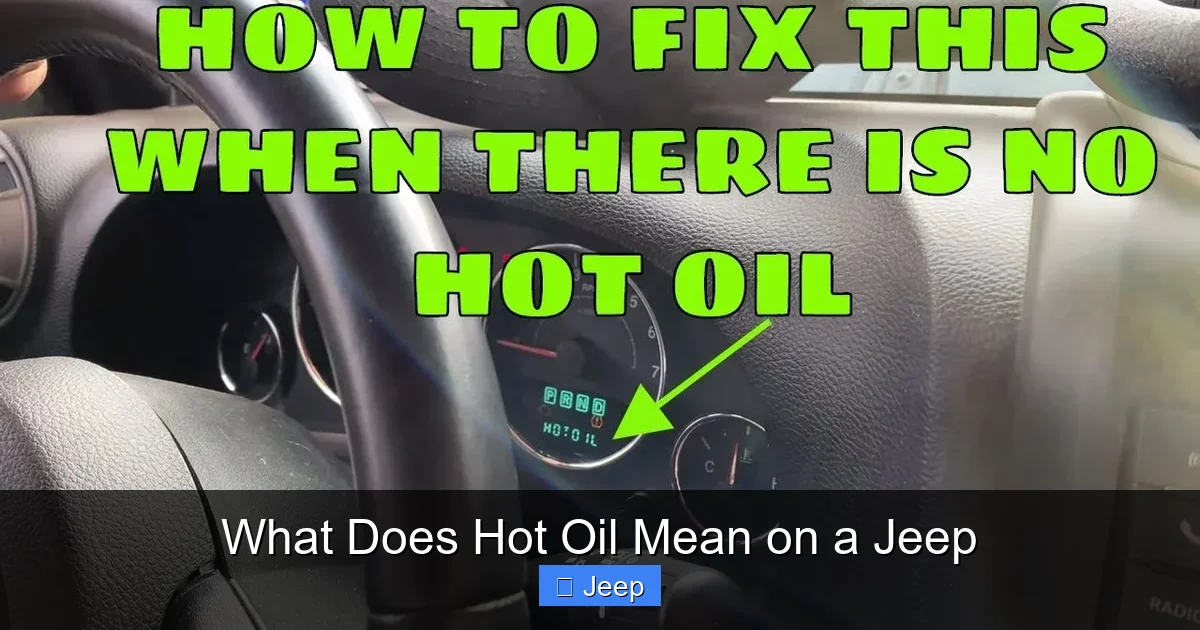
What Does Hot Oil Mean on a Jeep

Contents
- 1 Key Takeaways
- 2 📑 Table of Contents
- 3 Decoding the Dashboard: What “Hot Oil” Actually Means
- 4 The Usual Suspects: Common Causes of a Hot Oil Warning
- 5 Immediate Action Plan: What to Do When You See “HOT OIL”
- 6 Prevention Strategies: Keeping Your Jeep’s Oil Cool
- 7 Long-Term Health: Beyond the Immediate Fix
- 8 Conclusion: Respect the Warning
- 9 Frequently Asked Questions

Microfiber Car Cleaning Cloth

Bluetooth FM Transmitter

Car MP3 Player

Car Fog Light Bulb
Seeing “HOT OIL” on your Jeep’s dashboard is a serious, immediate warning that your engine oil temperature has exceeded a safe threshold. It is NOT an oil pressure warning. This indicates a critical risk of engine damage from overheating and insufficient lubrication. You must safely pull over, shut off the engine, and investigate the cause before driving further. Common causes include low oil level, degraded oil, a failing cooling system, or extreme driving conditions.
You’re cruising down the trail in your trusty Jeep Wrangler, the radio is playing, and the adventure is in full swing. Suddenly, your eyes catch a new, alarming message on the instrument cluster: HOT OIL. Your heart skips a beat. What does that even mean? Is it safe to keep driving? Your mind races with images of a smoking engine and a huge repair bill. If this has happened to you, take a deep breath. That warning is your Jeep’s most direct and urgent way of saying, “Stop! I am overheating in a way that will destroy me if you don’t act now.” This guide will break down exactly what “Hot Oil” means on a Jeep, why it’s so critical, what causes it, and the exact steps you must take to protect your engine and your wallet.
First, let’s get one thing crystal clear: “Hot Oil” is not the same as an oil pressure warning. An oil pressure warning (often a red oil can light) tells you the oil isn’t circulating under sufficient pressure. The “HOT OIL” message is a temperature warning. Your engine oil has a specific, safe operating temperature range, typically between about 180°F and 250°F, depending on the model and oil type. When the oil’s temperature climbs beyond that safe ceiling, your Jeep’s computer triggers this alert. Oil that gets too hot loses its viscosity—it becomes thin and slippery like water. This thin oil can’t form the durable, protective film needed between metal parts like bearings, pistons, and camshafts. The result is metal-on-metal contact, extreme friction, rapid wear, and ultimately, complete engine seizure. It’s a fast track to a “thrown rod” or a “blown engine.”
Jeeps, especially Wranglers and older models, are particularly susceptible to oil temperature issues for a few key reasons. Their upright, boxy design can trap heat in the engine bay. Many are used for off-roading, towing, or desert running in extreme heat, which puts immense thermal stress on all systems. Furthermore, some older Jeep engines (like the classic 4.0L inline-six) are known to run warm under normal conditions, making them more sensitive to any additional cooling system deficiencies. Understanding this warning isn’t just tech talk; it’s fundamental to being a responsible Jeep owner who wants their vehicle to last for decades and hundreds of thousands of miles. Let’s dive into the details.
Key Takeaways
- Urgent Warning: “Hot Oil” means your oil is too hot, not that it’s low. Continuing to drive can cause catastrophic engine failure within minutes.
- Immediate Action Required: Safely pull over, turn off the engine, and let it cool completely. Do not open the radiator cap while hot.
- Common Causes: Low oil level, old/dirty oil, a clogged or failing cooling system, or extreme towing/off-roading are typical culprits.
- Check the Basics First: After cooling, check the oil level and condition. Low oil or sludge-like oil are red flags requiring a change and top-off.
- It’s a System Issue: The problem often links the lubrication system (oil) and the cooling system. Both must function properly.
- Professional Diagnosis is Key: If oil level is fine, the issue could be a faulty sensor, oil pump, or internal engine problem requiring a mechanic.
- Prevention is Everything: Regular oil changes with the correct viscosity, monitoring gauges on long trips, and maintaining the cooling system prevent this warning.
📑 Table of Contents
Decoding the Dashboard: What “Hot Oil” Actually Means
When that ominous “HOT OIL” message illuminates your instrument cluster, it’s the culmination of data from at least one, and often multiple, sensors. Your Jeep’s Powertrain Control Module (PCM) is constantly monitoring the temperature of your engine coolant via the coolant temperature sensor. It also, on many modern Jeeps, monitors the actual oil temperature via a dedicated sensor in the oil pan or engine block. The “HOT OIL” alert is typically triggered when the oil temperature sensor reads a value above a predetermined, manufacturer-set threshold—usually somewhere in the range of 260°F to 280°F. This isn’t a gentle suggestion; it’s a hard, protective limit.
Think of your engine oil as the blood in your body. Your heart (oil pump) circulates it, and your skin and sweat glands (cooling system) keep it at the right temperature. If your blood gets too hot, you pass out. If your engine oil gets too hot, the engine “passes out” permanently. The viscosity of oil is carefully engineered. At operating temperature, it’s thick enough to cling and protect, but thin enough to flow. Heat is the enemy of viscosity. As oil heats up, its molecular structure weakens, and it thins out. Once it passes its thermal breakdown point, it can no longer protect the engine, no matter how much of it there is. This is why the warning is so severe—it signals an imminent loss of that critical protective layer.
Hot Oil vs. Oil Pressure vs. Check Engine Light
It’s vital to distinguish this warning from others. A low oil pressure warning (a red oil can icon) means the oil isn’t reaching all parts of the engine with enough force, often due to low oil level, a failing pump, or a blockage. You might have perfect oil temperature but zero pressure—both are fatal. The Check Engine Light is a generic catch-all for hundreds of potential issues, many of which are emissions-related and not immediately catastrophic. “HOT OIL” is a specific, high-priority warning that falls under the “Stop Now” category, much like a severe overheat coolant warning. If you see “HOT OIL,” your immediate focus is on temperature and lubrication, not catalytic converter efficiency.
The Usual Suspects: Common Causes of a Hot Oil Warning
Why is your Jeep’s oil overheating? The problem almost always exists within a network of related systems. It’s rarely a single, isolated failure. Here are the most frequent causes, starting with the simplest and most common.

Visual guide about What Does Hot Oil Mean on a Jeep
Image source: i.redd.it
Insufficient or Degraded Oil
This is the first thing to check. Low oil level is a prime suspect. With less oil in the sump, the oil has to work harder, cycles through the engine faster, and heats up more quickly. It also reduces the total heat-absorbing capacity of the system. Always check the dipstick when the engine is cool and on level ground. Old, dirty, or incorrect oil is just as bad. Oil breaks down over time and with heat cycles. It loses its additives that help manage heat and prevent sludge. Using an oil with a viscosity that’s too thin (e.g., 0W-20 instead of recommended 5W-30) for your climate or driving style can also cause it to thin out excessively under heat. Sludge from neglected oil changes can clog narrow oil passages, restricting flow and causing localized hot spots.
Cooling System Failures
Your engine’s cooling system doesn’t just cool the coolant; it indirectly cools the oil. Most modern engines have an oil cooler—a small radiator for the oil, often integrated into the main radiator or located separately. Hot oil is pumped through this cooler, where airflow (from the vehicle’s movement or electric fans) dissipates the heat. If the main cooling system is compromised—a faulty thermostat stuck closed, a failed water pump, low coolant level, broken cooling fans, or a clogged radiator—the entire engine runs hotter. This excess heat soaks into the oil, pushing its temperature over the edge. A leaking head gasket can also introduce combustion gases into the coolant, drastically reducing its efficiency.
Extreme Operating Conditions
Sometimes, the warning is a direct result of how you’re using the Jeep. Towing a heavy load up a long grade puts the engine under maximum load for an extended period, generating immense heat. Off-roading in deep sand, mud, or at low speeds eliminates the airflow that cools the radiator and oil cooler, causing heat to build up rapidly. Driving in extremely hot ambient temperatures (100°F+) reduces the cooling system’s margin for error. Extended idling, especially with the air conditioning on, can also cause heat soak if the electric cooling fans aren’t functioning properly. In these scenarios, the warning might appear even if your Jeep is in perfect mechanical health, simply because you’ve exceeded its thermal limits for that duration.
Mechanical Faults and Sensor Issues
If you’ve ruled out oil level, oil quality, and obvious cooling system issues, the fault could be internal. A failing oil pump might not circulate oil quickly enough, allowing it to pool and overheat in the pan. Blocked oil passages from sludge or debris can create the same effect. In rare cases, a faulty oil temperature sensor or its wiring can give a false reading, triggering the warning even if temperatures are normal. This is why a professional diagnosis is crucial if the basics check out. You don’t want to ignore a real problem because you assumed it was just a bad sensor.
Immediate Action Plan: What to Do When You See “HOT OIL”
Time is the enemy. The moment that message appears, you have a very short window—often less than 5-10 minutes of driving—before irreversible damage begins. Here is your step-by-step emergency protocol.

Visual guide about What Does Hot Oil Mean on a Jeep
Image source: fourwheeltrends.com
Step 1: Safely Pull Over and Shut Down
Do not panic and slam on the brakes. Signal, move to the shoulder, or find a safe turnout. Once stopped, turn off the engine immediately. Do not let it idle to “cool down.” idling still generates heat and pumps hot oil. Place the vehicle in park (or neutral for a manual), set the parking brake, and turn the key to the “off” position. If you have a manual transmission, leave it in gear to prevent rolling.
Step 2: Allow for a Significant Cool-Down Period
This is non-negotiable. The oil and engine components are scalding hot. You must wait at least 30-45 minutes for the heat to dissipate. Opening the hood can help, but do not touch the engine, radiator, or exhaust components. Do not attempt to check the oil or coolant while it’s hot; you risk severe burns from steam or splashing fluid.
Step 3: Perform Basic Checks (When Cool)
After the cool-down period, open the hood. First, visually check for any obvious leaks—puddles of oil or coolant under the vehicle or on components. Then, with the engine still off and cool, check the engine oil level using the dipstick. Pull it, wipe it clean, reinsert it fully, pull again, and read. Is it low? Is the oil on the dipstick dark, gritty, or sludge-like? Next, check the coolant level in the overflow reservoir (it will have min/max marks). Is it low? Is the coolant itself dirty or rusty? These simple checks provide the first clues.
Step 4: Assess and Decide: Call for Help
If the oil level was low, you can carefully add the correct type of oil (consult your owner’s manual) to bring it to the full mark. Do not start the engine again to check the pressure. If the oil was dirty or the level was fine, or if the coolant was low, your safest move is to call for a tow. Do not risk restarting the engine. If you are in a safe location and the oil was just slightly low, you might cautiously restart the engine, but you must monitor the temperature gauge like a hawk and be prepared to shut it down again at the first sign of rising temperature. The safest, most recommended course of action after a “HOT OIL” warning is to have the vehicle towed to a trusted mechanic. The cost of a tow is trivial compared to an engine replacement.
Prevention Strategies: Keeping Your Jeep’s Oil Cool
The best way to deal with a “HOT OIL” warning is to never see it. Prevention is built on consistent, intelligent maintenance and mindful driving habits.

Visual guide about What Does Hot Oil Mean on a Jeep
Image source: fourwheeltrends.com
Strict Adherence to Oil Change Intervals and Specifications
This is the single most important thing you can do. Use the exact oil viscosity and specification (e.g., API SP, Chrysler MS-6395) recommended in your Jeep’s owner’s manual. Modern Jeeps often require specific low-SAPS (sulfated ash, phosphorus, sulfur) oils for emissions equipment. Never cheap out here. Change the oil and filter at or before the recommended interval, especially if you do a lot of severe-duty driving (towing, dusty conditions, short trips). Consider using a high-quality synthetic oil, which has better thermal stability and resistance to breakdown than conventional oil. When you change the oil, always replace the oil filter with a high-quality unit. A clogged filter restricts flow and can cause hot spots.
Maintain the Cooling System with Zeal
Since the oil cooler relies on the engine’s cooling system, treat it as one system. Flush and replace the coolant according to the maintenance schedule (typically every 3-5 years). Use only the specified coolant type (usually OAT coolant for modern Jeeps). Regularly inspect hoses for cracks, bulges, or leaks. Ensure the radiator is clean. Use a gentle spray (never a pressure washer directly on a hot radiator) to clean bugs and debris from the fins, especially in summer. Test your thermostat and cooling fans periodically. The electric fan clutch or motor should engage when the engine gets hot. A fan that doesn’t work properly is a direct path to overheating.
Mindful Driving and Load Management
Be aware of your Jeep’s limits. When towing a max-rated trailer up a long mountain pass, expect the temperature gauge to climb. Slow down if necessary to reduce engine RPM and heat generation. On the trail, if you’re crawling through deep sand or mud for a long time, periodically stop, shift to neutral, and let the engine idle for a minute to allow airflow to cool the radiator. Avoid prolonged idling with the A/C on if the outside temperature is very high. These small habits can make a huge difference.
Consider an Auxiliary Oil Cooler for Severe Use
If you regularly tow heavy loads, live in a desert climate, or do serious rock crawling, the stock oil cooler might be inadequate. Installing an auxiliary oil cooler—a separate, larger cooler with its own fan—provides a massive increase in cooling capacity. This is a popular and effective modification for heavily used Jeeps. It’s an investment that directly protects your engine from thermal stress.
Long-Term Health: Beyond the Immediate Fix
Addressing a “HOT OIL” event isn’t just about getting the warning to go away. It’s about diagnosing and fixing the root cause to ensure it doesn’t happen again and cause cumulative damage.
Diagnostic Deep Dive
A competent mechanic should perform a systematic diagnosis. This includes: verifying the oil temperature with a scan tool (to rule out a faulty sensor), performing a block test for exhaust gases in the coolant (sign of a head gasket issue), pressure-testing the cooling system for leaks, checking the oil pressure with a mechanical gauge, and inspecting the oil for fuel dilution (which can lower flash point) or coolant contamination (a milkshake-like consistency). They may also check for internal blockages by removing the oil pan. Simply clearing the code and calling it fixed is a recipe for disaster.
If your Jeep has suffered a significant overheat event, even if you shut it down quickly, there could be internal damage. Extreme heat can cause piston rings to lose tension, bearings to become glazed, and cylinder heads to warp. A compression test and leak-down test might be warranted to assess internal engine health after a severe incident.
The Importance of Using Genuine Parts and Spec Fluids
When repairs are needed, use parts that meet or exceed OEM specifications. A cheap thermostat that opens at the wrong temperature or a water pump with a plastic impeller that can disintegrate will fail you when you need it most. The same goes for oil and filters. The cost savings on a no-name filter are negligible compared to the cost of an engine. For Jeeps, brands like Mopar (OEM), Wix, Mobil 1, and Amsoil are known for reliability.
Conclusion: Respect the Warning
The “HOT OIL” message on your Jeep is not a gentle reminder; it is a desperate, final shout from your engine’s computer before silence falls forever. It represents a state of imminent mechanical failure where the lifeblood of your engine has become too thin to protect it. Your response must be immediate, decisive, and cautious. The procedures outlined here—safely stopping, cooling, checking, and often towing—are designed to turn a potential five-thousand-dollar engine replacement into a manageable repair bill. Remember that prevention through strict maintenance schedule adherence, cooling system care, and mindful driving is the ultimate strategy. Your Jeep is a capable, rugged machine, but even it has thermal limits. Respecting the “HOT OIL” warning is the mark of an owner who understands that true adventure depends on a healthy engine waiting for you back at the trailhead, not a tow truck.
Frequently Asked Questions
Is it ever safe to drive my Jeep after the HOT OIL light comes on?
No, it is not considered safe. The warning indicates oil has exceeded its safe temperature limit. Continuing to drive, even for a short distance, risks severe and instantaneous engine damage. The only exception might be if you can safely move the vehicle a very short distance (like across a busy intersection) to get out of immediate danger, but you should then shut it down immediately.
What is the normal operating temperature for Jeep engine oil?
Normal operating oil temperature varies by model and engine but generally falls between 180°F and 220°F. The “HOT OIL” warning typically triggers around 260°F to 280°F. You can monitor normal oil temperature on many Jeeps by scrolling through the EVIC (Electronic Vehicle Information Center) or gauge cluster menus while driving.
Could a bad sensor cause a false HOT OIL warning?
Yes, it’s possible. A faulty oil temperature sensor or damaged wiring can send an incorrect, high reading to the PCM, triggering the warning even if oil temperature is normal. However, you should never assume it’s a false alarm. A proper diagnosis with a scan tool is required to confirm sensor accuracy before dismissing the warning.
Will adding oil immediately fix the HOT OIL warning?
It might, but only if low oil level was the sole cause. If the oil level was low, topping it off is a critical first step. However, if the oil is old, degraded, or if there is an underlying cooling system problem, the warning will likely return. You must identify and fix the root cause, not just treat the symptom.
Does the type of oil I use affect the likelihood of a HOT OIL warning?
Absolutely. Using the correct viscosity and specification is crucial. Oil that is too thin for your engine or climate will break down under heat faster. High-quality synthetic oils have better high-temperature stability (a higher viscosity index) and are more resistant to thermal breakdown, making them a better choice for severe duty use and hot climates.
Are certain Jeep models more prone to HOT OIL warnings?
Yes. Older Jeep models with the 4.0L inline-six engine are notorious for running warmer than modern engines, making them more sensitive to cooling system issues. High-performance models like the Grand Cherokee SRT or older V8-powered Wranglers also generate more heat under load. Any Jeep used for heavy towing, off-roading, or in extreme heat is at increased risk and requires extra vigilance with maintenance.