

What Does Audi Tt Stand For?

Contents
- 1 Key Takeaways
- 2 📑 Table of Contents
- 3 What Does Audi TT Stand For?
- 4 The Origins of the Audi TT Name
- 5 The Birth of the Audi TT: From Concept to Icon
- 6 Evolution Across Generations
- 7 Performance and Driving Experience
- 8 The End of an Era: Discontinuation in 2023
- 9 Legacy and Collector Value
- 10 Conclusion
- 11 Frequently Asked Questions

Car Seat Organizer

Car Trash Can

Car Glass Cleaner

Steering Wheel Cover
The Audi TT stands for “Tourist Trophy,” a legendary motorcycle race held on the Isle of Man. This name reflects Audi’s tribute to precision, speed, and engineering excellence, which the car embodies through its sleek design and dynamic performance.
Key Takeaways
- Audi TT stands for “Tourist Trophy”: Named after the famous Isle of Man motorcycle race, symbolizing speed and endurance.
- Rooted in motorsport heritage: The TT name connects Audi to a century-old racing tradition, emphasizing performance and innovation.
- First introduced in 1998: The Audi TT debuted as a concept car in 1995 and quickly became a production icon with its bold, minimalist design.
- Designed for driving pleasure: Known for its balanced handling, turbocharged engines, and all-wheel-drive system, the TT delivers a thrilling ride.
- Evolved across three generations: From the original coupe to modern digital cockpits and hybrid-ready tech, the TT has continuously advanced.
- Discontinued in 2023: Audi ended TT production to focus on electric vehicles, marking the close of an era for this beloved sports car.
- Remains a collector’s favorite: Enthusiasts value the TT for its design, driving dynamics, and emotional appeal.
📑 Table of Contents
What Does Audi TT Stand For?
Have you ever looked at an Audi TT and wondered what those two simple letters really mean? It’s not just a random combination—there’s a rich story behind it. The Audi TT stands for “Tourist Trophy,” a name deeply rooted in motorsport history. This isn’t just branding flair; it’s a nod to a legendary race that has challenged riders and engineers for over a century.
The Tourist Trophy (TT) race began in 1907 on the Isle of Man, a small island between Great Britain and Ireland. It quickly became one of the most dangerous and respected motorcycle races in the world. Over the years, it earned a reputation for testing both machine and rider to their absolute limits. By naming their sports car the TT, Audi wasn’t just borrowing a cool name—they were making a statement. They were saying, “This car is built for performance, precision, and passion.”
But the TT isn’t just about speed. It’s about design, innovation, and the joy of driving. From its first appearance as a concept car in 1995 to its final model in 2023, the Audi TT has captured hearts with its sleek lines, balanced handling, and unmistakable silhouette. Whether you’re a car enthusiast or just someone who appreciates beautiful engineering, the TT represents something special: a blend of heritage and modernity that few cars can match.
The Origins of the Audi TT Name

Visual guide about What Does Audi Tt Stand For?
Image source: slashgear.com
To truly understand what the Audi TT stands for, we need to go back to the beginning—not just of the car, but of the name itself. The Tourist Trophy race on the Isle of Man is where it all started. This grueling event was created to test the reliability and speed of early motorcycles, and it quickly became a proving ground for innovation. Manufacturers from across Europe sent their best machines, hoping to earn glory and prove their engineering prowess.
Audi, a brand with deep roots in German engineering and motorsport, saw an opportunity to connect its modern sports car to this storied past. When they unveiled the TT concept at the Frankfurt Motor Show in 1995, the name was no accident. It was a deliberate choice to evoke the spirit of competition, endurance, and excellence. The TT wasn’t just a new model—it was a tribute to a century of racing history.
Interestingly, the TT name wasn’t originally unique to Audi. Several other manufacturers, including Norton and Triumph, have used “TT” in their model names to honor the same race. But Audi gave it a fresh twist. Instead of building a motorcycle, they created a compact, front-engine sports car that balanced everyday usability with track-ready performance. The result? A car that felt just as at home on a winding mountain road as it did in a city parking garage.
Why the Tourist Trophy Matters
The Tourist Trophy isn’t just a race—it’s a legend. Held annually on public roads closed for the event, the TT course spans 37.73 miles of twists, turns, and elevation changes. Riders face stone walls, lampposts, and blind corners at speeds exceeding 200 mph. It’s one of the few races where man and machine are truly pushed to the edge.
By naming their car after this event, Audi aligned the TT with values like courage, precision, and innovation. These aren’t just marketing buzzwords—they’re qualities that define the car itself. The TT’s responsive steering, turbocharged engines, and quattro all-wheel-drive system all reflect a commitment to performance that echoes the demands of the Isle of Man race.
Audi’s Motorsport Legacy
Audi has a long history in motorsport, from rallying to endurance racing. The brand’s dominance in events like the 24 Hours of Le Mans with their diesel-powered R10 TDI showcased their engineering strength. The TT, while not a race car, carries that same DNA. It’s built to handle, to respond, and to inspire confidence behind the wheel.
Even though the TT was never designed to compete on the track, its performance credentials are undeniable. The TTS and TTRS variants, in particular, offer power outputs exceeding 300 horsepower, making them serious contenders in the sports car world. The name “TT” isn’t just symbolic—it’s a promise of driving excitement.
The Birth of the Audi TT: From Concept to Icon
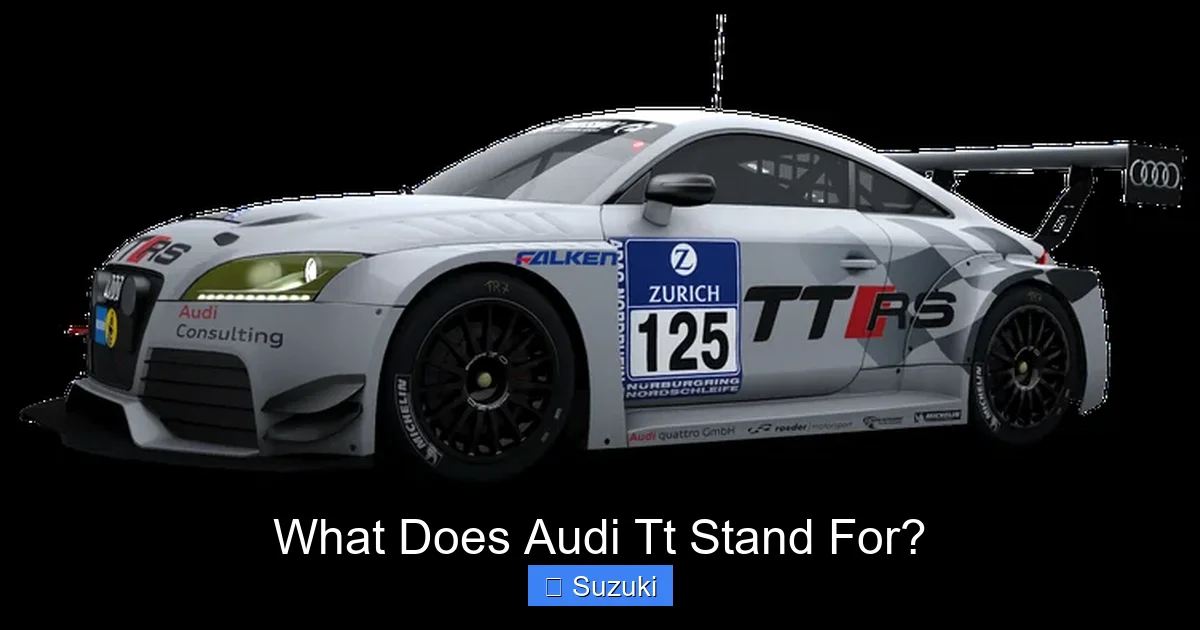
Visual guide about What Does Audi Tt Stand For?
Image source: prod.r3eassets.com
The story of the Audi TT begins not on the road, but on the drawing board. In the early 1990s, Audi was looking to create a car that would stand out—not just for its performance, but for its design. They wanted something bold, minimalist, and instantly recognizable. The result was the TT concept, unveiled at the 1995 Frankfurt Motor Show.
Designed by J Mays and Freeman Thomas at Audi’s design studio in California, the concept car drew inspiration from classic sports cars like the Porsche 356 and the Volkswagen Beetle. Its rounded shape, clean lines, and lack of unnecessary ornamentation made it a standout. But what really set it apart was its honesty—the design looked like it was shaped by function, not fashion.
The public reaction was overwhelming. People loved it. So much so that Audi decided to put it into production with only minor changes. The production version, launched in 1998, retained the concept’s iconic shape, including the distinctive wheel arches, short overhangs, and sleek roofline. It was a rare example of a concept car making it to showrooms almost unchanged.
The First Generation (1998–2006)
The first-generation Audi TT was available as both a coupe and a roadster. It came with a range of engines, starting with a 1.8-liter turbocharged four-cylinder that produced 180 horsepower. Later models included a 3.2-liter V6 with 250 horsepower and the introduction of Audi’s quattro all-wheel-drive system.
One of the TT’s standout features was its interior. The aluminum shift knob, spherical air vents, and minimalist dashboard gave it a futuristic yet timeless feel. It wasn’t just a car—it was a statement. Drivers didn’t just get from point A to point B; they enjoyed the journey.
But the TT wasn’t without its flaws. Early models had some handling issues, particularly with oversteer at the limit. Audi addressed this in later updates with improved suspension and electronic stability control. Still, the TT’s charm outweighed its quirks. It became a favorite among enthusiasts and celebrities alike.
Cultural Impact and Popularity
The Audi TT quickly became a cultural icon. It appeared in movies, music videos, and magazine spreads. Its design was praised by critics, and it won numerous awards, including the prestigious “Car of the Year” award from *Motor Trend* in 1999. But more than that, it became a symbol of modern German engineering—efficient, stylish, and fun.
Owners loved its blend of practicality and performance. The TT wasn’t a stripped-down track car; it had a usable back seat (though tight), a decent trunk, and modern amenities. It was a car you could drive every day, yet still feel special.
Evolution Across Generations

Visual guide about What Does Audi Tt Stand For?
Image source: motorbiscuit.com
Over its 25-year lifespan, the Audi TT evolved significantly. Each generation brought new technology, improved performance, and refined design. Let’s take a closer look at how the TT changed over time.
Second Generation (2006–2014)
The second-generation TT, introduced in 2006, was a major step forward. It featured a more rigid chassis, improved aerodynamics, and a wider track for better handling. The design was updated with sharper lines and a more aggressive stance, but it retained the classic TT silhouette.
Under the hood, the engine options expanded. The base model still used the 2.0-liter turbocharged four-cylinder, now producing 200 horsepower. The TTS model bumped that up to 272 horsepower, while the high-performance TTRS introduced a 2.5-liter five-cylinder engine with 340 horsepower—later increased to 360 horsepower.
One of the most notable upgrades was the introduction of the Audi Magnetic Ride suspension. This system used magnetorheological fluid in the dampers to adjust stiffness in real time, providing a smooth ride on rough roads and sharp handling on twisty ones. It was a game-changer for driving dynamics.
Third Generation (2014–2023)
The third and final generation of the TT debuted in 2014. It was based on the Volkswagen Group’s MQB platform, which also underpinned cars like the Golf and Audi A3. This allowed for greater efficiency and shared technology, but the TT still felt uniquely special.
The design was more angular and modern, with LED headlights, a wider grille, and a more sculpted body. Inside, the biggest change was the Virtual Cockpit—a fully digital 12.3-inch instrument cluster that replaced traditional dials. Drivers could customize the display to show navigation, media, performance data, and more. It was one of the first cars to offer such a feature, and it set a new standard for automotive interiors.
Performance continued to improve. The base 2.0-liter engine now produced 230 horsepower, while the TTS reached 310 horsepower. The TTRS, with its 2.5-liter five-cylinder, delivered a thrilling 400 horsepower and could sprint from 0 to 60 mph in just 3.7 seconds. It was one of the fastest Audis ever made.
Special Editions and Variants
Throughout its life, Audi released numerous special editions of the TT. These included the TT Clubsport, TT RS Plus, and limited-run models like the TT 20 Years edition. Each offered unique paint colors, interior trims, and performance upgrades.
One standout was the TT RS Heritage Edition, released in 2022 to celebrate the car’s legacy. It featured retro-inspired colors, bronze wheels, and special badging. Only a limited number were made, making them highly collectible.
Performance and Driving Experience
What made the Audi TT more than just a pretty face? It was the way it drove. From the moment you sat behind the wheel, you knew this was a driver’s car.
The TT’s compact size and low center of gravity gave it excellent balance. Whether you were cruising on the highway or carving through mountain roads, it felt agile and responsive. The steering was precise, and the suspension soaked up bumps without sacrificing cornering ability.
The turbocharged engines delivered strong acceleration, especially in the higher trims. The five-cylinder in the TTRS had a distinctive growl that enthusiasts loved. It wasn’t just about power—it was about character.
And then there was quattro. Audi’s all-wheel-drive system provided confidence in all weather conditions. Whether it was rain, snow, or dry pavement, the TT stuck to the road. It wasn’t just a performance feature—it was a safety advantage.
Real-World Driving Tips
If you’re lucky enough to drive an Audi TT, here are a few tips to get the most out of it:
- Use the drive modes: The TT offers settings like Comfort, Auto, Dynamic, and Individual. Dynamic sharpens the throttle and steering, perfect for spirited driving.
- Listen to the engine: The five-cylinder in the TTRS has a unique sound. Let it sing on open roads—it’s part of the experience.
- Check tire pressure: Proper inflation improves handling and fuel economy. The TT’s performance depends on good contact with the road.
- Enjoy the Virtual Cockpit: Customize the display to show what matters most to you—whether it’s lap times, navigation, or music.
The End of an Era: Discontinuation in 2023
In 2023, Audi announced the end of TT production. The decision wasn’t surprising—the automotive world is shifting toward electric vehicles, and Audi is focusing on models like the e-tron GT and Q6 e-tron. But for fans, it was still a bittersweet moment.
The TT had become a symbol of what a small sports car could be: stylish, fun, and deeply connected to driving pleasure. Its discontinuation marks the end of a chapter in Audi’s history. But it also opens the door for something new.
Audi has hinted that the TT spirit may live on in future electric models. While we may never see another gasoline-powered TT, the brand’s commitment to performance and design remains strong.
Why the TT Will Be Missed
The TT wasn’t just a car—it was an experience. It reminded us that driving could be joyful, that design could be meaningful, and that engineering could be beautiful. It wasn’t the fastest or the most powerful, but it was one of the most loved.
Enthusiasts will continue to cherish their TTs for years to come. Classic car markets are already seeing increased interest in well-maintained examples, especially the TTRS and special editions.
Legacy and Collector Value
Even though production has ended, the Audi TT’s legacy is secure. It’s already considered a modern classic, and its value is expected to rise among collectors.
Factors that influence collector appeal include:
- Low mileage: Cars with under 30,000 miles are especially desirable.
- Original condition: Unmodified examples with service records are more valuable.
- Special editions: Limited-run models like the Heritage Edition are highly sought after.
- Manual transmission: While most TTs came with S tronic automatics, manual versions are rarer and prized by enthusiasts.
If you own a TT, maintaining it properly is key. Regular servicing, keeping it garaged, and avoiding modifications will help preserve its value.
Future of the TT Name
Could we see the TT name return? Audi hasn’t ruled it out. With the rise of electric performance cars, a future “TT” could be a sleek, battery-powered coupe or roadster. Imagine a zero-emission sports car with instant torque, advanced tech, and that same iconic design language.
Only time will tell. But one thing is certain: the spirit of the Tourist Trophy—and the joy of driving—will live on.
Conclusion
So, what does Audi TT stand for? It stands for more than just two letters. It stands for heritage, performance, and passion. From its roots in the Isle of Man’s Tourist Trophy race to its place in automotive history, the TT has been a symbol of what a sports car should be: fun, stylish, and deeply connected to the joy of driving.
Though production has ended, the Audi TT’s legacy endures. It inspired a generation of drivers, influenced design trends, and proved that small cars can have big hearts. Whether you’re behind the wheel of a first-generation coupe or admiring a TTRS at a car show, the TT remains a testament to the art of engineering.
As we move toward an electric future, let’s not forget the cars that brought us here. The Audi TT wasn’t just a vehicle—it was an experience. And that’s something no acronym can fully capture.
Frequently Asked Questions
What does Audi TT stand for?
The Audi TT stands for “Tourist Trophy,” a famous motorcycle race held on the Isle of Man since 1907. The name reflects Audi’s tribute to motorsport heritage and performance excellence.
Is the Audi TT still in production?
No, Audi discontinued the TT in 2023 to focus on electric vehicles. The final models were produced in early 2023, marking the end of its 25-year run.
What engine does the Audi TT have?
The TT has featured various engines, including a 2.0-liter turbocharged four-cylinder and a 2.5-liter five-cylinder in the TTRS. Power outputs range from 200 to 400 horsepower depending on the model.
What makes the Audi TT special?
The TT is known for its iconic design, balanced handling, quattro all-wheel drive, and emotional driving experience. It blends everyday usability with sports car performance.
Will there be an electric Audi TT?
Audi has not confirmed an electric TT, but the brand is shifting toward EVs. A future electric sports car inspired by the TT’s spirit is possible.
Is the Audi TT a good car to buy used?
Yes, especially well-maintained examples with low mileage. The TTRS and special editions are particularly desirable among collectors and enthusiasts.


