What Does a Jeep Say About Your Personality?

Contents
- 1 Key Takeaways
- 2 📑 Table of Contents
- 3 The Call of the Wild: Adventure and Freedom
- 4 Built Tough: Resilience and Durability
- 5 Going Against the Grain: Non-Conformity and Individuality
- 6 Practical Power: Versatility and Utility
- 7 The Jeep Wave: Community and Loyalty
- 8 More Than a Vehicle: Customization as Self-Expression
- 9 Conclusion: Your Jeep, Your Story
- 10 Frequently Asked Questions


Driving a Jeep isn’t just about getting from A to B—it’s a statement. It signals a love for adventure, a resilient spirit, and a refusal to follow the crowd. Jeep owners often value practicality, community, and self-expression through their vehicle, seeing it as a tool for life’s journeys, not just a status symbol. Ultimately, your Jeep tells a story of freedom, capability, and a “go anywhere” mindset.
You see them everywhere. On the highway, splattered with mud from a recent trail run. Parked downtown, looking effortlessly cool with its boxy silhouette. Or being waved at by another driver in a similar vehicle. The Jeep is more than an automobile; it’s a cultural icon. And when you choose to own one, you’re not just buying transportation—you’re making a declaration. So, what does a Jeep say about your personality? It speaks volumes, often in the universal language of adventure, resilience, and a touch of rebellion.
This isn’t about judging a book by its cover in a negative way. It’s about understanding the powerful symbolism embedded in a vehicle that has remained remarkably true to its original, utilitarian design for over 80 years. From the WWII Willys that helped win a war to the modern Wrangler that dominates weekend trails, the Jeep has cultivated a mythology. When you put those keys in the ignition, you’re tapping into that legacy. Let’s explore the layers of personality your Jeep might be broadcasting to the world.
Key Takeaways
- Adventure Seeker: A Jeep owner prioritizes experiences and exploration over conventional luxury, valuing the journey as much as the destination.
- Resilient & Durable: You appreciate built-to-last engineering and are prepared for life’s bumps, mirroring your vehicle’s toughness.
- Non-Conformist: Choosing a Jeep often means rejecting the mundane; you value individuality and a vehicle that stands out from the typical sedan or SUV.
- Pragmatic Realist: You see your Jeep as a versatile tool—equally capable of a grocery run, a job site, or a mountain trail—prioritizing function over flash.
- Community-Oriented: The iconic “Jeep Wave” signifies a deep sense of belonging to a tribe that shares values of camaraderie and mutual respect on and off the road.
- Hands-On Customizer: You likely enjoy personalizing your Jeep, viewing it as a canvas for self-expression and a reflection of your unique tastes and needs.
📑 Table of Contents
- The Call of the Wild: Adventure and Freedom
- Built Tough: Resilience and Durability
- Going Against the Grain: Non-Conformity and Individuality
- Practical Power: Versatility and Utility
- The Jeep Wave: Community and Loyalty
- More Than a Vehicle: Customization as Self-Expression
- Conclusion: Your Jeep, Your Story
The Call of the Wild: Adventure and Freedom
At its core, the Jeep was born for adventure. Its very design—high ground clearance, short overhangs, solid axles—is a blueprint for going where roads end. Owning a Jeep, especially a Wrangler, is the most direct automotive connection to that pioneering spirit. It says you don’t just live for the weekend; you live for what you do on the weekend.
The Unwritten Itinerary
While a minivan owner might plan every detail of a family vacation, a Jeep owner is more likely to say, “Let’s see where this dirt road goes.” This personality type finds value in spontaneity and the unknown. The Jeep is the ultimate enabler of the unwritten itinerary. It whispers promises of hidden campsites, remote mountain peaks, and river crossings. This isn’t to say Jeep owners are reckless; it’s that they prioritize a different kind of richness—the kind measured in stories, not just photo ops at tourist traps. They are the friends who suggest a detour to a scenic overlook, simply because the trail looks inviting.
This love for adventure often extends beyond physical geography. It can symbolize a mental and emotional freedom—a desire to break free from routine, societal expectations, or the confines of a cubicle. The Jeep, with its removable doors and top, literally removes barriers between you and the world. Driving one feels like a small, daily act of rebellion against being cooped up. It’s a tangible tool for reclaiming a sense of openness and possibility.
Not All Who Wander Are Lost… But They Might Have a Map
It’s important to note that the “adventure” trait isn’t exclusively about extreme off-roarding. For many, it’s about the potential for adventure. The Jeep says, “I am ready.” It’s the vehicle you don’t have to think twice about when a snowstorm hits, a dirt road appears, or a spontaneous camping trip is proposed. This preparedness is a key personality marker: you are a pragmatist with a explorer’s heart. You might never take your stock Jeep on the Rubicon Trail, but knowing it could handle it is part of the appeal. This mindset often aligns with a “prepper” or “self-reliant” outlook on life, where capability is a form of currency.
Built Tough: Resilience and Durability
Jeeps are not known for their whisper-quiet cabins or feather-ride suspensions. They are known for being tough. The iconic clatter of the engine, the firm steering, the visible hardware—it’s all part of a design philosophy that prioritizes function over comfort. When you choose a Jeep, you’re aligning yourself with that philosophy. Your personality, therefore, often reflects a high tolerance for “character.” You don’t need everything to be smooth, silent, or effortless. You appreciate things that are built to work, and work hard.

Visual guide about What Does a Jeep Say About Your Personality?
Image source: i.pinimg.com
A “No Excuses” Mentality
The Jeep’s durability signals a “no excuses” mentality. You are the person who gets things done. Whether it’s hauling yard waste, towing a boat, or navigating a pothole-filled backroad, your vehicle is up for the task without complaint. This translates to a personality that is persistent, reliable, and perhaps a little stubborn. You value things that last, that can take a beating and keep going. This is the antithesis of disposable culture. You might keep your Jeep for 20 years, not because it’s a classic, but because it’s still useful. This speaks to a practical, long-term view of ownership and life.
This resilience isn’t just physical; it’s often emotional. Jeep owners frequently share stories of their vehicle surviving harsh winters, floods, or rocky trails. The Jeep becomes a metaphor for one’s own ability to endure. There’s a sense of partnership—you take care of it (regular maintenance is non-negotiable for a reliable Jeep), and it takes care of you. This is where understanding your vehicle’s needs becomes crucial. Knowing what your engine needs, like the right type of oil, is part of that resilient partnership. You can’t just put anything in there and expect it to thrive in tough conditions. A quick guide on what type of oil your engine really needs is essential knowledge for an owner who values durability.
Embracing the “Character”
A Jeep will have squeaks, rattles, and wind noise. A personality drawn to a Jeep is generally comfortable with imperfection. You don’t need a vacuum-sealed, silent cabin to feel content. You find charm in the mechanical sounds, the rugged feel, the sheer *presence* of the vehicle. This suggests a personality that is authentic, down-to-earth, and not overly concerned with keeping up appearances. You are more interested in the substance of an experience than its polished veneer. The minor annoyances are part of the charm, not deal-breakers. It’s the difference between someone who sees a dashboard warning light and panics, and someone who sees it as a simple puzzle to solve—like understanding what it means when your car leaks oil after a dusty trail run and knowing it’s likely just a seal needing attention.
Going Against the Grain: Non-Conformity and Individuality
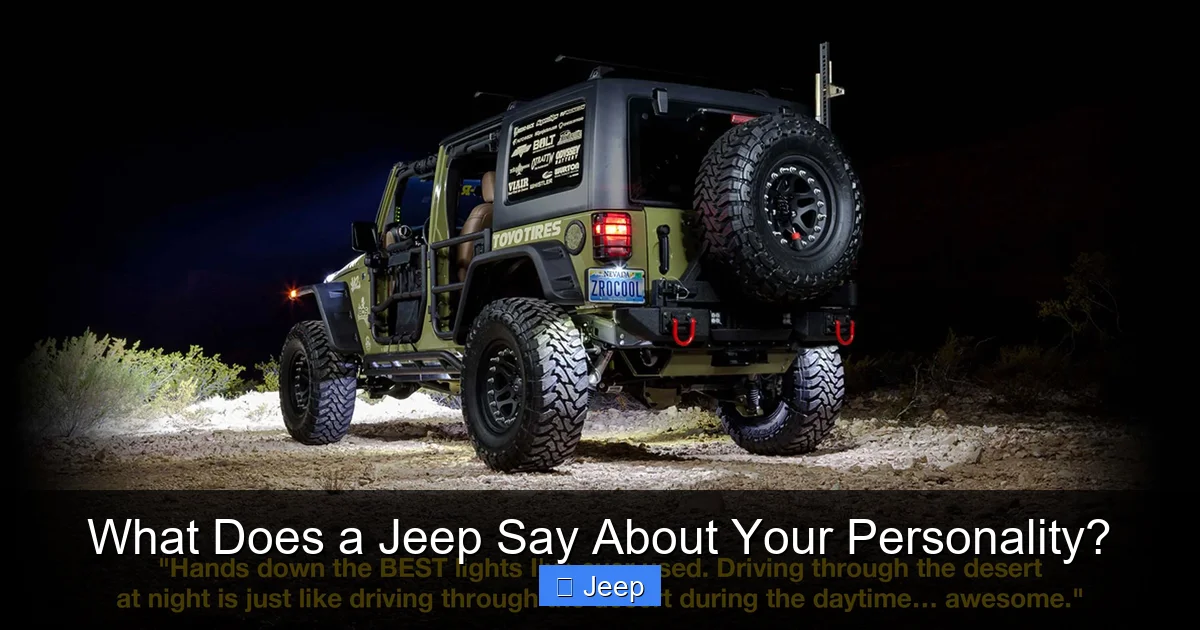
In a world of crossovers and streamlined designs, the Jeep is proudly, unapologetically boxy. It hasn’t changed its fundamental shape in decades. Choosing a Jeep is often a conscious rejection of automotive trends that prioritize aerodynamics and anonymity. Your personality, therefore, is likely one that values authenticity and self-expression. You are not interested in blending in.
Visual guide about What Does a Jeep Say About Your Personality?
Image source: cdn.shopify.com
The Anti-Sameness Statement
Driving a Jeep is an immediate visual cue that you march to the beat of your own drum. It says you prioritize purpose and history over what’s merely “new.” While others might seek the latest tech-laden sedan, the Jeep owner often celebrates a design that is virtually unchanged since the 1940s. This is a powerful statement about valuing legacy, simplicity, and iconic design. It suggests a personality that is confident, perhaps a bit nostalgic, and resistant to marketing hype that dictates what a “modern” SUV should be. You are a connoisseur of form that follows function.
This non-conformity extends to how you use your vehicle. While many SUVs never leave pavement, a Jeep’s raison d’être is to be used. Taking it off-road, getting it dirty, and using its capabilities is a badge of honor. It’s a rejection of the ” suburban soccer taxi” stereotype. This active engagement with your vehicle’s potential signals a hands-on, experiential personality. You don’t just own things; you use them. You’re the person who actually reads the manual, learns to engage the 4WD, and seeks out the terrain that makes the vehicle shine.
A Canvas for Self-Expression
The Jeep’s simplicity is its greatest strength for individualists. It’s a blank slate. The aftermarket world for Jeeps is arguably larger than for any other vehicle. From lift kits and monster tires to unique grilles and decals, customizing a Jeep is a national pastime. If your Jeep is highly modified, it screams creativity, technical interest, and a deep personal investment. It’s not just a purchase; it’s a project, a reflection of your specific tastes and needs. Even a stock Jeep often gets personalized with a sticker or two. This need to put your own stamp on things reveals a personality that is artistic, meticulous, and takes pride in ownership. You don’t want a cookie-cutter vehicle; you want your Jeep.
Practical Power: Versatility and Utility
Beneath the adventurous and individualistic exterior lies a profoundly practical core. The Jeep is, first and foremost, a tool. Its personality profile is incomplete without acknowledging the deep pragmatism of its owner. You likely chose your Jeep not just for how it makes you feel, but for what it can do. This marks you as a realist who values utility and versatility above all else.

Visual guide about What Does a Jeep Say About Your Personality?
Image source: img.buzzfeed.com
The Ultimate “Do-It-All” Vehicle
Need to haul a fridge? Fold the rear seats. Going to the beach with all the gear? The cargo space is square and useful. Got a serious snowstorm? The 4WD and high clearance are your friends. This multi-purpose capability is a huge draw. The Jeep owner’s personality is often that of a problem-solver. You see a vehicle not as a single-purpose item (commuter, luxury cruiser, etc.) but as a Swiss Army knife on wheels. This practicality often extends to a no-nonsense approach to life. You appreciate things that are straightforward, reliable, and effective. Fancy touchscreens are nice, but solid axles and a low-range transfer case are essential.
This utility-first mindset means you’re probably not overly concerned with premium fuel economy or plush ride quality. You accept the trade-offs because the benefits—true capability—outweigh the comforts. You are the person friends call when they need to move a couch or get out of a tight spot. Your vehicle is an extension of your helpful, capable nature. It’s also why Jeep ownership often involves a healthy dose of DIY maintenance. Understanding your machine is part of the practical contract. Knowing what a wrench light means on any vehicle is part of being a pragmatic owner, but for a Jeep owner, that knowledge is even more ingrained because the vehicle’s complexity is often lower and its uses more varied.
Weathering Any Storm
A practical Jeep owner sees their vehicle as an all-weather, all-season partner. The personality here is one of preparedness and resilience (which we touched on earlier). You don’t have to cancel plans because of a little snow or heavy rain. Your vehicle is equipped to handle it. This breeds a sense of independence and confidence. You are not at the mercy of the elements or road conditions. This trait can spill over into a general “can-do” attitude toward life’s challenges. If your Jeep can handle a rocky descent, you can probably handle a tough week at work.
The Jeep Wave: Community and Loyalty
Few vehicles inspire the kind of instant camaraderie that a Jeep does. The “Jeep Wave” is a real, global phenomenon. A simple hand raise or wave between two Jeep drivers is a silent acknowledgment of shared values and experiences. This speaks to a powerful community aspect of the Jeep owner personality: you are part of a tribe.
An Instant Bond
The wave isn’t about the model or the cost of modifications. It’s about the vehicle itself. It signals that you “get it.” You understand the unique joys and quirks of Jeep ownership. This creates an immediate, friendly bond with strangers. The personality here is one of openness and tribalism. You are loyal to your “tribe” and extend a baseline of friendliness and respect to fellow members. It’s a community built not on exclusivity of price, but on shared experience and a common passion. You are likely sociable, enjoy connecting with like-minded people, and find joy in these small, positive interactions.
This community extends to Jeep clubs, online forums, and organized trail rides. The Jeep owner is often eager to share knowledge, help with a repair, or plan a group adventure. There’s a strong undercurrent of mutual support. This suggests a personality that is generous, collaborative, and finds strength in shared interests. You might be an introvert in your daily life, but within the Jeep community, you’re a willing participant. The vehicle acts as a social catalyst and a common language.
Loyalty to the Brand and Each Other
Jeep owners are famously loyal. They buy Jeep after Jeep. This loyalty is rarely just about brand marketing; it’s about the relationship with the vehicle and the community it connects them to. This reflects a personality that values long-term relationships and consistency. Once you find something (or someone) that aligns with your values and delivers on its promises, you stick with it. There’s also a protective aspect. Jeep owners will passionately defend their choice against naysayers who call their vehicle uncomfortable or impractical. This defensiveness comes from a place of deep personal identification with the vehicle’s ethos. You don’t just own a Jeep; you believe in it.
More Than a Vehicle: Customization as Self-Expression
We touched on this in non-conformity, but it deserves its own deep dive. The culture of modifying Jeeps is so pervasive it’s almost expected. The degree of customization is a direct window into the owner’s personality, priorities, and technical comfort level.
The Spectrum of Customization
At one end, you have the pristine, lightly modified “weekend warrior” Jeep with a roof rack, all-terrain tires, and a few decals. This owner enjoys the aesthetic and mild capability boost. Their personality is likely casual, fun-loving, and appreciates subtle enhancements. At the other end is the hardcore rock-crawler with a massive lift, locked differentials, and a winch. This owner is an engineer, an adventurer, and a problem-solver who lives for the most extreme challenges. Their personality is intense, technically skilled, and deeply committed to a specific passion.
Most owners fall somewhere in between. A lift kit for better approach angles, bumpers for protection, auxiliary lights for night trails—each modification tells a story about how you use your Jeep and what you value. The person who adds a high-end audio system values music on the trails. The person who adds a kitchen pull-out values overlanding comfort. The person who keeps it bone stock values purity and reliability. Observing these choices is like reading a personality profile. It reveals your hobbies, your budget, your technical aptitude, and your aesthetic preferences.
The DIY Ethos
The customization process is often a DIY journey. For many Jeep owners, working on their vehicle is half the fun. This points to a personality that is hands-on, patient, and enjoys learning by doing. You are not afraid to get dirty and tackle a project. There’s a immense satisfaction in installing a part yourself and knowing it’s done right. This DIY spirit is connected to a broader sense of self-reliance and a distrust of over-complication. You want to understand your machine, not just hand it over to a shop for every minor issue. It’s a practical expression of the same resilient, capable personality that drew you to the Jeep in the first place.
Conclusion: Your Jeep, Your Story
So, what does a Jeep say about your personality? It paints a portrait of a complex and compelling individual. It says you are an adventurer at heart, seeking freedom and new experiences. It says you are resilient, durable, and appreciate things that are built to last. It says you have the confidence to be different and the creativity to express your individuality. It says you are pragmatic, valuing versatile utility over superficial luxury. And it says you are part of a loyal, friendly community that shares a unique bond over a legendary vehicle.
The Jeep is one of the last great automotive blank slates. It doesn’t impose a personality; it reflects and amplifies the one you already possess. Whether you’re a stock owner who loves the potential, a daily driver who braves snowstorms, or a trail-conquering enthusiast, your Jeep is a rolling manifesto. It’s a declaration that you value capability over convenience, community over anonymity, and the open road—especially the dirt ones—over the well-paved path. The next time you see a Jeep, wave. You’re not just acknowledging a vehicle. You’re acknowledging a kindred spirit, someone who, in their own way, has chosen to drive a little differently through life.
Frequently Asked Questions
Does owning a Jeep automatically mean I’m an extreme off-roader?
Not at all. While Jeeps are exceptionally capable off-road, many owners primarily drive on pavement. The personality trait is more about valuing the capability and potential for adventure rather than constantly using it. It signifies a mindset of readiness and appreciation for rugged design.
Are Jeep owners just trying to show off or be “cool”?
>The motivation is usually deeper than status. Jeep culture is more about shared experience and vehicle capability than prestige. While it can be a stylish vehicle, the community and practical utility are typically bigger draws for owners than simply projecting an image.
What does it say about me if I keep my Jeep completely stock?
>It suggests you value the original engineering, reliability, and purity of the design. Your personality may lean towards minimalism, practicality, and respecting the vehicle’s intended purpose without feeling the need to alter it. You appreciate it for what it is, not what you can make it.
Do all Jeep owners participate in the “Jeep Wave”?
>The vast majority do, as it’s a core part of the culture. However, some new owners might not know the custom, and a few might choose not to participate. Generally, returning the wave is seen as a friendly acknowledgment of shared membership in the Jeep community.
Is a Jeep a good vehicle for a pragmatic, non-adventurous person?
>It can be, but it’s not the most obvious choice. A Jeep’s strengths—capability, durability, visibility—are great for practicality. However, its compromises in ride comfort, fuel economy, and wind noise mean a pragmatic person would need to prioritize those strengths highly. For a true pragmatist who never needs the capability, a crossover or sedan might be a better fit.
What’s the biggest misconception about Jeep owners?
>A common misconception is that all Jeep owners are reckless, aggressive drivers who use their vehicles as rolling status symbols. In reality, the community heavily emphasizes responsible off-roading, trail etiquette, and a “tread lightly” philosophy. The personality is more about respectful capability than domination.