
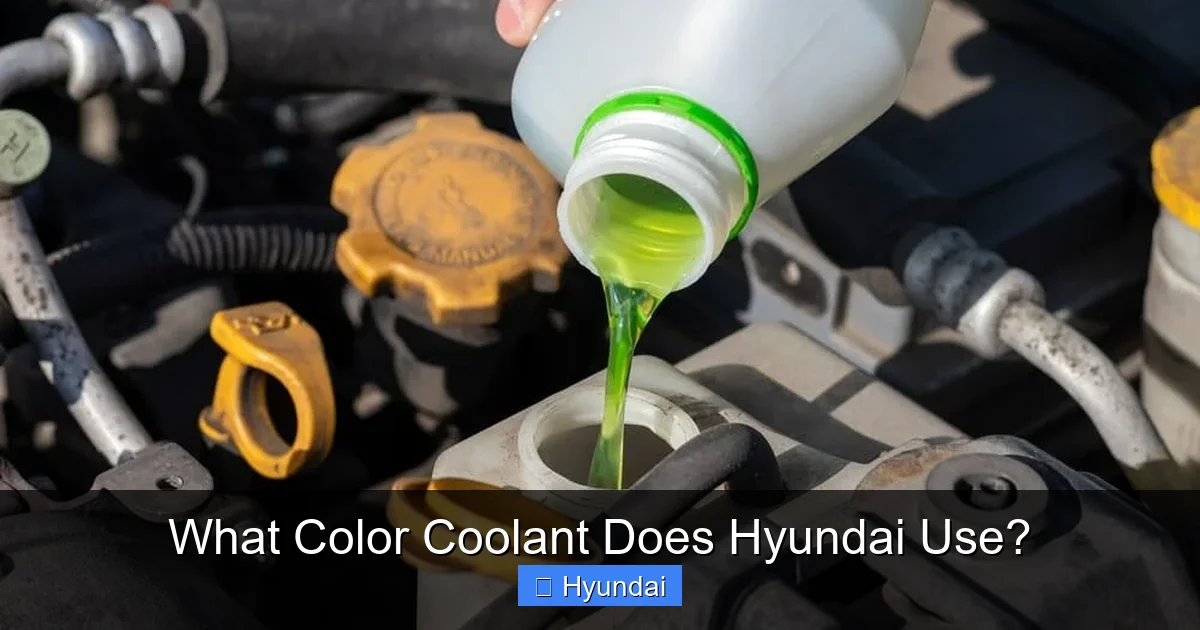
What Color Coolant Does Hyundai Use?

Contents
- 1 Key Takeaways
- 2 📑 Table of Contents
- 3 Introduction: The Great Coolant Color Confusion
- 4 The Evolution of Coolant Technology: Why Colors Changed
- 5 Hyundai’s Coolant Evolution by Model Era
- 6 Decoding Hyundai Coolant Colors: A Practical Guide
- 7 Why Color Alone Is a Terrible Way to Choose Coolant
- 8 How to Identify the Correct Coolant for Your Hyundai
- 9 Coolant Maintenance Best Practices: More Than Just Topping Off
- 10 Conclusion: Knowledge is Power (and Engine Protection)
- 11 Frequently Asked Questions

Car Tissue Holder

Car Seat Organizer

Rear View Camera
Side Window Sunshade
Hyundai uses specific coolant colors that vary by model year and engine type, typically pink or orange. Using the wrong coolant can cause severe engine damage, so always check your owner’s manual for the exact specification. Never mix different coolant types, as they can react and form harmful deposits that clog your cooling system.
Key Takeaways
- Hyundai coolant colors have evolved from traditional green to pink and orange based on chemical technology. Older models used green IAT coolant, while modern vehicles primarily use pink or orange P-OAT formulas.
- Color is not a reliable indicator; you must follow the manufacturer’s specification. The exact coolant type is defined by Hyundai’s engineering standards, not just its dye color.
- Mixing different coolant chemistries can cause catastrophic problems. Incompatible coolants can gel, lose corrosion protection, and cause overheating or engine damage.
- Most modern Hyundais (2000s+) require phosphate-free organic acid technology (P-OAT) coolant, often colored pink or orange. This is Hyundai Genuine Long Life Coolant or an equivalent meeting the specification.
- Always verify your coolant type via the owner’s manual, reservoir cap, or a dealership. The cap or manual will list the exact specification, such as “Hyundai Genuine Coolant” or “P-OAT.”
- Regular coolant maintenance is critical. Flush and replace coolant every 30,000-50,000 miles or per your manual’s schedule to prevent corrosion and maintain cooling efficiency.
📑 Table of Contents
- Introduction: The Great Coolant Color Confusion
- The Evolution of Coolant Technology: Why Colors Changed
- Hyundai’s Coolant Evolution by Model Era
- Decoding Hyundai Coolant Colors: A Practical Guide
- Why Color Alone Is a Terrible Way to Choose Coolant
- How to Identify the Correct Coolant for Your Hyundai
- Coolant Maintenance Best Practices: More Than Just Topping Off
- Conclusion: Knowledge is Power (and Engine Protection)
Introduction: The Great Coolant Color Confusion
Pop the hood of your Hyundai, and one of the first things you might notice is the colorful liquid in the translucent coolant reservoir. It’s often pink, orange, green, or even yellow. This leads to a very common and important question for every Hyundai owner: what color coolant does Hyundai use? The answer isn’t as simple as pointing to one color. It’s a journey through automotive chemistry, model years, and manufacturer specifications. Using the wrong coolant is not a minor mistake; it can lead to expensive engine repairs due to corrosion, overheating, or sludge buildup. This guide will decode the rainbow of Hyundai coolant, explaining exactly what your vehicle needs and why paying attention to more than just color is absolutely critical for your engine’s health.
We’ll break down the history of coolant technology, map out which Hyundai models use which colors, and give you foolproof methods to identify the correct fluid for your specific car. Whether you own a 2005 Elantra or a 2023 Santa Fe, by the end of this article, you’ll have a crystal-clear understanding of Hyundai’s coolant requirements and the confidence to maintain your cooling system properly.
The Evolution of Coolant Technology: Why Colors Changed
To understand Hyundai’s coolant colors, you first need to understand why coolant isn’t just “antifreeze.” Modern engine coolant is a sophisticated chemical cocktail. Its primary jobs are to transfer heat, prevent freezing and boiling, and—most critically—safeguard the intricate metal, plastic, and rubber components of your cooling system from corrosion. The “color” is simply a dye added by manufacturers for easy identification. The real story is the chemical base, or “technology type,” which has evolved dramatically.

Visual guide about What Color Coolant Does Hyundai Use?
Image source: rxmechanic.com
Inorganic Acid Technology (IAT) – The Traditional Green
This is the old-school, classic “green” coolant you might remember. IAT uses silicate and phosphate additives to protect metal surfaces, primarily aluminum and cast iron. It’s effective but has a shorter service life (typically 2-3 years or 30,000 miles) because the corrosion inhibitors deplete faster. It’s also more prone to forming abrasive silicate gel if mixed with other types. Many Hyundai models from the 1990s and early 2000s used a green IAT coolant.
Organic Acid Technology (OAT) – The Long-Life Pink/Orange
OAT coolants, often dyed pink, orange, or red, use organic acids as corrosion inhibitors. They are “phosphate-free” and “silicate-free,” which makes them much kinder to modern engine materials and seals. Their biggest advantage is an extended service life—often 5 years or 150,000 miles. This is the technology Hyundai adopted widely for its modern fleet. However, OAT coolants can be incompatible with older cooling systems designed for IAT, as they lack the immediate-acting silicate protection for aluminum.
Hybrid Organic Acid Technology (HOAT) – The Best of Both Worlds
HOAT coolants, sometimes yellow or turquoise, combine organic acids with a small amount of silicate for enhanced aluminum protection. They offer long life like OAT but with added security for certain high-temperature aluminum applications. Some European and Asian manufacturers use HOAT formulations. Hyundai’s primary modern specification is a P-OAT (Phosphate-free OAT), which is a specific subtype of OAT optimized for their engines.
This evolution is why you can’t just top off with “whatever pink coolant” is on sale. The chemical formulation must match your engine’s design and the materials in your cooling system. This is the core reason what color coolant does Hyundai use is a model-specific question.
Hyundai’s Coolant Evolution by Model Era
Hyundai, like all automakers, transitioned its coolant specifications over time to match engine technology and longer service intervals. Here’s a rough timeline to help you narrow down your vehicle’s likely requirement based on its age.

Visual guide about What Color Coolant Does Hyundai Use?
Image source: rxmechanic.com
Pre-2000s & Early 2000s: The Green Era
Models like the early Hyundai Accent, Sonata, and Elantra from the late 1990s to approximately 2005 typically used a green IAT coolant. It met the industry standard at the time. If you have a classic Hyundai, green is likely correct, but you must still verify the exact specification (e.g., ASTM D3306). Using a modern long-life pink coolant in an old system without a proper flush can sometimes cause issues due to the lack of silicates.
Mid-2000s to Early 2010s: The Transition Phase
This period saw Hyundai phasing in its new long-life coolant. Many models from 2006 onward began using a pink or orange-colored P-OAT coolant. However, there was overlap. Some 2006-2010 models might still have used the older green type depending on engine and market. This is the trickiest era for DIYers. The only sure way to know is to check your specific owner’s manual or the label on the coolant reservoir cap.
2010s to Present: The Pink/Orange Standard
For well over a decade now, Hyundai has standardized on a phosphate-free organic acid technology (P-OAT) coolant for the vast majority of its gasoline and diesel engines. This is the iconic pink or orange coolant. It’s sold as Hyundai Genuine Long Life Coolant or as an aftermarket equivalent that meets Hyundai specification MS 591-08 or similar. This includes popular models like the current-generation Sonata, Elantra, Tucson, Santa Fe, Kona, and the entire Genesis lineup. Some high-performance models or specific markets might have slight variations, but pink/orange P-OAT is the overwhelming norm.
For example, if you’re asking what color coolant does a Hyundai Santa Fe use, for any model from roughly 2013 onward, the answer is almost certainly pink or orange. The same goes for a Hyundai Elantra from 2011+. You can find the precise recommendation for your specific model in our detailed guides for the best coolant for a Hyundai Sonata or the best coolant for a Hyundai Santa Fe.
Decoding Hyundai Coolant Colors: A Practical Guide
Let’s get specific. When you look in your reservoir, what color should you see? And what does that color mean? Remember, the dye is just an identifier; the chemical formula is what matters.

Visual guide about What Color Coolant Does Hyundai Use?
Image source: fresh-catalog.com
The Classic Pink / Orange Coolant (Modern Standard)
This is Hyundai’s current, long-life coolant. It’s typically a vibrant pink or orange-red hue. Chemically, it’s a P-OAT (Phosphate-free Organic Acid Technology) formula. It’s designed to last up to 150,000 miles or 5 years when used exclusively in the system. It provides excellent corrosion protection for aluminum, cast iron, and copper/brass components. This is the coolant you will find in most Hyundai vehicles manufactured from the late 2000s to today. The official Hyundai part number is often something like 07100-00500. When purchasing aftermarket, look for a product that explicitly states it meets Hyundai specification MS 591-08 or is “for Hyundai/Kia Long Life Coolant.” Brands like Zerex G12++, Pentosin, and others make compatible versions. Never assume a generic “orange coolant” is the same; it must be P-OAT.
The Older Green / Yellow-Green Coolant
Found in older Hyundais (pre-~2006), this is a conventional green IAT coolant. It’s usually a more translucent green. Its service life is shorter, requiring changes every 2-3 years. It contains silicates and phosphates for immediate corrosion protection. If your older Hyundai’s manual specifies “Inorganic Acid Technology” or simply lists a green coolant, this is it. Mixing this with modern pink coolant is a bad idea, as the silicates can react and form gel.
Rare or Specialty Colors
You might occasionally see a blue, turquoise, or yellow coolant in a Hyundai. This is less common. A turquoise color might indicate a HOAT-type coolant used in some European applications, but it’s not standard for Hyundai. Yellow could be a different manufacturer’s dye for an OAT formula. The rule is: ignore the color, read the specification. A yellow coolant from one brand might be chemically identical to a pink one from another. Never rely on color alone.
What About “Universal” Coolants?
You’ll see products labeled “Universal Coolant” or “All Makes/All Models.” These are typically formulated to be somewhat compatible with all older technologies (IAT, OAT, HOAT). They are usually a yellow or green color. While they can be used in a pinch for topping off or in a pinch during a flush, they are not ideal for long-term use in a Hyundai designed for a specific P-OAT formulation. They may not offer the same extended service life or optimized corrosion protection. For a complete and permanent fill, always use a coolant that meets Hyundai’s exact specification.
Why Color Alone Is a Terrible Way to Choose Coolant
This is the most critical section. Relying solely on color is the #1 mistake people make, and it can cost thousands. Here’s why:
There is No Industry Standard for Coolant Color
There is no law or regulation that says “P-OAT must be pink.” One manufacturer might dye its P-OAT pink, another orange, and a third yellow. The color is purely a marketing and identification tool chosen by the company. Toyota’s pink coolant (which is also an OAT) is chemically different from Hyundai’s pink coolant, even though they look identical. Assuming all pink coolants are the same is like assuming all red sports cars have the same engine—it’s a dangerous oversimplification.
The Danger of Mixing Chemistries
When you mix IAT (green) and OAT (pink/orange) coolants, the chemical inhibitors can react. This reaction can cause:
- Gel or Precipitate Formation: Solids can form in the coolant, clogging the tiny passages in the radiator, heater core, and water pump. This leads to hotspots and overheating.
- Loss of Corrosion Protection: The mixed cocktail may not effectively protect any of the metals, leading to rapid rust and corrosion, especially of the aluminum components.
- Damage to Seals and Hoses: Some chemical combinations can degrade rubber seals and plastic tanks, causing leaks.
Once contaminated, the entire system must be chemically flushed, which is a more involved and expensive process than a simple drain and fill. This is why you must never top off with a different type. If you’re low, use the exact same coolant already in the system, or plan a complete flush.
Real-World Consequences: What Happens When You’re Wrong
Using the wrong coolant doesn’t cause immediate, dramatic failure. It’s a slow, corrosive process. Over months and years, the incorrect inhibitor package fails to protect the engine block, cylinder head, water pump, and radiator. You might first notice a sweet smell (leaking coolant), then see orange or white crusty deposits (corrosion byproducts) around the radiator cap or hoses. Eventually, a water pump seal fails, a radiator core leaks, or the cylinder head gasket is compromised due to localized overheating from clogged passages. The repair bill for a failed water pump and radiator, or worse, a head gasket, can easily exceed $2,000. Spending $30 on the correct coolant is the ultimate preventative maintenance.
How to Identify the Correct Coolant for Your Hyundai
So, you’ve been convinced that color is not enough. How do you find the truth? Here is your step-by-step verification process, in order of reliability.
1. The Owner’s Manual: Your Primary Source
The owner’s manual in your glove box is the absolute bible for your vehicle. Look in the “Fluids and Lubricants” section or the “Capacities and Specifications” section. It will list the coolant requirement by name and specification. It might say:
- “Hyundai Genuine Long Life Coolant”
- “Engine Coolant (P-OAT)”
- ” ethylene glycol-based coolant meeting Hyundai specification MS 591-08″
- Or it will list a specific part number.
This is the only 100% guaranteed method. If you don’t have the physical manual, Hyundai often provides digital copies on their owner’s website.
2. The Coolant Reservoir Cap: A Quick Reference
Many Hyundai reservoir caps have the specification printed directly on them. Look for text like “LONG LIFE COOLANT,” “P-OAT,” “Hyundai Genuine,” or a specification number (e.g., MS 591-08). This is an excellent, immediate visual cue. If it says “Long Life Coolant,” you need the pink/orange P-OAT type.
3. Decode Your VIN and Model Year
While not a substitute for the manual, your model year and engine type give a strong clue. As a general rule:
- Model Year 2006 and newer: Highly likely to require pink/orange P-OAT.
- Model Year 2005 and older: Likely requires green IAT, but verify.
- All turbocharged engines (like the 1.6T, 2.0T) from the last 15 years: Definitely use the specified long-life pink/orange coolant.
For specific models, our guides provide this decoded information. For instance, you can learn the exact requirements for a Toyota RAV4 to see how another major brand handles its specifications, which reinforces the principle that manufacturer specs are king.
4. Consult a Hyundai Dealer or Parts Department
Call your local Hyundai dealer’s parts department. Give them your VIN, and they can tell you the exact coolant specification and part number. This is a very reliable and quick method.
5. When in Doubt, Flush and Start Fresh
If you’ve just bought a used Hyundai and the coolant looks dirty, the wrong color, or you have no history, the safest course is a complete cooling system flush. This removes all old, incompatible coolant. Then, you can refill with the correct type as determined by your research for that model year. This eliminates any guesswork and contamination risk.
Coolant Maintenance Best Practices: More Than Just Topping Off
Knowing the right coolant is only half the battle. Proper maintenance ensures your cooling system lasts as long as your car.
Service Intervals: Follow the Manual
Hyundai’s long-life coolant is rated for 5 years/150,000 miles, but that’s under ideal conditions. Many mechanics recommend checking the coolant’s condition every 30,000 miles and considering a flush every 50,000-60,000 miles as a preventative measure. The fluid can become acidic over time, losing its protective properties. Never wait for the “low coolant” light; check the level and condition in the reservoir monthly. It should be bright, clear, and at the “FULL” line when the engine is cold.
The Proper Way to Top Off
If the level is low, you must use the exact same coolant already in the system. If you don’t know what’s in there, your options are: 1) Have a sample tested at a shop, or 2) Perform a complete flush and refill with the correct type. Never mix types, even for a temporary top-off. Always use a 50/50 mixture of coolant and distilled water (unless you buy pre-mixed). Never use straight coolant or tap water, as they can cause scaling or poor freeze/boil protection.
Flushing: Not Just a Drain
A simple “drain and fill” only removes about 50% of the old coolant. A proper flush uses a machine or repeated draining/filling with water to purge nearly all of the old fluid from the engine block, heater core, and radiator. This is essential when switching coolant types. For a detailed look at maintaining your Hyundai’s systems, understanding what kind of oil does a 2016 Nissan Rogue use can provide a parallel example of the importance of manufacturer-specific fluids across different brands.
Watch for Warning Signs
Be proactive. Signs of cooling system trouble include:
- Sweet smell (coolant leak)
- Visible leaks (puddles under car, wet hoses)
- Persistent low coolant level with no visible leak
- Engine running hotter than usual
- Crusty, rusty, or sludgy deposits in the reservoir
Addressing these early can prevent a minor issue from becoming a major engine repair.
Conclusion: Knowledge is Power (and Engine Protection)
The question what color coolant does Hyundai use opens the door to a much more important principle: your Hyundai’s fluids are meticulously engineered. The color is a helpful clue, but the chemical specification is the law. For the vast majority of Hyundai vehicles from the mid-2000s onward, that means a phosphate-free organic acid technology (P-OAT) coolant, typically colored pink or orange. For older models, it may be a traditional green IAT coolant.
Your action plan is simple: verify, don’t guess. Check your owner’s manual or reservoir cap. Use the exact specification. Never mix types. Adhere to service intervals. By treating your coolant with the same respect you give your engine oil, you ensure your Hyundai’s power plant stays cool, clean, and reliable for hundreds of thousands of miles. A $30 bottle of the right coolant is the cheapest insurance policy you can buy for your engine. When in doubt, consult a professional or refer to model-specific resources like our guides for the best coolant for a Hyundai Sonata or Santa Fe to ensure you’re making the perfect choice for your vehicle.
Frequently Asked Questions
Can I use any pink coolant in my Hyundai?
No. Not all pink coolants are created equal. You must use a coolant that meets Hyundai’s specific P-OAT formulation (often spec MS 591-08). Using a different brand’s pink OAT coolant that isn’t formulated for Hyundai may not provide adequate protection and could potentially cause issues with seals or materials specific to Hyundai engines.
What happens if I accidentally mix orange and pink coolant?
If both are actually the same P-OAT chemistry from Hyundai (which they often are, as “orange” and “pink” are just dye variations), mixing is usually fine. The danger lies in mixing different *chemistries*—like mixing a green IAT with a pink OAT. If you’re unsure of the chemical type in your system, it’s best to have it flushed to avoid potential gelling or corrosion.
How often should I change the coolant in my Hyundai?
Hyundai’s long-life P-OAT coolant is rated for up to 5 years or 150,000 miles. However, many mechanics recommend a preventative flush every 50,000-60,000 miles to ensure the corrosion inhibitors haven’t broken down. Always refer to your specific owner’s manual for the definitive interval for your model and year.
Where can I find the exact coolant type for my Hyundai?
Check your owner’s manual first. Second, look at the coolant reservoir cap, which often lists the specification. Third, call a Hyundai dealer with your VIN. You can also consult model-specific resources like our guide on the best coolant for a Hyundai Elantra for your particular generation.
Is coolant color a reliable way to determine the right type?
Absolutely not. Color is just a dye added by manufacturers for identification. There is no industry standard. A “pink” coolant from one brand may be chemically different from a “pink” from another. Always rely on the manufacturer’s specification (e.g., “Hyundai Genuine Long Life Coolant” or “P-OAT meeting MS 591-08”), not the color.
Can I use a universal coolant in my Hyundai?
While universal coolants are designed to be compatible with multiple systems, they are a compromise. They may not offer the same extended service life or optimized corrosion protection as a coolant formulated specifically for Hyundai’s P-OAT specification. For a permanent fill, it’s always best to use a coolant that explicitly states it meets Hyundai’s requirements.


