What Axles Are in My Jeep Tj?

Contents
- 1 Key Takeaways
- 2 📑 Table of Contents
- 3 Why Knowing Your Axles Isn’t Just for Gearheads
- 4 The Usual Suspects: Dana 30 Front, Dana 35/44 Rear
- 5 How to Identify What’s Actually Under Your TJ
- 6 Year-by-Year and Trim Package Breakdown
- 7 Gear Ratios: The Number That Matters Almost As Much
- 8 Upgrading Your Axles: From Dana 35 to Dana 44 and Beyond
- 9 Maintenance and Longevity: Caring for Your Dana
- 10 Conclusion: Your Axles Are Your Foundation
- 11 Frequently Asked Questions

Tire Repair Kit

Car Tool Kit Set

Car Scratch Remover

Anti Rust Spray
Figuring out what axles are in your Jeep TJ is crucial for maintenance, repairs, and off-road upgrades. The TJ typically came with a Dana 30 front axle and either a Dana 35 or Dana 44 rear axle, depending on the year and trim package. You can identify your specific axles by checking the axle tag, vehicle VIN, or by visual inspection of the axle housing and differential cover. Knowing your axle type determines your gear ratio options, locker compatibility, and overall strength for trails.
So, you’ve got a trusty Jeep TJ. That boxy, iconic shape is pure Americana. You love its capability, its grunt, and the way it makes you feel with the top off. But there’s one question that nags at every TJ owner, especially when a weird noise starts clunking from underneath or you’re dreaming bigger tires: “What axles are actually under my Jeep TJ?”
It’s not just a trivial detail. Your axles are the final link in the chain that puts your engine’s power to the ground. They determine how much abuse your rig can take, what gear ratios you can run, and whether you can bolt on a locker or a bigger axle shaft. Getting familiar with your Dana 30s and Dana 44s isn’t just for hardcore wheelers—it’s essential knowledge for any TJ owner who wants to maintain their vehicle properly and make smart modification choices. Let’s pop the hood, drop the differential covers (metaphorically, for now), and get to the bottom of what’s spinning under your TJ.
Key Takeaways
- The Jeep TJ most commonly used a Dana 30 front axle. This is a light-to-medium duty axle found in nearly all TJs, with strength that varies by year and gear ratio.
- The rear axle was either a Dana 35 or a Dana 44. The Dana 35 was standard on most models, while the Dana 44 was a heavy-duty option, especially on Rubicon and some Sahara trims with the manual transmission.
- Your Vehicle Identification Number (VIN) is a primary tool for identification. The 8th digit of the VIN can often tell you the axle ratio and type when decoded with a Jeep specification chart.
- Physical axle tags and stamps are the most reliable method. Look for metal tags on the differential cover or casting numbers on the axle housing itself for definitive proof.
- Year and trim package are huge factors. For example, 1997-1999 Rubicons got a Dana 44 rear, while 2000-2006 Rubicons got a Dana 44 rear only with the manual transmission.
- Gear ratios are intertwined with axle identification. The axle tag will list a ratio like 3.73 or 4.10, which is vital for matching tire size and engine performance.
- Upgrading from a Dana 35 to a Dana 44 is a common goal. This swap significantly improves strength for larger tires and off-road abuse, but requires careful planning of brackets, brakes, and shafts.
📑 Table of Contents
- Why Knowing Your Axles Isn’t Just for Gearheads
- The Usual Suspects: Dana 30 Front, Dana 35/44 Rear
- How to Identify What’s Actually Under Your TJ
- Year-by-Year and Trim Package Breakdown
- Gear Ratios: The Number That Matters Almost As Much
- Upgrading Your Axles: From Dana 35 to Dana 44 and Beyond
- Maintenance and Longevity: Caring for Your Dana
- Conclusion: Your Axles Are Your Foundation
Why Knowing Your Axles Isn’t Just for Gearheads
Before we dive into the specifics, let’s address the “why.” Why should you care if you have a Dana 30 or a Dana 35? It’s simple: strength, compatibility, and cost.
Think of your axle as a bridge. A small, rickety bridge (a Dana 35 with small shafts and a weak ring gear) can handle a light car. But try to drive a heavy truck (37-inch tires, locked differentials, and rock crawling) across it, and it will groan, bend, and eventually break. A stronger bridge (a Dana 44 with larger shafts and a robust ring gear) can handle the load. Knowing which bridge you have tells you what you can safely tow, what size tires you can run without breaking something, and what kind of traction devices (like air or electronic lockers) you can install.
Furthermore, axle identification is your first step in any major drivetrain work. If you need a new ring and pinion set, you must know the exact axle model and gear ratio. If you’re swapping in a used axle from a junkyard, you need to confirm it’s a direct bolt-in or what modifications are needed. This knowledge saves you from costly mistakes and hours of frustration.
The Real-World Cost of Not Knowing
Imagine this: You buy a set of 4.88 gears for your TJ, only to discover your Dana 30 front axle has a small-diameter ring gear that doesn’t support gears that low. Or, you install a lunchbox locker in your rear, only to snap an axle shaft because you have the weaker Dana 35. These aren’t hypotheticals; they’re common mistakes. Taking 30 minutes to identify your axles now can save you $1,000 in broken parts and labor later. While you’re planning your drivetrain upgrades, don’t forget the supporting cooling system—a high-quality aluminum radiator for your Jeep TJ can be a critical upgrade, especially if you’re adding power or tackling tough trails where engine heat is a constant battle.
The Usual Suspects: Dana 30 Front, Dana 35/44 Rear
Alright, let’s meet the cast of characters. For the Jeep TJ (1997-2006), Chrysler used axles from the Dana Corporation, a legendary name in axle manufacturing. The lineup was relatively straightforward but had some important variations.

Visual guide about What Axles Are in My Jeep Tj?
Image source: shunauto.com
The Front Axle: Almost Always a Dana 30
Virtually every single Jeep TJ rolled off the production line with a Dana 30 up front. This is a solid, capable axle that served the TJ well. However, “Dana 30” is a broad family. There are critical differences:
- 1997-1999 TJs: Used an early model Dana 30 with a 27-spline axle shaft and a 5-on-4.5-inch wheel bolt pattern. The ring gear diameter is 7.2 inches.
- 2000-2006 TJs: Received an updated Dana 30 with a 30-spline axle shaft (stronger) and a 5-on-5-inch wheel bolt pattern. The ring gear diameter increased to 7.6 inches. This is a key distinction—the later model is generally considered stronger and is the one most people refer to when talking about TJ front axles.
All TJ Dana 30s are driver-side drop (the differential is lower on the driver’s side), which is important for lift kit compatibility.
The Rear Axle: The Great Divide (Dana 35 vs. Dana 44)
Here’s where it gets interesting. Your rear axle tells the story of your TJ’s intended use and its factory options.
- Dana 35: This was the standard rear axle for the vast majority of TJs, including all automatic transmission models and many manuals. It’s a C-clip axle, meaning the axle shafts are held in by a C-clip inside the differential. This is a known weak point for hardcore wheeling, as a broken axle shaft can become a dangerous projectile. The Dana 35 has a 7.5-inch ring gear and 27-spline shafts. It’s perfectly fine for stock use, light off-roading, and smaller tires (up to 31-33 inches with caution).
- Dana 44: This is the holy grail for many TJ owners. It’s a much stronger axle with a larger 8.4-inch ring gear and 30-spline shafts. Crucially, it does NOT use C-clips; the shafts are held in by the internal spider gears, making it safer if a shaft does break. The Dana 44 was standard equipment on the Rubicon trim package, but with a major caveat: from 2000-2006, the Dana 44 rear was only available with the AX-15 manual transmission. Automatic Rubicons in those years got a Dana 44 front but a Dana 35 rear. Earlier (1997-1999) Rubicons got the Dana 44 rear with either transmission. Some Sahara models with the optional 3.73 or 4.10 gearing also sometimes got the Dana 44.
This Dana 44 vs. Dana 35 split is the single most important piece of information for a TJ owner. If you have a Dana 44 rear, you have a significantly stronger foundation for upgrades.
How to Identify What’s Actually Under Your TJ
Now for the practical part. You’re standing in your garage, wondering what’s bolted to your frame. Here are your methods, in order of reliability.

Visual guide about What Axles Are in My Jeep Tj?
Image source: adventurejeep.com
Method 1: Decode Your VIN (The Paper Chase)
This is your starting point, but it’s not always 100% definitive for axles. Your Jeep’s 17-digit VIN is a code. The 8th digit is the “Axle Ratio” code. You’ll need a Jeep TJ VIN decoder chart (easily found online in forums or factory service manuals). For example, a “3” in the 8th position might mean a 3.07 ratio, while a “5” might mean a 3.73. This tells you the gear ratio, which is stamped on the axle itself. However, the same ratio could be in either a Dana 35 or a Dana 44. So while VIN decoding narrows it down, it doesn’t always give you the final answer on the axle model.
Method 2: Find and Read the Axle Tag (The Gold Standard)
This is the most reliable factory method. Both Dana 30 and Dana 44 axles (and many Dana 35s) have a small, metal tag attached to one of the differential cover bolts or on the housing near the yoke. This tag is your treasure map. It will typically read something like:
- D30 or D44 (the axle model)
- 3.73 or 4.10 (the gear ratio)
- CTB or U (indicating if it’s a limited-slip or open differential)
Problem: These tags are often rusted, painted over, missing, or have been removed over the years. If you have it, clean it off and read it carefully. That’s your answer.
Method 3: Visual Inspection & Casting Numbers (The Detective Work)
When the tag is gone, you become a detective. You need to get under the Jeep and look. Safety first! Use jack stands on solid frame rails.
- Differential Cover Shape: This is your biggest clue. A Dana 30 cover is roughly triangular with a flat bottom. A Dana 35 cover is rounder, almost oval, with a distinctive flat spot on the bottom where the fill plug is. A Dana 44 cover is very similar to a Dana 30 but is noticeably larger and bulkier. Compare pictures online side-by-side—it’s easy once you know what to look for.
- Ring Gear Size (Requires Opening): If you’re willing to remove the differential cover, you can measure the ring gear diameter. A Dana 30 is ~7.2″ or 7.6″. A Dana 35 is 7.5″. A Dana 44 is 8.4″. This is definitive but messy.
- Casting Numbers: On the axle housing itself (often on the tube, near the differential, or on the piggyback housing), there will be raised casting numbers. For a Dana 30, you might see “30” or “D30”. A Dana 35 might have “35” or “D35”. A Dana 44 will have “44” or “D44”. These can be worn or obscured, but they’re a great clue.
- Axle Shaft Spline Count (Advanced): This requires removing the wheel, brake drum or caliper, and the axle shaft itself. Count the splines on the end that goes into the differential. A Dana 30 (1997-1999) has 27 splines. A Dana 30 (2000-2006) and a Dana 44 have 30 splines. A Dana 35 has 27 splines. This is a definitive, but labor-intensive, test.
Method 4: Use the “Rubicon Rule” (A Good Shortcut)
If your TJ is a Rubicon model, you almost certainly have a Dana 44 rear axle… but remember the transmission caveat from 2000-2006. Check your transmission code in the VIN (the 4th digit). If it’s an automatic (code often “4” or “A”), your 2000-2006 Rubicon likely has a Dana 35 rear. If it’s a manual (code often “6” or “M”), it has a Dana 44. For 1997-1999 Rubicons, you get the Dana 44 rear with either transmission. Saharas are trickier; they could have either axle based on the original order.
Year-by-Year and Trim Package Breakdown
Let’s make it simple. Here’s a general guide for U.S. market Jeep TJs. Always verify with your own VIN and physical inspection.
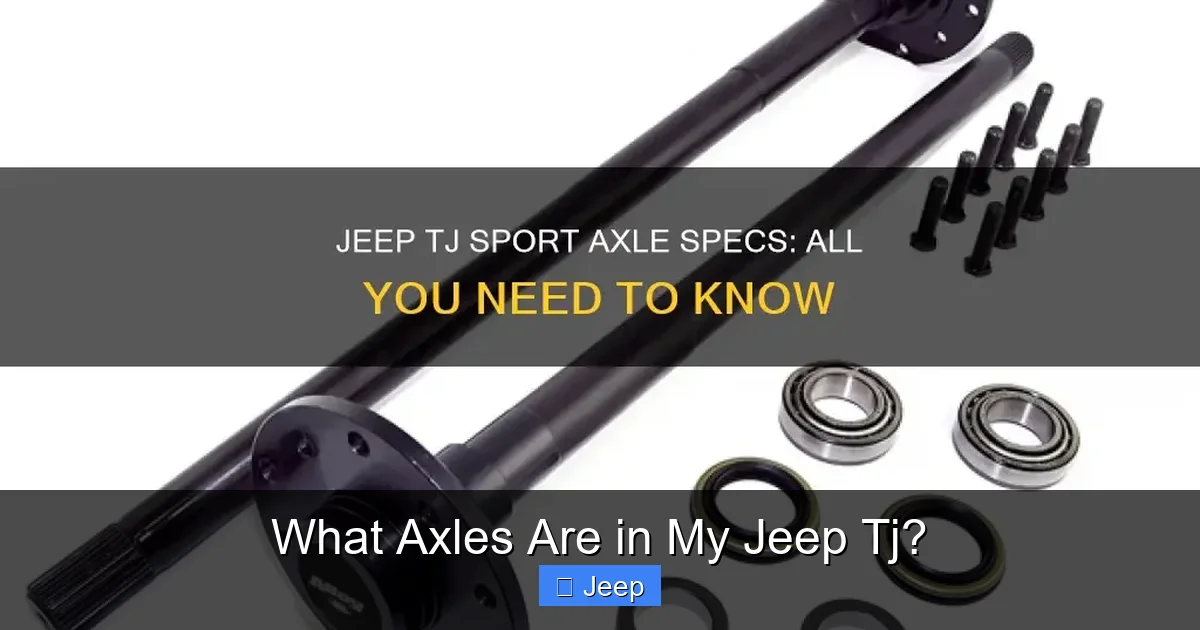
Visual guide about What Axles Are in My Jeep Tj?
Image source: shunauto.com
1997-1999 Model Years
- Base / SE: Dana 30 Front, Dana 35 Rear.
- Sport: Dana 30 Front, Dana 35 Rear.
- Sahara: Dana 30 Front, Dana 35 Rear (rare 4×4 Sahara with 3.73/4.10 *might* have Dana 44, verify).
- Rubicon: Dana 30 Front, Dana 44 Rear. (This is the golden combo. Manual or auto, you got the Dana 44 rear).
2000-2006 Model Years
- Base / SE / Sport: Dana 30 Front, Dana 35 Rear.
- Sahara: Dana 30 Front, Dana 35 Rear (the vast majority). Some special order or high-option Saharas with 4.10 gears *might* have a Dana 44, but it’s rare. Assume Dana 35.
- Rubicon: Dana 30 Front, Dana 44 Rear ONLY with AX-15 Manual Transmission. With the 42RLE Automatic Transmission, it has a Dana 35 Rear. This is the #1 point of confusion for TJ buyers.
Pro Tip: The 2003-2006 Rubicon package also included electronic locking differentials (both front and rear) on the Dana 44. If you have power window Rubicon switches on the dash, you likely have these lockers, confirming the Dana 44 rear.
Gear Ratios: The Number That Matters Almost As Much
Finding out you have a Dana 44 is great, but a Dana 44 with 3.07 gears is very different from one with 4.88 gears. The gear ratio is stamped on the axle tag and is also encoded in your VIN. Common TJ ratios were 3.07, 3.73, and 4.10.
- 3.07: Usually paired with the 2.5L 4-cylinder or early 4.0L for highway fuel economy. Too tall for most tire upgrades.
- 3.73: The most common ratio for 4.0L TJs with automatics. A good all-around ratio for 31-33 inch tires.
- 4.10: A lower, more aggressive ratio. Excellent for 33-35 inch tires, providing better low-end torque and reducing strain on the engine. Often found on manuals and Rubicons.
Why does this matter? Your speedometer calibration and engine RPM at highway speeds are directly tied to your gear ratio and tire size. If you change one, you should change the other. A 4.0L TJ with 35-inch tires and 3.73 gears will feel slow and overworked on the highway. The same setup with 4.10s would be much happier. Your axle identification is the first step in planning this critical gearing change.
Upgrading Your Axles: From Dana 35 to Dana 44 and Beyond
So you’ve identified your axles. Maybe you’re the proud owner of a Dana 35 rear and you’re planning on going to 37s. What now? The most common and effective upgrade is the Dana 44 swap.
The Dana 35 to Dana 44 Swap: A Feasible Dream
This is a popular project because the Dana 44 is a direct bolt-in replacement for the Dana 35 in a TJ. The housings are nearly identical in width and have the same spring perch locations. However, it’s not a simple “unbolt one, bolt the other.” You must consider:
- Brakes: If your donor Dana 44 has disc brakes (common on Rubicons) and your TJ had drums, you’ll need to swap brake lines, proportioning valves, and potentially the brake pedal bracket to accommodate the different master cylinder pushrod.
- Wheel Bearings & Seals: Always replace these on a used axle before installation.
- Gear Ratio: You’re stuck with whatever ratio is in the donor axle. If you want 4.88s, you’ll need to buy a Dana 44 with those gears already installed or rebuild it yourself.
- ABS Sensors: If your TJ has ABS (most did), the tone ring and sensor locations differ between Dana 35 and Dana 44. You’ll need to either swap your old ABS tone ring to the new axle shaft (if spline count matches) or disable ABS (which requires cutting the wiring and a dash bulb).
A clean swap involves finding a complete, running Dana 44 from a Rubicon, preferably a 2000-2006 model to match your spline count. Always visually and physically match the brake setup to your existing TJ to avoid surprises.
When to Consider an Even Stronger Axle
For most TJ owners, a Dana 44 is the endgame. But if you’re building a rock-crawling monster with 40-inch tires and 700 horsepower, you might look at:
- Dana 60: A massive, full-floating axle used in heavy-duty trucks. Requires significant custom fabrication (spring perches, motor mounts, driveshaft lengths). Not a casual swap.
- Ford 9-inch: A popular, strong axle with a vast aftermarket. Also requires full custom mounting but is a favorite for high-horsepower rigs.
- AJK (Articulating Jeep Kit) / RZP (Rock Zombie Performance) Dana 44: These are heavily modified, high-strength Dana 44s with 35-spline shafts, larger bearings, and other upgrades. They retain the bolt-in nature of the TJ but offer strength far beyond a stock Dana 44.
For 95% of TJ builds, a well-built Dana 44 (with 30-spline shafts, a Detroit or ARB locker, and 4.88 or 5.38 gears) is the perfect, strong, and reliable endpoint.
Maintenance and Longevity: Caring for Your Dana
Knowing your axle is step one. Keeping it alive is step two. Here’s universal advice for TJ axles:
- Fluid is Key: Use the correct gear oil. Most TJs use SAE 75W-90 GL-5. For limited-slip differentials (like the optional Trac-Lok), you Must use an GL-5 oil with an LSD additive (like Ford Friction Modifier or GM Posi-Traction additive). Check and change your differential fluid every 30,000-50,000 miles or if it’s contaminated with water or metal shavings.
- Seals and Bearings: The pinion seal and axle shaft seals are common leak points. If you see oil around the differential cover or on the inside of your wheel, a seal is likely bad. Wheel bearings should be repacked or replaced during a major service if you have drum brakes. For disc brakes, check the bearing play during brake jobs.
- C-Clip Safety (Dana 35): If you have a Dana 35, be extra vigilant about axle shaft condition. A slight bend or crack can lead to catastrophic failure. Regular visual inspection during oil changes is wise.
- Listen and Feel: A whining or grinding noise that changes with vehicle speed (not engine RPM) is often a sign of failing wheel bearings or ring/pinion wear. A clunk when accelerating or decelerating points to worn U-joints, slip-yoke issues, or differential problems.
Conclusion: Your Axles Are Your Foundation
Your Jeep TJ’s axles are more than just metal tubes spinning under your feet. They are the foundation of its legendary capability. By now, you should understand that the magic words are “Dana 30 front” and “Dana 35 or Dana 44 rear.” You have the tools—VIN decoding, axle tags, visual cues—to definitively answer “What axles are in my Jeep TJ?” for yourself.
That knowledge empowers you. It allows you to buy the correct repair parts, choose the right gear ratio for your new tires, and plan a Dana 44 swap with confidence. It turns a mysterious clunk into a diagnosable problem and a dream of bigger tires into a realistic build plan. So go out there, get under your TJ, and solve the mystery. Your wallet and your off-road adventures will thank you for it. After all, a TJ with known, strong axles is a TJ ready for anything the trail (or the grocery store parking lot) throws at it.
Frequently Asked Questions
How can I tell if my TJ has a Dana 44 rear without removing the axle?
First, check if it’s a Rubicon. If it’s a 1997-1999 Rubicon, it has a Dana 44 rear. If it’s a 2000-2006 Rubicon with a manual transmission, it has a Dana 44. With an automatic, it has a Dana 35. Second, look for the 3.73 or 4.10 badge on the rear hatch of a Sahara—some of these had Dana 44s. Finally, the most reliable way without removal is to find and read the metal axle tag on the differential cover. If the tag says “D44” or “44,” you have it.
Is a Dana 35 really that weak? Can I run 33-inch tires on it?
The Dana 35 is adequate for stock use and light off-roading with 31-33 inch tires. Its main weakness is the C-clip design and 27-spline shafts. Under hard acceleration or severe traction (like a locked rear on rocks), the shafts can break. For casual wheeling and 33s, it’s usually fine if you’re gentle. For 35s or more aggressive use, a Dana 44 swap is highly recommended for safety and reliability.
What’s the difference between the front Dana 30 in my 1999 TJ and a 2004 TJ?
The main difference is the axle shaft spline count and wheel bolt pattern. Your 1999 TJ has a Dana 30 with 27-spline shafts and a 5-on-4.5-inch bolt pattern. The 2000+ TJs have a stronger 30-spline shaft and a 5-on-5-inch bolt pattern. The ring gear size also increased slightly. This means axles shafts are not interchangeable between these generations.
Can I put a Rubicon Dana 44 rear into my non-Rubicon TJ?
Yes, it’s one of the most common and straightforward axle swaps for the TJ. The Dana 44 from a Rubicon is a direct bolt-in replacement for the Dana 35. You must address the brake lines if your TJ has rear drums and the Rubicon axle has discs, and you’ll need to handle the ABS sensor difference. Otherwise, the spring perches, shocks, and driveshaft are typically compatible.
My axle tag is missing. Is there any other way to confirm my gear ratio?
Yes. The most accurate method is to mark the driveshaft and a tire, then turn the tire one full revolution while counting how many times the driveshaft turns. This gives you the axle ratio. Alternatively, you can decode the 8th digit of your VIN, which corresponds to the factory gear ratio. However, the VIN code only tells you the ratio, not the axle model (D35 vs D44).
I have a 2003 Rubicon automatic. My rear tag says “D35.” Is that correct?
Yes, that is correct. From 2000 to 2006, Jeep only equipped the Rubicon package with the Dana 44 rear axle when it was ordered with the AX-15 manual transmission. If your 2003 Rubicon has the 42RLE automatic transmission, it came from the factory with a Dana 35 rear axle and a Dana 30 front. This is a common point of confusion for used TJ buyers.