Washington Window Tint Law

Contents
- 1 Key Takeaways
- 2 📑 Table of Contents
- 3 Understanding the Foundation: What is VLT and Why Washington Cares
- 4 A Detailed Breakdown by Vehicle Location
- 5 Special Considerations: Exemptions, Factory Tint, and BMWs
- 6 Enforcement, Penalties, and What Happens If You’re Stopped
- 7 Professional Installation vs. DIY: The Smart Choice for BMW Owners
- 8 Staying Compliant: Long-Term Maintenance and What to Do If You’re Unsure
- 9 Conclusion: Style, Comfort, and Compliance Go Hand-in-Hand
- 10 Frequently Asked Questions

Magnetic Car Phone Mount

OBD2 Scanner Tool

Digital Tire Pressure Gauge

Liquid Car Polish
Washington state has specific window tint laws that all vehicle owners, including BMW drivers, must follow. The rules center on VLT (Visible Light Transmission) percentages, with stricter limits for front side windows. Understanding these regulations helps you avoid fines, ensures safety, and maintains your vehicle’s warranty. This guide breaks down exactly what’s legal, the penalties for violations, and practical advice for BMW owners considering tint.
So, you’ve got your hands on the wheel of a sleek BMW. The ride is smooth, the engineering is precise, and you want that perfect blend of privacy, style, and sun protection. Window tint seems like the obvious next step. But before you book that appointment, you need to become an expert on one thing: Washington window tint law. It’s not just about picking a shade you like; it’s about what the law allows. Getting it wrong can mean wasted money, a fix-it ticket, and even a headache with your dealer. Let’s break down everything a Washington-based BMW owner needs to know, in plain English.
Key Takeaways
- VLT is Key: Washington law measures tint darkness by Visible Light Transmission (VLT) percentage. Lower numbers mean darker tint.
- Front Sides are Strict: Front side windows must allow over 70% of light in (VLT 70+), a significant difference from rear windows.
- No Exemptions for BMWs: Luxury brand status or factory-installed tint does not grant exemptions from state VLT laws.
- Medical Exemptions Exist: Drivers with specific medical conditions can apply for a waiver, but it requires official documentation.
- Penalties Add Up: Violations result in a “fix-it” ticket, requiring tint removal or correction and a fee, plus potential court costs.
- Factory Tint Often Compliant: Many modern BMWs come with a light factory tint (typically 70-80% VLT) that is already legal in Washington.
- Professional Installation is Crucial: Improperly installed tint can bubble, peel, and lead to non-compliance claims, voiding warranties.
📑 Table of Contents
- Understanding the Foundation: What is VLT and Why Washington Cares
- A Detailed Breakdown by Vehicle Location
- Special Considerations: Exemptions, Factory Tint, and BMWs
- Enforcement, Penalties, and What Happens If You’re Stopped
- Professional Installation vs. DIY: The Smart Choice for BMW Owners
- Staying Compliant: Long-Term Maintenance and What to Do If You’re Unsure
- Conclusion: Style, Comfort, and Compliance Go Hand-in-Hand
Understanding the Foundation: What is VLT and Why Washington Cares
You’ll hear the term “VLT” a lot. It stands for Visible Light Transmission. Think of it as a percentage of sunlight that can pass through your window. A VLT of 70% means 70% of outside light gets in, making it quite light. A VLT of 20% is very dark, only letting in 20% of light. Washington state is concerned with VLT because it directly impacts driver visibility and law enforcement safety. Too dark, and an officer can’t see inside the vehicle during a traffic stop, which is a safety concern for everyone.
The Core Legal Thresholds in Washington
Washington’s laws are found in RCW 46.37.500. They are straightforward but have a critical nuance. For passenger vehicles (which includes your BMW 3 Series, X5, or X1):
- Front Side Windows: Must have a VLT of 70% or greater. This is the most important and restrictive rule. It means the glass must let in at least 70% of light. Factory tint on most new BMWs is often around 70-80%, which is perfectly legal.
- Rear Side Windows and Rear Window: There is no specific darkness limit. You can go as dark as you want here. This is where you can add significant privacy and reduce glare.
- Windshield: Non-reflective tint is permitted on the top 6 inches of the windshield. This is the “visor strip” you see on many cars. You cannot tint the entire windshield.
For multipurpose passenger vehicles (like some larger BMW X7s if classified differently, or vans/SUVs used for multiple purposes), the rules can differ slightly, often allowing darker rear side tints. However, for standard BMW sedans and SUVs, the passenger vehicle rules apply. Always confirm your specific vehicle classification with the Washington State Patrol or a professional tint shop.
A Detailed Breakdown by Vehicle Location
Let’s walk around your BMW and see what’s allowed on each window. This is where most confusion happens.

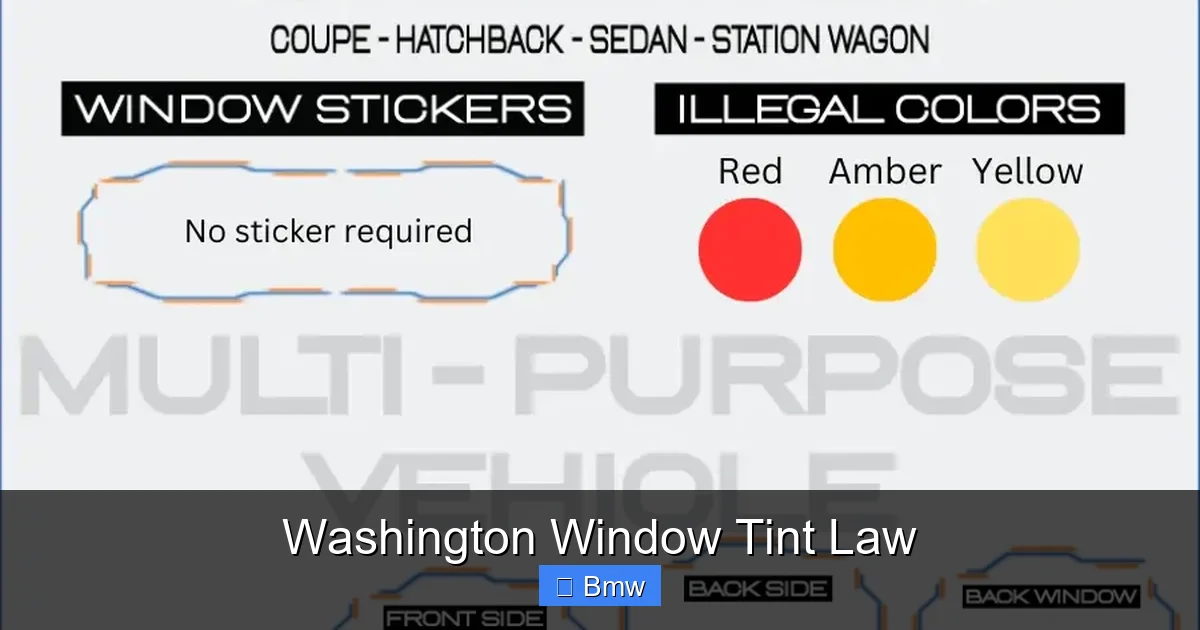
Visual guide about Washington Window Tint Law
Image source: windowtintlaws.us
Front Side Windows: The 70% Rule is King
This is the make-or-break rule. The glass on the driver’s and front passenger’s doors must be very light. If your BMW came from the factory with a light tint, you’re already good. If it has clear glass (common on base models), adding any aftermarket tint that brings the VLT below 70% is illegal. A common mistake is thinking a “50%” tint is legal because it’s not super dark. It’s not. 50% is darker than 70%. For a factory-tinted BMW with 75% VLT, adding a 30% film over it would likely push you below 70%, making it illegal. You must know your starting VLT. You can use a tint meter to check, or ask your BMW dealer for the factory specs.
Rear Side and Back Window: Your Privacy Playground
Here’s where you have freedom. The rear side windows (behind the driver and passenger) and the rear back window can be tinted to any darkness, including limo black (5% VLT). This is excellent for keeping the trunk private, reducing solar heat on rear seats, and protecting rear passengers from UV rays. Many BMW owners opt for a darker rear to complement the lighter front, creating a “two-tone” look that is both stylish and legal. Remember, the rear window tint must not be reflective in a way that creates a mirror effect, as Washington prohibits overly reflective tints on any window.
Windshield: Only a Narrow Strip
You cannot tint the entire windshield for glare reduction in Washington. The only legal tint is a non-reflective strip at the very top, spanning no more than the top 6 inches. This helps block sun glare from the high angle without impairing the driver’s main field of vision. Some BMWs have a faint factory gradient at the top; this is usually compliant as it’s non-reflective and within the 6-inch zone.
Special Considerations: Exemptions, Factory Tint, and BMWs
Now, are there any loopholes? Special rules? Yes, a few, but they have strict criteria.

Visual guide about Washington Window Tint Law
Image source: windowtintlaws.us
Medical Exemptions: A Valid but Documented Process
Washington state allows for a medical exemption if a licensed physician certifies that a person’s medical condition requires protection from sunlight. Conditions like lupus, melanoma, or severe photosensitivity may qualify. You must carry the notarized statement in your vehicle at all times. The exemption typically permits darker tint on all windows, including the front sides. It is not a free pass; you still need to apply and get approval. Contact the Washington State Department of Licensing for the specific form and process.
Factory Tint vs. Aftermarket Tint: The BMW Owner’s Critical Distinction
This is huge for BMW owners. Many new BMWs, especially in the Premium Package or higher, come with what’s called “Privacy Glass” or “Solar Glass.” This is a light tint (usually 70-80% VLT) applied during manufacturing at the glass plant, not a film. It’s part of the glass itself. This factory tint is automatically legal in Washington because it meets the front-side VLT requirement. You do not need to add more tint to those windows. In fact, adding film over factory tint can be risky:
- It can trap heat between the glass and film, causing bubbling or cracking.
- It may void the BMW warranty on the glass.
- It will almost certainly make the VLT darker, potentially illegal.
Always check your BMW’s build sheet or window sticker for “Solar Attenuating Glass” or similar wording. If you have it, your front doors are already tinted legally. You only need to tint the rear if you want more privacy. For a complete guide on how to identify your BMW’s factory tint level, you might find resources on what 70% window tint looks like in real life helpful for comparison.
Out-of-State Vehicles: Washington’s “Grace Period”
If you just moved to Washington with your BMW from a state with different (darker) tint laws, you generally have a short grace period—often until your next registration renewal—to become compliant. You cannot simply keep your illegal (for WA) tint forever. You will be required to fix it during your annual safety inspection or if pulled over. It’s best to correct it as soon as possible after establishing residency.
Enforcement, Penalties, and What Happens If You’re Stopped
You’re driving your tinted BMW down I-5, and you get pulled over. What then?

Visual guide about Washington Window Tint Law
Image source: windowtintlaws.us
How Police Check Tint
Washington State Patrol troopers and local police use a device called a “tint meter.” It’s a simple tool that measures the VLT of your window by shining a light through it. They will typically check the front side windows first, as that’s the most common violation. They may also check if the windshield tint exceeds 6 inches. The reading is immediate and objective. If your front side windows read below 70% VLT, you’re in violation.
The “Fix-It” Ticket and Associated Costs
Washington does not typically issue a standard fine for a first-time window tint violation. Instead, you receive a “Notice of Correction” or “Fix-It Ticket.” This requires you to:
- Remove or replace the illegal tint on the front side windows to achieve 70%+ VLT.
- Pay a administrative fee (usually around $25-$50) to the court.
- Sign an affidavit of compliance.
- Sometimes, you must show proof of correction to the court or law enforcement agency.
If you fail to correct it, the ticket can convert to a standard traffic citation with a higher fine and potential court appearance. The real cost isn’t just the fee; it’s the cost of removing the illegal tint (which can damage defroster lines) and then legally retinting or leaving the windows clear. For a BMW, improper removal can be expensive. This is why getting it right the first time with a reputable shop that knows Washington law is so important. The financial and time cost of a ticket often far exceeds the price difference between a legal and slightly darker film.
Professional Installation vs. DIY: The Smart Choice for BMW Owners
You might be handy and think, “I’ll save money and do it myself.” For a complex curve like a BMW window, this is generally not advisable.
Why Professional Installation is Non-Negotiable for Quality and Compliance
BMW windows have complex curves, sharp angles, and integrated antennas and heating elements (defroster lines). A poor DIY job will:
- Result in bubbles, wrinkles, and peeling edges within months.
- Risk cutting into or damaging the delicate factory defroster lines, rendering them useless and costing hundreds to repair.
- Likely not achieve a precise, clean edge, which looks terrible and can interfere with window operation.
- Potentially use a film of unknown or misrepresented VLT, leaving you non-compliant.
A professional installer, especially one familiar with European brands like BMW, uses plotter-cut patterns, high-quality films with manufacturer-backed VLT certifications, and techniques to avoid damaging your vehicle’s electronics and glass. They can also accurately measure your factory tint and recommend the exact film percentage to achieve a legal 70%+ VLT on the front if you desire a darker look overall (by using a very light film over factory tint). The cost of professional auto window tint varies but is an investment in quality, warranty, and legal compliance.
Common Mistakes Even Pros Can Make (And You Should Avoid)
Even with a pro, be aware of these pitfalls:
- Not Testing the Factory Tint: Assuming your BMW’s factory tint is darker than it is. Always measure it.
- Using Cheap, Uncertified Film: Some films fade or change VLT over time. Insist on film from reputable brands (like 3M, Llumar, Huper Optik) that provide VLT certificates.
- Ignoring the Reflectivity Rule: Washington prohibits a “mirror” or “metallic” appearance. Some dark, shiny films are illegal regardless of VLT. Your installer should know this.
- Forgetting the Windshield Visor Strip: If you want a top strip, ensure it’s non-reflective and certified for the 6-inch limit.
For a deeper dive into installation errors, our article on common car window tinting mistakes is a valuable resource.
Staying Compliant: Long-Term Maintenance and What to Do If You’re Unsure
You’ve got your perfectly legal, beautifully installed tint. Now what?
How to Check Your Tint’s VLT Over Time
Quality film should hold its VLT for years. However, cheap film or prolonged extreme sun exposure can cause fading, which might actually make the tint *lighter* (higher VLT) and thus remain legal, or in rare cases of degradation, darker. If you’re ever in doubt, you can purchase a handheld tint meter online for $20-$50. For absolute certainty, especially if you bought the car used, have a professional shop check it. This is a good practice before an annual safety inspection.
Dealing with Damage: Chips, Scratches, and Bubbles
If your tint gets damaged—a rock chip, a deep scratch, or a large bubble—it needs repair. Often, the only proper repair is to replace the entire panel’s tint. A small patch will look terrible and may not be legal if it alters the uniform VLT. Check your tint warranty; many professional installations offer a 5-10 year warranty against peeling, bubbling, and fading. Use it. For BMW owners, maintaining that factory-quality appearance is part of the ownership experience.
The Ultimate Reference: State-by-State Comparisons
If you travel frequently or plan a road trip in your BMW, remember that tint laws change at state lines. What’s legal in Washington might be illegal in Oregon (which also has a 70% front rule) or Idaho (which is more lenient). Always check the laws of any state you enter. Our comprehensive guide to window tint laws by state is an excellent tool for cross-country drivers.
Conclusion: Style, Comfort, and Compliance Go Hand-in-Hand
Washington’s window tint law is clear: 70% VLT minimum for front side windows, no limit for the rear, and a small non-reflective strip on the windshield. For BMW owners, this often means your factory “Privacy Glass” is already compliant, and your main decision is about the rear windows. The key takeaway is this: knowledge is power. Before spending a dollar on tint, know your car’s starting VLT and Washington’s limits. Choose a reputable installer who uses certified film and understands the nuances of European car glass. Do it right the first time, and you’ll enjoy the benefits—reduced glare, cooler cabin temperatures, UV protection, and enhanced privacy—for years without a second thought from law enforcement. It’s not just about avoiding a ticket; it’s about making a smart, informed modification that respects the law and preserves the value and integrity of your BMW. Drive comfortably, drive legally, and enjoy the Evergreen State with confidence.
Frequently Asked Questions
Can I get a ticket for my BMW’s factory tint in Washington?
No, if your BMW’s factory-installed tint meets the 70% VLT requirement for front windows (which most do), it is legal. The law applies to aftermarket modifications. You can verify your factory tint level through your BMW window sticker or by having it professionally measured.
What is the penalty for having illegal window tint in Washington?
Washington typically issues a “fix-it” ticket, not a standard fine. You must correct the illegal tint (remove/replace it) and pay a small administrative fee (around $25-$50) to the court. Failure to correct it can lead to a larger fine and court costs.
Are there any windows I can tint as dark as I want in Washington?
Yes. The rear side windows (behind the driver and passenger seats) and the rear back window have no VLT darkness limit. You can install a very dark “limo” tint on these windows without violating state law.
How do I apply for a medical exemption for window tint in Washington?
You must obtain a notarized statement from a licensed physician that certifies your medical condition requires protection from sunlight. This statement must be carried in your vehicle at all times. Contact the Washington State Department of Licensing for the official application form and detailed requirements.
Does the 70% rule apply to my BMW’s sunroof?
Yes. A sunroof is considered a movable window. The glass panel of the sunroof must also meet the 70% VLT minimum for front-side windows if it is in the front section of the vehicle. Many factory sunroofs are already tinted to a light degree compliant with this rule.
I bought a used BMW with dark tint. How can I check if it’s legal?
The only surefire way is to use a tint meter, a device that measures VLT. Many professional tint shops and some auto detailers will check it for you for a small fee or for free. You can also look for a sticker on the window (often in the corner) that states the VLT percentage from the installer. If there’s no sticker, assume it’s illegal until proven otherwise, especially on the front doors.