
What Is Lane Change Assist on the 2025 Toyota Camry?

Lane Change Assist on the 2025 Toyota Camry is an advanced driver aid that monitors blind spots and can gently steer you back into your lane if an unsafe change is detected. It uses radar and cameras to enhance highway safety, reducing side-swipe risks. While not fully autonomous, it’s a valuable second set of eyes for everyday driving.
Key Takeaways
- It’s a proactive safety system: Lane Change Assist actively monitors your Camry’s blind spots using radar sensors and can provide visual, audible, and haptic alerts before you even initiate a turn signal.
- It can intervene with gentle steering: If you begin to move into an occupied lane despite warnings, the system can apply subtle steering torque to help keep you in your original lane.
- It works with Toyota Safety Sense: This feature is part of the comprehensive Toyota Safety Sense 3.0 suite, integrating with Pre-Collision System and Lane Tracing Assist for layered protection.
- It has operational limits: The system may be less effective in severe weather, with dirty sensors, or when driving near large vehicles like trucks and motorcycles. Driver supervision is always required.
- Customization is available: You can adjust alert sensitivity or turn the feature off entirely via the vehicle settings, which you can learn more about in our guide on how to manage Lane Assist.
- It’s a convenience, not a replacement: The system is designed to assist an attentive driver, not to drive the car for you. Always perform a visual shoulder check before changing lanes.
📑 Table of Contents
- Welcome to the Next Generation of Safe Lane Changes
- What Exactly is Lane Change Assist? More Than Just a Blind Spot Light
- The Technology Behind the Magic: Sensors, Cameras, and Smart Software
- Benefits of Lane Change Assist in Real-World Driving
- Limitations and Things to Keep in Mind
- Customizing and Using Lane Change Assist on Your 2025 Camry
- The Future of Lane Change Assist and Toyota’s Vision
- Final Thoughts: Your Co-Pilot for Confident Highway Driving
Welcome to the Next Generation of Safe Lane Changes
Let’s talk about one of the most common—and most stressful—maneuvers on the road: changing lanes. You’re on a busy highway, perhaps in your shiny new 2025 Toyota Camry, cruising along. You signal, glance in your mirror, and… wait, is that car in your blind spot? That split second of doubt is exactly what Toyota’s engineers set out to eliminate with Lane Change Assist. It’s not just a buzzer or a light; it’s a thoughtful co-pilot that watches where your eyes might miss. For many drivers, this feature transforms highway driving from a tense exercise into a smoother, more confident experience. In this complete guide, we’ll break down exactly what Lane Change Assist is, how it works its magic, and how you can make the most of it in your daily drive.
Think of it as having a friendly backseat driver who only speaks up when it truly matters. This system is a cornerstone of the 2025 Camry’s advanced safety credentials, working silently in the background until you need it most. Whether you’re a new driver or a seasoned road warrior, understanding this technology will help you drive smarter and safer.
What Exactly is Lane Change Assist? More Than Just a Blind Spot Light
Defining the System
At its core, Lane Change Assist (LCA) is an active safety feature designed to prevent side-swipe collisions during lane changes. It goes beyond the traditional blind spot monitoring systems that simply light up an icon when a car is alongside you. LCA on the 2025 Camry takes a proactive approach. It uses a combination of radar sensors (usually mounted in the rear bumper) and forward-facing cameras to continuously scan the lanes next to and slightly behind your vehicle.

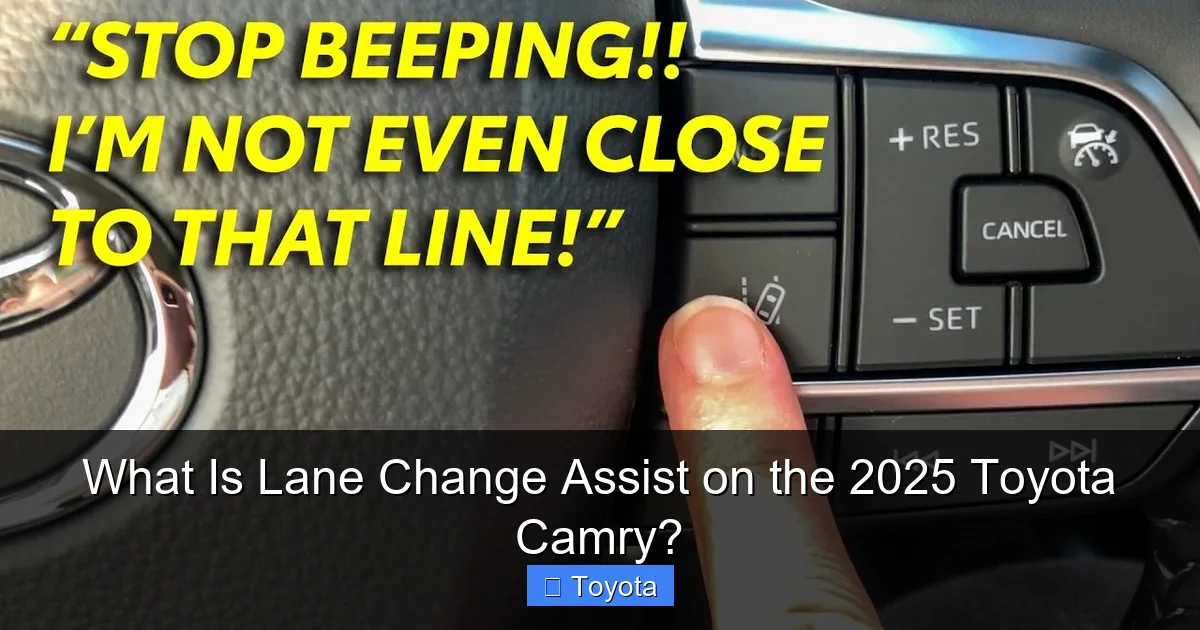
Visual guide about What Is Lane Change Assist on the 2025 Toyota Camry?
Image source: i.ytimg.com
Here’s the key difference: while standard blind spot monitoring is reactive (it tells you a car is *already* there), Lane Change Assist is predictive. It assesses the speed and trajectory of approaching vehicles the moment you activate your turn signal. If it detects a potential conflict—meaning a vehicle is in your path and closing in—it immediately alerts you. More impressively, if you continue to steer into the occupied lane, the system can provide a gentle, corrective steering input to guide your Camry back toward the center of your original lane. It’s like an invisible hand giving your steering wheel a subtle nudge in the right direction.
How It’s Packaged: Toyota Safety Sense 3.0
On the 2025 Camry, Lane Change Assist is a primary component of Toyota Safety Sense 3.0 (TSS 3.0), Toyota’s latest suite of active driver-assistance technologies. TSS 3.0 is standard on most, if not all, 2025 Camry trims, making this advanced protection widely available. It works in concert with other systems like:
- Pre-Collision System (PCS): Monitors for pedestrians, cyclists, and vehicles ahead.
- Lane Tracing Assist (LTA): Provides steering support to help keep your Camry centered in its lane on the highway.
- Dynamic Radar Cruise Control (DRCC): Maintains a set distance from the car ahead.
This integration means your Camry has a 360-degree awareness. For instance, if you’re using DRCC and LTA on a long drive, LCA adds that crucial layer of protection for when you need to pass a slower vehicle. The systems share sensor data, creating a more cohesive and reliable safety net. You might also find LCA bundled within the Toyota Convenience Package on certain trims, which adds other useful features like a digital key or premium audio, so it’s worth checking your specific model’s window sticker.
The Technology Behind the Magic: Sensors, Cameras, and Smart Software
To understand how reliable Lane Change Assist is, it helps to peek under the hood at its technological components. The 2025 Camry’s system is a masterclass in sensor fusion.
Visual guide about What Is Lane Change Assist on the 2025 Toyota Camry?
Image source: i.ytimg.com
The Radar’s Role: Seeing in the Dark and the Rain
Hidden in the rear bumper are microwave radar sensors. These are the workhorses for blind spot detection. Unlike cameras, radar isn’t fazed by darkness, rain, fog, or snow. It sends out radio waves that bounce off objects and return, allowing it to calculate the distance, speed, and relative position of vehicles up to several car lengths behind and beside you. This is why LCA remains functional in poor visibility conditions where a camera’s view might be obscured. The radar’s wide field of view covers the critical blind spot zones just outside your direct line of sight.
The Camera’s Eye: Recognizing Lane Markings
Mounted behind the windshield, usually near the rearview mirror, is a high-resolution forward-facing camera. This camera’s primary job in the LCA ecosystem is to identify lane markings. For the system to know *where* your lane ends and the next one begins, it must first see the road lines clearly. If the camera’s view is blocked by heavy dirt, snow, or direct glare, the system may not function properly and will likely alert you with a dashboard message. This camera also feeds data to Lane Tracing Assist, creating a symbiotic relationship between staying in your lane and changing it safely.
The Brain: The Processing Unit
All that raw data from the radar and camera streams into the vehicle’s central processing unit—essentially the car’s brain. Sophisticated software algorithms analyze this information in real-time. It’s not just detecting “an object”; it’s identifying “a vehicle approaching from behind at 65 mph, currently 1.5 car lengths away, and on a collision course if I continue this lane change.” The software calculates risk levels and decides when to alert you and when to intervene. This processing happens in milliseconds, far faster than any human could process the same information.
Benefits of Lane Change Assist in Real-World Driving
Now for the fun part: how this technology actually makes your life easier and safer on the road. The benefits extend beyond just avoiding crashes.
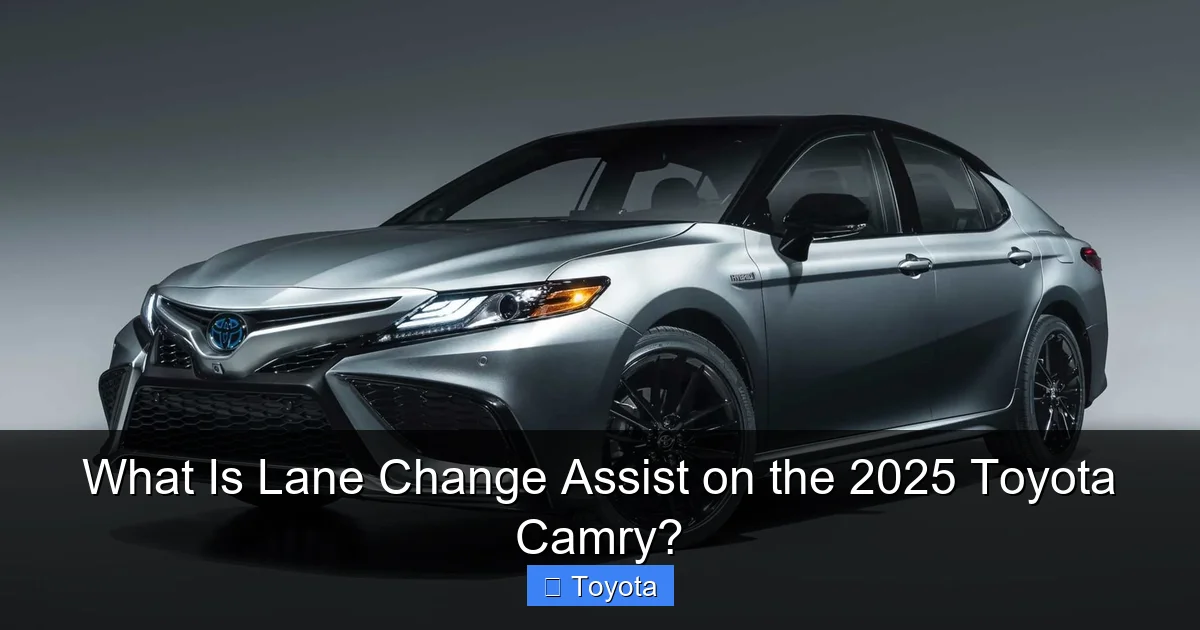
Visual guide about What Is Lane Change Assist on the 2025 Toyota Camry?
Image source: gaadiwaadi.com
1. Drastically Reducing Blind Spot Anxiety
We’ve all been there: you’re on a three-lane highway, you want to pass a slow-moving truck, but you’re not sure if the minivan in the next lane is in your blind spot. You might hesitate, slow down, or make a risky guess. Lane Change Assist removes that guesswork. The moment you touch the turn signal, the system assesses. If the adjacent lane is clear, nothing happens—you change lanes with confidence. If a car is there, a bright amber LED will illuminate on the corresponding side mirror (or A-pillar, depending on your Camry’s design), and you’ll likely hear a gentle chime. This immediate, intuitive feedback allows you to make a decision without second-guessing.
2. Providing a Critical Safety Net for Distracted Moments
Even the best drivers have moments of distraction—adjusting the climate control, talking to a passenger, or simply zoning out. LCA acts as a vital backup. If you signal and start to drift into an occupied lane while your attention is elsewhere, the system’s steering intervention can physically prevent the lane change. That corrective torque is firm but not jerky; it’s enough to get your attention and correct the path. This is especially valuable on monotonous highway drives where driver fatigue can set in. It’s a system that doesn’t just warn; it actively helps prevent a mistake.
3. Boosting Confidence for New and Nervous Drivers
For new drivers or those who lack confidence on high-speed roads, LCA is a game-changer. It provides an extra layer of assurance that the vehicle is watching out for them. This can reduce stress and make highway driving a more pleasant experience. Knowing the car has your back allows a driver to focus more on the overall traffic flow and less on the constant, anxious shoulder checks.
4. Enhancing Highway Traffic Flow
On a broader scale, widespread use of systems like LCA can improve overall traffic efficiency. When drivers can make lane changes more decisively and safely—knowing they have accurate blind spot data—it reduces hesitation and sudden braking. Smoother lane changes mean fewer disruptions in the traffic stream, helping everyone get to their destination a little faster and with less road rage.
Limitations and Things to Keep in Mind
While Lane Change Assist is a fantastic tool, it’s crucial to understand that it is a driver-assistance system, not a driver-replacement system. Knowing its limits is key to using it safely and effectively.
Sensor Limitations: Weather, Dirt, and Obstructions
The radar sensors are robust, but they aren’t infallible. Heavy, pouring rain or dense fog can sometimes scatter radar signals, potentially reducing effectiveness or range. The camera is more vulnerable; a mud-splattered front bumper, a windshield covered in bugs or snow, or even a dirty side mirror (if the camera is integrated there) can obstruct its view. Toyota recommends regular cleaning of the camera and radar areas to ensure optimal performance. Also, certain materials like some carbon-fiber splitters or large aftermarket bumper stickers can interfere with radar signals.
It May Not See Everything: Motorcycles and Small Vehicles
Radar is excellent at detecting large, metallic objects like cars and trucks. However, it can have more difficulty with smaller, narrower vehicles like motorcycles or bicycles, especially if they are not directly in the sensor’s optimal detection zone. The system is optimized for typical passenger vehicles. Therefore, you must still perform a deliberate visual check, especially for motorcycles that may be filtering through traffic. A quick shoulder check remains the gold standard for seeing what sensors might miss.
Large Vehicles and “Phantom” Alerts
Driving near very large vehicles—semi-trucks, buses, or even large vans—can sometimes create unusual sensor readings. The radar might “see” the trailer of a truck two lanes over and interpret it as a vehicle in your immediate blind spot, triggering an alert. This is often called a “phantom alert.” While uncommon with modern, refined systems, it can happen. It’s a reminder that your own judgment is the final authority. If an alert seems odd, trust your eyes over the light on the mirror.
System Deactivation and Driver Responsibility
The system can be turned off, either temporarily or via vehicle settings. It will also automatically deactivate if the windshield camera’s view is severely compromised or if the vehicle’s 12V battery is disconnected. You are always legally and ethically responsible for the lane change. The steering intervention is a last-resort safety nudge, not a mechanism to enable lazy or inattentive driving. Never rely solely on the system; always use your mirrors and check over your shoulder. For more on managing these features, our article on how to adjust or disable Lane Assist provides model-specific instructions.
Customizing and Using Lane Change Assist on Your 2025 Camry
Getting the most out of LCA means understanding how to interact with it. The 2025 Camry’s system is designed to be intuitive, but there are a few settings and behaviors to know.
Activation: It’s Usually “Always On”
For most drivers, Lane Change Assist is enabled by default every time you start the car. There’s no separate button to turn it on; it’s an integrated function of TSS 3.0. You’ll know it’s active by a small icon on your multi-information display (MID) or driver’s screen, typically a car with radiating lines or a lane change symbol. If you see a message saying the system is unavailable, check for a blocked sensor or camera, or consult your owner’s manual.
How to Know It’s Working: The Alerts
The feedback is clear and multi-modal:
- Visual: A bright amber light will illuminate on the side mirror or A-pillar on the side of the impending lane change.
- Audible: You’ll hear a distinct, increasing beep or chime if you continue to steer into the occupied lane.
- Haptic (Steering): If the risk is imminent and you haven’t corrected, the steering wheel will vibrate or provide a gentle resisting torque. This is the system physically trying to keep you safe.
It’s a good practice to do a quick test in a safe, empty parking lot or low-traffic road to familiarize yourself with these alerts. Signal to change into an empty lane—nothing should happen. Then, have a friend drive slowly in the adjacent lane while you signal to change; you should see the light and hear the alert.
Adjusting or Turning It Off
While we strongly recommend keeping LCA enabled for maximum safety, Toyota understands that some drivers may want to adjust the alert timing or disable the steering intervention. Here’s how you typically do it:
- Use the steering wheel buttons or touchscreen to enter the Vehicle Settings menu.
- Navigate to Driver Assistance or Toyota Safety Sense.
- Look for Lane Change Assist or Blind Spot Monitor options.
- You may find toggles for: Alert Sensitivity (early/late), Steering Assist (on/off), or a master System Enable/Disable.
Disabling the steering assist will leave you with only the visual and audible alerts. Turning the whole system off is usually possible but not recommended. Remember, if you sell the car, the settings will revert to factory defaults. For detailed, trim-specific steps, our dedicated guide on managing Lane Assist features is an excellent resource.
The Future of Lane Change Assist and Toyota’s Vision
Lane Change Assist on the 2025 Camry represents a mature, reliable step toward more automated driving. But where is it headed? Toyota is already pushing the boundaries with its “Chauffeur” and “Guardian” autonomous driving philosophies.
From Assistance to Automated Lane Changes
Current LCA requires the driver to initiate the lane change with the turn signal. The next evolution is automated lane changing. In this future scenario, you could simply press a button (or the system could decide) to have the car safely execute a pass maneuver on its own, handling the steering, acceleration, and braking without driver input. This is already being tested in prototype form and will likely trickle down to consumer vehicles like the Camry over the next decade. It would rely on even more precise mapping, sensor fusion (including LiDAR), and AI-driven decision-making.
Vehicle-to-Everything (V2X) Communication
Imagine your Camry not only seeing the car in the next lane but also “talking” to it. V2X technology allows vehicles to exchange data with each other and with infrastructure like traffic lights. In this future, a car in your blind spot could broadcast its position and speed directly to your Camry, providing a 100% reliable signal that isn’t dependent on line-of-sight radar. This would make LCA virtually infallible and work seamlessly in all weather conditions. Toyota is actively participating in V2X development, and the 2025 Camry’s architecture is likely designed to be upgradeable for such future connectivity.
Over-the-Air Updates and Continuous Improvement
The software that runs Lane Change Assist isn’t set in stone. Through technologies like Toyota’s Data Communication Module (DCM), your Camry could receive over-the-air (OTA) updates. These updates could refine the system’s algorithms, improve its reaction times, or add new subtle features. This means the Lane Change Assist in your 2025 Camry might actually get smarter and more capable over time, a concept borrowed from the tech industry and now becoming standard in modern vehicles. Understanding your car’s connectivity, as explained in articles about what DCM is, helps you appreciate how your vehicle evolves.
Final Thoughts: Your Co-Pilot for Confident Highway Driving
Lane Change Assist on the 2025 Toyota Camry is more than just a checkbox on a feature list. It’s a tangible, daily-use safety tool that addresses a specific and common driving challenge. By combining radar’s all-weather capability with camera-based lane recognition and intelligent software, it provides timely alerts and, when necessary, gentle steering corrections. It reduces stress, prevents accidents, and builds driver confidence.
However, its ultimate effectiveness hinges on one thing: you. The system is an assistant, not an autopilot. It’s there to support your good driving habits, not replace them. Keep your sensors clean, understand the alerts, and always perform that final shoulder check. When used correctly, Lane Change Assist embodies Toyota’s commitment to safety—not with flashy gimmicks, but with thoughtful, reliable technology that works seamlessly in the background. So the next time you’re on the highway and reach for that turn signal, take a moment to appreciate the silent guardian watching your blind spot. It’s one less thing to worry about, and that’s a feature worth celebrating.
Frequently Asked Questions
Is Lane Change Assist standard on all 2025 Toyota Camry models?
Yes, Lane Change Assist is a standard component of the Toyota Safety Sense 3.0 suite, which comes equipped on all 2025 Camry trims. You don’t need to purchase a special package to get it, though higher trims may offer additional customization options for the system.
How do I know when Lane Change Assist is active or has detected a vehicle?
You’ll see a small icon on your driver’s display indicating the system is on. When a vehicle is detected in your blind spot, a bright amber light will illuminate on the corresponding side mirror or A-pillar. If you signal to change lanes into that occupied space, an audible chime will sound, and if you continue, the steering wheel will provide a gentle vibration or resistance.
Can I turn off the steering intervention but keep the visual and audible alerts?
Yes, in most cases. Within the Toyota Safety Sense settings on your Camry’s infotainment screen, you can typically adjust the Lane Change Assist settings to disable the active steering assist while leaving the blind spot monitoring alerts (lights and sounds) enabled. This allows you to retain warnings without the steering wheel intervention.
Will Lane Change Assist work in heavy rain, snow, or fog?
The radar sensors are designed to work in most weather conditions, including rain and snow. However, the forward-facing camera can be obscured by heavy precipitation, dirt, or snow on the windshield. If the camera’s view is blocked, the system may not function correctly and will likely display a warning message. Always ensure your windshield is clear for optimal performance.
Does Lane Change Assist detect motorcycles and bicycles?
The system is optimized to detect standard passenger vehicles. While it may detect larger motorcycles, smaller bikes or cyclists can be more challenging for the radar sensors to pick up, especially if they are not directly in the sensor’s path. This is why performing a visual shoulder check is always the safest and most reliable method before any lane change.
What’s the difference between Lane Change Assist and Blind Spot Monitoring?
Traditional Blind Spot Monitoring (BSM) typically only provides a visual alert (a light on the mirror) when a vehicle is present in your blind spot. Lane Change Assist is a more advanced version that adds a predictive element: it assesses the risk when you signal and can provide an audible alert and even gentle steering intervention if you attempt an unsafe change. Think of BSM as a passive warning, and LCA as an active assistant.