
Universal Car Cover Issues: Common Problems and Practical Fixes

Quick Answer
The biggest universal car cover issues are poor fit, wind movement, paint rubbing, trapped moisture, exposed areas, and stress around mirrors or spoilers. A universal cover can still work well when it closely matches your vehicle’s dimensions, stays secure, breathes properly, and is only installed over a clean, dry car.
Common problems to check first
- Loose fabric: Excess material can move across the paint when wind gets underneath it.
- Poor coverage: A cover that’s too small may leave bumpers, lower panels, or other areas exposed.
- Paint rubbing: Dirt trapped between the cover and paint can become abrasive when the fabric moves.
- Moisture buildup: Dampness can linger when the car is covered wet or the material cannot release water vapor effectively.
- Wind problems: A loose hem or poorly positioned straps can let the cover lift, shift, or come off.
- Pressure points: A cover that’s too tight can pull against mirrors, antennas, spoilers, and sharp body contours.
Fastest way to reduce trouble
- Measure the vehicle before buying, keep both surfaces clean, and secure every provided strap before leaving the car covered outdoors.
Universal car covers appeal to everyday drivers for a simple reason: they’re easy to find, affordable, and available for broad vehicle sizes. The tradeoff is that one pattern has to accommodate many different body shapes.
That compromise creates most universal car cover issues. This guide explains what goes wrong, how to tell whether your cover is causing trouble, and when you should move to a better-fitting option.
In This Guide
- What Are the Most Common Universal Car Cover Issues?
- Why Can a Universal Car Cover Scratch Paint?
- Why Does a Universal Car Cover Blow Off or Fit Poorly?
- Can a Universal Car Cover Trap Moisture?
- What Other Universal Cover Problems Appear Outdoors?
- Universal vs. Semi-Custom vs. Custom Car Covers
- How Can You Use a Universal Car Cover More Safely?
- Frequently Asked Questions
- Should You Keep Using a Universal Car Cover?
What Are the Most Common Universal Car Cover Issues?
The most common problem isn’t that every universal cover is poorly made. It’s that its shape may not match the specific curves, height, mirrors, bumpers, and accessories on your vehicle.
Definition: A universal car cover is a cover manufactured in broad size categories so one design can fit multiple vehicles rather than one exact make, model, year, and body configuration.
A sedan and another sedan with similar lengths can still have different rooflines and mirror locations. SUVs become even harder to generalize because roof rails, spoilers, spare tires, and overall height vary significantly.
Problems caused by a cover that’s too loose
Extra fabric creates areas where moving air can lift the cover away from the body. The material can then settle back onto the paint repeatedly.
- Flapping: Large loose sections move during windy weather.
- Dust entry: Open areas around the hem can allow dirt beneath the cover.
- Pooled rainwater: Sagging fabric can form low spots that hold water temporarily.
- Uneven protection: The cover may shift and expose part of the vehicle.
- Faster wear: Repeated movement can strain seams, hems, and attachment points.
Problems caused by a cover that’s too tight
Going smaller isn’t automatically safer. An undersized cover may put constant tension on protruding parts.
- Mirror housings can become pressure points.
- Spoilers may stretch the fabric or prevent full coverage.
- Antennas can puncture material if no suitable opening is provided.
- Elastic hems may creep upward instead of staying under the bumper.
- Sharp body contours can wear through stressed fabric.
My practical rule is simple: don’t judge fit only by whether the cover reaches both bumpers. Look at what happens across the middle of the vehicle.
If you can gather large folds over the hood, doors, or roof, the cover has enough slack to move. If you’re pulling hard just to reach the bumper, it’s probably too small.
| What You Notice | Likely Issue | Best First Step |
|---|---|---|
| Large loose folds | Cover is oversized | Check measurements and use proper tie-downs |
| Hem won’t reach bumper | Cover is undersized | Move to the next suitable size |
| Fabric lifts in wind | Loose fit or poor securing | Secure straps and inspect hem tension |
| Marks appear after windy days | Movement over contaminated paint | Clean car and cover; reduce movement |
Section Takeaway: Universal doesn’t automatically mean unsuitable. The real question is whether the selected size stays stable without stretching across protruding parts.
Why Can a Universal Car Cover Scratch Paint?
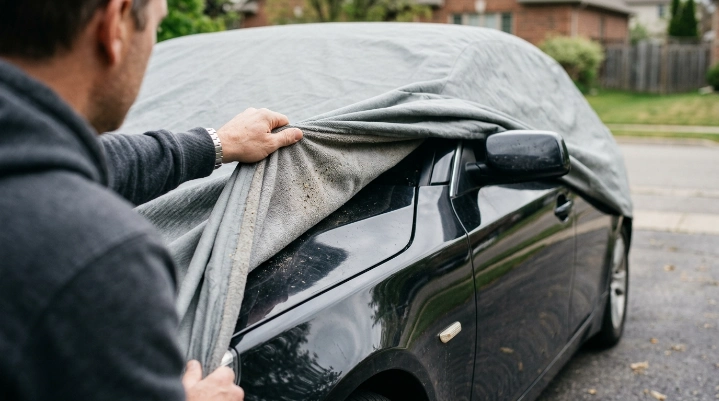
A universal car cover can contribute to paint marks when abrasive contamination sits between the fabric and clear coat. Movement turns that trapped contamination into the damaging part of the equation.
A clean, soft cover placed carefully over clean paint presents much less risk. A dusty vehicle under a loose cover outdoors creates a far less favorable combination.
The dirt-plus-movement problem
Road dust isn’t always obvious. Fine grit can remain on horizontal surfaces even when the vehicle looks clean from several feet away.
Now add loose fabric. Each movement can drag particles across the finish rather than leaving them undisturbed.
- Dust and sand: Fine particles can become abrasive under moving fabric.
- Road grime: Contamination around lower doors and bumpers can transfer to the lining.
- Dirty inner fabric: A cover can carry old dirt back onto a freshly washed vehicle.
- Improper removal: Dragging the entire cover sideways can move contamination across paint.
Does a soft lining guarantee scratch-free use?
No. Soft inner material is useful, but it cannot make trapped grit harmless.
The condition of both surfaces matters. That’s why cleaning the cover is part of paint care rather than optional housekeeping.
Broader vehicle-care guidance from Consumer Reports’ maintenance and repair resources also emphasizes staying on top of basic vehicle upkeep instead of waiting for visible damage.
How to install and remove the cover with less rubbing
- Start clean and dry. Don’t cover a vehicle carrying loose dust, mud, or road grit.
- Identify front and rear. Avoid turning the cover around repeatedly against the paint.
- Position it over the roof first. Then work toward the ends in a controlled way.
- Secure it before wind moves it. Use the attachment system supplied for that cover.
- Remove it in sections. Fold or roll fabric onto itself rather than dragging it along the car.
- Store it clean. Don’t drop the inner surface onto the driveway or garage floor.
Watch the contact areas after several uses. Mirror caps, fender edges, roof corners, and bumper corners can reveal unwanted movement before the whole vehicle shows obvious marks.
Section Takeaway: Fabric softness matters, but cleanliness and movement matter more. A dirty car under a loose cover is the combination you want to avoid.
Why Does a Universal Car Cover Blow Off or Fit Poorly?
A universal cover usually blows off because wind finds enough loose material or open space to get underneath it. Once the cover begins lifting, the fabric can behave more like a sail than a fitted protective layer.
The elastic hem alone may not be enough in exposed outdoor parking. Properly positioned straps matter when the cover was designed to use them.
Signs your cover has too much wind movement
- The center section balloons upward during gusts.
- One corner repeatedly climbs off a bumper.
- The cover shifts sideways overnight.
- Straps become noticeably loose after installation.
- Fabric snaps or flaps against doors and quarter panels.
- The same section keeps collecting dirt underneath.
Don’t solve every wind problem by tightening a strap as hard as possible. Excess tension can transfer stress into seams, grommets, or the vehicle’s protruding parts.
Check the direction of the cover
Some universal covers look almost symmetrical when they’re spread on the ground. They may still have different shapes at the front and rear.
Look for manufacturer markings before installing it. Correct orientation can improve how the elastic hem sits around each bumper.
Check accessories before blaming the cover
A universal size chart usually assumes a fairly standard vehicle profile. Accessories can change that profile enough to create a poor fit.
- Roof racks and crossbars
- Large rear spoilers
- Aftermarket mirrors
- External antennas
- Front splitters
- Bike or cargo mounting hardware
- Rear-mounted spare tires
If an accessory creates a sharp tent-like peak in the cover, forcing the fabric over it isn’t a good long-term solution. Choose a cover made to accommodate the feature.
Section Takeaway: If the cover repeatedly lifts or shifts after correct installation, the problem is probably fit rather than your tying technique.
Can a Universal Car Cover Trap Moisture?
Yes, moisture can linger beneath any car cover when a wet vehicle is covered or water vapor cannot escape effectively. Universal fit can worsen the problem by creating sagging areas where water and damp fabric remain in contact longer.
The important distinction is between blocking liquid water and allowing water vapor to escape. Those aren’t the same property.
Why condensation appears under a cover
Temperature and humidity change through the day and night. That can leave moisture on surfaces even when rain didn’t directly enter beneath the cover.
A damp car makes the situation simpler to diagnose. If water is already present when you install the cover, the cover can slow drying.
- Covering after rain: Water remains on paint, glass, trim, and hidden seams.
- Covering after washing: Water can stay around mirrors, handles, badges, and body gaps.
- Poor ventilation: Moisture takes longer to escape beneath less breathable material.
- Ground humidity: Outdoor storage can expose the lower vehicle area to persistent damp conditions.
Waterproof doesn’t always tell you enough
Don’t choose a cover based on the word “waterproof” alone. Read the manufacturer’s description of breathability, outdoor use, ventilation, seams, and fabric construction.
As of 2026, product descriptions use terms such as waterproof, water-resistant, breathable, multi-layer, and weatherproof in different ways. Compare actual intended use rather than assuming those labels all mean the same thing.
What should you do if the cover is wet?
- Remove the cover when conditions allow.
- Let the vehicle surface dry completely.
- Dry the cover according to its care instructions.
- Check the inner surface for dirt, staining, or mildew odor.
- Reinstall only after both surfaces are ready.
Persistent moisture deserves attention beyond the cover itself. Weather seals, clogged drains, damaged trim, and existing body corrosion may also need inspection.
For general ownership and preventive-care principles, the Kelley Blue Book maintenance guide is a useful reference alongside your vehicle’s owner’s manual.
Section Takeaway: Keep rain out, but also give moisture a way out. Never rely on a car cover to dry a vehicle that was wet when you covered it.
What Other Universal Cover Problems Appear Outdoors?
Poor fit, scratches, and moisture get most of the attention, but outdoor use exposes several other weaknesses. Some are problems with the cover, while others come from asking a lightweight cover to do a job it wasn’t designed for.
Water pooling in loose sections
Baggy fabric can create depressions between higher points on the vehicle. Rainwater may collect temporarily instead of shedding cleanly from the cover.
Repeated pooling also adds stress to fabric and seams. A more contoured fit usually sheds water more predictably.
Uneven UV and weather exposure
A cover that shifts can leave portions of a bumper, wheel arch, or side panel exposed. That defeats the goal of consistent protection.
Material matters too. Indoor dust covers shouldn’t be treated as substitutes for outdoor covers unless the manufacturer specifically rates them for that use.
Torn seams and worn attachment points
Outdoor movement puts repeated load on hems, seams, straps, buckles, and grommets. Inspect these areas instead of waiting for the cover to tear completely.
- Look for stretched stitching.
- Check elastic that no longer grips.
- Inspect straps for fraying.
- Check buckles before windy weather.
- Replace damaged attachment hardware as directed by the manufacturer.
Damage from hot components
Don’t throw a cover over a vehicle immediately when the manufacturer’s instructions warn against contact with hot exhaust components. Some fabrics can be damaged by concentrated heat.
Follow the cover manufacturer’s cool-down guidance. Pay particular attention around tailpipes and exposed performance exhaust parts.
False expectations about impact protection
A flexible cover can help keep dust, droppings, sap, and similar contamination away from surfaces. It shouldn’t be treated as structural protection against heavy branches, hail, falling objects, or vehicle impacts unless specifically designed and rated for that purpose.
That distinction matters. A thicker-looking cover does not automatically turn into a padded shelter.
Universal vs. Semi-Custom vs. Custom Car Covers: Which Is Better?
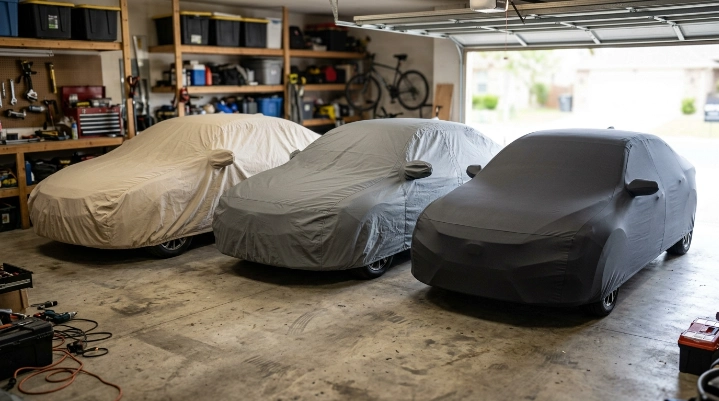
A universal cover is usually best when convenience, flexible compatibility, and occasional use matter most. A custom-fit cover makes more sense when the same vehicle stays covered frequently and fit stability is a priority.
Semi-custom covers sit between those choices. They narrow the pattern to a vehicle category or shape without being tailored to one exact model.
| Factor | Universal | Semi-Custom | Custom-Fit |
|---|---|---|---|
| Vehicle compatibility | Broad size range | Vehicle-type focused | Specific vehicle application |
| Typical fit precision | Lowest | Moderate | Highest |
| Ease of switching vehicles | Best | Moderate | Limited |
| Loose-fabric risk | Depends heavily on sizing | Usually reduced | Usually lowest when correctly specified |
| Accessories accommodated | Limited | Varies by design | Varies by ordered configuration |
| Best use case | Occasional or flexible use | Regular use with improved fit | Frequent protection of one vehicle |
When a universal cover makes sense
- Your vehicle falls comfortably within the manufacturer’s measurements.
- The cover stays reasonably smooth when secured.
- You mainly need temporary or occasional protection.
- You want one cover that may work with similar vehicles.
- You can store the vehicle in a relatively sheltered location.
When upgrading makes sense
- The cover moves frequently despite correct securing.
- You store the same vehicle outdoors for long periods.
- Your car has an unusual roofline or exterior accessories.
- You repeatedly find exposed sections after windy weather.
- The existing cover creates obvious tension or loose folds.
The label alone doesn’t determine protection. Material, correct sizing, clean installation, weather suitability, and secure attachment all remain important even with a custom-fit cover.
How Can You Use a Universal Car Cover More Safely?
You can avoid many universal car cover problems by treating installation as part of vehicle care. Don’t simply pull the fabric over the car and forget it.
Start with measurement. The manufacturer’s size chart matters more than a generic label such as sedan, SUV, or large.
Before buying
- Measure length: Compare bumper-to-bumper length with the cover’s stated range.
- Check width and height: Especially important for SUVs, crossovers, vans, and trucks.
- List exterior accessories: Include spoilers, roof rails, antennas, and spare tires.
- Match the environment: Indoor dust protection and outdoor weather exposure require different designs.
- Check attachment features: Understand how the cover is intended to stay secure.
Before every installation
- Check that the vehicle is reasonably clean.
- Make sure the paint and cover are dry.
- Shake loose debris from the cover away from the car.
- Inspect the inner surface for grit.
- Check the cover for tears or damaged straps.
- Install it using the correct front-to-rear orientation.
- Secure every required attachment point.
While the car is covered
Check it after changing weather conditions. A cover that was stable yesterday may shift after strong wind or heavy rain.
- Reposition a shifted hem promptly.
- Don’t leave pooled water sitting in sagging fabric.
- Look for straps rubbing against painted surfaces.
- Check whether dirt has entered around loose edges.
- Remove the cover periodically during extended storage for inspection.
When removing and storing it
Keep the dirty exterior of the cover away from its inner paint-contacting surface. Folding the cover consistently can make the next installation cleaner and easier.
Follow the manufacturer’s washing instructions rather than assuming every cover is machine washable. Coatings, multi-layer materials, seams, and soft linings can require different care.
For broader maintenance planning, Edmunds’ car maintenance resources provide useful ownership guidance beyond exterior protection.
Section Takeaway: A universal cover works best as a maintained piece of protective equipment, not a fabric sheet that can be installed on any vehicle in any condition.
Frequently Asked Questions About Universal Car Cover Issues
Are universal car covers bad for cars?
No. A correctly sized universal car cover isn’t automatically bad for a vehicle. Problems are more likely when the cover is excessively loose, installed over dirt or moisture, poorly secured, or used in weather conditions beyond what its material was designed to handle.
Can a universal car cover scratch my paint?
It can contribute to scratches or swirl marks if dirt becomes trapped beneath moving fabric. Keep the vehicle and inner cover surface clean, minimize loose material, and avoid allowing the cover to flap repeatedly against painted panels.
Why does my universal car cover keep blowing off?
The cover may be oversized, incorrectly positioned, inadequately secured, or poorly matched to your vehicle’s shape. Check the manufacturer’s dimensions and attachment instructions. If it still shifts repeatedly when properly installed, a closer-fitting cover may be the better solution.
Should a car cover be tight or loose?
It should be secure without excessive stretching. Large loose areas can move in wind, while an undersized cover can create tension around mirrors, spoilers, antennas, bumpers, and other body features. Aim for stable coverage rather than maximum tightness.
Can I put a universal car cover on a wet car?
It’s better to let the vehicle dry before covering it. Installing a cover over a wet surface can slow evaporation and leave moisture around trim, seams, paint, and other areas. Dry the cover too before putting it back onto the vehicle.
Is a custom-fit cover always better than a universal cover?
A custom cover normally provides more precise fit for its intended vehicle, but fit alone doesn’t guarantee trouble-free protection. A dirty custom cover can still rub contamination against paint, while the wrong material can still be unsuitable for the storage environment.
When should I replace my universal car cover?
Consider replacement when the material tears, straps or hems no longer secure it, the inner surface cannot be cleaned adequately, protective coatings deteriorate, or the cover no longer fits reliably. Follow the manufacturer’s care and replacement guidance when available.
Should You Keep Using a Universal Car Cover?
Keep using it if the cover fits securely, stays reasonably stable, suits your parking environment, and isn’t creating recurring moisture or rubbing problems. A good universal cover can be practical protection for the right vehicle and use case.
Replace it when you’re constantly fighting loose fabric, exposed sections, strained corners, or repeated movement. Those are signs that the convenience of a universal design is no longer outweighing the fit compromise.
Above all, protect the contact surface. Clean car, clean cover, dry surfaces, correct sizing, and secure installation solve more problems than marketing labels ever will.