Twin Cam 88 Oil Capacity

Contents
- 1 Key Takeaways
- 2 📑 Table of Contents
- 3 Understanding the Twin Cam 88: More Than Just a Number
- 4 Twin Cam 88 Oil Capacity: The Official Numbers
- 5 Choosing the Right Oil: It’s Not Just Any 20W-50
- 6 How to Check and Change Your Twin Cam 88 Oil: A Step-by-Step Guide
- 7 Common Mistakes and How to Avoid Them
- 8 Conclusion: Your Twin Cam’s Longevity Starts Here
- 9 Frequently Asked Questions
Fuel Injector Cleaner

Magnetic Car Phone Mount

Car Ambient Light Kit

Car Tire Inflator
The Twin Cam 88 engine requires between 3.5 and 4.0 quarts of oil for a standard change, but always verify with the dipstick. Using the correct Harley-Davidson specified oil viscosity, typically 20W-50, is non-negotiable for proper lubrication and cooling. An accurate oil capacity check involves the bike being level, the dipstick seated properly, and following a specific warm-up procedure.
So, you’re the proud owner of a Harley-Davidson with the legendary Twin Cam 88 engine. That deep rumble, that torque—it’s what motorcycling dreams are made of. But keeping that heart beating strong comes down to the basics, and few things are as fundamentally important as getting the Twin Cam 88 oil capacity exactly right. It’s not just a number on a bottle; it’s the lifeblood of your V-twin. Too little, and you risk catastrophic engine seizure. Too much, and you create a foamy, aerated mess that can’t lubricate properly. Let’s cut through the noise and dive deep into everything you need to know about the oil capacity for your Twin Cam 88, from the factory specs to the final dipstick check.
Key Takeaways
- Official Capacity Range: A standard oil change for a Twin Cam 88 typically holds 3.5 to 4.0 quarts (3.3 to 3.8 liters), but the final check must always be the dipstick reading after following the correct procedure.
- Oil Specification is Critical: Harley-Davidson mandates the use of specific viscosity oils, most commonly 20W-50, that meet their Severe Duty requirements. Using the wrong oil can cause premature wear.
- The “Warm & Level” Rule: The oil level must be checked with the engine at full operating temperature and the motorcycle on a perfectly level surface, with the dipstick fully seated and then withdrawn for reading.
- Capacity Varies by Model: Slight variations exist between Softail, Dyna, and Touring models, and between years (e.g., 1999-2006 vs. 2007+). Always consult your specific owner’s manual.
- Change Includes Filter: The stated capacity is for a change that includes a new oil filter. Forgetting to account for the filter’s oil retention will lead to a low reading on the first start-up.
- Overfilling is Dangerous: Adding too much oil causes aeration (foaming), leading to loss of lubrication, increased pressure, and potential seal and gasket failures.
- It’s Part of a System: Proper oil capacity and quality are just one part of engine health. Other critical fluids, like the Harley 6-speed transmission fluid, also have strict capacity and specification requirements.
📑 Table of Contents
- Understanding the Twin Cam 88: More Than Just a Number
- Twin Cam 88 Oil Capacity: The Official Numbers
- Choosing the Right Oil: It’s Not Just Any 20W-50
- How to Check and Change Your Twin Cam 88 Oil: A Step-by-Step Guide
- Common Mistakes and How to Avoid Them
- Conclusion: Your Twin Cam’s Longevity Starts Here
Understanding the Twin Cam 88: More Than Just a Number
Before we talk quarts, let’s appreciate the beast we’re servicing. The Twin Cam 88, introduced in 1999, was a monumental shift for Harley-Davidson. It replaced the aging Evolution engine with a dual-camshaft design, hence “Twin Cam.” The “88” refers to the 88 cubic inches (1450 cc) of displacement. This engine is known for its strong low-end torque and distinctive sound.
Why Precision Matters for the Twin Cam
The Twin Cam’s design, with its complex valvetrain and high-output demands, is less forgiving of lubrication errors than some older engines. The oil does more than just lubricate; it cools the pistons, operates the hydraulic lifters, and protects against wear under high stress. An incorrect oil level directly impacts all these functions. The tight tolerances mean that being even a quart low or high can have noticeable effects on performance and longevity.
The Role of the Dipstick: Your Final Authority
Here’s the golden rule that applies to every single Harley-Davidson, especially the Twin Cam: The dipstick is the law. Factory capacity numbers are a starting point—a guideline for how much to pour in before the final check. But the true, correct oil level is what the dipstick shows after you’ve followed the precise Harley procedure. Why? Because factors like how completely the old oil drained, slight variations in engine machining, and even the specific oil filter you use can affect how much new oil the engine actually needs to be perfectly full. Never, ever guess based on how many quarts you poured in. Always, always finish with the dipstick check.
Twin Cam 88 Oil Capacity: The Official Numbers
Now, for the figures you’ve been waiting for. We need to break this down because “Twin Cam 88” covers a wide range of models from 1999 through the early 2000s before the 96 and 103ci versions took over.
Visual guide about Twin Cam 88 Oil Capacity
Image source: theseasonedwrench.com
General Capacity for a Standard Change
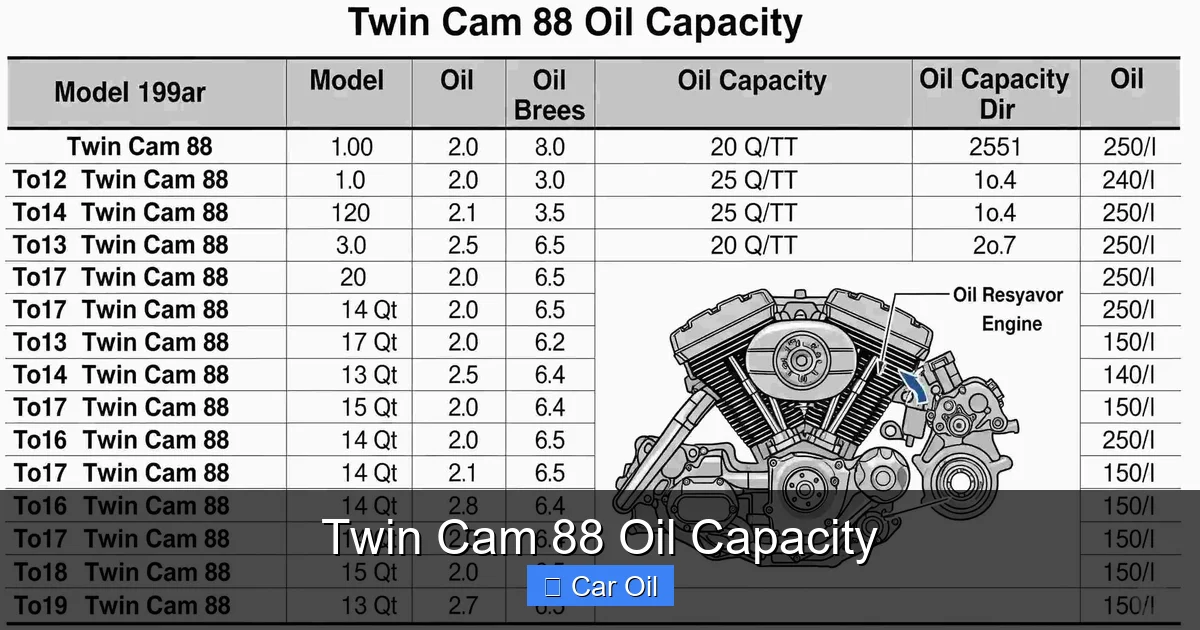
For a standard oil change that includes replacing the oil filter, the Twin Cam 88 engine in most applications (Dyna, Softail, Touring models from 1999-2006) will hold approximately 3.5 to 4.0 quarts (3.3 to 3.8 liters) of new oil. A common, safe starting point is to add 3.5 quarts, replace the filter, run the engine, and then check and top off as needed. Many mechanics will tell you that for a fully drained system, 3.75 quarts is a very common final fill amount. However, your manual is your best friend here.
Model Year and Family Variations
While the core engine is the same, mounting and sump design can cause slight variations:
- Touring Models (Road King, Electra Glide, etc.): Often on the higher end of the range, sometimes needing up to 4.0 quarts.
- Dyna Models (Dyna Super Glide, etc.): Typically right in the middle, around 3.75 quarts.
- Softail Models (Heritage, Fat Boy, etc.): Can vary slightly due to the different frame and oil tank placement, but still within the 3.5-4.0 quart window.
Critical Note for 2007+ Models: In 2007, Harley introduced the Twin Cam 96 (96 cubic inches). The 88 was phased out. If you have a 2007 or newer bike, you have a 96, 103, or 110ci engine, which have different capacities. This article is strictly for the 1999-2006 Twin Cam 88. If you’re unsure, check your frame sticker or VIN.
When in doubt, the most authoritative source is your specific Harley-Davidson Owner’s Manual. It will list the exact capacity and, more importantly, the exact procedure for checking the level. This procedure is universal for Harley and must be followed to the letter.
Choosing the Right Oil: It’s Not Just Any 20W-50
Knowing the capacity is pointless if you fill it with the wrong fluid. Harley-Davidson is very specific about their oil requirements for a reason.
Visual guide about Twin Cam 88 Oil Capacity
Image source: img.yumpu.com
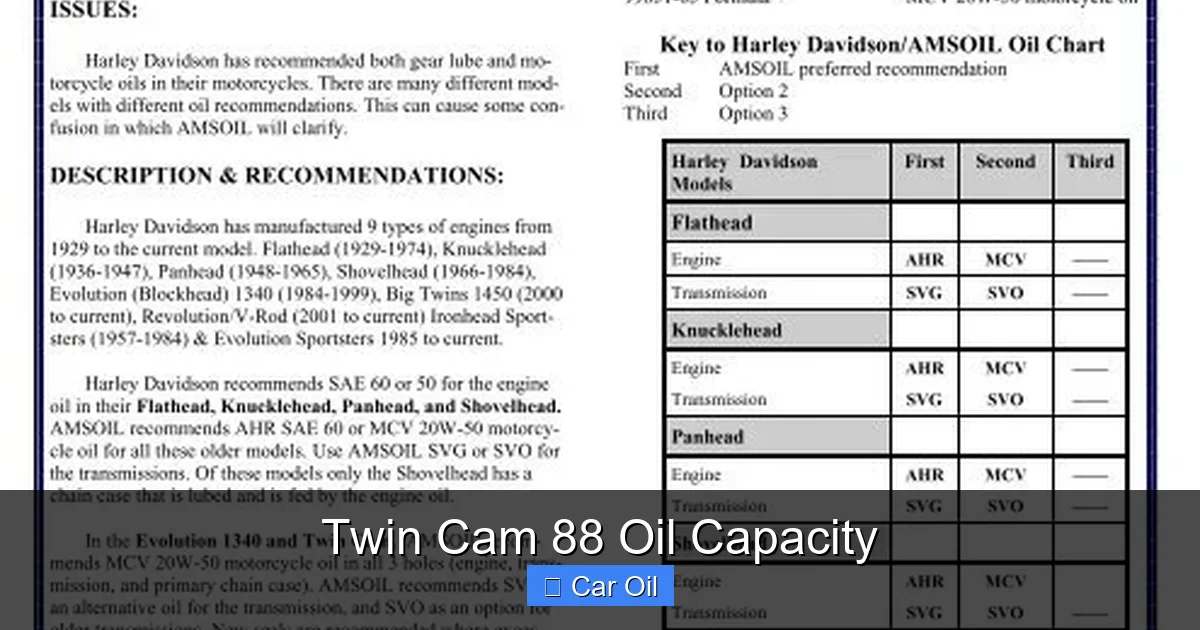
The Viscosity Grade: 20W-50 is King
For the Twin Cam 88, Harley-Davidson specifies 20W-50 motorcycle oil. This multi-grade viscosity ensures the oil flows well when cold (the “20W” part) for easy starting and protects at high operating temperatures (the “50” part). Using a different viscosity, like 10W-40 or 15W-50, can lead to insufficient protection at high temps or poor cold-start circulation. Always use oil that meets or exceeds the JASO MA2 standard for motorcycle applications (wet clutch compatibility).
Harley-Davidson Brand vs. Premium Alternatives
You can use Harley-Davidson branded oil, and it’s formulated specifically for their engines. However, there are excellent, often more affordable, alternatives from brands like Mobil 1, Amsoil, Red Line, and Rotella T4 (which is a popular choice among Harley owners, though note Rotella T6 is 5W-40). The key is finding a high-quality synthetic or synthetic-blend motorcycle oil that is explicitly JASO MA or MA2 certified. This certification ensures the oil has the correct friction modifiers for your clutch and the additive package for the high-shear environment of a V-twin. You can find great recommendations in our guide to the best motor oils, which covers general principles that apply here—look for the same specs: high-quality base stocks, robust anti-wear additives, and the correct certification.
How to Check and Change Your Twin Cam 88 Oil: A Step-by-Step Guide
Let’s get our hands dirty. Here is the definitive procedure for a perfect oil change and level check.
Visual guide about Twin Cam 88 Oil Capacity
Image source: wikihow.com
Tools and Preparation
You’ll need: new oil (3.5-4.0 qts of correct 20W-50), a new oil filter (use a high-quality brand like K&N, Harley OEM, or Wix), a drain pan, a socket for the drain plug (usually 13/16″ or 17mm), a filter wrench, gloves, and rags. Have your best oil filter ready—a good filter is as important as good oil. Safety first: let the engine cool if it’s hot, but you’ll need it warm for the check later.
The Step-by-Step Process
- Warm the Engine: Ride the bike for at least 10-15 minutes to get the oil up to full operating temperature. This thins the oil so it drains completely.
- Level the Bike: Place the motorcycle on a perfectly level surface, using the center stand or a paddock stand. This is non-negotiable for an accurate reading later.
- Drain the Oil: Remove the drain plug and let the oil flow completely into your pan. Be prepared for it to be hot. Replace the drain plug with a new washer and torque to spec (usually 18-20 ft-lbs, check manual).
- Replace the Filter: Remove the old filter. Before installing the new one, lightly coat the rubber seal with fresh oil. Hand-tighten the new filter until the seal contacts, then give it an additional 3/4 to 1 turn (or per filter instructions). Do not overtighten.
- Initial Fill: Pour in 3.5 quarts of new oil through the oil filler cap/dipstick tube.
- Run and Check (The Most Important Step): Start the engine and let it idle for about 30 seconds. Do NOT rev it. Turn the engine off. Wait 1-2 minutes for oil to settle. Now, with the bike still level, pull the dipstick, wipe it clean, reinsert it fully until it seats, and then pull it out again to read. The oil level should be between the “F” (Full) and “L” (Low) marks, ideally right at “F.” If it’s below “F,” add oil in small increments (1/4 quart at a time), rechecking each time. If it’s above “F,” you must drain some out.
- Final Check: After topping off, run the engine for another minute, shut off, wait, and check one last time to ensure the level is stable and correct.
This “warm, level, seat, read” procedure is the only way to know your Twin Cam 88 oil capacity has been met accurately for your specific bike.
Common Mistakes and How to Avoid Them
Even experienced mechanics can slip up. Here are the pitfalls to dodge.
Mistake 1: Ignoring the Dipstick Procedure
Pouring in a set number of quarts and calling it a day is the #1 error. As we’ve stressed, the dipstick check is mandatory. The 3.5-quart starting point is a guess without it.
Mistake 2: Checking the Level Cold or on a Slope
Checking a cold engine or on an uneven surface will give a falsely high reading. Oil needs to be at operating temperature and the bike absolutely level to sit correctly in the sump for an accurate measurement.
Mistake 3: Not Seating the Dipstick Properly
The dipstick must be pushed in all the way until it stops. A partially seated stick will read low, tempting you to overfill. Make sure you hear or feel it click into place.
Mistake 4: Overlooking the Filter’s Oil Hold
A new oil filter holds about 0.25 to 0.5 quarts of oil in its media and housing. If you drain the engine but forget to pre-fill the filter (a debated but common practice), your initial 3.5-quart fill will read low after startup because the filter “steals” that oil. The standard procedure above accounts for this by having you run and recheck.
Mistake 5: Using the Wrong Oil Type
Using car oil or a non-motorcycle oil can destroy your clutch and lack the shear stability for a Harley. Always use JASO MA/MA2 certified motorcycle oil. While we focus on oil here, remember other fluids are equally specific. For instance, the fork oil capacity and type on a Harley is another critical, model-specific specification that follows similar precision rules.
Conclusion: Your Twin Cam’s Longevity Starts Here
Getting the Twin Cam 88 oil capacity right is one of the simplest yet most impactful maintenance tasks you can perform. It’s a direct line to your engine’s health, performance, and longevity. Remember the core mantra: Start with 3.5 quarts, but finish with the dipstick. Use only the specified 20W-50 JASO MA2 motorcycle oil. Follow the warm, level, seated, and read procedure without exception. By respecting these details, you’re not just changing oil; you’re actively preserving the soul of your Harley. It’s the difference between a reliable, thumping ride and a costly, avoidable repair. Treat your Twin Cam right, and it will reward you with countless miles of open-road freedom.
Frequently Asked Questions
What is the exact oil capacity for a Twin Cam 88?
The standard capacity for a Twin Cam 88 (1999-2006) with a filter change is between 3.5 and 4.0 quarts. The precise amount for your specific bike is determined by the dipstick check after following the warm-engine, level-bike procedure. Start with 3.5 quarts and top off as needed.
Can I use regular car oil in my Twin Cam 88?
No. You must use motorcycle-specific oil that is JASO MA or MA2 certified. Car oil lacks the friction modifiers for a wet clutch and may not have the shear stability needed for a high-stress V-twin engine, leading to clutch slippage and premature wear.
How often should I change the oil in a Twin Cam 88?
Harley-Davidson’s official recommendation is every 5,000 miles under normal conditions and every 2,500 miles under severe conditions (frequent short trips, very hot/cold climates, dusty conditions). Many owners use a synthetic oil and extend this to 7,500-10,000 miles, but the safest practice is to follow the manual and your own riding habits.
What happens if I overfill the Twin Cam 88 with oil?
Overfilling causes the crankshaft to dip into the oil, aerating it and creating foam. Aerated oil cannot lubricate properly, leads to loss of oil pressure, increased engine temperatures, and can cause catastrophic failure of seals, gaskets, and bearings due to excessive pressure.
How do I know if my oil level is correct?
The only correct way is to check with the engine at full operating temperature, the motorcycle on a perfectly level surface, the dipstick fully seated, and then read the level between the “F” and “L” marks. The level should be at or just below the “F” mark.
Is the oil capacity different if I’m only adding oil, not doing a full change?
Yes. If you are just topping off a low system, you will add less than the full capacity amount. The 3.5-4.0 quart figure is for a complete drain and fill with a new filter. Always use the dipstick to determine how much to add in any situation, never guess based on capacity specs alone.