
Harley-davidson 6-speed Transmission Oil Capacity

Knowing the right Harley-Davidson 6-speed transmission oil capacity is essential for optimal performance and longevity. This guide covers oil types, fill procedures, and common mistakes to avoid, ensuring your motorcycle runs smoothly mile after mile.
If you’re a Harley-Davidson rider, you know that your bike is more than just a machine—it’s a lifestyle. From the deep rumble of the engine to the smooth glide of the gears, every component plays a role in delivering that signature Harley experience. One of the most critical yet often overlooked parts of your ride is the 6-speed transmission. And when it comes to keeping it running like new, few things are as important as using the right amount and type of transmission oil.
Let’s be honest—motorcycle maintenance can feel overwhelming, especially when you’re not sure what goes where or how much to use. But don’t worry. Whether you’re a seasoned rider or just getting started with your first Harley, understanding the Harley-Davidson 6-speed transmission oil capacity doesn’t have to be complicated. In this guide, we’ll break down everything you need to know—from how much oil your transmission holds to the best practices for filling it, the right fluids to use, and how to avoid common mistakes.
By the end of this article, you’ll have the confidence to handle your transmission oil changes like a pro. No more guessing, no more second-guessing. Just smooth shifts, reliable performance, and more time enjoying the open road.
Key Takeaways
- Correct Oil Capacity: Most Harley-Davidson 6-speed transmissions hold between 24 to 32 ounces (0.7 to 0.95 liters) of oil, depending on the model and year.
- Use Only Recommended Fluids: Always use Harley-Davidson Formula+ Transmission and Primary Chaincase Lubricant or an approved equivalent to avoid damage.
- Check Oil Level Cold: Always check and fill the transmission oil when the engine is cold for an accurate reading.
- Proper Fill Procedure: Use the correct fill hole and dipstick (if equipped) to avoid overfilling, which can cause leaks and poor shifting.
- Regular Maintenance Matters: Change the transmission oil every 10,000 to 20,000 miles or as specified in your owner’s manual.
- Watch for Leaks and Noise: Unusual noises or oil leaks around the transmission may indicate low oil or seal issues.
- Consult Your Manual: Always refer to your specific motorcycle’s service manual for exact specifications and procedures.
📑 Table of Contents
- Understanding the Harley-Davidson 6-Speed Transmission
- Harley-Davidson 6-Speed Transmission Oil Capacity by Model
- Recommended Transmission Oil for Harley-Davidson 6-Speed
- How to Check and Fill Harley-Davidson 6-Speed Transmission Oil
- Common Mistakes to Avoid
- Signs Your Transmission Oil Needs Attention
- Conclusion
Understanding the Harley-Davidson 6-Speed Transmission
The 6-speed transmission is a hallmark of modern Harley-Davidson touring and softail models, offering improved fuel efficiency, quieter operation, and better highway performance compared to older 5-speed systems. Introduced in the mid-2000s, this transmission has become standard on many popular models like the Electra Glide, Street Glide, Road King, and Softail series.
Unlike car transmissions, motorcycle gearboxes are compact and integrated into the engine and primary drive system. This means the transmission shares space and sometimes even lubrication with other components, like the primary chaincase. However, the transmission itself has its own dedicated oil reservoir, which must be maintained separately from the engine oil.
One of the biggest misconceptions among riders is that all oils are interchangeable. That’s simply not true. The transmission in your Harley is designed to work with specific viscosities and additives that reduce wear, prevent clutch slippage, and ensure smooth gear engagement. Using the wrong oil—or the wrong amount—can lead to poor shifting, increased wear, and even transmission failure over time.
So, why does oil capacity matter? Think of it like this: too little oil, and your gears won’t be properly lubricated, leading to overheating and premature wear. Too much oil, and you risk foaming, leaks, and increased pressure that can damage seals. Getting the capacity right ensures your transmission runs cool, quiet, and efficient.
How the 6-Speed Transmission Works
The Harley-Davidson 6-speed transmission uses a constant-mesh design, meaning all gears are always engaged, but only one is actively driving the output shaft at a time. A shift drum and shift forks move the gears into position when you change gears. This system relies on consistent lubrication to reduce friction and heat during gear changes.
Because the transmission operates under high stress and heat, the oil must maintain its viscosity and protective properties even under extreme conditions. That’s why Harley specifies high-quality, shear-stable lubricants designed specifically for motorcycle transmissions.
The oil also plays a role in cooling internal components. As it circulates, it absorbs heat from the gears and bearings, helping to prevent overheating during long rides or stop-and-go traffic.
Transmission Oil vs. Engine Oil: What’s the Difference?
Many new riders assume that engine oil and transmission oil are the same. While both are lubricants, they serve different purposes and are formulated differently.
Engine oil is designed to handle combustion byproducts, high temperatures, and contaminants from fuel burning. It contains detergents and dispersants to keep the engine clean.
Transmission oil, on the other hand, is optimized for gear protection, clutch performance, and smooth shifting. It has different additives to prevent wear on gear teeth and reduce friction between moving parts. In some Harley models, the transmission and primary chaincase share the same oil, but it’s still a specialized fluid—not regular engine oil.
Using engine oil in your transmission can lead to poor shifting, clutch chatter, and accelerated wear. Always use the oil specified by Harley-Davidson for your transmission.
Harley-Davidson 6-Speed Transmission Oil Capacity by Model
Visual guide about Harley-davidson 6-speed Transmission Oil Capacity
Image source: motorbikeinsider.com
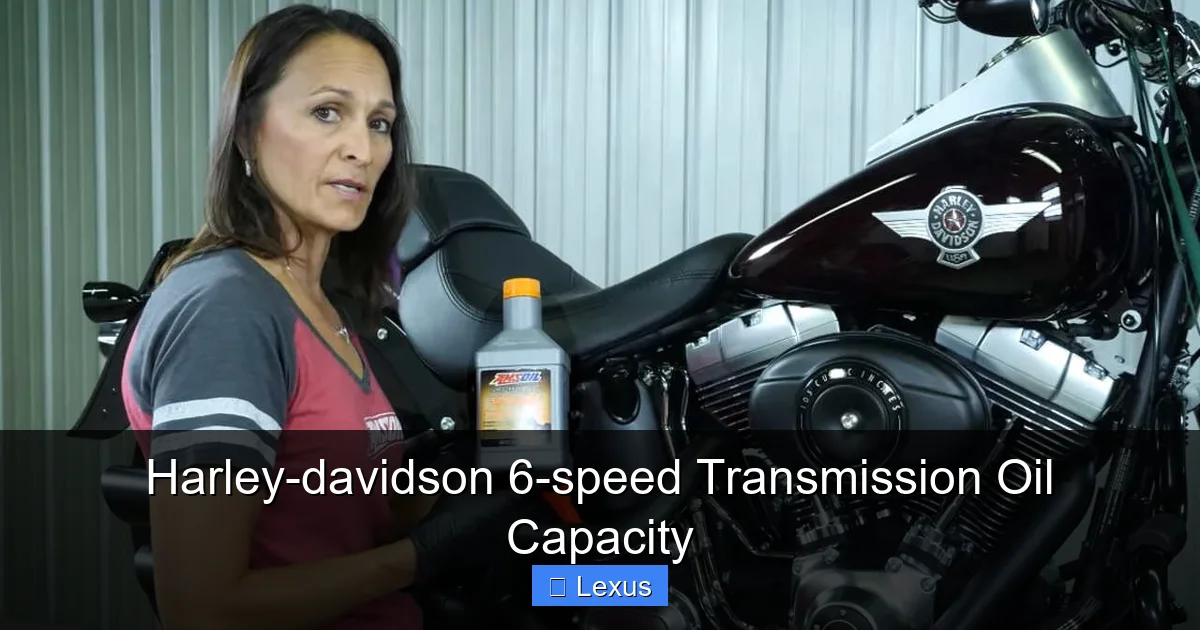
One of the most common questions riders ask is: “How much oil does my Harley transmission hold?” The answer isn’t always straightforward, as oil capacity can vary slightly depending on the model, year, and whether the transmission is shared with the primary drive.
However, most Harley-Davidson motorcycles with a 6-speed transmission have a transmission oil capacity between **24 and 32 ounces (0.7 to 0.95 liters)**. This range covers the majority of touring and softail models from 2006 onward.
Let’s break it down by popular models:
Touring Models (Electra Glide, Street Glide, Road King, Ultra Classic)
These bikes typically have a transmission oil capacity of **28 to 32 ounces (0.83 to 0.95 liters)**. The exact amount depends on whether the transmission and primary chaincase share oil or are separate.
For example:
– 2006–2016 Touring models with separate transmission and primary: ~32 oz (0.95 L) in the transmission.
– 2017 and newer Touring models with combined transmission/primary: ~32 oz total, shared between both.
Always check your owner’s manual or service manual for the exact specification. Some models may require slightly less due to design changes.
Softail Models (Heritage, Fat Boy, Breakout, Street Bob)
Softail models with 6-speed transmissions generally hold **24 to 28 ounces (0.7 to 0.83 liters)** of transmission oil. These bikes often have a separate transmission and primary chaincase, so the oil is not shared.
For instance:
– 2007–2011 Softail models: ~24 oz (0.7 L) in the transmission.
– 2012–2017 Softail models: ~28 oz (0.83 L) due to updated cases.
Again, always verify with your manual. Even a few ounces off can affect performance.
CVO and Special Edition Models
Custom Vehicle Operations (CVO) models and other limited editions usually follow the same oil capacity as their standard counterparts. However, some may have upgraded components or seals that affect oil volume. When in doubt, consult Harley’s official service documentation.
Why Capacity Varies
You might be wondering why there’s a range instead of a single number. The reason lies in design evolution. Over the years, Harley has made changes to transmission cases, seals, and oil passages. Some models use a wet clutch system that requires more oil for cooling, while others have improved sealing that reduces oil volume needs.
Additionally, aftermarket modifications—like different primary covers or transmission cases—can alter oil capacity. If you’ve made upgrades, double-check with the manufacturer or a trusted mechanic.
Recommended Transmission Oil for Harley-Davidson 6-Speed
Visual guide about Harley-davidson 6-speed Transmission Oil Capacity
Image source: motorbikeinsider.com
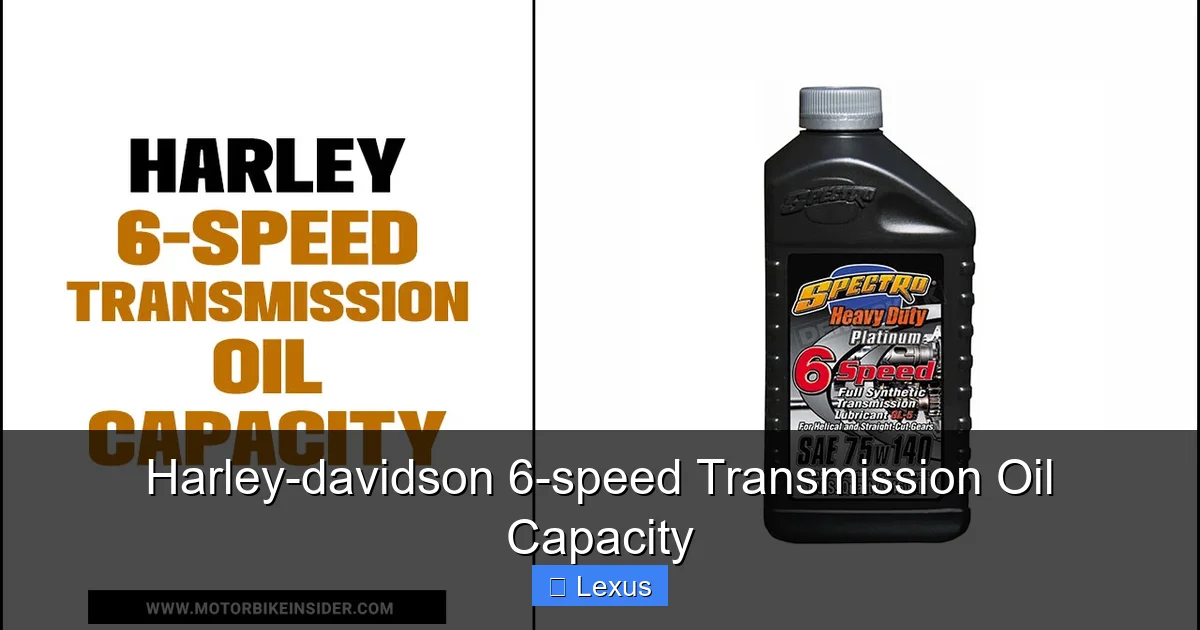
Using the right oil is just as important as using the right amount. Harley-Davidson recommends **Formula+ Transmission and Primary Chaincase Lubricant** for most 6-speed transmissions. This oil is specifically formulated for Harley’s gearboxes and primary drives, offering excellent protection against wear, heat, and clutch slippage.
Why Formula+?
Formula+ is a synthetic-based oil with additives that:
– Reduce friction between gear teeth
– Prevent clutch chatter and slippage
– Resist thermal breakdown at high temperatures
– Protect against corrosion and oxidation
It’s also designed to work with Harley’s wet clutch systems, which are sensitive to oil additives. Some automotive transmission fluids contain friction modifiers that can cause clutch slippage in motorcycles—something you definitely want to avoid.
Approved Alternatives
If Formula+ isn’t available, Harley approves a few alternatives, including:
– **Harley-Davidson SYN3 Synthetic Lubricant** (for models where transmission and primary share oil)
– **Amsoil Synthetic V-Twin Transmission Fluid**
– **Red Line V-Twin Transmission Oil**
– **Spectro Heavy Duty Gear Oil (75W-90)**
Always check your owner’s manual for approved substitutes. Avoid using generic automotive gear oils or engine oils, as they may not meet Harley’s specifications.
Oil Viscosity and Climate Considerations
Most Harley 6-speed transmissions use a **75W-90** viscosity oil, which provides good protection in both cold starts and high-heat conditions. This multi-grade oil flows well in winter but remains stable in summer.
If you ride in extremely cold climates (below 20°F), you might consider a 75W-80 oil for easier cold starts. In hot climates (above 90°F), stick with 75W-90 to ensure proper film strength.
Never use 10W-30 or 10W-40 engine oil in your transmission—it’s too thin and won’t protect your gears.
How to Check and Fill Harley-Davidson 6-Speed Transmission Oil
Visual guide about Harley-davidson 6-speed Transmission Oil Capacity
Image source: motorbikeinsider.com
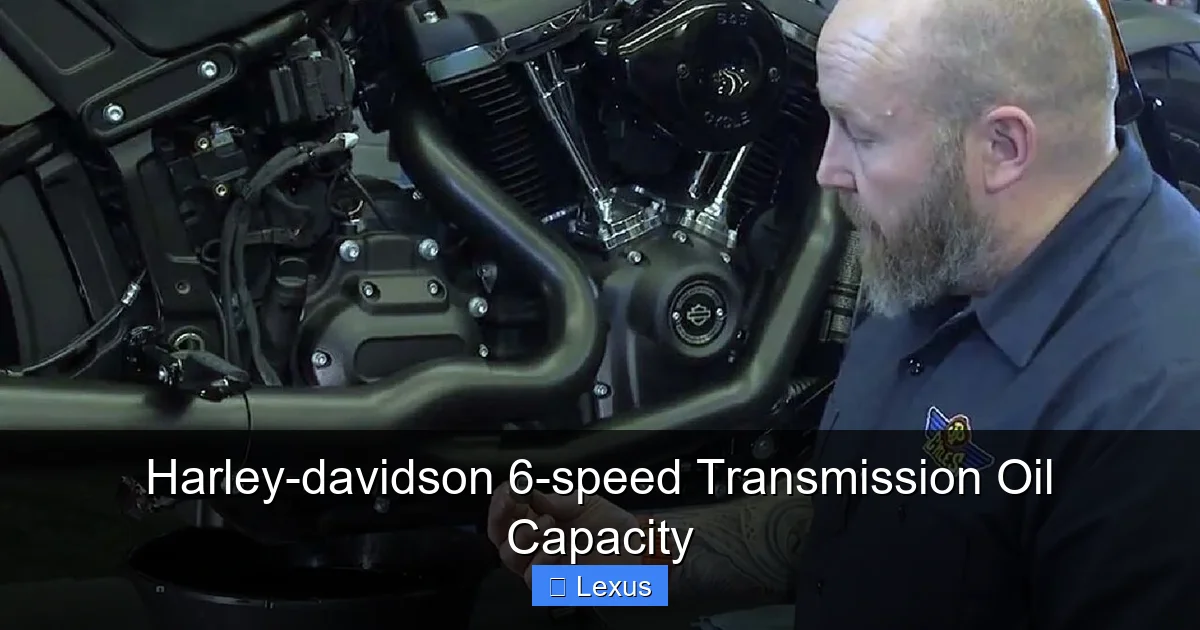
Checking and filling your transmission oil might seem intimidating, but it’s a straightforward process if you follow the right steps. Here’s a step-by-step guide to help you do it safely and accurately.
Tools and Supplies You’ll Need
– Harley-Davidson Formula+ or approved transmission oil
– Funnel (preferably with a long, flexible spout)
– Clean rag or shop towels
– Torque wrench (for drain and fill plugs)
– Drain pan
– Gloves and safety glasses
Step 1: Prepare Your Bike
Start by parking your Harley on a level surface and letting the engine cool completely. Transmission oil should always be checked and filled when cold. Hot oil expands, which can give a false reading and lead to overfilling.
If you’ve just ridden the bike, wait at least 2–3 hours before checking the oil.
Step 2: Locate the Fill and Drain Plugs
On most Harley 6-speed transmissions, the fill plug is located on the right side of the transmission case, near the rear. It’s usually a 3/8-inch or 1/2-inch hex bolt. The drain plug is directly below it.
Some models have a dipstick instead of a fill plug. If your bike has a dipstick, it will be threaded into the transmission case and marked with “Full” and “Add” lines.
Step 3: Drain the Old Oil (If Changing)
If you’re performing an oil change, place the drain pan under the transmission and remove the drain plug. Let the oil drain completely—this may take 10–15 minutes.
Once drained, clean the drain plug and reinstall it with a new crush washer. Torque it to the manufacturer’s specification (usually 12–15 ft-lbs).
Step 4: Fill with New Oil
Insert the funnel into the fill hole. Slowly pour in the recommended oil. For most models, start with about 24 ounces and check the level.
If your bike has a dipstick, insert it fully (do not thread it in), then remove it to check the level. The oil should be between the “Add” and “Full” marks.
If there’s no dipstick, fill until oil just begins to seep out of the fill hole. This indicates the transmission is full.
Step 5: Reinstall the Fill Plug
Once full, clean the fill plug and reinstall it with a new crush washer. Torque it to spec (usually 12–15 ft-lbs). Wipe away any spilled oil to prevent false leak reports.
Step 6: Start and Test
Start the engine and let it idle for a few minutes. Shift through all the gears to circulate the oil. Then, recheck the level and top off if needed.
Take a short test ride to ensure smooth shifting. Listen for any unusual noises or grinding.
Common Mistakes to Avoid
Even experienced riders can make mistakes when it comes to transmission oil. Here are some common pitfalls and how to avoid them.
Overfilling the Transmission
Adding too much oil is one of the most frequent errors. Overfilling can cause oil to foam, leading to poor lubrication and increased pressure. This can blow out seals and create leaks.
Always fill slowly and check the level frequently. If oil starts to drip from the fill hole, stop—you’re full.
Using the Wrong Oil
As mentioned earlier, using engine oil or automotive gear oil can damage your transmission. Stick to Harley-approved fluids or equivalents.
Checking Oil When Hot
Hot oil expands and gives a false high reading. Always check and fill when the bike is cold.
Ignoring the Crush Washers
Reusing old crush washers on drain and fill plugs can lead to leaks. Always replace them with new ones during oil changes.
Skipping Regular Changes
Transmission oil breaks down over time. Even if it looks clean, it loses its protective properties. Change it every 10,000 to 20,000 miles, or as recommended in your manual.
Signs Your Transmission Oil Needs Attention
Your Harley will often give you clues when something’s off with the transmission oil. Watch for these warning signs:
Hard or Grinding Shifts
If shifting feels rough or you hear grinding, it could mean low oil or degraded fluid. Check the level and condition of the oil.
Oil Leaks Around the Transmission
Leaks near the fill or drain plugs may indicate overfilling or worn seals. Inspect the area and address any issues promptly.
Clutch Slippage or Chatter
This is often caused by the wrong oil or low oil levels. If your clutch slips under acceleration, check your transmission oil.
Unusual Noises
Whining, whirring, or clunking sounds from the transmission area can signal inadequate lubrication or internal wear.
If you notice any of these symptoms, don’t ignore them. Address them early to avoid costly repairs.
Conclusion
Taking care of your Harley-Davidson 6-speed transmission doesn’t have to be complicated. By knowing the correct oil capacity, using the right fluid, and following proper maintenance procedures, you can keep your bike shifting smoothly for years to come.
Remember: most 6-speed transmissions hold between 24 and 32 ounces of oil, and Harley’s Formula+ is the gold standard for lubrication. Always check and fill when cold, use new crush washers, and change the oil regularly.
Your Harley is built for the long haul—don’t let something as simple as transmission oil stand in the way of your next adventure. With the knowledge from this guide, you’re ready to hit the road with confidence.
Frequently Asked Questions
What is the oil capacity for a Harley-Davidson 6-speed transmission?
Most Harley-Davidson 6-speed transmissions hold between 24 and 32 ounces (0.7 to 0.95 liters) of oil, depending on the model and year. Always check your owner’s manual for the exact specification.
Can I use engine oil in my Harley transmission?
No, you should never use engine oil in your transmission. Engine oil lacks the proper additives for gear protection and can cause clutch slippage and poor shifting.
How often should I change my Harley transmission oil?
Harley recommends changing the transmission oil every 10,000 to 20,000 miles, or as specified in your owner’s manual. Regular changes help maintain smooth shifting and prevent wear.
What happens if I overfill my transmission with oil?
Overfilling can cause oil foaming, increased pressure, and seal leaks. It may also lead to poor lubrication and transmission damage. Always fill to the correct level.
Can I use synthetic oil in my Harley transmission?
Yes, Harley approves synthetic oils like Formula+ and SYN3. These offer better protection and performance, especially in extreme temperatures.
How do I know if my transmission oil is low?
Signs of low oil include hard shifting, grinding noises, clutch slippage, or oil leaks. Check the oil level when the engine is cold and top off if needed.
