Warning Signs Your Car Has the Wrong Battery

Installing the wrong car battery can cause a cascade of problems, from immediate failure to start to long-term damage to your vehicle’s electrical system. Key symptoms include slow engine cranking, warning lights on the dashboard, and issues with electronics like power windows or the radio. Ensuring you have the correct battery size, type, and specifications is crucial for your car’s health and your safety.
In This Article
- 1 Key Takeaways
- 2 📑 Table of Contents
- 3 Warning Signs Your Car Has the Wrong Battery
- 4 The Critical Battery Specs You Need to Know
- 5 Symptom 1: The Car Won’t Start or Cranks Very Slowly
- 6 Symptom 2: Electrical Gremlins and Warning Lights
- 7 Symptom 3: Physical Fit and Installation Problems
- 8 Symptom 4: The Battery Dies Repeatedly or Quickly
- 9 Symptom 5: Swelling, Leaking, or Strange Smells
- 10 What to Do If You Suspect the Wrong Battery
- 11 Conclusion
- 12 Frequently Asked Questions
- 12.1 Can the wrong battery damage my car’s computer?
- 12.2 What’s more important, CCA or Group Size?
- 12.3 I have a start-stop system. Can I use a regular battery?
- 12.4 How long can a wrong battery last?
- 12.5 Can I put a bigger, higher CCA battery in my car?
- 12.6 Who can tell me the exact right battery for my car?
Key Takeaways
- Immediate Starting Problems: A battery with insufficient Cold Cranking Amps (CCA) will struggle or fail to start the engine, especially in cold weather.
- Electrical System Chaos: Incorrect voltage or size can cause flickering lights, malfunctioning accessories, and erratic dashboard warnings.
- Physical Fit Issues: A battery that’s too large won’t fit in the tray; one that’s too small can shift, causing shorts, leaks, or damage.
- Premature Battery Death: The wrong battery will not be charged properly by the alternator, leading to a drastically shortened lifespan.
- Risk of Damage: Using an incompatible battery can overstress the alternator, starter, and sensitive computer modules, leading to costly repairs.
- Check Your Owner’s Manual: The definitive guide for the correct battery Group Size, CCA, RC, and type (e.g., AGM, Flooded) for your specific vehicle.
- Professional Consultation is Key: When in doubt, have a trusted mechanic or auto parts specialist verify compatibility using your car’s make, model, and year.
📑 Table of Contents
- Warning Signs Your Car Has the Wrong Battery
- The Critical Battery Specs You Need to Know
- Symptom 1: The Car Won’t Start or Cranks Very Slowly
- Symptom 2: Electrical Gremlins and Warning Lights
- Symptom 3: Physical Fit and Installation Problems
- Symptom 4: The Battery Dies Repeatedly or Quickly
- Symptom 5: Swelling, Leaking, or Strange Smells
- What to Do If You Suspect the Wrong Battery
- Conclusion
Warning Signs Your Car Has the Wrong Battery
You need a new car battery. It seems simple, right? You go to the store, pick one that looks right, and swap it in. But what if that quick swap leads to more headaches than it solves? Using the wrong battery is a surprisingly common mistake. It can turn a simple fix into a recurring nightmare.
Car batteries are not one-size-fits-all. They are precision-engineered components. Your vehicle’s computer, alternator, and starter are all designed to work with a very specific power source. When you introduce the wrong one, it’s like giving a gourmet chef spoiled ingredients. The result won’t be good.
This guide will walk you through the clear and subtle warning signs that your car has the wrong battery. We’ll help you understand why these problems happen. And we’ll show you how to fix the issue for good. Let’s get your car’s heart beating properly again.
The Critical Battery Specs You Need to Know
Before we dive into symptoms, let’s understand what makes a battery “wrong.” It’s not just about physical size. Several key specifications must match your car’s needs.
Visual guide about Warning Signs Your Car Has the Wrong Battery
Image source: i1.wp.com
Cold Cranking Amps (CCA)
This is the battery’s ability to start your engine in cold weather. Think of it as raw starting power. A battery with CCA lower than your car requires will struggle on chilly mornings. It might crank slowly or not at all.
Reserve Capacity (RC)
This measures how long the battery can run essential electronics if the alternator fails. It’s your safety buffer. A lower RC than recommended means less backup power in an emergency.
Group Size
This is the battery’s physical footprint—its length, width, and height. It also refers to the terminal placement. The wrong group size simply won’t fit in the designated tray. Or the terminals might be on the wrong side, forcing you to stretch cables dangerously.
Battery Type
Modern cars often require specific types. Many vehicles with Start-Stop technology need an AGM (Absorbent Glass Mat) or EFB (Enhanced Flooded Battery) battery. These handle frequent cycling. Using a standard flooded battery in these cars is a sure path to early failure.
Symptom 1: The Car Won’t Start or Cranks Very Slowly
This is the most obvious sign. You turn the key or push the button and hear… nothing. Or worse, a slow, labored “urrrr… urrrr…” sound. This is often the sound of insufficient power.
Visual guide about Warning Signs Your Car Has the Wrong Battery
Image source: i.pinimg.com
Why This Happens
If the new battery has a Cold Cranking Amps (CCA) rating that is too low, it cannot deliver the burst of power your starter motor demands. The engine needs a certain minimum “oomph” to overcome internal friction and compression. A weak battery just can’t provide it. It’s like trying to start a lawnmower with a small toy battery.
Practical Tip: Check your old battery’s label or your owner’s manual for the required CCA. Compare it to the new battery. Even a difference of 50-100 CCA can be crucial in winter.
Symptom 2: Electrical Gremlins and Warning Lights
Your car’s electrical system is a delicate ecosystem. The battery is its foundation. The wrong battery can send this system into chaos.
Visual guide about Warning Signs Your Car Has the Wrong Battery
Image source: res.cloudinary.com
Common Electrical Issues
- Flickering or dimming headlights and interior lights, especially when idling or using accessories.
- Power windows, seats, or sunroofs moving slower than usual or stopping mid-operation.
- The infotainment screen resetting, freezing, or behaving oddly.
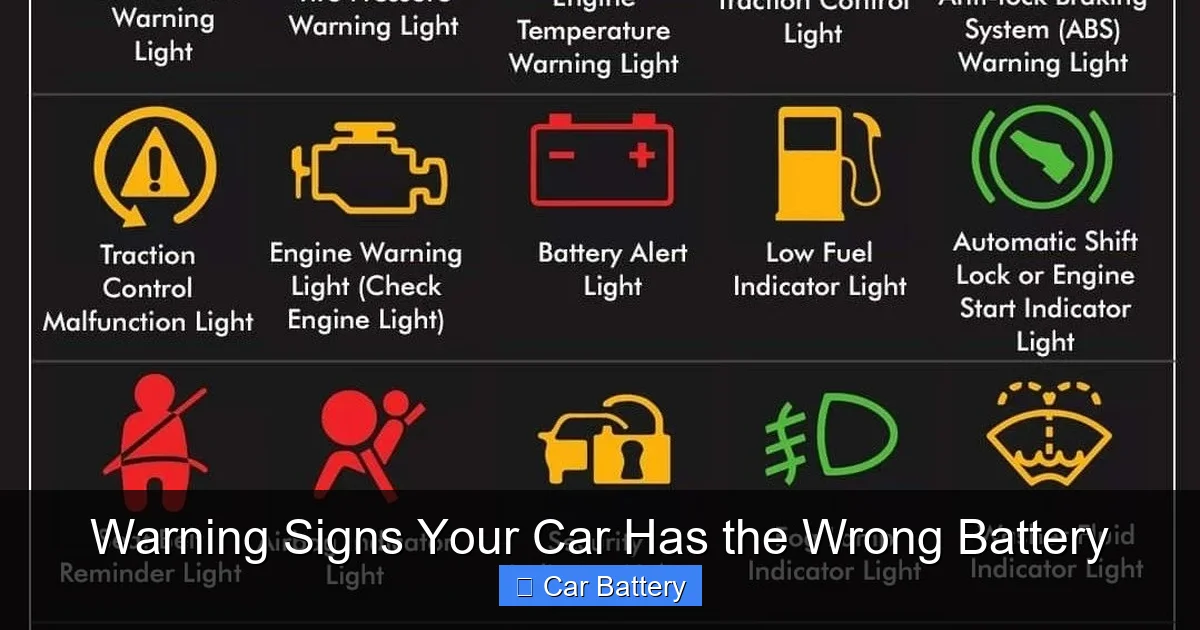
- A chorus of dashboard warning lights—check engine, battery, ABS, ESP. The car’s computers are not getting stable voltage.
Why This Happens
An undersized battery or one with low Reserve Capacity cannot maintain stable voltage under load. When you ask for power (like rolling up a window), the voltage dips. This confuses sensitive electronics. Furthermore, if the battery chemistry (like using a flooded instead of AGM) is wrong, the car’s Battery Management System (BMS) can’t regulate charging properly. This leads to wild voltage swings.
Symptom 3: Physical Fit and Installation Problems
Sometimes, the wrong battery is obvious before you even connect it. A proper fit is about safety, not just convenience.
Visible Red Flags
- The battery doesn’t sit flat in the tray. It rocks or is clearly too tall, wide, or long.
- The hold-down clamp won’t fit or secure the battery. An unsecured battery is a major hazard in a crash.
- The terminals are on the wrong sides. You have to stretch the positive cable to reach or let it rest against the metal hold-down (a short-circuit risk!).
- The terminals themselves are the wrong size (e.g., side-post vs. top-post).
Practical Tip: Never force a battery to fit. Never modify the tray or hold-down clamp. If it doesn’t fit snugly and securely with the proper clamp, it’s the wrong Group Size.
Symptom 4: The Battery Dies Repeatedly or Quickly
You bought a brand-new battery, but within weeks or months, it’s dead again. You jump-start it, it works for a day, then dies. This is a classic sign of a deep incompatibility.
Why This Happens
Your car’s alternator is programmed to charge a specific type and capacity of battery. If you install a battery with a different chemistry or amp-hour (Ah) rating, the alternator’s charging algorithm is off. It may undercharge the battery, leaving it perpetually starved. Or, it may overcharge it, boiling off the electrolyte and killing the cells. Both lead to a very short battery life.
Symptom 5: Swelling, Leaking, or Strange Smells
These are serious symptoms that demand immediate attention. They indicate failure and potential safety risks.
What to Look For
- A bulging or swollen battery case. This is often caused by excessive heat from overcharging.
- Visible fluid leaks or corrosion around the terminals or on the battery tray.
- A rotten egg (sulfur) smell coming from under the hood. This indicates a battery is gassing excessively or has a cracked case.
Why This Happens
As mentioned, the wrong battery type can lead to overcharging. This causes heat and pressure buildup inside, leading to swelling. It can also cause the electrolyte to boil and leak. This acidic fluid damages metal parts and the battery tray. If you see these signs, turn off the car and have it inspected. A swollen battery can rupture.
What to Do If You Suspect the Wrong Battery
Don’t panic. The solution is straightforward, but important to get right.
Step 1: Verify the Specifications
Grab your vehicle’s owner’s manual. Look up the recommended battery specifications. You can also find a label on your old battery (if you still have it) or look up the specs online using your car’s exact make, model, and year.
Step 2: Get a Professional Opinion
Visit a trusted auto parts store or mechanic. They have catalogs and tools to look up the exact battery your car needs. They can also test your charging system to rule out alternator problems.
Step 3: Make the Correct Swap
Purchase the correct battery. Have it professionally installed if you’re unsure. Ensure the terminals are clean, tight, and treated with anti-corrosion grease. Make sure the hold-down clamp is secure.
Final Thought: Investing the time to get the right battery saves you money, frustration, and risk in the long run. It protects your car’s expensive electronics and ensures you’re never stranded by a preventable problem.
Conclusion
Your car battery is more than just a black box. It’s a tailored component vital to your vehicle’s health. Ignoring the signs of a wrong battery—slow cranks, electrical issues, poor fit, or early death—can lead to a domino effect of damage and leave you stranded.
The fix is simple: know your specs, consult your manual, and seek expert help when needed. Don’t guess with your battery. A perfect match means reliable starts, a healthy electrical system, and peace of mind for miles to come. Listen to your car’s warning signs. It’s telling you what it needs.
Frequently Asked Questions
Can the wrong battery damage my car’s computer?
Yes, absolutely. An incompatible battery can cause voltage spikes or drops that are outside the safe operating range for your car’s Engine Control Unit (ECU) and other modules. This can lead to corrupted data, failed components, and very expensive repairs.
What’s more important, CCA or Group Size?
Both are equally critical and non-negotiable. The Group Size ensures a safe, secure physical fit. The CCA ensures the battery has the power to start your engine. You must match both specifications for correct and safe operation.
I have a start-stop system. Can I use a regular battery?
No, you should not. Start-stop systems require batteries like AGM or EFB that are designed for frequent, deep cycling. A standard flooded battery will fail prematurely and may not support the system’s high electrical demands when the engine restarts.
How long can a wrong battery last?
It varies, but often much shorter than a correct battery. You might see failure in 6-18 months instead of the typical 3-5 years. In some cases, a severely mismatched battery may not work from day one or could fail within weeks.
Can I put a bigger, higher CCA battery in my car?
Generally, yes, as long as it is the correct Group Size and type. A higher CCA than required provides a safety margin, especially in cold climates. However, a physically larger battery or one with a vastly different chemistry is not advisable.
Who can tell me the exact right battery for my car?
Your vehicle’s owner’s manual is the best source. Alternatively, any reputable auto parts store or dealership service department can look up the exact specification using your Vehicle Identification Number (VIN) or your car’s make, model, and engine year.