
Loose Car Cover Problem: Why It Happens and How to Fix It

Quick Answer
A loose car cover usually means the cover is too large, installed off-center, no longer gripping at the elastic hem, or not secured with its intended straps. Re-center it, seat both hems below the bumpers, secure the built-in tie-downs, and replace the cover if excess fabric still balloons or flaps; for broader upkeep basics, see Kelley Blue Book’s car maintenance resources.
Most likely causes
- Wrong size: Too much length or width leaves fabric for wind to catch.
- Off-center fit: A shifted cover can feel loose on one end even when the labeled size is correct.
- Weak elastic: A stretched hem may stop gripping the front or rear of the vehicle.
- Unused straps: Outdoor covers often depend on their supplied belly or wheel-area straps for wind control.
- Shape mismatch: A universal cover may fit the length but still leave loose panels around mirrors, rooflines, or bumpers.
Fast check
- With the cover centered and fully seated, look for large folds or suspended panels that can inflate in a breeze. If they remain after the intended straps are secured, the cover is probably oversized or the wrong shape.
A loose car cover seems minor until wind moves it across the paint. Most fit problems are easy to diagnose without tools.
As of 2026, cover designs vary widely, but diagnosis still comes down to installation, retention, and fit.
In This Guide
Why Is My Car Cover Loose?
A car cover becomes loose when its size, shape, or retention system cannot keep the fabric stable. Oversizing, poor positioning, worn elastic, and loose straps are the usual causes.
Definition: A loose car cover is one that leaves enough uncontrolled fabric to shift, flap, lift, or balloon after the cover is correctly positioned and secured according to its instructions.
The cover is simply too large
Length is only part of sizing. A cover can match the vehicle’s overall length yet still be too wide or too tall for its roof, mirrors, bumpers, or body style.
The cover is installed off-center
A cover can look oversized when it is only shifted forward, backward, or sideways. Start by locating any front or rear label, mirror pockets, antenna sleeve, or zipper that identifies its intended orientation.
The elastic or retention straps have lost tension
Elastic hems can relax with age, heat, repeated stretching, and long outdoor use. Straps can also loosen at buckles or become less effective if their stitching or attachment points wear.
- Front hem slips upward: The front elastic may no longer grip below the bumper.
- Rear hem creeps off: The rear elastic may be stretched or the cover may be too short after shifting forward.
- Middle section balloons: A belly strap may be loose, missing, or routed incorrectly.
- One side hangs lower: The cover may be rotated or pulled off-center.
Wind is exposing a marginal fit
A cover that seems acceptable in still air may behave badly when gusts reach under an edge. Wind pressure can lift loose fabric and make an already marginal fit much more obvious.
How Do I Diagnose a Loose Car Cover?
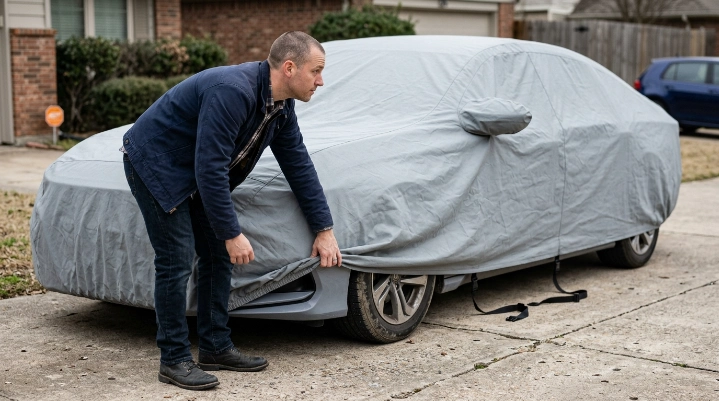
Diagnose the problem with the vehicle parked, cool, clean, and dry. Check orientation first, then the hems, widest body points, straps, and remaining excess fabric.
My practical fit check uses three areas: the front hem, the rear hem, and the widest part around the mirrors or doors. If all three sit correctly but a large roof or side panel still balloons, I suspect the cover size or shape.
- Confirm the labeled size. Compare the cover’s stated vehicle range with your car’s body style and dimensions.
- Find the front and rear. Use labels, mirror pockets, zipper placement, or the manufacturer’s instructions.
- Center the roof section. Spread the cover evenly before stretching either bumper hem into place.
- Seat both hems. The elastic should wrap around the intended lower edge rather than resting on top of a bumper.
- Secure every supplied strap. Route straps only where the manufacturer specifies.
- Watch the fabric in a light breeze. Small movement is normal, but large panels should not repeatedly inflate or whip against the body.
| What you see | Likely cause | Quick check | Best first fix |
|---|---|---|---|
| Loose at both ends | Cover too long or elastic worn | Center it and reseat both hems | Replace if excess remains |
| Loose on one end only | Cover shifted off-center | Compare front and rear overhang | Re-center before tightening |
| Roof or doors balloon | Too much width or missing belly restraint | Secure the intended center strap | Use correct strap or better-fitting cover |
| Cover lifts in gusts | Wind entering under an edge | Inspect hem seating and tie-downs | Secure approved wind straps |
| Fit worsened over time | Elastic, straps, or fabric stretched | Compare tension with a new installation | Repair only if maker supports it; otherwise replace |
How Do I Fix a Loose Car Cover?
Start with reinstallation before buying anything. Many loose-cover complaints come from a cover that is reversed, shifted, or not fully seated around the bumpers.
- Remove and inspect the cover. Check for torn strap anchors, stretched elastic, damaged seams, and obvious distortion.
- Clean the contact surfaces. Remove grit from the vehicle and from the inside of the cover before tightening it against paint.
- Identify the correct orientation. Match front and rear markings, mirror pockets, and access zippers.
- Lay the center section over the roof. Keep roughly equal material on the left and right sides.
- Fit the mirror areas without forcing them. A pocket that only reaches when heavily stretched usually signals poor alignment or wrong fit.
- Pull the hems into their intended positions. Seat the front and rear evenly instead of over-stretching one end first.
- Fasten the supplied restraints. Tighten them enough to control lift, but follow the cover maker’s routing and tension instructions.
If the cover uses a center belly strap, make sure it is not twisted. Keep any under-vehicle strap away from hot exhaust parts, moving components, sharp edges, and places the manufacturer tells you to avoid.
If the vehicle was recently driven, let it cool before working around the underside. Never crawl under a vehicle that is only supported by a jack, and do not drive with a full car cover installed.
What if the cover is still too loose?
Do not solve a large sizing error by tying random knots in the fabric. That can create pressure points, trap water, stress seams, or put hard hardware against the paint.
- Use approved accessories: Choose the manufacturer’s compatible gust straps, cable system, or tie-down kit.
- Check the next size down: Only do this if your vehicle still falls inside that size chart.
- Move to semi-custom or custom fit: This is often the cleaner solution when the body shape is the real mismatch.
- Replace worn retention parts: Do this only when the maker sells or approves replacement straps or elastic components.
Section Takeaway: Reinstall first, secure only the points the cover was designed to use, and replace a genuinely oversized cover instead of improvising aggressive tie-downs.
Can a Loose Car Cover Scratch or Damage Paint?
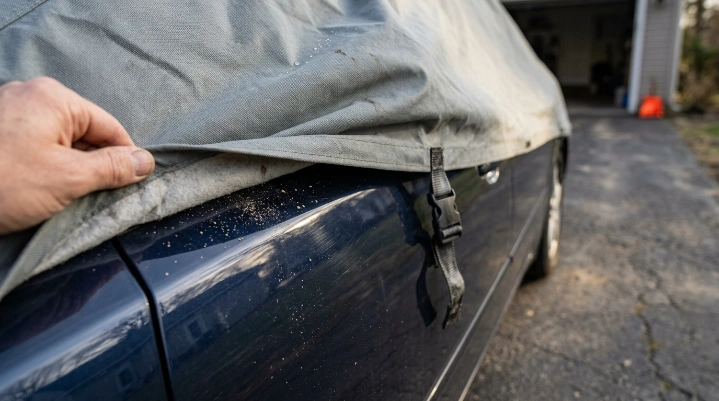
Yes, a loose cover can contribute to paint marring when it repeatedly moves over a dirty surface. The fabric itself may be soft, but trapped dust or grit can become the abrasive layer.
Flapping can turn contamination into an abrasive
Repeated movement across dust, sand, pollen, or dried road film can create fine marks in the clear coat. The risk rises when wind makes the same panel rub back and forth for hours.
General maintenance resources from Consumer Reports also emphasize the value of routine vehicle care, which matters before long-term covering. Clean paint gives the cover a safer surface to contact.
Loose fabric can collect water
Excess material can form low spots over the roof, hood, or trunk. Those pockets may hold rainwater and pull the cover into areas it was not designed to load.
Hardware can become the real scratch source
Buckles, cable ends, hooks, or improvised clamps should not slap against painted panels. Keep hardware in its intended position and add only accessories designed for that cover.
- Look for fresh dull patches: Repeated contact can show up as hazy areas under direct light.
- Stop if hardware touches paint: Reroute or remove the accessory before the next windy day.
Should I Tighten, Modify, or Replace the Cover?
Tighten the cover when the size is correct and only the retention system is loose. Replace it when the cover remains baggy after correct installation, no longer grips at the hems, or has damaged attachment points.
| Option | Best when | Avoid when |
|---|---|---|
| Re-center and tighten | Cover matches the vehicle and straps are intact | Fabric remains oversized after correct setup |
| Add maker-approved wind restraints | Normal fit becomes unstable only in wind | The basic cover size is already wrong |
| Repair a strap or buckle | Manufacturer provides a compatible repair or replacement | Anchor fabric is torn or weakened |
| Replace the cover | Elastic is spent, fabric is distorted, or size is wrong | A simple positioning error is the only problem |
Universal vs. custom fit
A universal cover trades precision for broad compatibility. It can work well in a garage or mild conditions when the size range closely matches the vehicle.
When replacement makes more sense
- Elastic no longer rebounds: The hem hangs instead of gripping.
- Strap anchors are tearing: Tightening them loads already weakened fabric.
- Seams are opening: Wind can enlarge the damage.
- Coating or fabric is failing: Fit repairs will not restore weather protection.
- The size chart does not match: A different cover is safer than forcing the wrong one.
How Do I Keep a Car Cover Secure in Wind?
Wind control starts with the correct fit, not extra rope. A centered cover with seated hems and properly used retention straps gives the wind fewer openings to exploit.
- Cover a clean, dry vehicle. This reduces grit and moisture problems if the fabric moves.
- Install in the correct direction. Front and rear panels are often shaped differently.
- Seat the elastic fully. A hem resting on top of a bumper is easier for wind to lift.
- Use every intended wind strap. Follow the maker’s routing and tension guidance.
- Keep straps flat. Twisted straps can loosen and may concentrate pressure.
- Inspect after strong weather. Re-center the cover if it has shifted before the next windy period.
- Choose a more sheltered parking spot when practical. A wall or garage reduces direct wind exposure without modifying the cover.
Avoid bricks, loose weights, metal clamps, or exposed hooks on top of the vehicle. Those fixes can become hazards or damage the paint if they move.
If strong winds are forecast beyond what the cover maker recommends, removal may be safer than trying to overpower the wind with improvised restraints. Follow the product instructions for weather limits and storage.
For broader ownership basics, see Car and Driver’s car-care guide.
Section Takeaway: The best wind fix is a correctly sized cover installed exactly as designed, with clean paint underneath and no improvised hard objects touching the body.
Frequently Asked Questions
Can I make an oversized car cover fit better?
A slightly loose cover may improve after centering and using its approved straps. If large folds or ballooning remain, choose the correct size or a more vehicle-specific pattern.
Should a car cover be completely tight?
No; a cover should be secure without hard stretching over mirrors, spoilers, antennas, or sharp edges. Small designed slack is normal, but repeated flapping, lifting, or ballooning is not.
Why does my car cover blow off even when it has elastic?
Elastic may not control a poor outdoor fit in wind. Seat both hems fully, center the cover, fasten supplied wind straps, and replace worn elastic or an oversized cover when needed.
Can I use bungee cords to tighten a loose car cover?
Avoid improvised bungee cords unless the manufacturer specifically approves them and provides safe attachment points. Purpose-built restraints reduce the risk of hooks, excess tension, or slipping hardware damaging the cover or vehicle.
Is a universal-fit cover okay for outdoor parking?
Yes, if its dimensions and shape closely match the vehicle and it has suitable outdoor restraints. If large roof or side panels stay loose, a semi-custom or model-specific cover is usually easier to secure.
How often should I check a car cover stored outdoors?
Inspect it after strong wind, heavy rain, or weather that may shift it. During longer storage, also check straps, paint, and the underside for grit, dampness, tears, or loosening.
Final takeaway: A loose car cover is usually a fit or retention problem, not something you should solve with aggressive makeshift tie-downs. Re-center it, use the intended restraints, protect clean paint, and replace the cover when its size or worn components prevent a stable fit.
If the cover still lifts after those checks, compare your vehicle’s body style and dimensions with the manufacturer’s size chart before your next outdoor storage period.