Jeep Cherokee Won’t Start but Has Power

Contents
- 1 Key Takeaways
- 2 📑 Table of Contents
- 3 Understanding the “Has Power” Symptom in Your Cherokee
- 4 Top Causes for a No-Crank Situation (Jeep Won’t Turn Over)
- 5 Top Causes for a Crank-No-Start Situation (Engine Turns Over But Won’t Fire)
- 6 Diagnostic Steps: A Systematic Approach to Find the Problem
- 7 Preventive Maintenance to Avoid a No-Start
- 8 When to Call a Professional: The Complex Cases
- 9 Conclusion: Patience and Process Win the Day
- 10 Frequently Asked Questions

Digital Tire Pressure Gauge

Car Glass Cleaner

LED Emergency Road Flares

Liquid Car Polish
If your Jeep Cherokee won’t start but has power, it means the battery is good enough for lights and radio, but the engine isn’t turning over or isn’t getting fuel/spark. This points to issues like a faulty starter motor, a failed fuel pump, a bad crankshaft sensor, or a security system glitch. A systematic check of these components is key to finding and fixing the problem.
You slide into the driver’s seat of your trusty Jeep Cherokee, turn the key, and… nothing happens. Or maybe you hear a rapid clicking, or the engine cranks over slowly but won’t catch. The weird part? The interior lights come on bright. The radio works. Your phone charger is powered. So the battery isn’t completely dead, but your Cherokee just refuses to start. This exact scenario—Jeep Cherokee won’t start but has power—is a incredibly common and frustrating problem. It tells you the electrical system is alive enough to run accessories, but something is blocking the critical sequence that turns the engine. The good news? We can figure this out together. This guide will walk you through the most likely culprits, from the simple to the complex, so you can diagnose and solve the issue with confidence.
First, let’s get our terms straight because “has power” can mean two different things, and they point to very different problems. Scenario A: You turn the key to “start” and hear absolutely nothing—no crank, no click, no sound at all. The dash lights might dim slightly or stay bright. Scenario B: You turn the key and the engine cranks normally (sounds like it’s trying to start) but it just won’t fire up and run on its own. Both mean the battery has some charge for accessories, but the starting process is broken. We’ll tackle both scenarios. Think of it like this: Scenario A is a “no-crank” problem (the starter isn’t engaging). Scenario B is a “crank-no-start” problem (the starter is working, but the engine isn’t getting fuel or spark). This distinction is your first and most important diagnostic clue.
Key Takeaways
- Power vs. Start: “Has power” means the battery runs accessories, but the starter isn’t cranking the engine or it cranks without firing up, indicating different failure points.
- Starter is Prime Suspect: A clicking sound or silent crank with power on often means a bad starter motor, solenoid, or related wiring/connections.
- Fuel & Spark are Critical: If the engine cranks normally, the problem is likely no fuel (pump, filter, injectors) or no spark (coils, plugs, sensors).
- Security System Lockout: The Cherokee’s immobilizer system can disable the fuel pump or spark if it doesn’t recognize your key, a common and frustrating cause.
- Diagnostics are Key: Listening for sounds, checking for codes with an OBD2 scanner, and simple tests (like fuel pressure) narrow down the cause efficiently.
- Don’t Ignore the Basics: Always confirm the battery is truly strong (not just able to light a dome light) and check for simple issues like a loose battery terminal or a blown fuse.
- Know When to Call a Pro: Issues with the engine control module (PCM), internal engine damage, or complex security reprogramming require a dealer or specialist.
📑 Table of Contents
- Understanding the “Has Power” Symptom in Your Cherokee
- Top Causes for a No-Crank Situation (Jeep Won’t Turn Over)
- Top Causes for a Crank-No-Start Situation (Engine Turns Over But Won’t Fire)
- Diagnostic Steps: A Systematic Approach to Find the Problem
- Preventive Maintenance to Avoid a No-Start
- When to Call a Professional: The Complex Cases
- Conclusion: Patience and Process Win the Day
Understanding the “Has Power” Symptom in Your Cherokee
Your Jeep Cherokee’s starting system is a chain of events. The battery provides power. That power goes through the ignition switch to the starter solenoid, which tells the starter motor to engage the engine’s flywheel and crank it over. As the engine cranks, the engine control module (PCM) reads signals from the crankshaft and camshaft position sensors. The PCM then triggers the fuel pump to pressurize the system and fires the spark plugs at the exact right moment. If any link in this chain fails, you get a no-start.
When we say the Cherokee “has power,” we’re confirming the battery voltage is above roughly 12.4 volts. That’s enough to light the dome light and run the radio. But the starter motor needs a huge surge of current—often 200+ amps—to turn the heavy engine over. A battery can have enough voltage for accessories but be too weak (high internal resistance) to deliver that starter current. That’s why a seemingly “good” battery can still cause a no-crank. Conversely, if the engine cranks fine but won’t start, the battery and starter are doing their job, and we must look downstream at fuel, spark, or the computer’s commands. This symptom separation is universal across vehicles; you’ll find similar explanations for a my car won’t start but has power situation, whether it’s a Honda or a Toyota.
The Two Main Branches: No-Crank vs. Crank-No-Start
Let’s solidify this with a simple test. Next time it happens, pay close attention to what happens when you turn the key to the “start” position.
- No-Crank (Silent or Click Only): You hear a single loud click, or a rapid-fire ticking sound, or total silence. The engine does not turn over at all. This is almost always an electrical issue preventing the starter from getting enough power or being told to engage. Think starter, solenoid, battery cables, or ignition switch.
- Crank-No-Start: The engine turns over at a normal speed (or maybe a little slow) but never fires. You might smell raw fuel from the exhaust if it’s trying. This means the starter is working, so the problem is with what the engine needs to run: fuel, spark, or air (less common). Also, a major security system lockout can mimic this by disabling fuel or spark while allowing cranking.
This first observation will save you hours of guessing. Now, let’s dive into the specific causes for your Jeep Cherokee.
Top Causes for a No-Crank Situation (Jeep Won’t Turn Over)
If your Cherokee is completely silent or just clicks when you turn the key, here are the usual suspects, in order of likelihood.

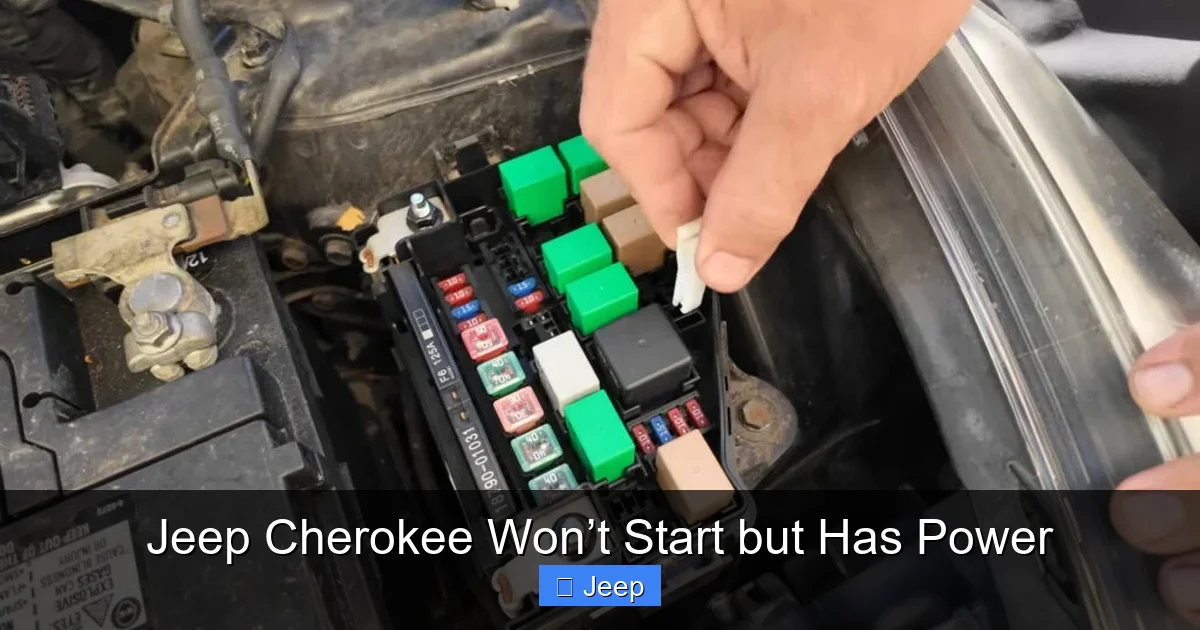
Visual guide about Jeep Cherokee Won’t Start but Has Power
Image source: jeepinside.com
1. A Weak or Failing Battery (Even If It Seems Okay)
This is the #1 cause. A battery can read 12.6 volts at rest (which seems fine) but fail under load. The starter motor draws hundreds of amps. A battery with old, sulfated plates or a bad cell can’t sustain that current. The voltage at the starter terminal will plummet, and the solenoid won’t pull in. You might see the dash lights dim dramatically when trying to start.
What to do: Get the battery load-tested at any auto parts store—it’s usually free. A proper load test simulates the starter’s draw. Also, inspect the battery terminals. Are they clean, tight, and free of white/green corrosion? A loose or corroded connection creates massive resistance, preventing starter current. Clean the terminals with a baking soda/water mix and a wire brush, and ensure the clamps are torqued down.
2. Faulty Starter Motor or Solenoid
The starter is a heavy-duty electric motor. Over time, the brushes wear out, the armature can short, or the solenoid (the little cylinder on top) can fail. A bad solenoid might click but not engage the starter gear (Bendix drive) with the flywheel. A bad motor might try to spin but not have enough torque.
What to do: Have someone turn the key to “start” while you listen. The starter is usually on the driver’s side lower part of the engine, near the transmission bellhousing. A solid click from the solenoid but no crank means the solenoid is working but the motor is bad or getting insufficient power. No click at all points to a solenoid control circuit issue (ignition switch,neutral safety switch, or wiring). Tapping the starter housing with a hammer (carefully) can sometimes jolt a stuck motor to work temporarily, confirming it’s bad.
3. Issues with the Neutral Safety Switch or Ignition Switch
For safety, your Cherokee won’t start unless it’s in Park (or Neutral for a manual). The neutral safety switch (on the transmission) or the clutch switch (manual) must close to complete the starter circuit. These switches wear out. Similarly, the ignition switch itself (the lock cylinder you turn) has contacts that can burn out, specifically the “start” contact.
What to do: Ensure you are firmly in “P” (try “N” too). Wiggle the gear selector while trying to start. If it starts in Neutral, the Park switch is bad. For an ignition switch, try wiggling the key while in the “start” position. If it starts while wiggling, the switch is failing.
Top Causes for a Crank-No-Start Situation (Engine Turns Over But Won’t Fire)
If your Cherokee’s engine cranks at a normal speed but won’t start, the starter and battery are probably fine. Now we look at what the engine needs to ignite: fuel, spark, and compressed air (which we assume is okay unless you have major mechanical damage). Security system issues are also very common here.
Visual guide about Jeep Cherokee Won’t Start but Has Power
Image source: vehiclers.com
1. Fuel Delivery Problems
No fuel or low fuel pressure means the engine can’t run. The fuel pump inside the tank might be dead, the fuel filter could be clogged, the fuel pressure regulator might be leaking, or the injectors might be clogged/no power.
- Fuel Pump: Listen when you turn the key to “ON” (before cranking). You should hear a 2-second hum from the rear of the vehicle (fuel tank area). No hum suggests a dead pump, bad relay, or no power to the pump. The pump is a common failure point on many Jeeps.
- Fuel Pressure: Requires a mechanical gauge to test properly. Low pressure points to a bad pump, clogged filter, or faulty regulator.
- Fuel Quality: Did you just fill up with bad gas? Water contamination or severely old gas can prevent ignition.
2. Spark and Ignition System Failures
The PCM needs to send power to the ignition coils, which create the high-voltage spark at the plugs. If there’s no spark, fuel is just pumped into the cylinders unburned (you might smell it).
- Crankshaft Position Sensor (CKP): This is the #1 sensor for starting. It tells the PCM the engine’s position and speed. If it fails, the PCM won’t know when to fire the spark plugs or injectors. No spark, no fuel injection. Very common failure on Jeeps and many other models. A scan tool can check for its signal.
- Camshaft Position Sensor (CMP): Works with the CKP. Failure can cause a no-start.
- Ignition Coils/Coil Packs: If a coil fails completely, you get no spark on that cylinder. On a multi-coil system, one bad coil might still let the engine run poorly, but if all coils lose power (a fuse or PCM driver issue), you get zero spark.
- Spark Plugs & Wires: Worn-out plugs or damaged wires can prevent spark, though they usually cause a misfire rather than a total no-start.
3. The Jeep Security System (Immobilizer) Glitch
This is a huge one for Jeeps. Your Cherokee has a transponder chip in the key and an immobilizer module. When you turn the key, the module reads the chip. If it doesn’t get the correct code, it tells the PCM to disable the fuel pump and/or spark. The engine will crank normally but never start. The dash may show a security light (a car with a key symbol).
What to do: Ensure you are using the correct, programmed key. Try the spare key if you have one. Sometimes, the system gets confused. A common trick is to turn the key to “ON” for 10-15 seconds (dashboard lights on, engine off), then turn it off, wait a few seconds, and try starting again. This resets the system. If that works, the issue may be a weak key fob battery or a failing immobilizer antenna ring around the ignition cylinder. This problem can be tricky and often requires a dealer with a special programmer to fix if the key or module is faulty.
Diagnostic Steps: A Systematic Approach to Find the Problem
Don’t just start replacing parts. Follow this logical flowchart to pinpoint the issue safely and efficiently.

Visual guide about Jeep Cherokee Won’t Start but Has Power
Image source: vehiclers.com
Step 1: Confirm the “Crank” Status and Listen
As established, is it a no-crank or crank-no-start? Also, listen closely:
- Rapid clicking: Classic weak battery or bad connection. Could also be a failing starter drawing too much current.
- Single loud click: Usually the solenoid is engaging, but the starter motor isn’t turning. Could be a bad starter or a very weak battery.
- Grinding noise: The starter gear is worn or not engaging properly with the flywheel. Needs immediate attention.
- Normal cranking sound: Good. The starter is working. Move to fuel/spark/security checks.
Step 2: Check the Battery and Connections
Even if it seems okay, rule this out first. Use a multimeter. A fully charged battery should read 12.6 volts or higher. Anything below 12.4 volts is discharged. Now, do a voltage drop test across the battery terminals and the main ground cable while cranking (have a helper crank). More than 0.5 volts drop on the positive side or 0.3 volts on the negative side indicates a bad cable or connection. Clean and tighten all terminals and the ground strap to the engine/chassis.
Step 3: Scan for Trouble Codes
Plug any OBD2 scanner (even a cheap one) into the port under the dash. Even if the check engine light isn’t on, the PCM may have stored a history code. Look for codes related to the crankshaft position sensor (P0335, P0336), camshaft sensor (P0340), fuel pump, or immobilizer. This is the single most helpful step for a crank-no-start. For example, a P0335 is a huge red flag for a CKP sensor issue. You can find similar diagnostic advice for a car cranks but won’t start in our general guide.
Step 4: Test for Fuel and Spark
Fuel Test: Listen for the fuel pump hum as described. You can also carefully crack open a fuel line (have rags ready) or use a fuel pressure test kit on the Schraeder valve (if your Cherokee has one on the fuel rail). No pressure means pump, relay, filter, or wiring issue. Spray a small amount of starting fluid (ether) into the throttle body while cranking. CAUTION: Do this in a well-ventilated area, away from sparks. If the engine tries to start with starting fluid, you have a fuel delivery problem (pump, filter, injectors). If it doesn’t, you have a spark or severe timing issue.
Spark Test: Remove a spark plug wire, attach a spark tester (or a spare plug gapped to 0.040”) to the wire, ground it to the engine, and have a helper crank. You should see a strong blue spark. No spark or a weak orange spark points to coils, wires, or sensors. Never ground a plug wire while the engine is running.
Step 5: Investigate the Security System
If there are no fuel or spark issues and the engine cranks, the immobilizer is the prime suspect. Check for a security indicator light on the dash. Try the key reset procedure (key to “ON” for 15 sec, then start). Try the spare key. If the problem is intermittent, it could be a failing antenna ring or a module that needs reprogramming. This often requires a professional with a DRB-III or equivalent scan tool.
Preventive Maintenance to Avoid a No-Start
Many of these failures can be delayed or prevented with regular care.
Battery Care
Have your battery tested at least once a year, especially before winter. Clean terminals annually. If your battery is over 4-5 years old, consider proactive replacement. Jeep engines require a lot of cranking power, so don’t cheap out on a replacement battery—get one with sufficient Cold Cranking Amps (CCA) for your model’s requirements.
Fuel System Health
Use quality fuel from reputable stations. Add a bottle of fuel system cleaner (like Seafoam) to a tank every 3,000-5,000 miles to keep injectors clean. Replace the fuel filter at the manufacturer’s recommended interval (often neglected). For high-mileage Cherokees, a fuel pump replacement is a common repair; using a quality pump and replacing the filter at the same time is wise.
Ignition System Inspection
Replace spark plugs at the specified interval (often 30k-100k miles depending on type). Inspect ignition coils for cracks or carbon tracking (white powdery residue). Replace coil packs as needed. A failing CKP sensor often gives warning signs like intermittent stalling before it fails completely.
Security System Awareness
Use your primary key regularly. A worn-out key blade can sometimes not turn the cylinder properly, confusing the system. If the key fob battery is low (keyless entry works but range is poor), it can sometimes affect the immobilizer. Replace the fob battery proactively. If you have aftermarket accessories (alarms, remote starters), they can interfere with the factory immobilizer.
When to Call a Professional: The Complex Cases
Some issues are beyond safe DIY diagnosis. Call a qualified mechanic or dealer if:
- You’ve confirmed good battery voltage, a working starter, fuel pressure, and spark, but it still won’t start. This could indicate a mechanical problem like a broken timing belt/chain, low compression, or a faulty PCM.
- The security system is locked out and the key reset procedure doesn’t work. Reprogramming keys or replacing the immobilizer module requires proprietary software.
- You smell strong raw fuel but see no evidence of a fuel leak and it won’t start. This could be a dangerously leaking fuel injector or a stuck-open pressure regulator, which is a fire hazard.
- You are not comfortable working with high-current electrical systems or fuel under pressure. Safety first.
For complex electrical gremlins that come and go, a professional with a factory-level scan tool (like a dealer for Jeep/Chrysler products) is invaluable. They can monitor live data from the CKP/CMP sensors, fuel pump command, and security system status in real-time while you crank the engine.
Conclusion: Patience and Process Win the Day
A Jeep Cherokee that won’t start but has power is a puzzle, but it’s a solvable one. The key is to not panic and start throwing parts at it. Start with the simplest, most common causes: a weak battery and corroded terminals. Then, use your ears and a basic scan tool to determine if it’s a no-crank (electrical power path) or crank-no-start (fuel/spark/security) problem. From there, methodically test the starter circuit, fuel pump, and critical sensors like the crankshaft position sensor. Don’t forget the notorious Jeep immobilizer system—it’s a frequent culprit that can leave you scratching your head. Remember, the problem is almost always something specific and findable. By following this guide, you’ll either fix it yourself or have such a clear description of the symptoms and tests you’ve performed that any mechanic will know exactly what to check next. Your Cherokee is a capable machine; with a little patience and the right knowledge, you’ll have it back on the road.
Frequently Asked Questions
My Jeep Cherokee makes a rapid clicking sound when I try to start it. What is it?
This is the classic sign of a weak battery or a poor electrical connection at the battery terminals. The starter solenoid is trying to engage but the battery voltage drops too low under the starter’s high current demand. Start by cleaning and tightening the battery terminals and having the battery load-tested.
The engine cranks normally but won’t start. What’s the most common cause?
For a crank-no-start, the most common culprits are a failed fuel pump, a faulty crankshaft position sensor, or a security system lockout. Use a scan tool to check for codes (especially P0335 for the crankshaft sensor) and listen for the fuel pump hum when you turn the key to “ON.”
Could a bad key or security system really prevent my Cherokee from starting?
Absolutely. Jeep’s immobilizer system is a frequent cause. If the transponder chip in your key isn’t read correctly, the PCM will disable the fuel pump and/or spark. The engine will crank but never fire, and a security light will usually flash on the dash. Try the spare key and the 15-second “key reset” procedure (key to ON for 15 sec, then start).
I have power, but when I turn the key, I hear nothing—total silence. Is it the starter?
It could be, but always check the simplest things first. A completely dead battery, a severely corroded or loose battery terminal, or a blown main fuse can cause total silence. Verify you have at least 12.4 volts at the battery posts. If voltage is good at the battery but not at the starter, you have a wiring or connection problem.
My Cherokee started right after I put in new gas, but now it won’t start again. What gives?
This points to bad fuel. Water contamination or severely degraded old gas can cause a no-start. If you recently filled up at a station with a known issue or used old gas from a container, the fuel may need to be drained and replaced. Adding a fuel system additive might help if the issue is minor varnish, but contaminated water usually requires a drain.
Is it safe to keep trying to start it if it smells like gas?
No. If you smell a strong, persistent raw fuel odor (not just a whiff when cranking), stop immediately. This could indicate a leaking fuel injector, a failed fuel pressure regulator, or a broken fuel line. Fuel leaking onto hot engine components is a serious fire risk. Have the vehicle towed for repair.